REVIEW: “Blue Jasmine”

BLUE poster

Each year has its share of certainties: we grow a year older, we have to pay our taxes, my sports teams disappoint me, and Woody Allen puts out a new movie. Now that doesn’t mean that every one of Allen’s films are masterpieces (ala “Midnight in Paris”). In fact some of them are just dreadful (ala last year’s “To Rome with Love”). But one thing about the bad ones, you always know the next film is only a year away. And maybe, just maybe, Allen will land one of the real gems he’s capable of making.

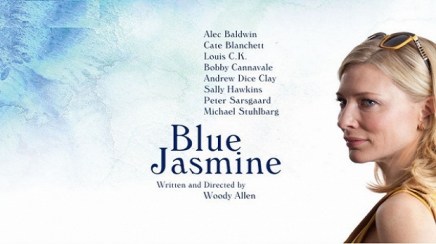
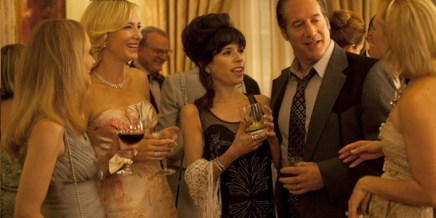
Here’s the good news – “Blue Jasmine” is one of the good ones. This character study touches on a number of subjects from business ethics to family troubles to rabid consumerism. At the center of it all is a captivating performance by Cate Blanchett. She plays Jasmine Francis, a New York socialite whose posh lifestyle collapses when her crooked husband is arrested and loses their fortune. Penniless and without a place to go, Jasmine flies to San Francisco and moves in with her estranged working-class sister Ginger (Sally Hawkins). It’s here that she must learn to start a new chapter of her life or drown in her despair of leaving the affluent upper crust.
BLUE1

To go further, Jasmine is a wreck. She’s coming off of a nervous breakdown, she pops anxiety pills like candy, and she has an affinity for heavy drinking. She still carries her spoiled and privileged attitude which clashes with her new destitute reality. And all of this is brought on by her lousy husband. We see the events leading to Jasmine’s fall from luxury through several cleverly incorporated flashbacks. We watch her husband Hal (Alec Bladwin) and his penchant for women and shady business deals while she lives in a diamond-studded state of naïveté. She’s content with living high on the hog while asking no questions whatsoever. That proves to be a costly mistake, both mentally and monetarily.

Jasmine’s snooty ego doesn’t fit well with the circle of people she is introduced to in San Francisco. This class clash is the prominent focus for most of the film. This is also where we meet the film’s fantastic assortment of side characters. Hawkins is great as Jasmine’s kindhearted sister and I really liked Bobby Cannavele as her blue-collar beau hunk boyfriend. We get Michael Stuhlbarg as a lovestruck dentist and Peter Sarsgaard pops up as a wealthy businessman with political aspirations. But the biggest treat was Andrew Dice Clay. Yes you heard me, Andrew Dice Clay. Gone is the loud obnoxious standup routine. Here he plays a humble, hard-working fellow that you can’t help but sympathize with. And it’s all because of the unbelievable turn from Dice Clay. He was completely natural and restrained. Brilliant work.

BLUE2

But the true star is Cate Blanchett who undoubtedly gives one of the year’s finest performances. There are bits of subtle humor that are sprinkled in throughout her story. But she’s more of a sad, self-destructive woman who has no sense of direction or belonging. Blanchett visualizes her struggles through every fidget, every bead of sweat, and every outburst. She’s not a likable character by any stretch but she’s simply mesmerizing. Blanchett gives a performance that is getting some Oscar hype. Personally I think it demands an Oscar nomination.

It’s clear that “Blue Jasmine” was influenced by other films. For example if you listen closely you can hear “A Streetcar Named Desire” passing in the distance. But Woody Allen has always been a filmmaker who treasures inspiration and when he is on his game he can truly deliver. This is really good material handled by an excellent cast including a surprise performance from Andrew Dice Clay and some of the best work of Cate Blanchett’s career. “Blue Jasmine” may not stay with you for a long time nor be considered among Allen’s very best by the bigger fans of his work. For me it really worked and it’s definitely good Woody Allen.
VERDICT – 4 STARS

REVIEW: “The Way, Way Back”

WAY WAY BACK Poster

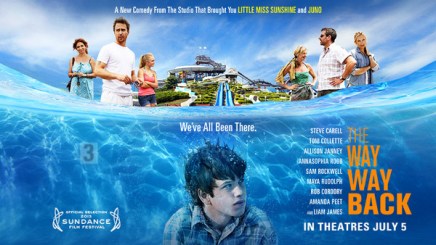
I love it when a movie really surprises me. Such was the case with “The Way, Way Back”. This one-half comedy and one-half drama is a wonderful and entertaining stew that caught me off guard. Written and directed by the team of Nat Faxon and Jim Rash, “The Way, Way Back” is a warm and authentic coming-of-age picture. It’s a smart and funny film that at times dances close to cliché but then always turns and goes in a more smart and believable direction. It really worked for me.

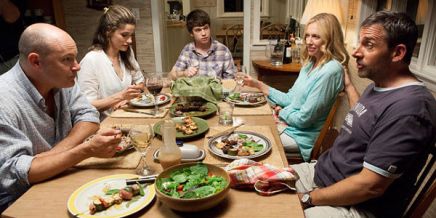
Liam James plays Duncan, a sullen and awkward 14-year old who is trapped in a world of selfish, adolescent adults. He is forced to accompany his divorced mother Pam (Toni Collette), her jerk of a boyfriend Trent (Steve Carell), and his daughter Steph (Zoe Levin) on a vacation to Trent’s summer home in a small New England beach town. Duncan’s life is full of complications. He is disconnected from his emotionally needy mother and at constant odds with the annoying and disingenuous Trent. Then there are the assortment of oddball characters from his new summer neighborhood none of which give him a feeling of belonging.

WAY WAY1

But things change a bit when Duncan meets Owen (Sam Rockwell), a laid back water park manager. Owen takes a liking to Duncan and actually connects with him on a level that the struggling teen desperately needs. Rockwell is fabulous here and he gives arguably the funniest performance of the year. He’s obviously a naturally funny guy and you’ll swear you’re watching improvisation as he delivers one quick-witted funny line after another. Faxon and Rash along with Maya Rudolph have small roles as fellow water park employees and they round out what becomes Duncan’s sanctuary. It’s where feels free. It’s where he feels he belongs.

One of the film’s great strengths is that the story is told almost entirely from Duncan’s perspective. We see his perception of dysfunctional adults, broken marriages, and juvenile behavior from those who should be anchors of support. It really is the adults who are the irresponsible and objectionable ones. As one equally frustrated young character describes it – “It’s spring break for adults” and not in a good way. But there are always cleverly injected bits of humor that keeps the tone a tad lighter than it may sound. Much like their previous Oscar-winning work on “The Descendants”, Rash and Faxon’s script takes on serious life situations and laces them with subtle bits of comedy. It’s great writing that will have you laughing one minute and feeling deep empathy the next.

WAY WAY 3

This is a character-driven movie and the performances don’t disappoint. The relatively unknown Liam James is just what the lead role needed. He’s restrained and grounded which allows for so much truth to flow from the character. I also really liked Steve Carell in a role that is drastically different from what we’re used to seeing him do. It’s interesting that the biggest comedian in the entire cast has the most serious role in the film. Allison Janney is a lot of fun as a spacey next door neighbor and Rob Corddry and Amanda Peet are delightfully insufferable as two of Trent’s close friends.

The story of an insecure socially displaced youth isn’t new, but often times it’s told using the same overused formulas and contrivances. “The Way, Way Back” doesn’t exactly carve a new path but it does stay out of the usual trappings. It’s refreshingly honest and surprisingly funny. There are also some fabulous characters brought to life through some good acting led by Rockwell. His performance was a real eye-opener for me. The soundtrack, the perfect pacing, etc. As I said, it’s a wonderful and entertaining stew and I was hooked from the first scene. What a nice surprise.

VERDICT – 4.5 STARS

REVIEW: “Nebraska”

NEB POSTER

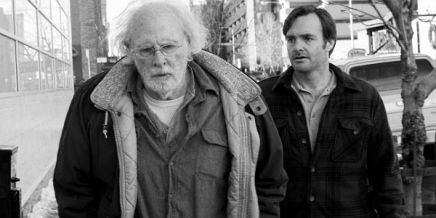
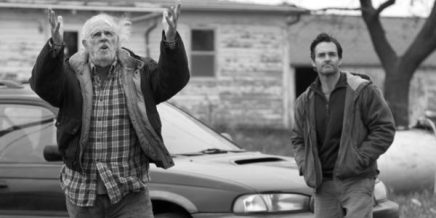
In the comedy/drama “Nebraska” Bruce Dern plays an elderly man named Woody Grant from Billings, Montana. Woody receives a marketing flyer in the mail that convinces him he has won $1 million. All he needs to do to collect is travel to Lincoln, Nebraska and claim his prize. The problem is his two sons and his cantankerous wife all know it’s a scam. But Woody is determined that he is going to Lincoln even if he has to go on foot. To appease Woody, David (Will Forte) agrees to drive him to Lincoln and hopefully have some bonding time with the father he barely knew.

That’s the main story, but this is an Alexander Payne film so you know there is a lot more under the surface. Payne has always been interested in characters and this is a character-driven picture. “Nebraska” touches on a variety of real life subjects including alcoholism, greed, family dysfunction, and declining health of the elderly among others. And while there’s nothing inherently funny about these things, Payne and writer Bob Nelson don’t allow the movie to drown in its seriousness. In fact at times it’s a very funny film – that near perfect mix of comedy and drama.

NEB1

One of my favorite things about “Nebraska” is its authenticity. This could easily have been a conventional comedy featuring a stereotypical old codger. Instead it’s a very real story featuring real characters and set around a very real depiction of small-town America. With a few small exceptions, “Nebraska” never hits a false note. The majority of the time the characters feel just right and the Nebraska locations seem yanked out of real life.

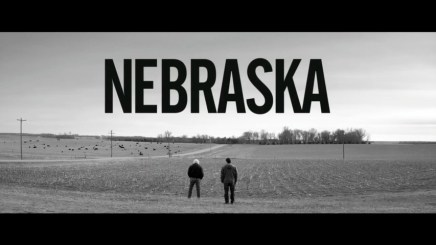
I also love the choice to shoot the film in black-and-white. While it wasn’t popular with the studio, Payne and cinematographer Phedon Papamichael saw it as an intricate part of their storytelling. I think it was a brilliant choice. It creates a very gloomy and bleak look that is perfectly in tune with much of Woody’s story. But it also works in the film’s portrayal of America’s dying small towns. There is a striking parallel between Woody and these rural locales that I found fascinating and the black-and-white made it all the more powerful. But at the same time there is a beauty to the look of this picture – a classic beauty that I don’t think color could provide.

That hints at another facet of the movie that really worked me. As someone born and raised in a place very similar to Woody’s hometown of Hawthorne, I was impressed with the film’s accuracy in capturing the essence of the small town. Payne, a Nebraska native, was able to show the sad side of what these places look like now while also painting a beautiful picture of how they once were.

NEB3

But once again it’s the characters that gives this film its life. Bruce Dern delivers one of the most earnest and committed performances of the year. Woody is a captivating character with more layers than you may think. He’s deeply flawed yet genuinely sympathetic. He can be unintentionally hilarious yet also sad and depressing. There is also a cloud of mystery that surrounds Woody. We get hints that he’s battling some form of dementia but it’s never clearly stated. Also, through the eyes of his wife and sons, we see Woody as a pretty bad husband, father, and man. Yet we learn new things about him from the people in his hometown that tell a slightly different story. There are numerous other nuances to this character that I loved.

The great film critic Leonard Maltin noted that “Payne has a Fellini-like eye for great faces”. I couldn’t have said it better. Much like a Coen brothers film, there are an assortment of memorable faces which add so much character and detail to the setting and the story itself. Everywhere you look there is one small character that feels a part of the fabric that makes up “Nebraska”.

NEB2

There are also an assortment of other great characters many of which are comic spark plugs. Perhaps the most talked about is June Squibb as Woody’s mean and degrading wife Kate. She undoubtedly has some of the movie’s funniest moments, but she also exposes one of the film’s only problems. Payne takes her snarky, belligerent, and sometimes foul attitude a bit too far. Don’t get me wrong, I laughed my butt off at some of her antics, but Payne overdoes it. Here’s an example. There’s a great scene where Kate, Woody, and David are visiting family grave sites at a small country cemetery. It’s a fantastic scene with the right mix of drama and humor. That is until the Kate character suddenly does a vulgar act clearly intended for a cheap laugh. It really hurts what could have been a brilliant scene.

While Payne does overplay his hand which hurts the movie a bit, I still found “Nebraska” to be one of the strongest films of the year. Not only is it a piercing examination of some very real issues, it’s also one of the funniest movies of 2013. And if Bruce Dern doesn’t get a Best Actor Oscar nomination for his phenomenal work, it will be hard to take the category seriously.  It is smart and fresh filmmaking that I really hope gets rewarded this awards season.

VERDICT – 4.5 STARS

REVIEW: “The Hobbit: The Desolation of Smaug”

HOBBIT poster

Excitement, intrigue, skepticism, and division. These are just some of the words that describe the reactions to Peter Jackson’s “The Hobbit” trilogy. Was there enough material to stretch out into three films? Was there enough character depth? I’m certain you’re familiar with all of these debates and concerns. With the tablesetting done in the first film, the attention now turns to the second installment. In many ways this is the film that will tell whether the trilogy decision was a mistake. With the first movie set around introduction, does the second film have enough meat-and-potatoes to satisfy an audience especially considering Jackson’s format of near 3 hour movies.

The short answer to that question is an emphatic yes. “The Desolation of Smaug” is another huge sprawling Middle-Earth epic loaded with special effects and ambition. Better yet, it’s actually a nice step up for the trilogy. The film carries with it a true sense of adventure and I felt a much greater sense of urgency and peril than in the first film. These were big reasons why I really liked “The Desolation of Smaug”. While the first Hobbit picture was a fun and entertaining experience, I felt it lacked the big dynamic threat or plot driving exigency. That’s certainly not the case here.

HOBBIT1

After a strange but brief opening flashback, the story picks up right where the last film left off. Gandolf, the hobbit Bilbo, Thorin Oakenshield and his twelve fellow dwarves continue their quest to retake their home within The Lonely Mountain. Hot on their trail is the pale orc Azog and his troops. Their journey takes them through cursed forests, ancient runs, and expansive mountains. They encounter skinchangers, giant spiders, elven warriors, and of course a deadly fire-breathing dragon named Smaug. The urgency grows, the stakes get higher, and by the end we are set up for what should be a tremendous final chapter.

I have to admit I was really surprised at just how well the story moves along and how much ground is covered. I’ll admit there were a couple of points where things slowed down a tad and Jackson does buy some time while his camera pans around admiring the beautiful scenery or impressive set pieces. But as a whole these things didn’t bother me. The story is compelling and the excitement moves from one great action sequence to another. The best is an amazing barrel escape down a white rapid river as an army of orcs attack our heroes from the shores. It’s an incredible spectacle to watch.

HOBBIT3

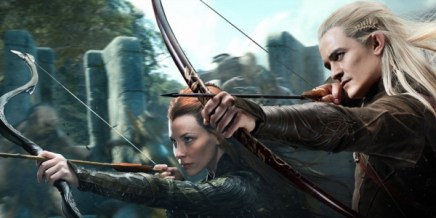
I think the decision to include sections from Tolkien’s “The Return of the King” appendices was a key reason this worked. Having read neither “The Hobbit” nor the “Lord of the Rings”, I can’t say how well the film melds the contents of both books. But from a cinematic standpoint the appendices do a great job of not only adding more content and weight to the story but also connecting it to the three “Lord of the Rings” films. Some have taken issue with this creative choice but for me it worked very well and it helps bring together Jackson’s massive cinematic universe. There is a clear link being formed between the two trilogies which go beyond simple references. Old favorite Legolas (Orlando Bloom) has an action-packed presence in this film. The true corrupting influence of the ‘one ring’ begins to surface. And there are several other cool connections that I wouldn’t dare spoil.

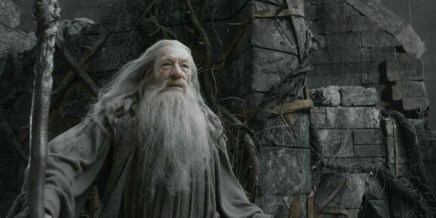
Once again the characters of the story are a real treat. Ian McKellen is great as always although he is given a few too many overly dramatic lines. You know the ones – the camera zooms in on his face and he utters an intense one-liner about the peril that lies ahead. Martin Freeman hits another home run as Bilbo. There is a real transformation (both good and bad) going on in the character and Freeman’s performance wonderfully captures that. But perhaps my favorite performance again comes from Richard Armitage as Thorin. This strong but emotionally driven character is tough as nails but he is constantly trying to reign in his sorrow, anger, and thirst for revenge. It’s a great character and a great performance.

HOBBIT2

But there are also some really good new characters introduced. Evangeline Lilly plays Tauriel, a headstrong elf who can certainly hold her own. Then there is Luke Evans who plays Bard, a single father who finds himself thrust into the middle of Thorin’s quest. Both have significant roles and add a lot to the picture. I also like Lee Pace’s small but intriguing part as an Elvenking from Mirkwood. And then there is Benedict Cumberbatch who voices Smaug the fearsome, treasure-hoarding dragon. There simply couldn’t have been a greater choice than Cumberbatch. Then you have the twelve other dwarves. Thankfully we do see an expanded role for a couple of them, but unfortunately the majority of them remain indistinct making empathy for them rather tough.

So let me get back to the original debate. Could “The Hobbit” story be told in two films? Probably so. Am I glad they expanded it to three by adding content from “The Lord of the Rings”? Absolutely! “The Desolation of Smaug” is a solid answer to the questions and criticisms thrown its way. The special effects are superb, the action sequences had my heart racing, the stakes are high, and we spend more time with these wonderful characters. On the flip-side there are a couple of lulls and the indistinct tag-along dwarves still bug me. But those gripes do little to hurt the overall experience and Peter Jackson has me hooked for what the third installment will bring. It should be a blast.

VERDICT – 4.5 STARS

REVIEW : “The Descendants”

DESCENDENTS POSTER

“The Descendants” is a film from director Alexander Payne that first came out Oscar ripe. It’s a heavy story that deals with several conflicting emotions that flow from situations that are all too real for many people. It can be a difficult film to watch at times but it can also be quite moving. I can certainly understand the reason for the Oscar buzz it received mainly due to some incredible performances. But the movie both underplays and overplays some parts of the story which for me held it back a tad.

The story follows Matt King (Clooney), a husband and father of two who lives in Hawaii. He’s a rich man who gained his wealth by being a descendant of Hawaiian royalty. He is the sole trustee of 25,000 acres of pristine virgin land on the island of Kauai. But Matt tries to stay grounded. He works as a lawyer and uses that salary to support his family while employing his father’s perspective that you should always work for your money. Matt and his cousins have entertained offers for the land. Some want to sell it to a huge group from Chicago while others want to sell to a local Kauai developer. Matt has the final say and must weigh the wishes of his family with what’s best for the community. We learn most of this in the first few minutes of the movie through expository voice-overs. In many films this could be seen as a crutch but here it works surprisingly well and gives us key elements to the story which sets up what’s to come.

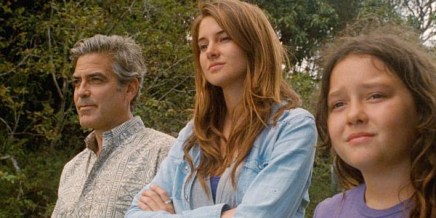
But within the first few minutes of the film it’s revealed that Matt’s wife has had a serious boating accident which leaves her comatose in an intensive care unit. Things look bleak and Matt struggles to bring together his two daughters. One is the impressionable 10 year old Scottie (Amara Miller) and the other is the bitter, irreverent 17-year old Alex (Shailene Woodley). To make matters worse, Matt finds out that his wife has been cheating on him with a younger real estate agent. The story takes Matt on an emotional roller coaster as he tries to balance feelings of anger and betrayal with the reality of his wife’s current state. There is a unique complexity to the story and while there is a lot going on emotionally, Payne makes everything feel genuine and authentic.

DESCENDENTS1

While “The Descendants” does keep everything feeling reel, it does overplay a vital element to one of the film’s key relationships. Matt struggles and at times looks inept when it comes to parenting. This was never more clear than in his relationship with his older daughter Alex. Payne certainly portrays her as angry and rebellious but I felt he terribly overdid it. I was particularly turned off by her constant vulgarity and irreverence. Even as their relationship supposedly grows stronger, we see her or her airhead boyfriend speak to Matt as if they were drinking buddies. Woodley gives a brilliant performance but I never completely appreciated her character mainly due to some shoddy writing which kills the otherwise wonderful moments between the two. Her character never truly evolves as I had hoped.

And while it overplays that particular relationship I felt it underplayed the relationship between Matt and his wife. To be fair, we do get all the information we need and I had no trouble understanding the relationship between the two. But I couldn’t help but wish for more. We never see them together before the accident. All of the details of their marriage is brought out through conversations with neighbors and family. It’s a smart method of storytelling and I guess it worked well enough. But the nitpicker in me really would have liked to have seen more.

Descendents2

One of the most important lines in the movie occurs during a conversion Matt has with another character. Matt is told “Everything just happens”. This seems to be a main point that Payne tries to make with this film and we see it throughout the picture. But I couldn’t buy into that premise. I go back to Matt’s relationship with his daughter. Alex’s attitude and disrespect didn’t just happen. She is a product of her parents poor parenting. His wife’s affair didn’t just happen. Her poor decisions and lack of self-control led to the adultery. If “Everything just happens” is a main point as many have said, Payne never sold me on it.

As I mentioned, their are some fantastic performances here. Clooney is controlled and reserved and delivers one of his best performances. I’ve already mentioned the great work from Woodley but young Miller is also quite good. With the exception of the peculiarly cast Matthew Lillard, there are several brief but strong performances from actors like Robert Forster and Beau Bridges. I also loved the use of Hawaii as a location. We do get small glimpses at its island beauty but for the most part Payne treats it as a real place where people live – a community with all the same trials and troubles as any other state. The mix of uniqueness and commonality was very effective.

There is a lot to like with “The Descendants”. It deals with some weighty subject matter in a real and thoughtful way. It shows glimpses of greatness even though it’s brought back down by some poor creative direction that strips one of the more intriguing characters of much of her likability. But I found myself caring about what happened to these people. It’s strong stuff and “The Descendants” handles it all well. It’s a film with a great concept and some great moments. Unfortunately a few speed bumps in the script keep it from being a truly great film.

VERDICT – 3.5 STARS

REVIEW: “The Lone Ranger”

Lone Ranger poster

“Pirates of the Caribbean” set in the old west. It’s an unavoidable comparison. It’s also a very accurate description of Gore Verbinski and Jerry Bruckheimer’s “The Lone Ranger”. Johnny Depp again takes center stage and is the ringleader of this wacky and sometimes absurd action adventure. The ingredients are all here. A charismatic and eccentric lead, a fun and action-packed story model, and a filmmaking team who has experienced success before. Maybe that’s why the end result is so disappointing.

As a kid I loved the old television reruns of The Lone Ranger starring Clayton Moore and Jay Silverheels. Well let me say that it didn’t take long for me to see the mammoth sized differences between this film and the great original material. I mean to call this film a reimagining would be a gross understatement. There is almost no similarity between these film and the classic story other than the name and some of the basic cosmetics. There is the white hat and white horse. There are silver bullets and the black masks. There are also a few familiar names and familiar plot points. But you’ll be hard pressed to find many other resemblances. Who knows, maybe that’s where the first of the film’s many missteps begins.

Lone Ranger 2

Now I wasn’t expecting this to be an ultra-serious tribute to this classic character. Again this is from the makers of “Pirates of the Caribbean”. But I also didn’t expect it to be so drastically different and so blasted silly. It starts with the Lone Ranger character himself. Armie Hammer seems completely lost at times playing a character who is a bumbling oaf from the first time we see him until the final credits. The character has good intentions but he’s a far cry from the heroic masked administrator of justice I was hoping for. Hammer’s performance doesn’t help. He struggles through a ridiculous and sometimes numbingly lame script that drags him through a plethora of slapstick and oddball humor that admittedly works on occasions. But more often than not it lands with a thud and Hammer just can’t sell it.

The nuttiness isn’t just confined to Hammer and the lead character. Johnny Depp’s Tonto is in many ways a Native American Jack Sparrow. He channels his famed pirate character in a variety of different ways and I found myself laughing out loud on several occasions. But he also has his share of ludicrous, over-the-top moments. And that can be said for the entire film. It has several eye-rolling moments that are so insanely absurd that they’re impossible to digest. But it also sharply turns in other directions. “The Lone Ranger” has some jarring tonal issues. One minute horses are standing up in trees wearing cowboy hats and the next has a character cutting out and eating a human heart. The movie is literally all over the map.

But perhaps it’s biggest sin is that it’s just so boring in the middle. It starts with a some promise and there are hints of a good story throughout the picture. But soon the film bogs down in a mire of drab and pointless plot. There’s an underwritten and poorly serviced romance. There are throwaway characters such as Helena Bonham Carter’s ivory-legged brothel head whose story would better serve on the cutting room floor. Then there is the film’s general snail paced way of telling the main story. It takes way too long and it becomes a test of endurance just to make it through the arduous 2 hours and 30 minute running time.

Lone ranger 1

But I have to say that the big finale saves the film from being a total disaster. The huge set piece is quite the spectacle and I remember perking up the moment that the William Tell Overture suddenly kicked in. The ending almost feels like its own little short film. It doesn’t feel anything like a Lone Ranger sequence and there isn’t a semblance of realism to be found. But it is insanely entertaining if you can accept its cartoonish and exaggerated approach and go with it. For me it was easily the best part of the film even with its absurdities.

There are some beautiful locations and some of the action is really good. There are moments where the wacky humor works very well. I also enjoyed seeing an assortment of my favorite supporting actors (William Fichtner, Tom Wilkinson, Barry Pepper, and James Badge Dale) even if their roles aren’t particularly well written. But in the end “The Lone Ranger” loses itself in its overbearing insanity and bloated, uneven plot. It never feels like a western and it never knows when to end. What really stinks is that this could’ve been a really good summer movie. Instead it’s $250 million dollars worth of mediocrity and a waste of some really good talent. I may be wrong but I would think Disney would want more from such an investment.

VERDICT – 2 STARS