REVIEW: “The Third Man”

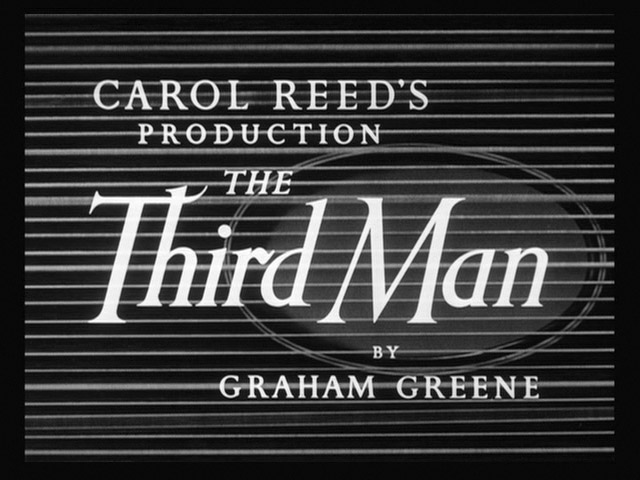
“The Third Man” is a stunning British film noir from 1949 directed by Carol Reed and starring Joseph Cotten. It’s a film featuring a tight Hitchcockian story and some extremely clever uses of cameras and lighting. Novelist Graham Greene wrote the screenplay that takes place in a battered post-World War 2 Vienna. The city has been broken up into sectors, each owned by different countries. This plays a big part in Greene’s story. Throughout the film we see shells of buildings, burnt out cars and piles a debris left from the war and it creates one of the most believable atmospheres. This is in large part due to the incredible cinematography from Richard Krasker but more on that later.

This is the Vienna that novelist Holly Martins (Joseph Cotten) enters into. He arrives there at the request of his friend Harry Lime who has offered him a job. But he finds out that Harry had just been killed after being struck by a car. Curious about the circumstances surrounding his death, Martins begins to suspect that Harry was murdered. Along the way he runs into several characters including a cryptic British military policeman (Trevor Howard), Harry’s girlfriend (Anna Schmidt), a couple of Harry’s suspicious “friends” (Ernst Deutsch & Siegfried Breuer), Harry’s doctor (Erich Ponto), and an eyewitness to Harry’s death (Paul Horbiger). Martins sets out to piece together the tidbits of information he gets from each of these people and soon finds out that the truth may be a hard thing to handle.

The story moves at a perfect pace while nicely delivering all the elements you would expect from a high quality mystery and film noir. Cotten is fabulous as always and the supporting cast does a marvelous job of creating the shady and hard-to-read characters that give a movie like this such energy. It’s also necessary to mention that Orson Welles has a small but pivotal part in the movie and, just as you would expect, he is superb. The story never hits a lull nor does it ever overplay it’s hand. It’s intelligent and well constructed and I was consumed by both the narrative and the environment in took place in.

Getting back to Krasker’s cinematography, it’s impossible to watch this picture and not be struck by it. His work was ahead of its time and serves as an object lesson on creative camera angles and the use of lighting. The film was shot almost entirely in Vienna. Krasker goes to great lengths to capture the historical beauty of the city although it’s often shrouded in the darkness of night. But his impeccable use of lighting and shadows draws out the attraction of the statues, architecture, and cobblestone streets as well as the devastation left by the war. Also, you can’t talk about the presentation without mentioning the lovely score by Anton Karas. It features some great tunes none better that the beloved “Third Man Theme”.

I love “The Third Man”. Everything from its production value to the performances to the mesmerizing story works for me. This is great example of classic film noir and it had me hooked from the opening moments until that perfect final shot. This is a film that may have slid under some people’s classic movie radar. But this film excels in both visual presentation and intelligent storytelling. “The Third Man” is a real gem and it’s a movie that simply must be seen.

VERDICT – 5 STARS

5 STARSs

5STAR K&M

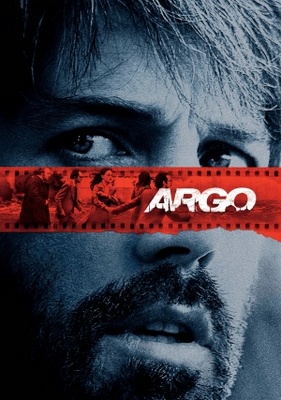
REVIEW: “Argo”

And you thought movies were for entertainment only! “Argo” is the third feature film directed by Ben Affleck. It’s also his best work to date. “Argo” takes place during the 1979 Iran hostage crisis and is loosely based on CIA exfiltration specialist Tony Mendez’s bizarre but daring rescue attempt of six US diplomats. For the most part Affleck steers clear of politics instead choosing to focus more on the intensity of the events. This results in a well conceived and focused story that sizzles from the opening scene to the end credits.

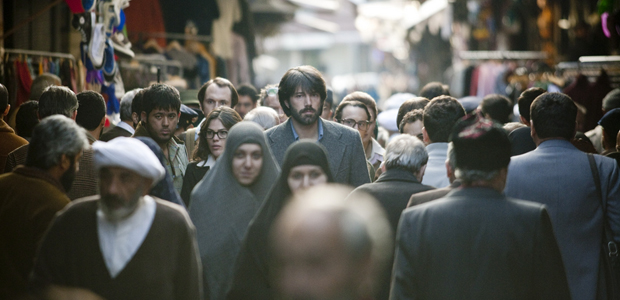
The film opens up with what’s arguably the best 20 minutes in cinema so far this year. Affleck instantly sets the stakes high by showing the immediate causes of the unrest in Tehran through a brief but effective opening montage. In 1979 Iran was in chaos after the people had overthrown their unpopular Shah and replaced him with an Islamic Republic. Anti-American sentiment boiled over after the United States granted asylum to the deposed leader. Led by Islamic militants, a mass of people break into the US Embassy and begin taking hostages. Six diplomats manage to escape and find refuge at the home of the Canadian ambassador. The protesting and subsequent storming of the US Embassy is packed with tension and it’s brilliantly visualized through a mix of old news footage and clever camera work. And I’m not just speaking of the hostile crowd outside of the gates. We see diplomats inside, fully expecting a breach, frantically gathering sensitive documents to incinerate and shred. We see last-minute contacts being made which sends Washington scurrying. All of this is realized as truly riveting, edge-of-your-seat cinema.

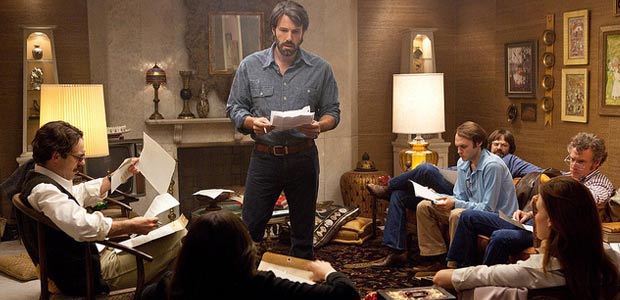
As mentioned, six American diplomats manage to escape and hide in the home of Canadian ambassador (Victor Garber). Knowing the militants will soon realize that six Americans are unaccounted for, the State Department brings in Tony Mendez (played by Affleck) to come up with a plan to get them out. He convinces his superiors to allow him to enter Tehran, meet up with the hidden diplomats, and leave the country with them posing as a Canadian film crew scouting out a location for a sci-fi movie. Knowing how thorough the militants will investigate the ruse if suspicious, Mendez is sent to movie make-up artist John Chambers (John Goodman) and Lester Siegel (Alan Arkin), a semi-successful Hollywood film producer. Together they put all the pieces in place for their fake movie including a title (“Argo”), a script, a production company, and even a movie poster, all intended to give credibility to Mendez’s cover.

The film then follows the planning of the mission, the anxiety of the diplomats in hiding, and the ever-present uncertainty in Washington from those who don’t fully buy into Mendez’s plan. All of this is told by the able hands of Affleck who has certainly established himself as a skilled storyteller. His style fits perfectly with Chris Terrio’s sharp and layered screenplay. Terrio crafts a potent dramatization by adding just enough to the real events to give the narrative a real dramatic pop. A couple of fictional characters are thrown in and there are moments that are purely for dramatic effect. But that’s what cinema does and I can’t imagine this story playing out any better than it does here. It also has the sharp sting of relevance. I couldn’t help but think of the recent Benghazi embassy attack During the film’s opening sequence.

You also can’t help but be impressed by the movie’s impeccable attention to detail in creating a believable late 70s and early 80s atmosphere and vibe. The movie opens with the old late 70s Warner Bros. logo which perfectly set the table for me. Then there are the obvious things – the cars, the clothes, the hairstyles, the technology. But Affleck also employs several clever devices such as original news footage featuring the likes of Tom Brokaw, Dan Rather, and Ted Koppel. We see archived footage of President Jimmy Carter as well as authentic newscasts of the turmoil in Iran at the time. It blends in perfectly with the fictional additions to give a true credence to everything we see on-screen.

“Argo” is a rock-solid movie that does all of these things well, and I haven’t even gone into the fantastic performances. Some have said otherwise, but I found Affleck to be a compelling lead. Then you have the incredible supporting work of Bryan Cranston, Kyle Chandler, Titus Welliver, and Michael Parks. And of course Goodman and Arkin are a blast. The performances are just another strength and this gripping and well-made film. It grabs you and holds you right through to its nail-biting finale. And be sure to stay through the credits for some great images of the real people involved in this amazing rescue attempt. It’s just icing on the cake of one of the better films of 2012.

VERDICT – 4.5 STARS

4-5-stars

THE THROWDOWN: “Annie Hall” vs. “Midnight in Paris”

Wednesday is Throwdown day at Keith & the Movies. It’s when we take two movie subjects, pit them against each other, and see who’s left standing. Each Wednesday we’ll look at actors, actresses, movies, genres, scenes, and more. I’ll make a case for each and then see how they stand up one-on-one. And it’s not just my opinion that counts. I’ll share my take and then open up the polls to you. Visit each week for a new Throwdown. Vote each week to decide the true winner!

*Last week Schwarzenegger (53%) out-muscled Stallone (47%) in our action icon Throwdown*

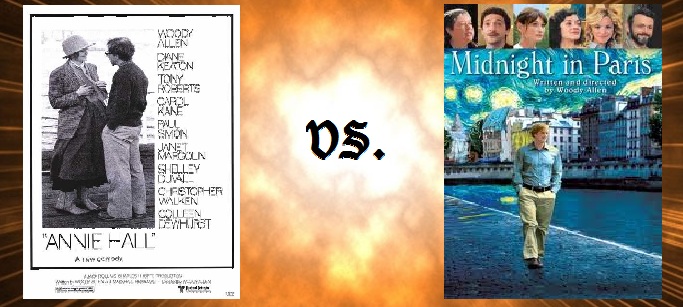
This week we move about as far away from the previous week as humanly possible. It’s old Woody versus new Woody in a Woody Allen Throwdown! When you see a Woody Allen film you know it’s a Woody Allen film. Yet in some ways his approach to filmmaking has changed over the past few years. So I thought it would be fun to pit what many view as a romantic comedy masterpiece in “Annie Hall” against Allen’s more recent and widely popular “Midnight in Paris”. These movies are wildly different yet each look and feel like a Woody Allen picture. So enough of the buildup. It’s old Woody Allen against new Woody Allen. It’s New York against Paris. It’s the Throwdown and your votes decide the winner.

“ANNIE HALL” VS. “MIDNIGHT IN PARIS”

In 1977, Woody Allen released “Annie Hall”, a movie that some have called the quintessential romantic comedy. Allen’s quick wit is never more evident than in the lightning fast and razor-sharp dialogue from the script he wrote about an eccentric New Yorker and his quirky perception of love and relationships. Diane Keaton won an Oscar for her role as Annie, a woman who ended her relationship with Allen’s character a year earlier. Allen spends the film lamenting his lost relationship and then moving on with his life. But can he ever really get Annie out of his mind? “Annie Hall” received three other Oscars including Best Picture and Best Original Screenplay. While I’m on record as saying I’m not the biggest fan of “Annie Hall”, it’s a movie that is loved by many.

In 2011, Woody Allen’s European tour stopped in The City of Light, Paris, France. “Midnight in Paris” is Allen’s love letter to the city, its beauty, and its history. Owen Wilson is fantastic as Gil Pender, a hack writer who believes he was meant to live in Paris during the 1920s. Allen shows us the magic of the city now and takes us back to the days of Hemingway, Picasso, and the Fitzgeralds. It features an incredible supporting cast highlighted by Tom Hiddleston and Corey Stoll as well as beautiful cinematography in some if Paris’ most glorious locations. This is a step outside of the box for Allen. More importantly, it’s a wonderfully romantic film that gives the most lovely look at one of the world’s greatest city. Allen won an Oscar for the screenplay and I can say without hesitation he certainly deserved it.

So is it Allen’s Best Picture winner “Annie Hall” or his love letter to the City of Light “Midnight in Paris”? I’ve got a clear favorite between the two. Do you? Your votes decide the winner. Click below and vote NOW!

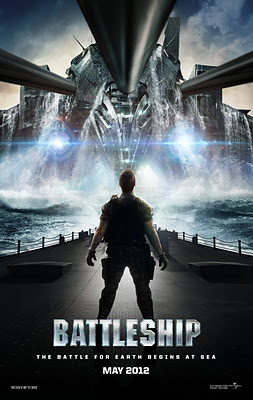
REVIEW: “Battleship” (2012)

Hollywood has made movies based on just about everything. They’ve made movies based on fairy tales, movies based on old TV shows, and even movies based on video games. So should it come as a surprise to anyone that they would make a movie based on an old Hasbro board game? I guess it would be more accurate to say that “Battleship” is loosely based on the popular board game that first appeared in 1967. Obviously the story has little to do with the back-and-forth game itself, but in some ways it’s just as boring as watching two people play. This movie is all about the visual eye candy with almost no attention given to storytelling or dialogue. But visuals only take you so far and at about 130 minutes long, the movie eventually becomes an almost tedious exercise in endurance.

The story is about as shallow and stripped down as they come. Taylor Kitsch plays Alex, a shaggy-haired loser who always finds a way to get into trouble. Fed up with Alex’s “do nothing” approach to life, his older brother comes up with a great idea – force Alex to join him in The United States Navy. Apparently there’s nothing to joining and advancing in the Navy because next we see Alex as a lieutenant aboard the USS John Paul Jones. He’s still getting into trouble and eventually finds himself on the verge of being tossed out. But that’s before a hostile alien force lands near Hawaii and Alex’s leadership may be the only thing that can save the planet. Sense some all too familiar storylines here? How about this one – he wants to marry his girlfriend (Brooklyn Decker) who happens to be his commander’s daughter. I’ll bet you can figure out how that plays out. Oh, and this one – Alex is forced to work alongside his chief rival (Tadanobu Asano) in order to survive and save mankind. It’s pretty obvious where that goes isn’t it?

Jon and Erich Hoeber’s script is riddled with cheesy dialogue and there’s not a single action movie cliché that isn’t used here. If you’ve seen any of these types of movies you will see where the amateurish plotting is going from a mile away. Director Peter Berg tries to give the film some credibility and weight with his heavy-handed use of patriotism and military camaraderie. There’s certainly nothing wrong with the message but the cut-rate execution makes it feel like a cheap knock-off of a number of other films. And it’s impossible to take any of these attempts seriously mainly due to some horribly written and sometimes unintentionally hilarious dialogue. I found myself completing a character’s sentence just because their lines were so familiar. I also caught myself laughing several times during dramatic moments that weren’t meant to be funny.

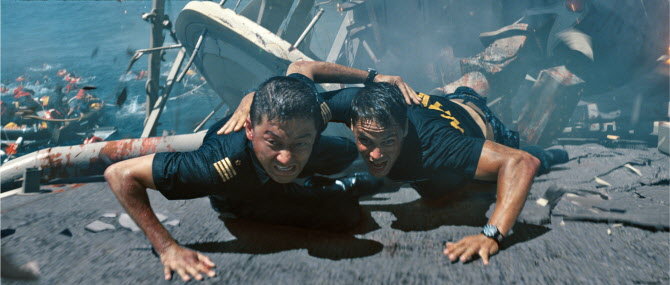
Now let’s be clear, “Battleship” doesn’t aim to be anything more than a simple, loud, CGI-heavy, summer popcorn picture that strictly adheres to the Michael Bay “Transformers” formula. It bombards you with large-scale special effects sequences, many of which are quite impressive yet undeniably repetitive. I can’t count how many times we see alien ships hopping up and down out of the water or arming their weapons over and over in what looks like the exact same scenes. But the film does at times look spectacular and it can be fun in occasional bursts. There is one particular sequence where the aliens send a metal rollie pollie that literally shreds a destroyer vessel from the inside out. Sure they rip off a couple of scenes from James Cameron’s “Titanic” as the ship sinks but it’s still a wildly impressive scene.

Maybe I’m just getting old but this film left a lot of potential on the table. I suppose “Battleship” would work for the passive movie fan or if you were 12 years old. But even those folks won’t rush to see it again. Yet I have to admit there are some amazing visuals here and I did find myself occasionally caught up in them. But underneath the bombastic veneer of grinding metal, explosions, and destruction lies a corny and often times ridiculous story that can’t be saved by the fancy coat of CGI paint. “Battleship” is a hard film to rate. Narratively speaking its a train wreck. But it’s a visually stunning wreck which makes the experience bearable. But I need more than that in my movies.

VERDICT – 2 STARS

5 PHENOMENAL MOVIE GAS STATION SCENES

In the movies gas stations offer much more than just a place to use the bathroom and top your tank. There have been all sorts of cool and funny movie scenes involving gas stations. So this is one of those weird Phenomenal 5 lists that looks at great movie gas station scenes. Now there were several scenes I really love that were left out just for the sake of variety. That being said, I wouldn’t call this the definitive list. But there’s no denying that these five movie gas station scenes are absolutely phenomenal.

#5 – “IT’S A MAD, MAD, MAD, MAD WORLD”

This wacky 1963 comedy is known for possibly having the biggest ensemble cast of great actors in movie history. It also has one of the greatest gas station scenes you’ll find. In this wild race to get to a load of stolen money first, a furniture mover named Lennie (Jonathan Winters) gets double-crossed by the greedy Otto (Phil Silvers). Lennie finally runs Otto down at gas station and chases him all over the property causing all sorts of damage. Otto escapes and the attendants tie Lennie up while waiting for the men in white coats to come get him. Lennie gets loose and ends up leveling (quite literally) the entire station. It’s a hilarious scene.

#4 – “ROBOCOP”

There’s a great and pivotal gas station scene in the 1987 sci-fi action romp “Robocop”. Emil, a member of the brutal gang that killed Alex Murphy which in turn caused him to become Robocop, stops at an all-night gas station. He robs the place and fills up with gas while terrorizing the attendant. Robocop notices a crime in progress and pulls up. After triggering Robocop’s memory, Emil sprays gas everywhere, throws down his cigarette, and tears off on his motorcycle. The gas station explodes with Robocop walking out of the flames. He thwarts Emil’s getaway but this scene is mostly important for putting Murphy on track to remembering who he was.

#3 – “KALIFORNIA”

There are actually two great gas station scenes in the 1993 gritty thriller “Kalifornia”. Pre-mega star Brad Pitt gives what I believe is his best performance as Early Grayce, a psycho who, along with his wife, hitches a cross-country ride to California with David Duchovny and Michelle Forbes. In the first unnerving scene, they stop for gas and a man with a wad of cash catches Early’s eye. Early follows him into the restroom, stabs him to death, and takes his money. But in an even more frightening scene, later they arrive at a different gas station as a huge electrical storm brews. It’s in this key scene that the rest of the group discovers the brutally unbalanced man that Early really is. Both scenes are intense and disturbing but also incredibly well done.

#2 – “THE BIRDS”

Alfred Hitchcock’s classic killer birds movie has several great moments but few are better than the gas station scene. As an attendant gasses up a customer’s car, two birds attack him knocking him down. As people rush to check on him, no one notices the nozzle continuing to spew gasoline. The flow of gas crosses the street into a parking area where a man steps out of his car and lights a cigar. Before he can be warned the match burns his finger then falls into the gas. BOOM! The man and several cars are gone and the flame blazes up the gas stream and the gas pumps explode. Hitchcock ends the scene with an amazing overhead shot of the horrible event. Classic!

#1 – “NO COUNTRY FOR OLD MEN”

Hands down my favorite gas station movie scene has to be from Joel and Ethan Coen’s fabulous “No Country for Old Men”. Hired killer Anton Chigurh (Javier Bardem) stops by a small isolated gas station to fill his tank and grab a package of peanuts. The elderly attendant makes the mistake of making small talk with Chirgurh which leads to one of most tense yet hilarious conversations I’ve ever scene. It ends with a coin toss with the attendant’s life on the line. I swear, I can watch this scene over and over and never get tired of it.

So there they are. What have we learned from this week’s Phenomenal 5? For one thing, it doesn’t pay to be a gas station attendant in the movies. So many good ones could have been mentioned. So what’s your favorite?

REVIEW: “The 400 Blows”

Francois Truffaut heads the list of great directors whose work I’m fairly unfamiliar with. Truffaut was an esteemed French filmmaker who was also a father to the French New Wave of the late 1950’s and 1960’s. He was deeply critical of the state of French cinema in the mid-50’s and eventually begin to make films of his own. His first feature-length picture came in 1959 with “The 400 Blows”. This is my launching point into the films of Truffaut and what a wonderful way to start. “The 400 Blows” is a gripping and deeply penetrating picture that instantly grabbed me with its heartfelt realism and its crisp visual style. And judging by this, his initial effort, there’s a clear reason why Truffaut is heralded as one of the most influential filmmakers in cinema history.

“The 400 Blows” follows 12-year old Antoine (played wonderfully by Jean-Pierre Leaud) and his life in 1950’s Paris. At first Antoine comes across as unruly and rebellious. But as the story unfolds we see that he is inundated with negative influences. His father is a forceful and sometimes pernicious authoritarian who takes the frustrations from his life out on his son. His abusive temper shows itself physically and verbally even to the point of publically humiliating his son . His mother is even more unhappy and discontent and she lets it show through her emotional negligence and general disinterest in her son. It’s only after Antoine catches her in an affair that she begins to show affection for him but even that is grounded in her own arrogant self-interest. Even at school Antoine faces his teacher whose meanness is based on his assumptive judgements that Antoine is and forever will be a bad kid.

Antoine finds refuge on the streets of Paris and in the company of his best friend Rene (Patrick Auffay). Rene is a mischievous type and it’s uncertain whether he’s the best influence either. But the two have a true friendship which Antoine depends on. Some of the movies best scenes are with these two friends walking the streets of Paris talking back and forth. As things break down at home and at school, Antoine sees the streets as his only out and it’s Rene who’s there to help him survive, although not always in the most wise of ways.

At its core, this is really a heartbreaking story. It’s a perfect example of a young boy being a product of his environment yet fighting hard not to be. Those who should be the stable, influential forces in his life utterly fail him. Even the law enforcement system heartlessly mistreat him later in the film. But Antoine just wants to be a little boy. We get to see the childlike yearnings for a stable home with a loving mother and father.

400

There’s a scene where Antoine is at home alone with his father and they are preparing dinner. It’s one of the few instances where his father is being a father. Truffaut elegantly shows Antoine’s love for this father-son moment through the young boys gazes and expressions. There is also another scene where the family goes out to see a movie together. For these few moments we see the happy family that Antoine wants and needs. Sadly, these are anomalies – exceptions to an otherwise dismal life for the 12-year old.

“The 400 Blows” is a powerful movie that will take you through a wide range of emotion. We experience the playfulness and cruelty of life along with the young boy. Before long, we’re rooting for him yet we’re uncertain of what the future holds right up to the last shot. It’s truly a magnificent film that put Truffaut on the map and I can certainly see why it remains influential to this day. It’s gorgeously crafted, deeply moving, and features penetrating performances. Enough with the adjectives. Let’s just say I loved “The 400 Blows” and I can’t wait to dive into more of Truffaut’s work.

VERDICT – 5 STARS

5 STARSs

5STAR K&M