Batman & Warner Bros. – What Comes Next?

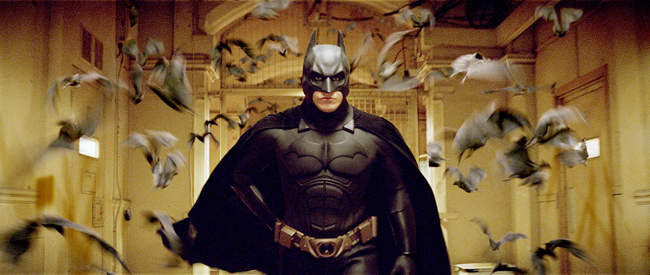
I still remember anxiously waiting in line at the movie theater during June of 1989. It was the weekend for Tim Burton’s “Batman”, a movie I had been anxiously waiting for. Warner Bros. had done an excellent job building up the film in an era (unlike now) with no easy access to the internet and other modern methods of promotion. The film was a huge success and it ended up raking in over $400 million dollars. After it came “Batman Returns” in 1992 – a movie that had its moments but still fell terribly short of the first film both in quality and in money earned. Joel Schumacher took over the franchise with 1995’s “Batman Forever” and although the box office take went up, the quality went down even more. Schumacher then finished his execution of that Batman series with the hideous “Batman and Robin”, a movie that made considerably less money and remains completely unwatchable.

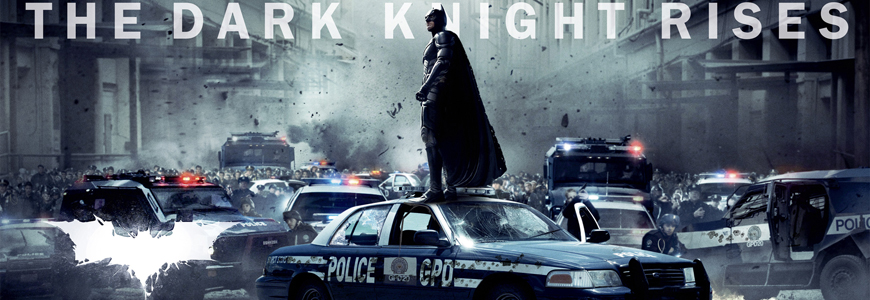
After a lengthy layoff, Warner Bros. brought Batman back in Christopher Nolan’s Batman trilogy, a series that has already been heavily discussed on this blog. The Warner approach was a good one – place the character in the hands of a capable visual and intellectual storyteller and let him share his own vision of the Dark Knight. It worked wonderfully both in terms of box office revenue and the quality of the films. For my money, the Nolan trilogy features the greatest superhero story ever told on film and it’s a rousing cinematic accomplishment.

But now Nolan is done. “The Dark Knight Rises” has hit the theaters and once again Warner Bros. has no strong chess piece on the superhero movie board. “The Man of Steel” is due out next year but we all know how their last attempt at bringing back Superman went. I was a fan of that picture up until the end where Bryan Singer and company completely blew the entire film. “Green Lantern” was the studio’s most recent attempt at getting another major superhero franchise going. And while I enjoyed parts of the movie, it was a cramped and poorly conceived story that both fanboys and casual moviegoers couldn’t latch on to.

So the question remains, what’s next? Warner Bros. and DC Comics are both desperate to tap into some of the success that Marvel Studios has had through a series of highly successful and genuinely good superhero flicks. And while “The Man of Steel” is on the horizon, questions certainly remain about it. Other DC Comics properties are in the works but let’s face it, now that Batman is gone, Warner Bros. doesn’t have a single heavy-hitting superhero film franchise to call their own. And when it comes down to it, Batman has been shown to be the studio’s anchor in the genre. So when Batman returns (and he most certainly will return), my advice would be to follow in the footsteps of the Dark Knight trilogy not in terms of the story but in how the studio approaches it. Find a creative visionary – someone with a unique but intelligent visual storytelling style – and let them share their vision. But (and this is a huge but) they had better choose wisely.

REVIEW: “Moonrise Kingdom”

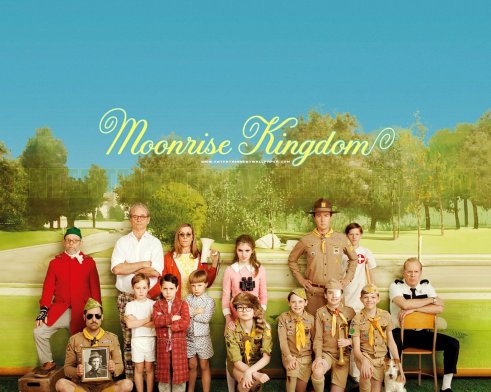
Going into a Wes Anderson film there are several things you know to expect: a healthy dose of dry and sometimes offbeat humor, a unique visual style, and familiar aesthetics that permeate each of his movies. “Moonrise Kingdom” is no different from other Anderson efforts in terms of it’s storytelling style and visual presentation.  This is his first film since 2009’s Oscar winner “Fantastic Mr. Fox” but it’s clear from the opening credits that his dedication to his style of filmmaking is still as strong as ever.

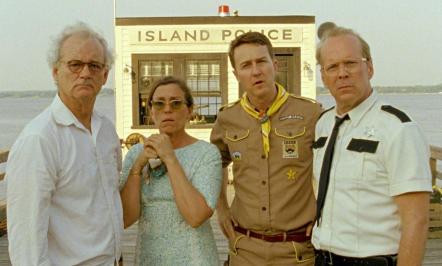
“Moonrise Kingdom” takes place in a small community on a New England island in 1965. A very Wes Andersonish  narrator sets the table for us and we meet several of the community folks including Scout Master Ward (Edward Norton) the leader of the island’s branch of the Khaki Scouts. While doing morning inspections, he discovers that 12 year-old Sam (Jared Gilman), a picked on, eccentric young boy has run away from the camp. Elsewhere on the island young Suzy Bishop (Kara Hayward) lives at Summer’s End, her home shared with her parents and three young brothers. Suzy is a reserved introvert who has no friends and finds refuge by retreating into her fantasy novels and looking through her binoculars – something that she pretends gives her super powers. It’s through her binoculars that she discovers her mother Laura (Frances McDormand) meeting secretly with the community policeman Captain Sharp (Bruce Willis). Her father Walt (Bill Murray) is impervious to the signs of his wife’s secret fling mainly due to their fractured relationship.

Suzy ends up running away from home and through a flashback we learn that it’s something she and Sam had been planning since they first met at a local church play the year before. The two meet in a meadow then set out on a journey together through the rugged and rainy island terrain. Sam flexes his extensive outdoor knowledge before Suzy by pitching tents, building fires, and catching and cooking fish. Meanwhile, after discovering the kids are gone, the dysfunctional community sets out to find them.

Anderson has several interesting dynamics at work, the first being the relationship between the two kids. It’s easy to see why they are drawn to each other. Both feel detached and out-of-place. There’s a void in their lives and they find solace in the fact that they no longer feel alone in the world. Both Gilman and Hayward are stunningly good especially considering this is the first feature film for both. Anderson’s childlike deadpan dialogue flows naturally from the two characters and he really gives them a believable foundation for the budding adolescent romance. Some have argued that the romance between the two was lacking and never provided the spark to drive the relationship. I argue that there’s no huge passionate spark mainly due to the children’s age and the newness of love and romance. I feel that their attraction to each other is based more on their personal, emotional, and social similitude. Being in each other’s presence fills a substantial emptiness in their lives and let’s them know they aren’t alone. A form of love sprouts up from that and Anderson depicts it with tenderness even amid the laugh out loud moments and the hilarious, straight-faced dialogue.

My biggest problem with the way Anderson handles the children’s relationship is the way he handles his child actors in one particular scene. Intended to show a sexual curiosity and almost unwanted compulsion, there is a brief scene where Gilman and Hayward are asked to engage in something that I have no problem saying I was uncomfortable with. At the time of filming, both actors were 12-years old and the willingness of Anderson to shoot this particular scene is disappointing. It’s certainly not graphic but it’s also not appropriate and that fact that it’s used more for comic effect is even more frustrating.

But while the story of Sam and Suzy drives the main narrative, perhaps the biggest microscope is put on the community and the fact that they are each flawed individuals forced to make important and sometimes redemptive decisions. As you look at each character you see situations unfold that bring them to the point of either doing the right thing and changing the direction of their lives or watching as things crumble in around them. In a very real sense, the disappearance of Sam and Suzy is the catalyst for some pretty real and important character transformations in Captain Sharp, Scout Master Ward, Laura, and Walt. Even Sam’s fellow Khaki Scouts are faced with their own moment of truth.

I talked about Gilman and Hayward’s performances but they’re surrounded by some equally strong work. I was particularly drawn to Bruce Willis who delivers some great laughs but through a very controlled performance that’s perfectly fitting for Wes Anderson material. Willis occasionally gets to show his acting range and this is a good Oscar caliber example of that. And I have to say, as someone who isn’t the biggest Edward Norton fan, that he was a lot of fun here. He’s goofy, nerdy, and his delusion of control that’s evident in some of the early scenes results in some of the films funnier moments. Frances McDormand is perfectly cast and Bill Murray is funny as always. I also thought Anderson favorite Jason Schwartzman was funny running around in full Khaki Scout attire.

“Moonrise Kingdom” is another Wes Anderson picture that’s a side-splitter to some but a head-scratcher to others. I laughed a lot through the film but I was also touched by its tenderness and care in addressing struggling children with feelings of isolation and insecurity. Anderson does get careless and I feel irresponsible in one brief scene but there are still several undercurrents that touch on important themes without fully diving into them. We not only see it with the children but in the community and it really worked for me. “Moonrise Kingdom” may not be for everyone but I loved its full package and stylish presentation. It’s a breath of fresh air in a comedy genre filled with raunchy movies and lazy humor. I’ll take this over them any day.

VERDICT – 4.5 STARS

“TO ROME WITH LOVE” – 2 STARS

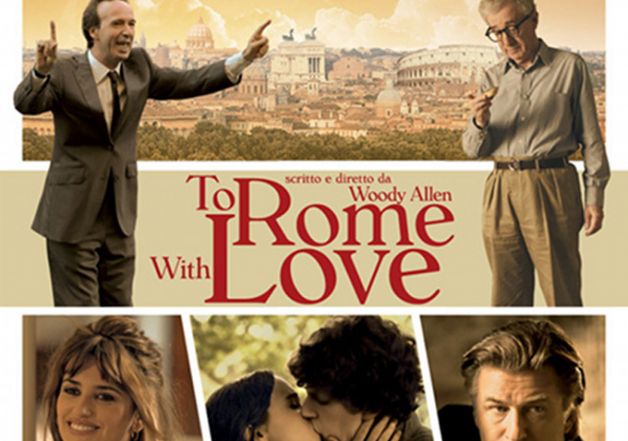
I’ve never been a big Woody Allen fan. But my appreciation for his filmmaking grew with last year’s amazing “Midnight in Paris”, a fantastic film that was wonderfully written, genuinely funny, and purely magical. Allen’s European tour continue’s with “To Rome With Love” yet another romantic comedy taking place in one of Europe’s most beautiful cities. “To Rome With Love” is a collage of individual stories about a number of different people and their relationships, their predicaments, and their quirks. It starts by capturing some of that same magic that made “Midnight in Paris” such a strong film but the second half of the movie runs off the rails and the result is an uneven and ultimately disappointing result.

The different unconnected stories battle for screen time and all start on the right track. In one, Haley (Allison Pill), an American tourist visiting Rome meets, falls in love with, and is soon engaged to a local hunk named Michelangelo (Flavio Parenti). After her parents fly over to meet his parents, her father (Woody Allen), who compares his recent retirement to a premature death, thinks his career is rejuvenated after discovering Michelangelo’s shower singing father (Fabio Armiliato). In another story, Roberto Benigni plays a mundane and predictable husband and father who suddenly becomes the object of immense fame and notoriety over nothing more than what type of underwear he wears and how he likes his toast.

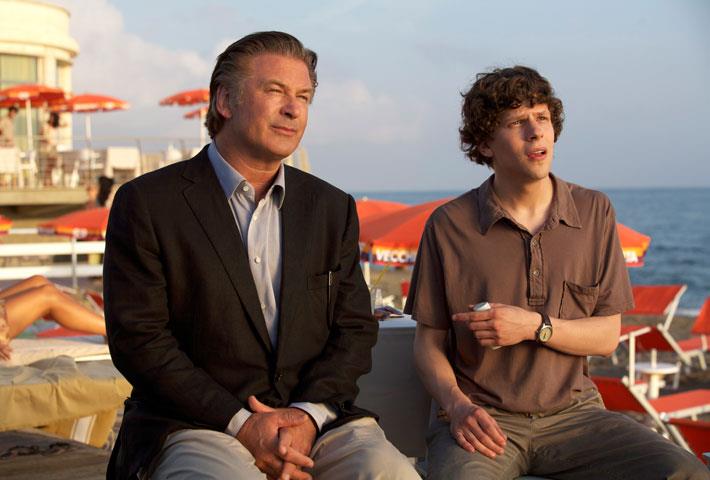
In yet another story Alec Baldwin plays John, a middle-aged architect back in Rome visiting the neighborhood where he once lived as a young man. He bumps into Jack (Jesse Eisenberg), a young architect living in Rome with his girlfriend Sally (Greta Gerwig). Their relationship is strained when her best friend Monica (Ellen Paige) flies in to visit from the states. John follows Jack around everywhere sounding off warnings about his budding relationship with the flakey Monica. And then there are the reserved small-town newlyweds (Alessandro Tiberi and Alessandra Mastronardi) who arrive in Rome where the husband hopes to get a job from his wealthy family. Through several off-the-wall events, the two are separated in the city and each find their love for the other challenged by the people they meet including a  prostitute played by Penelope Cruz. This was easily the weakest story of the four.

These four storylines stay within their own individual walls and they never intersect with each other. As I mentioned they each start strong and Allen packs a lot of good laughs particularly the first half of the movie. At first I really thought Allen was doing something clever and crafty with the four stories. The film addresses an interesting array of issues and the characters are actually quite intriguing up to a point. But things begin to slowly turn sour and not only does Allen’s story fly wildly out of control but many of his characters become pretty pathetic individuals who depict the movie’s warped and cynical view of love, devotion, and relationships. Several of the characters are faced with sexual temptations and ultimately fall prey to them, some with almost no meaningful struggle of conscience. Other storylines become preposterous which is ok if you’re going somewhere with it. And while I definitely laughed at some of the over-the-top gags, keeping my loosely attached interest intact  hinged on the idea that Woody was doing more with these self-indulgent characters and outlandish situations than what we were seeing. As it turns out he really wasn’t.

As I’m sure you noticed, Allen still has a knack for attaching great talent to his productions. There’s not a bad performance in the entire film and the actors almost pull it off even when the material goes south. Woody Allen himself delivers some of the film’s biggest laughs while portraying the same neurotic and pessimistic character as in his other roles. Speaking of neurotic, but on a much smaller scale, I also really enjoyed Eisenberg’s performance as well. But the biggest star of the film may be the city of Rome itself. Allen truly has an affection for Rome and he goes to great lengths to show its history, beauty, and romantic charm. While Rome certainly doesn’t take on main character status as Paris did in “Midnight in Paris”, it’s still a key ingredient in giving the movie the romantic vibe its shooting for. In fact, for me the movie loses most of its sense of romance with the exception of the charming city that’s present in almost every scene. Even when I was growing detached from the stories, Allen’s camera would capture a location in Paris that sucked me back in.

“To Rome With Love” is truly a story of two halves. The first half of the movie was an absolute blast even though some of the four stories were more interesting than others. But in the second half of the movie I sat in the theater noticing that I hadn’t laughed in some time. As I slowly lost interest in the characters I began noticing that Allen really wasn’t going anywhere with the film. There’s no clever or memorable twist. It spits and sputters to its finale and by the end I was asking myself how Allen could have made two halves so totally different. I also wasn’t all that interested in Allen’s seemingly loose ideas of love, fidelity, and trustworthiness and in this case it hollowed out his characters with the exception of those in Haley and Michelangelo’s story. For some, the spectacular location and the number of funny moments will be enough to carry the picture. But for me it was terribly uneven and it ends up tearing down everything it itself creates. In fact, “To Rome With Love” feels like a film that needed another year of writing and production. The rushed results were nothing short of disappointing.

REVIEW: “The Amazing Spider-Man”

It was 2007 when we last saw Spider-Man on the big screen in the underwhelming and over-blown “Spider-Man 3”. While nowhere near as good as the first two films, “Spider-Man 3” still earned close to $900 million at the box office. In light of that, plans for “Spider-Man 4” immediately took off. But the movie had several problems including creative differences between director Sam Raimi and Sony Pictures which resulted in his departure from the project. The decision was made to scrap “Spider-Man 4” and instead opt for a complete reboot of the popular Marvel Comics franchise. That meant good-bye to Tobey Maguire and hello to Andrew Garfield.

So that brings us to “The Amazing Spider-Man”. Marc Webb takes over the directing duties with James Vanderbilt handling the writing. Vanderbilt goes heavy into the origin of Spider-Man, this time with some new twists but also with the same basic premise. The film starts with Peter Parker’s (Garfield) parents being spooked after their home study is ransacked. In the study, Peter’s father retrieves some secret documents from their hiding place – obviously what the intruders were searching for – then along with Peter’s mother drops Peter off with his Aunt May (Sally Field) and Uncle Ben (Martin Sheen) before hurriedly leaving.

We then skip ahead several years. Peter is the quiet, nerdy teen interested in science, photography, and a beautiful fellow student named Gwen Stacy (Emma Stone). Peter finds out that his father had ties to Dr. Curt Connors (Rhys Ifans), an accomplished scientist working for Oscorp. Connors lost his right arm some time ago and thinks he’s found a solution to his handicap through his cross-species regeneration experiments. After slipping into Connors’ Oscorp lab, Peter begins snooping around and comes across an experiment involving – what else – genetically altered spiders. You know the story – he’s bit which leads to new powers and new responsibilities. Meanwhile events unfold that cause Connors to prematurely try out his regeneration formula on himself and, as I’m sure you guessed, it goes terribly wrong. It transforms him into a super strong, destructive, reptilian creature and Peter, now known as Spider-Man, is the only one who can stop him.

As I mentioned above, the movie spends a lot of time retelling the origin of Spider-Man. It’s certainly not a carbon copy of Sam Raimi’s first Spider-Man picture, in fact it seems to go to great lengths to distant itself from the original three movies. Several key parts of the origin differ greatly not only from the previous films but from the comic book source material as well. But originality isn’t a bad thing as long as the source material is respected and it certainly is here. But the film’s biggest problem is also tied into the decision to go heavy into the origin. While it is well written and stands strong on its own, I never could get over the feeling that it was just too soon for a reboot. Even with the fresh approach it still felt too familiar and at about the 1 hour 15 minute mark I was really ready for the story to move on.

But there are some things that “The Amazing Spider-Man” does better than the previous films. On thing is the relationship between Peter and Gwen. I really responded to their complicated romance and it felt more genuine and real than the Peter/Mary Jane relationship in the first movies ever did. Here it felt authentic and I bought into their emotions and affections. I also think more attention was given to fleshing it out whereas Peter and M.J. from the first films were built around a very simple blueprint and they stuck closely to it.

I also think Andrew Garfield was fantastic and his performance was head and shoulders above Tobey Maguire’s. He played the nerdy, reserved introvert very well and even after he gains his powers, Garfield never overplays his character. He throws out just enough witty banter with the criminals he’s putting away and I never doubted the genuineness of his scenes that required more raw emotion. A lot of that is due to Garfield but a lot is also due to how well Vanderbilt handles the character in his writing. I was also a big fan of Emma Stone’s performance. She’s grounded and believable and she sells her character very well. Sally Field and Martin Sheen are serviceable as Aunt May and Uncle Ben and Denis Leary makes for a pretty decent Captain Stacy, Gwen’s father. But the real stars are Garfield and Stone.

The special effects are quite good particularly during the huge, action-packed finale. The spider-influenced fight choreography is a lot of fun and there are several cool tricks used to give Spider-Man’s New York City swinging a different look than in the previous movies. As far as the Lizard goes, he’s a little of a mixed bag. There are times, especially during the fight sequences, when he looks very good. I also remember a specific scene where the Lizard looks awesome as he was walking around in a ripped Connors lab coat. But there are also a few scenes where the CGI was very noticeable and regardless of the attempts at motion capture, it still looked a little unrealistic. But as a whole the visuals are very good. They’re not overused and for the most part they capture exactly what you would want from a Spider-Man picture.

“The Amazing Spider-Man” can’t quite escape the fact that it just feels too soon to be offering up a rebooted Spider-Man series. In light of that, the first half of the film can drag and it seems a little wasted. The movie definitely creates its own unique beginning but the thrust of the origin is nothing all that new. That aside, Garfield is a solid replacement as Spider-Man and his character is one you can really invest in. Now with the origin out of the way, I’m anxious to see where the series goes next. If they’re able to keep their components in place and avoid the trappings of “Spider-Man 3”, we could be in for a real treat.

VERDICT – 3.5 STARS

THE TOP 5 MOVIES OF 2012…SO FAR

2012 has been an interesting year at your local theater. We’ve had our share of big budget, target audience pictures, some pointless and some amazing sequels, some highly anticipated films, and some smaller surprises. We’ve also seen several trends that mercilessly continue – a bombardment of raunchy comedies and the typical assortment of sub-par romantic comedies. I could point several other negatives about the 2012 movie year but this is all about the positive.

It’s July which marks the half-way point of the movie year. So in place of the normal “Phenomenal 5”, I’m going to look at my top 5 movies of 2012 so far. Mid-year lists do carry with them a disclaimer. Things can change throughout the movie year and when my year-end top 10 list is done, all of these could be in still here or left out. Second viewings always help in determining my overall feelings about a film and I’m really anxious to see some of these again. But, all have made an impression on me thus far so they have earned their spot on the list. With that, here we go….

#5 – “HAYWIRE”

I was stunned that I liked an action thriller starring a mixed martial arts fighter. But such was the case with “Haywire” and it’s largely due to the fantastic Steven Soderbergh. His direction, editing, and cinematography gives the film a slick stylish look which perfectly matches the unorthodox action movie vibe. Also surprising is the movie’s star, Gina Carano, who works in large part to her tremendous physical ability but also due to the measured way she is used. And how can I not mention the fantastic supporting cast featuring Michael Fassbender, Antonio Banderas, Ewen McGregor, Michael Douglas, and an even decent performance from Channing Tatum. “Haywire” went largely unnoticed by audiences but it’s a movie that I had a blast with.

#4 – “THE KID WITH THE BIKE”

From the Belgian filmmaking duo the Dardenne brothers, “The Kid with the Bike” is a foreign picture that debuted overseas in 2011 but made its US opening earlier this year. It’s an emotional drama that completely grabs you from its opening moments. The Dardenne’s use a visual style that pulls you into the story and that also engages the audience with the characters on pretty personal levels. Young Thomas Doret’s performance is quite good but it’s Cecile de France that really blew me away. Her character’s acts of grace combined with the personal void in her own life is a key component to what makes the movie work so well. It’s a great little movie with a punch and it’s one more people need to see.

#3 – “PROMETHEUS

Many have voiced their problems with Ridley Scott’s highly anticipated return to the science fiction genre. And while I don’t deny the second half of the film isn’t as polished as the first and there are a few storytelling issues, I really responded to the film. The visual presentation is astounding and Scott’s mix of top-notch CGI and elaborate set  pieces make the futuristic world believable. For my money Scott asks enough questions to challenge the audience and his intentional ambiguity, a turn-off for some, worked for me. The cast is strong particularly Michael Fassbender who is already on my short list for Best Supporting Actor for his performance. I’m a huge Ridley Scott fan and “Prometheus” does nothing to change that. It may not have met everyone’s expectations but it certainly met mine (and they were high).

#2 – “CORIOLANUS

Coriolanus” is a movie that could also be considered a 2011 film but it made its limited premiere here earlier this year and I loved it. The film marks Ralph Fiennes’ directorial debut and he really shines. He takes the Shakespeare story and throws it into a more modern setting while keeping the original language intact. It’s tricky material and the movie nails it. Fiennes also stars in the film and his towering performance is mesmerizing from his first appearance on-screen until the last scene. “Coriolanus” also features a fantastic supporting cast including Gerard Butler, Jessica Chastain, Vanessa Redgrave, and Brian Cox. The movie’s choice of language can be a bit jarring at first but it quickly becomes perfect for what the movie is shooting for. Fiennes’ first shot at directing is incredibly good and his performance reminds us that he’s one of the better actors in the business.

#1 – “THE AVENGERS

Speaking of high expectations. In what may be one of the most ambitious projects in movie history, Marvel Studios not only succeeded in bringing their superhero team together on the big screen, they gave us an incredibly funny and action-packed movie that took the movie world by storm. What’s great is that “The Avengers” is actually a genuinely good movie. It’s not all explosions and spandex. One of the reason it works so well is because of Joss Whedon’s script. His familiarity with the characters and the injection of just the right amount of humor makes everything gel nicely. Whedon also had the challenge of taking the previous movies that have led up to “The Avengers” and giving them all a harmony. Mission accomplished. The cast, led by Robert Downey, Jr., is simply wonderful and Whedon (who also directed the film) uses them perfectly. “The Avengers” is a blast and Marvel Studios accomplished their goal. I think the over $1 billion box office proves that.

So what did I miss. There are a few other movies that were right there but just fell short of my Top 5. What are your top 5 movies of the year so far?

REVIEW: “Big Miracle”

The “incredible true story” of three California gray whales trapped in ice in The Arctic Circle certainly has all the ingredients for a feel-good family film. But as with many of these types of pictures, they are often burdened with shallow characters and even shallower writing. Unfortunately “Big Miracle” falls well short of the potentially good subject matter. It’s yet another case of taking a surefire gimme of a story and completely missing the mark.

“Big Miracle” is a movie with a message but it also tries to play it both ways. Drew Barrymore stars as Rachal Kramer, a rather rabid Greenpeace environmentalist who is immediately drawn to the news story of three whales trapped in ice off the coast of Alaska. The story is reported by Adam Carlson (John Krasinski), a local reporter who hopes to use the story as a way to climb the TV journalism ladder. Rachel and Adam know each other and we learn that they have a history. Her more dogmatic approach to the whales’ plight clashes with his career boosting motivations and, as you will see coming a mile away, he must decide what’s more important, the lives of the whales or his own selfish ambitions.

We also get several stereotypical characters that Hollywood never gets tired of using. We get the blonde reporter who is beautiful but all about the story first. We get evil politicians who, by the film’s depiction, hates the whales and the environment and are only interested in fattening their pockets and increasing their approval ratings. We get a macho National Guardsman who is straight-laced and by the books and even a mean old oil executive. Oh, and throw in some local whale hunters and the obligatory “cute kid” to round things out. All of these people are brought to the light by our compassionate environmentalist heroine.

Now there’s nothing wrong with making a movie with characters who are environmentalists and there is certainly nothing wrong with making movies with a good message about taking care of the environment. Some movies have done it right, others bludgeon you to death with it (see “Avatar”). But in “Big Miracle”, Barrymore’s character is just whiny and grating. Now to be fair, the movie does try to show her as someone who doesn’t quite understand the big picture. The local Inupiat whale hunters make a case that hunting is their way of supporting their families. It provides food and other necessities. The movie uses a couple of scenes that attempts to show both sides of the argument. I don’t know if this was an honest attempt at representing all bodies of opinion or if it was just an attempt to not seem so heavy-handed with their main message. Either way the supposed friction between the two sides feels terribly contrived.

The movie also isn’t helped by some pretty lame dialogue. Rachel is constantly making overly dramatic and at times down right silly statements, my personal favorite being “Ronald Reagan killed the whales!” So many characters speak in ways that are true to the typical caricatures they portray. Throw in several of the gimmicks used with these types of movies and in the end you really don’t have anything that impressive or memorable.

“Big Miracle” does have a pretty amazing story at it’s core and to be fair you do get glimpses of it. The idea of people coming together from different viewpoints both environmentally and politically is certainly a good message. Also the movie does manage to keep you interested in the whales and whether or not they’ll survive their horrible predicament. While the ending offers no real surprise, it’s still fairly successful in packing a little emotional punch.

That being said, “Big Miracle” still has too many flaws to make it worth recommending. It feels like a film dedicated to an overused formula, a formula that quite frankly I’ve grown tired of. It’s also another example of a “family film” that still feels the need to slip in an assortment of profanities and even uses the always annoying ‘kid cursing’ attempt at humor. Throw in the cheesy dialogue, boring caricatures, and uneven direction and you have a movie that fails to execute even with the good story it has to work with.

VERDICT – 2 STARS