REVIEW: “Jesus Revolution” (2023)

(CLICK HERE to read my full review in the Arkansas Democrat-Gazette)

In recent years there’s been a noticeable maturation of “faith-based” movies. It’s been visible in both the quality of the filmmaking and the depth of storytelling. Not only are their characters becoming more rooted in the real world, but they’re demonstrating a more lived-in faith. And filmmakers are finding that they can still convey their faith-centered messages without pounding their pulpit or speaking to their audience in platitudes. Obviously these welcomed shifts don’t guarantee great movies. But they do help these films to be seen and judged by a more equal standard.

The latest example is “Jesus Revolution” from co-directors Jon Erwin and Brent McCorkle. Based on Greg Laurie and Ellen Vaughn’s book of the same name, the movie tells of the Jesus Movement and its growth in Southern California during the early 1970s. The Jesus Movement was a Christian counterculture revolution that emerged in the late 1960s and exploded across the country in the early 1970s. Born out of the burgeoning hippie sub-culture, the movement wasn’t just restricted to disillusioned flower children. Young people from around the country left their traditional church settings and joined fellow “Jesus Freaks” in the many communes along the West Coast.
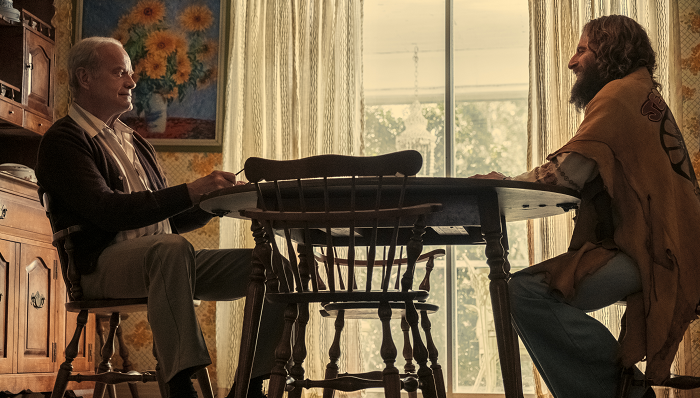
Image Courtesy of Lionsgate

Some within the Christian ranks have celebrated the Jesus Movement as the last great “spiritual awakening”. Many have praised its use the culture to draw young people; how its anti-establishment roots helped redefine church services; and how it gave birth to today’s lucrative contemporary Christian music industry. Critics saw it as more of a cultural movement than a biblical one. And they noted its emphasis on signs and experience over doctrine and theology. There’s certainly no doubting which side the movie lands on.

“Jesus Revolution” is taken from megachurch pastor and producer Greg Laurie’s early experiences as a member of the Jesus Movement. It’s a well made, well directed, and well acted mixture of biographical, coming of age, and faith-based elements. The “based on a true revolution” story (written by Erwin and Jon Gunn) covers a lot of ground and does so by focusing on three key characters: Greg Laurie (played by Joel Courtney), Chuck Smith (Kelsey Grammer), and Lonnie Frisbee (Jonathan Roumie).

The film opens in 1968, a time when you couldn’t turn on your radio or television without hearing about the growing peace-and-love hippie movement bursting out of San Francisco’s Haight-Ashbury district and across Southern California. It’s here that we meet a young Greg Laurie who lives in Newport Beach with his hard-drinking and hard-living mother (Kimberly Williams-Paisley). Greg gets a good taste of hippie culture after meeting and falling for a spirited and beautiful girl named Cathe (a terrific Anna Grace Barlow).

Meanwhile, Pastor Chuck Smith has watched his Costa Mesa church’s numbers dwindle down to a faithful few. His first inclination is to blame the culture, specifically the shaggy-haired, barefoot, drugged-out hippies who are all over the news. But when Chuck meets a traveling hippie street-preacher named Lonnie Frisbee, he’s immediately captivated by what he hears. He invites Lonnie and some of his Jesus-loving friends to his church. Of course it initially upsets Chuck’s congregation who the movie paints as a bunch of old starched and stuffy squares. But soon the church is drawing hippie youth from all around, including Greg and Cathe.

Image Courtesy of Lionsgate

The movie’s blinding affection for the Jesus Movement ultimately shapes how it’s portrayed. The filmmakers don’t offer any real critique and there’s certainly not much interest in a biblical assessment. It even comes through in their treatment of the real-life characters, most notably Lonnie Frisbee. He was undoubtedly a central figure in the Jesus Movement but also a complicated one. The movie touches on some of his later missteps but dodges the more controversial parts of his life.

But despite its obvious lean, “Jesus Revolution” still makes for an diverting look at a more recent slice of America’s spiritual and cultural history. The impressive production value, costume design, and needle-drops create a vibrant and authentic late 60s and early 70s atmosphere (although I did chuckle at a character in 1968 singing along with a song that actually came out in 1970). And there are moments that inspire, both spiritually and socially. There’s a good chance it’ll speak to those whose faith needs recharged or to those who simply need a reminder that people from different camps can come together in meaningful ways. Now there’s a message that we certainly need today. “Jesus Revolution” is out now in theaters.

VERDICT – 3.5 STARS

REVIEW: “Devil’s Peak” (2023)

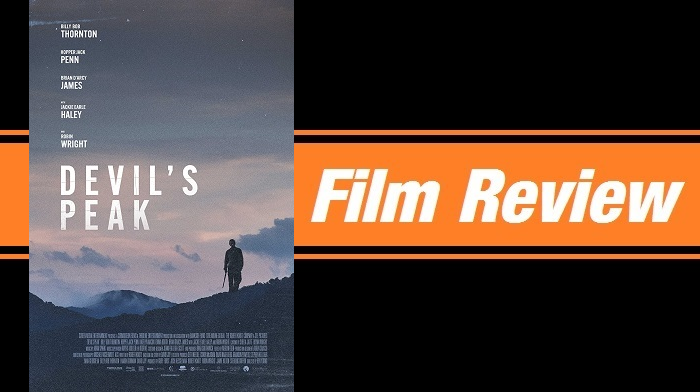
Based on the novel “Where All Light Tends to Go” by David Joy, “Devil’s Peak” is a modest crime thriller set in poverty-stricken, drug-infested rural Appalachia. It’s not the first movie to examine this troubled yet compelling region in the Eastern United States, but director Ben Young and screenwriter Robert Knott have some interesting pieces to work with. Unfortunately the material is plagued with overly simple story beats, thinly sketched characters, and an inescapable air of familiarity.

The story takes place in Jackson County, North Carolina and the roles are filled by a solid ensemble. Hopper Penn plays Jacob McNeely, the son of a hardcore drug dealer named Charlie (Billy Bob Thornton) who has had the impoverished local community by the throat for years. Jacob runs an auto body shop which is really a front for the father’s drug ring. We learn Charlie has had his son selling crystal meth since he was nine-years-old. It’s the family business.

But Jacob has a decency inside that sets him apart from his father. It comes out in his affection for his troubled mother and Charlie’s ex-wife Virgie (Robin Wright). We also see it in his love for his girlfriend Maggie (Katelyn Nacon) who is about to go to college in Wilmington. She’s the daughter of a crooked politician (Brian d’Arcy James) who’s not too keen on his daughter’s choice of a boyfriend. Jackie Earle Haley chips in as the local sheriff named Dwight while Emma Booth plays Charlie’s live-in girlfriend Josephine.

Much of “Devil’s Peak” focuses on the dysfunctional family tension between Jacob, Charlie, and Virgie. To no surprise Thornton, with his shaved head and bushy jet-black goatee, has no trouble playing a vile and irredeemable menace. It’s an effective performance that’s a little cartoonish but fittingly repellent. Wright brings more nuance, playing a junkie trying to overcome the mistakes of her past. Sadly Wright is dealt a bad hand and isn’t given much to work with. Penn isn’t quite as convincing. As Jacob struggles to get out from under his family name, Penn struggles to earn our empathy. His somewhat muted performance isn’t able to muster the excitement or emotion that the character and the movie needs.

“Devil’s Peak” could have taken its characters in a number of interesting directions. Instead it plays it safe, telling a story that follows its one trajectory to the very end. And despite the commitment of the cast, even the characters crumble under the weight of formula. To its credit, Young’s pacing ensures it’s never boring. But with so little under its Southern Gothic exterior, it’s hard to find much to get excited about. “Devil’s Peak” is now available on VOD.

VERDICT – 2 STARS

New to Home Video: “Training Day” 4K ULTRA HD

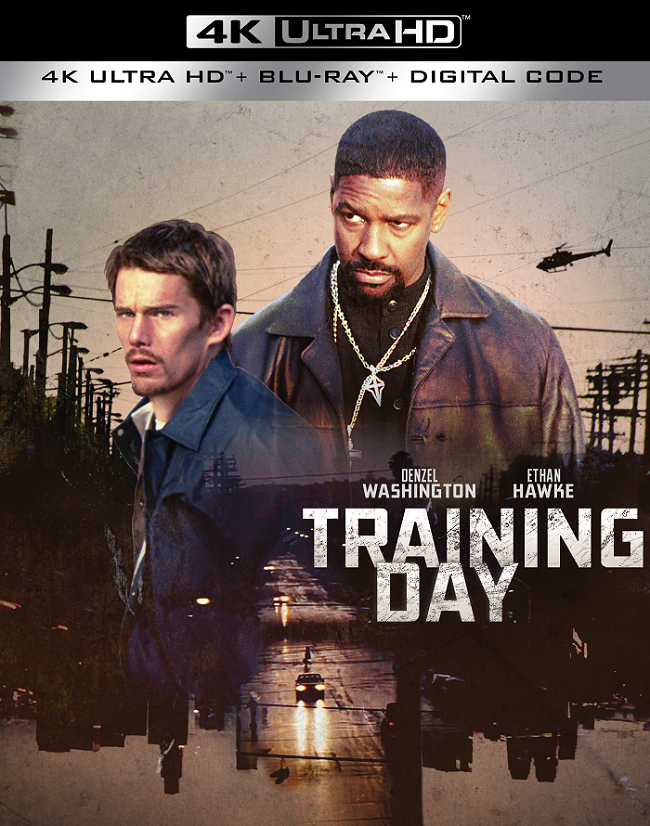
Led by Academy Award winner Denzel Washington and Academy Award nominee Ethan Hawke, “Training Day” comes to home video in a new 4K UHD combo-pack courtesy of Warner Bros. Discovery Home Entertainment. Now over 20 years old, this critically acclaimed crime thriller still boils with the same edge-of-your-seat intensity. It remains director Antoine Fuqua’s best film to date, and is among the best performances in the brilliant careers of both Washington and Hawke.

This new 4K Ultra HD edition of “Training Day” hits shelves FEBRUARY 28, 2023. See below for a full synopsis and breakdown of the bonus features.

OFFICIAL SYNOPSIS:

Year: 2001

Rating: R

Runtime: 122 Minutes

Director: Antoine Fuqua

Starring: Denzel Washington, Ethan Hawke, Scott Glenn, Eva Mendes, Cliff Curtis, Raymond Cruz, Noel Gugliemi, Dr. Dre, Peter Greene, Snoop Dogg, Nick Chinlund, Jaime P. Gomez, Macy Gray, Tom Berenger, Raymond J. Barry, Terry Crews, Denzel Whitaker, Charlotte Ayanna, Harris Yulin

About the Film:

Denzel Washington delivers an Academy Award-winning performance opposite Ethan Hawke in this gritty drama set in the morally ambiguous world of undercover police work. Every day a war rages between drug dealers and cops on the streets of America’s inner cities. With every war come casualties, none greater than 13-year veteran Los Angeles narcotics officer Alonzo Harris (Washington), whose questionable methods blur the line between legal and corrupt. Today Alonzo gets a new partner, idealistic rookie Jake Hoyt (Hawke), and Jake has one day–and one day only–to prove his mettle to his fiercely charismatic superior. Over 24 hours, Jake will be dragged into the ethical mire of Alonzo’s logic as both men risk their careers and their lives to serve conflicting notions of justice.

BONUS FEATURES

“Training Day” Ultra HD Blu-ray contains the following previously released special features:

•           Pharoahe Monch’s “Got You” music video

•           Nelly’s “#1” music video

•           Deleted Scenes

•           Commentary by director Antoine Fuqua

•           Training Day: Crossing The Line Featurette

•           Alternative Endings

RETRO REVIEW: “Chinatown” (1974)

Revisiting “Chinatown” for the first time in years was like digging up a decades-old time capsule and rediscovering everything inside as if it were the first time. I’ve always appreciated “Chinatown”, but perhaps not quite like I should have following my first watch back in the early 1990s. It wasn’t until a second viewing some 15 (ish) years later that the movie really clicked for me. Since then my appreciation has only grown.

I was inspired to rewatch “Chinatown” following the recent release of Sight and Sound magazine’s “Greatest Films of All Time” poll. For those unfamiliar with it, the poll has been taken every ten years since 1952. A select group of film critics and industry insiders are asked to vote for the ten greatest movies of all time. It has generally been a highly regarded poll partly due to the exclusivity of its voting body. But last year brought both controversy and skepticism, with S&S boosting its voters to 1,639 hand-picked participants (there were 145 in the 2002 poll; 846 in 2012). Naturally it resulted in some big changes to list.

But I didn’t revisit “Chinatown” because of its prominent place on the S&S list. No, instead it was because the landmark 1974 classic was booted from the list entirely. On the surface it seems like a mind-blowing omission and a real shock to the poll’s credibility (“The Godfather Part II”, “Rio Bravo”, “Raging Bull” and others also got the boot). So I fired up the film to see if something had changed. Nope, it still hits every mark and impressed me more this time than during any of my previous viewings. Sorry Sight and Sound. You got this one wrong.

Image Courtesy of Paramount Pictures

“Chinatown” comes from director Roman Polanski, a blemish that alone probably cost the film several votes. But the pure quality of the movie itself stands on its own. As does the exceptional Oscar-winning screenplay from Robert Towne. As does the cool and charismatic lead performance from Jack Nicholson – arguably the best of his career. As does the stellar supporting work from Faye Dunaway and John Huston. As does the period set design and costumes. As does Jerry Goldsmith’s transporting score. I feel like I could go on and on.

Set in 1937 Los Angeles, Nicholson plays a private detective named J. J. “Jake” Gittes. One afternoon a woman (Diane Ladd) identifying herself as Evelyn Mulwray comes to his office. She suspects her husband, Hollis Mulwray (Darrell Zwerling), is having an affair and she wants Gittes to find out. He takes the job and upon investigating learns that Mulwray is the chief engineer at LA’s Department of Water and Power. Gittes starts tailing Mulwray, eventually snapping some photos of him with a young woman – photos that mysterious end up in the newspaper.

The next day Gittes is confronted by the real Evelyn Mulwray (Dunaway) who hits him with a lawsuit. Steamed that he’s been used by someone to disgrace Hollis Mulwray, Gittes and Evelyn cut a deal. He’ll find out who set up her husband, and she’ll drop the lawsuit. Seems simple enough, but of course it’s not. What started as an infidelity case soon gives way to lies, city corruption, and (as in most good noirs) murder. Even worse, there’s something far more sinister underneath it all.

For lovers of classic noirs, watching “Chinatown” is like putting on a soft warm sweater. It fits snugly within the bygone genre and feels right at home next to the many films that undoubtedly inspired it. Yet Polanski and Towne add their own special seasoning which makes this more than just a copy-and-paste experience. Much of it is in the way Polanski plays with POV or how he shoots his sun-baked Los Angeles (DP John A. Alonzo received an Oscar nomination). But it’s also evident in Polanski’s willingness to tinker with genre conventions, to the point that we’re never certain where he’s taking us.

Image Courtesy of Paramount Pictures

Then you have Towne’s absorbing screenplay. It has a few signature noir movie twists with everything being revealed at the very end (Interestingly, Polanski added some grit to the ending, changing it up in a way that initially frustrated Towne. Later, Towne would admit that Polanski’s climactic finish was the right choice). But there is so much more to Towne’s dense and complex story. He offers a deep and compelling spin on the California Water War and all the political deception and chicanery that went with it.

Towne also does some incredible character work. Written specifically for Nicholson, Gittes is a cynical wisecracking sleuth but with an uncommon sense of decency at his core. Dunaway’s Evelyn is an elegant and high-class femme fatale who does her best to hide her fragility. And of course there’s the devilishly good John Huston playing Evelyn’s wealthy and powerful father, Noah Cross. Towne fleshes them all out through his crackling dialogue and his patient attention to detail. They all have roles to play within his winding story, but they are also given plenty of room to develop.

“Chinatown” spends a lot of time covering a lot of ground, yet it’s surprisingly efficient. There’s simply no wasted scenes, no meaningless lines, and no throwaway moments. And while the disgraced director’s vile, post-“Chinatown” offenses undoubtedly hang over his work, there’s a richness to Polanski’s direction, and I love how he entrusts his audience to follow along. In the end, every facet of great filmmaking can be found in “Chinatown”. And I’m sorry to say it, but it’s hard to take a “Greatest Films of All Time” list seriously that doesn’t include this 1974 classic.

VERDICT – 5 STARS

REVIEW: “At Midnight” (2023)

(CLICK HERE to read my full review in the Arkansas Democrat-Gazette)

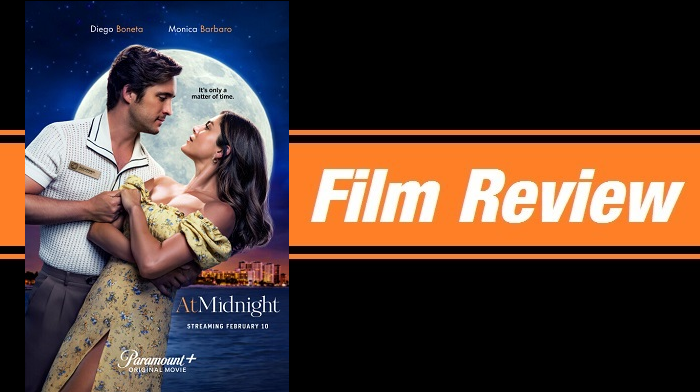
Directed by Jonah Feingold, “At Midnight” can never quite break out of its rom-com mold. It employs nearly every genre trope in the book and ends exactly where and how you expect it to. But that’s not to say there isn’t some enjoyment to be had. Feingold does a good job tapping into the chemistry between his two leads. And the script (written by Feingold, Maria Hinojos, and Giovanni M. Porta) takes some light but effective jabs at Hollywood politics. And its lead, Monica Barbaro (“Top Gun Maverick”) should be a star on the rise and she makes it easier to look past some of the film’s more frustrating shortcomings.

Barbaro plays Sophie Wilder, an actress preparing to shoot the third film in the popular superhero trilogy “Super Society”. But things get complicated after she walks in on her obtuse co-star and boyfriend Adam (Anders Holm) cheating on her. Sophie’s antsy manager Chris (Casey Thomas Brown) and her outspoken agent Margot (Whitney Cummings) push her to keep the scandal under wraps, fearing the sudden breakup of Hollywood’s ‘it’ couple would be a publicity nightmare for their upcoming film. Needless to say it adds a little stress to the scheduled press tour.

Image Courtesy of Paramount+

Soon Sophie is off to shoot the movie in Mexico, accompanied by her free-spirited comic relief best friend Rachel (because most rom-com best friends have to be free-spirited comic relief). She’s played by comedian Catherine Cohen who delivers a handful of good laughs despite being handcuffed by an all-too-familiar stock character archetype. Upon arriving at their deluxe hotel, Sophie meets Alejandro (Diego Boneta) in the most rom-com of ways (you’ll know what I mean when you see it). He’s a good-looking junior manager working in guest relations with big dreams of opening up his own hotel.

I doubt it’ll surprise you where things go from there. Sophie and Alejandro start off at odds with each other only to soon fall in love. But of course there has to be some tension. For Sophie it’s the studio’s wish to hide her split with the buffoonish Adam. For Alejandro it’s the hotel’s strict rules against employees hooking up with guests. It all leads to some late-night sneaking around and some comic close-calls. To Feingold’s credit he never overdoes the hijinks. What humor we get doesn’t always land, but at least we aren’t drowned in it.

Things inevitably get a little syrupy at the end which should surprise no one. But in a way it’s hard to hold that against Feingold and his film. While I may wish it had something more original to offer, there’s a specific crowd expectation that comes with a movie like this. Feingold and company set out to meet that expectation, and I’m betting there’s a very specific audience who will leave “At Midnight” plenty satisfied. It also serves as another highlight for Monica Barbaro who is good throughout and routinely elevates the material she’s given. “At Midnight” is now streaming on Parmount+.

VERDICT – 2.5 STARS

RETRO REVIEW: “Mister Scarface” (1976)

“Mister Scarface” is very much a movie of its time. Inevitably some will read that as a criticism, and I understand why. Movies don’t always age well,. But it also seems that people’s ability (or in many cases willingness) to not only see past but admire a movie’s limitations, especially among today’s younger audiences, has waned. That’s a shame. But for anyone who loves genre history, genre filmmaking, and genre storytelling, there’s much to enjoy in this breezy Italian poliziottesco noir.

Poliziotteschi (also called Euro-crime and spaghetti crime) movies were born out of a consummation between the violent French crime films of the late 1960s, the quick rise of exploitation flicks, and the resurgence of mobster movies. They were also heavily inspired by Italy’s real-life political and social turmoil of the day. Cynicism and frustration was prevalent, and many filmmakers chose to express it in their work. Among them was director and screenwriter Fernando Di Leo.

“Mister Scarface” came near the end of Di Leo’s feature film career yet it very much falls in line with many of his previous crime movies. Written by Di Leo and Peter Berling, the story follows Tony (Harry Baer) who collects protection movie for a local mob ran by Don Luigi Cerchio (Edmund Purdom). Tony has grown tired of the small-time work. He’s ready to earn some real dough so that he can realize his dream of moving to Rio de Janeiro and living high with his brother Ric (Al Cliver).

After a powerful rival mob boss, known by the moniker Mister Scarface (a movie-stealing Jack Palance), knowingly cuts Luigi a hot check to cover his gambling losses, Tony sees an opportunity. While Luigi is hesitant about confronting Scarface, Tony convinces his boss to give him a shot, hoping it will move him up the gang’s ladder. He recruits Ric and Napoli (Vittorio Caprioli), one of Luigi’s enforcers. But rather than winning the boss’ trust, the trio puts Luigi in Scarface’s crosshairs which ends up triggering a violent mob war.

It may sound pretty by-the-book, but Di Leo packs quite a bit into the film’s taut 98 minutes. Minus a giggle-worthy exception or two, the script is pretty crafty in the way it immerses us into its Italian gangland. It’s done through a propulsive story that throws a few twists our way as it steamrolls towards an action-fueled showdown in an old abandoned slaughterhouse. It’s such a well-conceived and well-executed climax.

But Di Leo immerses us most through his characters. While none of them can be deemed “good people”, Di Leo’s affection for them is evident and infectious. Before long we find ourselves sympathetic towards this guy or rooting for that guy. Of course this is a gangster flick meaning many of them are going to die. And in several cases (to Di Leo’s credit) we actually care. A few really good performances help. Some of the acting is shaky (at best). But we get especially strong work from Purdom, Caprioli, and of course Jack Palance who exudes gravitas, swagger, and menace.

Admittedly, there are a few unintentionally funny bits that I couldn’t help but laugh at. Take Tony riding around the city of Rome in a red dune buggy (one that immediately called to mind memories of Hanna-Barbera’s Saturday morning cartoon “Speed Buggy” from the 70s). Not sure why they went with a dune buggy in the big city, but ok. And then there’s Tony’s fighting which is a funky mix of karate and interpretive dance. And his goofy banter doesn’t help.

Without question, the movie’s age and budget bleed through (in some instances more so than others). But in terms of genre and the filmmakers who helped shape them, “Mister Scarface” has all the savory poliziotteschi ingredients. It’s certainly not Fernando Di Leo’s best film, and it’s tame next his other mob movies such “The Boss” and “The Italian Connection”. But it’s such a fun watch, especially for those who not only recognize the history of genre filmmaking, but who also celebrate it.

VERDICT – 3.5 STARS