REVIEW: “The Hand That Rocks the Cradle” (2025)

“The Hand That Rocks the Cradle” is a new Hulu streaming exclusive that may sound familiar to viewers of a certain age. That’s because it’s a remake of the 1992 Curtis Hanson directed film of the same name which starred Annabella Sciorra and Rebecca De Mornay. The original wasn’t a particularly great film, but it was an entertaining domestic thriller despite its silliness. This new spin on the story doesn’t fare quite as well.

Directed by Michelle Garza Cervera and written by Micah Bloomberg, this new iteration of Amanda Silver’s 1992 screenplay uses the basic framework of the original film but surrounds it with a considerably different and less convincing story. It’s enough to set the movie apart from its inspiration. But it’s mostly a drab contemporary reimaging that relies too much on the incompetence of characters and the willingness of audiences to go along no matter how frustrating things get.

Image Courtesy of 20th Century Studios

The film stars a committed Mary Elizabeth Winstead who squeezes what she can out of her character. She plays Caitlin Morales, a successful Los Angeles attorney who has just given birth to her second daughter. The tightly wound Caitlin and her remarkably dense husband Miguel (Raúl Castillo) live comfortably in a swanky suburb where the only real inconvenience are speeding cars and the need of a stop sign.

Caitlin is set to return to work while hoping to avoid another poorly defined post-partum episode like the one that followed the birth of her first child. To help, Caitlin and Miguel decide to hire a nanny to help watch their 10-year-old Emma and newborn Josie. They decide on Polly Murphy (Maika Monroe), a former client at Caitlin’s firm who impresses Caitlin with her knowledgeable of saturated fats and microplastics. Polly wastes no time ingratiating herself to the family, even earning an invite to move into their guest room.

Amazingly Polly’s hushed intensity and ice-cold demeanor doesn’t set off warning sirens. Instead, she gains Caitlin and Miquel’s full trust. Of course we know immediately that she’s up to no good and is not the person she claims to be. We watch as Polly secretly breaks Caitlin’s rules to win the children’s affection and methodically works on turning Emma against her mother.

Image Courtesy of 20th Century Studios

It takes a while before Caitlin finally grows suspicious but she gets no support from the oblivious Miguel who couldn’t see light if he were staring into the son. So we’re left to watch an hour of endless gaslighting as Polly pushes Caitlin over her psychological edge. It’s here that the frustration sets in as the movie becomes a near endless cycle of Polly’s ruthlessness, Caitlin’s suffering, and Miguel’s mind-boggling incognizance. Meanwhile any hint at a motive for Polly’s actions is stashed away until late in the movie when any chance at building suspense is gone.

Many of the movie’s wild swings at modernizing the story come off as thematically lazy. Look no further than its bungled attempt at addressing childhood trauma. Even more surprising is the lack of genuine tension, especially in a movie with this kind of premise. The pace does finally pick up as the movie races towards a payoff. But even then, the rush of final act reveals is too little too late. “The Hand that Rocks the Cradle” is streaming now exclusively on Hulu.

VERDICT – 2 STARS

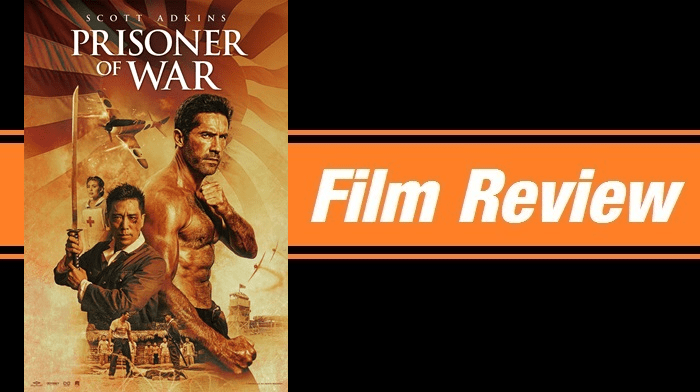
REVIEW: “Prisoner of War” (2025)

Back in the 1980s there was a wave of Vietnam War era action movies that focused on the P.O.W. experience. They included such poppy franchise flicks as “Missing in Action” and “Rambo: First Blood Part II”, smaller star-driven films like “Uncommon Valor”, and more obscure Cannon Group titles like “P.O.W. the Escape”. I admit to endlessly absorbing these movies as a kid, repeatedly renting them on VHS from our favorite video store.

The vanilla titled “Prisoner of War” hearkens back to those movies of old, proudly possessing many of their strengths and weaknesses. The film does distinguish itself in one key way – rather than Vietnam, its story is set in Japan during the waning days of World War II. It’s directed by Australian actor turned director Louis Mandylor and written for the screen by Marc Clebanoff. It stars English actor and martial artist Scott Adkins who also originated the story.

Image Courtesy of Well Go USA Entertainment

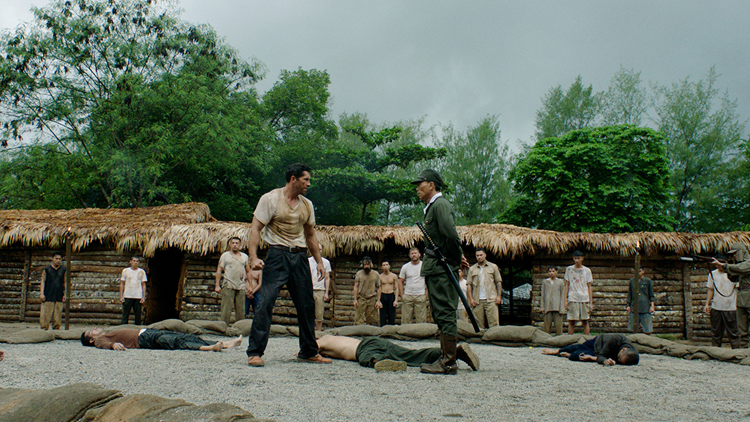
Adkins plays James Wright, a Wing Commander in the Royal British Air Force. In April of 1942, his plane is shot down while carrying out a mission over the Bataan Peninsula in the Philippines. Wright survives but is quickly captured and taken to a Japanese prison camp ran by Lieutenant Colonel Ito (Peter Shinkoda). After evading an attempted execution, Wright gains the attention of Ito who pits him in a series of fights against the Colonel’s best warriors. For Wright, they are fights for survival. For Ito, it’s the opportunity to publicly strip his prisoner of his honor.

When not fighting, Wright is on work detail where he gets to know the other POWs. They’re a mostly generic group of captives with only a handful of them sketched enough to stand out. They’re led by an American, Captain Collins (Cowboy Cerrone) who’s light of personality but heavy on brawn. Other prisoners such as Sergeant Villanueva (Michael Copon) and Beard (Michael Rene Walton) get a little to do. But most are faceless fodder to be killed at certain intervals to show Ito means business.

The same can be said for the Japanese soldiers. Aside from Ito, there is the short-tempered Captain Endo (Masanori Mimoto) who bullies his way to an evitable showdown at the end. And there’s the woefully underdeveloped Hiroshi (Atsuki Kashio) who is sympathetic to the prisoners and their plight. The rest of the soldiers are little more than faceless targets for Wright and company to take out. The movie attempts to add more humanity via a kindly nurse named Theresa (Gabbi Garcia). But she too is trapped in a fairly shallow supporting role.

Image Courtesy of Well Go USA Entertainment

Overall the story follows a fairly conventional blueprint, finishing off with a predictable big escape that goes exactly as we expect. Along the way there are a few references to the greater war and more specifically the Bataan Death March. But it’s never enough to add much weight. And it’s all bookended by two post-war scenes of Wright seeking some closure. But most of the storytelling revolves around the dynamics at play within the camp.

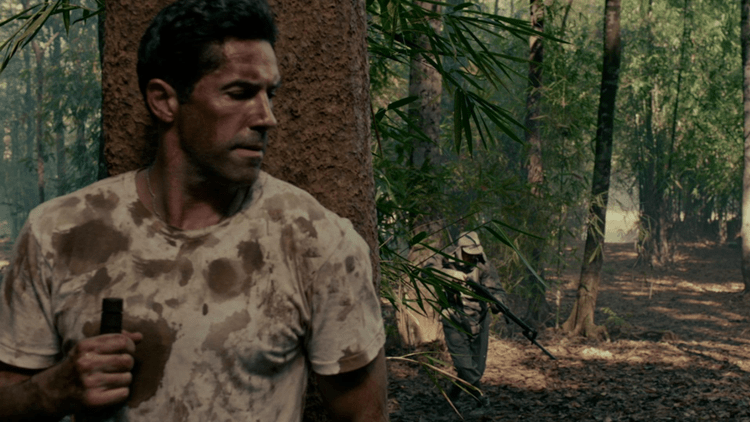
While “Prisoner of War” may struggle in the narrative department, it excels with the action, especially the well-choreographed and deftly shot fight sequences. Adkins is a formidable martial artist and a convincing presence in front of Mandylor’s camera. The director locks onto the action rather than chopping it to death with quick cuts. Meanwhile the hard-working Adkins does most of the heavy lifting, impressively kicking and punching life into this serviceable throwback action movie.

VERDICT – 2.5 STARS

REVIEW: “Shaman” (2025)

Director Antonio Negret effectively explores the cultural clash of spiritual beliefs and less effectively observes the impact of colonialism in his new feature “Shaman”, a supernatural horror film penned by his brother, Daniel Negret. Their collaboration is both beautiful and terrifying, with the brothers using horror’s well-traveled possession subgenre as a means of examining its bigger and more specific themes.

The story is set in a remote part of Ecuador where a well-meaning Catholic missionary family have come to minister to the indigenous locals under the direction of a local priest, Father Meyer (Alejandro Fajardo). Candice (Sara Canning), her husband Joel (Daniel Gillies), and their teenage son Elliot (Jett Klyne) have jumpstarted a school, they offer medicines to the sick, and provide warm meals to those in need.

Image Courtesy of Well Go USA

But things take a sinister turn after Elliot ventures into a nearby cave despite the warnings of some local kids. He inadvertently breaks a seal that unleashes a malicious spirit which is later identified as Supay, the God of Death. Unknowingly possessed by the evil Supay, Elliot returns home. But it’s not long before Candice begins noticing her son acting unusual. To no surprise his actions progressively get more disturbing, from disappearing in the middle of the night to throwing up blood (among other things).

Adding to the eeriness is a creepy old shaman (Humberto Morales) who takes an immediate interest in Elliot. The devout Candice wants no part of the shaman or his unsettling rituals. But his repeated presence raises concern. Is he someone who can help and can he be trusted? Or is he and his black magic the root cause of Elliot’s condition? That mystery plays a big part of the film’s second half. As Elliot’s condition worsens, a troubled Candice feels more helpless and the shaman’s presence grows more peculiar.

Image Courtesy of Well Go USA

“Shaman” is not for the squeamish. In addition to the strange totems, animal sacrifices, and creepy occult rituals, there is no shortage of graphic and squirm-worthy images to make you uncomfortable. Bleeding eyes, burning skin, cracking bones, scorpions. The movie throws in a variety of genre conventions plucked from all kinds of past possession movies. That inevitably strips away some of the tension for fans who have seen it all before. But the setting remains interesting even when the scares aren’t quite hitting their marks.

Thematically, the movie takes some swings at religion and colonialism through the clash between the family’s firm Catholic beliefs and the local culture. Meanwhile we get a slow drip of revelation that hints at past family troubles. But within the bounds of the story neither are explored in enough detail to matter much. Still “Shaman” manages to get under your skin just enough to be effective. And familiar possession tropes aside, the film does things with its unique setting to give the story its own distinct identity.

VERDICT – 3 STARS

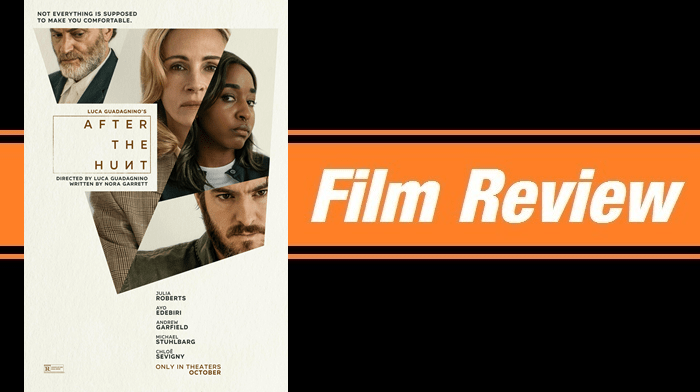
REVIEW: “After the Hunt” (2025)

Luca Guadagnino puts aside some of his usual preoccupations in his latest feature “After the Hunt”. Known for his provocative fixations on sensuality, desire, and obsession, the enigmatic filmmaker can often get hung up on his own interests to the detriment of his characters and storytelling. There are remnants of that in “After the Hunt”. But it mostly feels like an interesting departure for Guadagnino, although one not without its own self-induced problems.

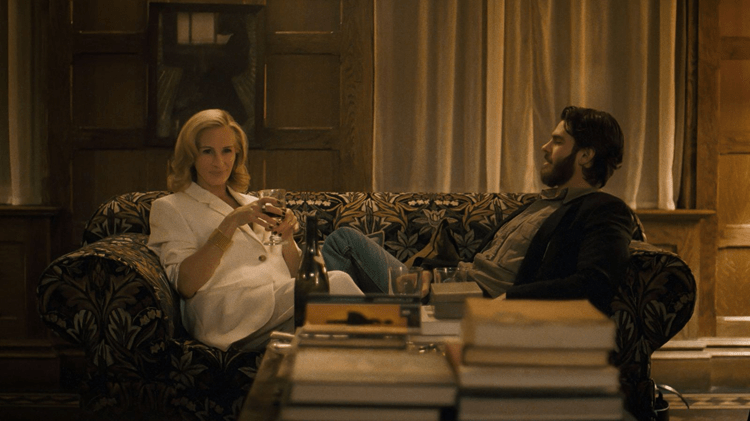
Guadagnino amasses a compelling ensemble led by Julia Roberts who’s given her most savory role in years. She plays Alma Imhoff, a highly regarded philosophy professor at Yale University. Alma is a complex woman of stature in the world of male-dominated academia. From one angle she’s an intimidating and impenetrable intellectual who relishes being the center of attention. From another angle she’s a troubled woman concealing her personal pain and bottling up anything resembling emotions.

Image Courtesy of Amazon MGM Studios

Alma’s tightly self-controlled world is shaken after her student and protégé Maggie Resnick (Ayo Edebiri) accuses Alma’s colleague and close friend Hank Gibson (Andrew Garfield) of sexual assault. The alleged transgression happened after a dinner party at Alma’s home. Hank admits to Alma that he walked Maggie home and even went up to her apartment for a nightcap. But he fiercely denies he assaulted Maggie.

There are dubious layers to Alma and Hank’s relationship that raises a number of questions. Professionally, both are pillars in the university’s philosophy department and they are the two finalists for the school’s lone tenure spot. Away from work they are uncomfortably close, to the point of kindling suspicions in Alma’s passive yet internally frustrated husband Frederik (played by a perfectly tuned Michael Stuhlbarg).

Alma’s relationship with Maggie proves to be equally complex but for much different reasons. She enjoys Maggie’s adoration and takes pride in being considered a mentor. But the two immediately clash over how to handle her accusations. Alma’s view is shaped by her own history, especially within the patriarchal construct. It causes her to be cold and unsympathetic, often thinking more about self-preservation and consequences than condemnation. Maggie shamelessly hides her real self behind various marginalized identities. In reality she’s dishonest, opportunistic and manipulative which quickly calls her credibility into question.

Guadagnino and screenwriter Nora Garrett make Alma their focus, following the character as she navigates the #MeToo minefield between the untrustworthy Maggie and the boozy flirt Hank. As they do, the filmmakers sling us into a thematic whirlwind of power dynamics, victimization, privilege, academia, support systems, culture shifts, and generational divides. Their storytelling strikes a peculiar balance between empathizing with Ivy League elites and excoriating them. But make no mistake, the film’s overall tenor ranges from morally murky to downright dastardly, with only a few measures of grace sprinkled in.

Image Courtesy of Amazon MGM Studios

Guadagnino and Garrett forsake ‘nice and tidy’ for something that challenges audiences willing to engage with the film on its own terms. There is an intentional ambiguity woven throughout the story that forces us to reckon with our own perceptions. Yet a later scene nearly undercuts that aim as Guadagnino seems to tip the scales in one direction. It’s a frustrating inclusion that obstructs the filmmaker’s intentions without fully derailing them.

“After the Hunt” is a technically savvy and narratively enthralling drama, anchored by awards-worthy performances from Roberts, Garfield, and Stuhlbarg, while offering a bold take on a sensitive subject that sparked a cultural flashpoint. The movie isn’t without flaws, such as a key plot point hinging on an absurd moment of pure happenstance. And an ending that leaves us questioning some things more than wrestling with them. Still Guadagnino impresses with his latest – an intelligent and guileful feature that’s both riveting and challenging.

VERDICT – 3.5 STARS

REVIEW: “Black Phone 2” (2025)

Scott Derrickson’s 2021 horror gem “The Black Phone” left a mark with its sinister tone and edge-of-your-seat suspense. But its ace in the hole was Ethan Hawke who took on a role unlike any other in his brilliant forty-year career. Hawke played The Grabber, a serial killer and child abductor who terrorized the residents of a Denver suburb. Hawke lost himself in the character and delivered a horror movie antagonist that was both chilling and fascinating.

Derrickson returns to direct and rejoins C. Robert Cargill in writing the script for “Black Phone 2”, a sequel set four years after the events of the first film. Even more exciting, Ethan Hawke returns as The Grabber who (and this may be a spoiler for series newcomers) was killed at the end of the first film. But Derrickson and Cargill have created a surprisingly compelling angle to bring their villain back, and they manage to extend the original story in a unique and effective way.

“The Black Phone” drew its inspiration from a 2005 short story by Joe Hill. It laid the groundwork for the unexpected narrative twists of “Black Phone 2”. Set in 1982, the sequel continues the stories of brother and sister Finney and Gwen Blake (played by the returning Mason Thames and Madeleine McGraw). Now 17-years-old, Finney has tried burying his trauma since grabbing headlines as the lone survivor of The Grabber’s murder spree.

Image Courtesy of Universal Pictures

But the movie is most interested in Finney’s kid sister Gwen, whose mysterious power (or curse) played a big part in the first movie. Gwen’s clairvoyance is manifested in dreams that she doesn’t fully understand. Lately they’ve been horrifying nightmares where she witnesses the brutal murders of three young boys. There is also the piercing rings of a black rotary phone – a potential connection to The Grabber. Each new nightmare gets more vivid and more disturbing. And each points to Alpine Lake Youth Camp high up in the Rocky Mountains.

Desperate for answers, Finney, Gwen, and her wannabe boyfriend Ernie (Miguel Mora) head to Alpine Lake to investigate. Posing as counselors in training, the trio arrive in the middle of a blizzard and are greeted by a limited staff including the owner, Armando Reyes (Demián Bichir). While there, Gwen’s terrifying dreams intensify. They begin with horrific encounters with the three mutilated little boys. But soon it’s The Grabber himself, now a raging vengeful spirit with an ax to grind with Finney and Gwen.

Derrickson really leans into the added supernatural spin, taking an already dark and unnerving story and making it even more unsettling. Along the way, we’re treated to several intriguing connections and unexpected reveals, some of which change our perspective on the first film in some surprisingly clever ways. They tell us more about The Grabber’s violent history as well as Finney and Gwen’s family struggles.

The performances from the young stars are generally good although the script trips them up on occasion. This is especially true with McGraw who is routinely forced to blurt out 80s-inspired insults which sound more hokey than authentic. Otherwise both she and Thames meet the many demands of their roles. We also get good supporting turns from Bichir and Jeremy Davies as Finney and Gwen’s father, Terrence.

Image Courtesy of Universal Pictures

As for Hawke, aside from a few glimpses in a handful of early flashbacks, it’s nearly an hour before we see him as The Grabber. And once he appears he is every bit as chilling as before, lurking in the shadows of Gwen’s dreams while grimly uttering his lines with an ethereal menace. He’s a haunting presence with powers inspired by Freddy Krueger, but whose vengeful rage and sadism is far more serious and focused.

The movie makes a number of impressive choices, but some of the most effective involve its bold visuals. Derrickson shoots Gwen’s dream sequences using Super 8mm and 16mm, giving them a grainy old home video quality. Together with the crackle of static in the audio, it creates an eerie and dread-soaked atmosphere. It’s a very specific and potent visual choice that’s more than just a gimmick. And it stands out even more once Derrickson begins integrating it with the digital photography of the ‘real world’.

“Black Phone 2” is a terrific sequel that many of us didn’t know we needed. From its well-developed character arcs to its sinister set pieces, the movie uses every facet of filmmaking to make us squirm in our seats but also empathize with its characters as they navigate such common yet weighty themes as processing trauma, facing fears, family bonds, and the testing of faith. Admittedly the rules of ‘dreams versus reality’ aren’t always clear, especially in the final act. But it’s easy to look past such small gripes after considering the keen vision and first-rate execution of this worthwhile sequel that’s full of proud callbacks and original twists all its own.

VERDICT – 4 STARS

New on Home Video: “F1” on 4K Ultra HD + Digital

Warner Bros. Home Entertainment and Apple Original Films is bringing the high-octane summer blockbuster “F1” to home video. Fresh off directing two box office smash hits “Top Gun: Maverick” and “Twisters”, Joseph Kosinski helms this visually exhilarating yet character centered racing drama set in the world of Formula One. The film features an electric cast that includes Brad Pitt, Kerry Condon, Javier Bardem, and an eye-opening Damson Idris. This terrific home video edition vividly captures all the edge of your seat racing action that made this one of the must-see movies of the summer.

This 4K Ultra HD Blu-ray edition of “F1” includes a digital copy is available to purchase right now. See below for a full synopsis of the film as well as a list of special features.

About the Film:

Year: 2025

Runtime: 155 Minutes

Director: Joseph Kosinski

Screenwriter: Ehren Kruger 

Cast: Brad Pitt, Damson Idris, Kerry Condon, Tobias Menzies, Kim Bodnia, Javier Bardem, Sarah Niles, Will Merrick, Joseph Balderrama, Abdul Salis, Callie Cooke, Samson Kayo

Rating: PG-13 for strong language and violence

Dubbed “the greatest that never was,” Sonny Hayes (Brad Pitt) was FORMULA 1’s most promising phenom of the 1990s until an accident on the track nearly ended his career. Thirty years later, he’s a nomadic racer-for-hire when he’s approached by his former teammate Ruben Cervantes (Javier Bardem), owner of a struggling FORMULA 1 team that is on the verge of collapse.

Ruben convinces Sonny to come back to FORMULA 1 for one last shot at saving the team and being the best in the world. He’ll drive alongside Joshua Pearce (Damson Idris), the team’s hotshot rookie intent on setting his own pace. But as the engines roar, Sonny’s past catches up with him and he finds that in FORMULA 1, your teammate is your fiercest competition — and the road to redemption is not something you can travel alone.

Special Features:

“F1” 4K UHD and Blu-ray contain the following special features:  

  • Inside the “F1” Table Read (featurette) – 5:05
    • On June 19, 2023, the cast of F1 joined Director Joseph Kosinski and Producer Jerry Bruckheimer at Silverstone for a table read. As excitement and anticipation builds, the cast reminisce on the momentous occasion and reflect on their friendships.​
  • The Anatomy of a Crash (featurette) – 6:23
    • One of the most intense scenes in the film was loosely inspired by FORMULA 1 driver Romain Grosjean’s Bahrain crash in 2020. Take an in-depth look at how this technically challenging scene was filmed practically.​
  • Getting Up to Speed (featurette) – 5:00
    • Get the inside track on how Brad Pitt and Damson Idris became racing drivers. Lead driving choreographers Luciano Bacheta and Craig Dolby reveal the hard work and dedication that went into getting the cast behind the wheel and up to speed.​
  • APXGP Innovations (featurette) – 5:21
    • Each year, FORMULA 1 teams make serious engineering and technological advancements to their cars. The same can be said for the F1® crew, who worked hard across departments – sound, camera, RF, rigging, stunts and SFX – and found new ways to innovate.​
  • Making it to Silverstone (featurette) – 5:04
    • The first days of filming at the Formula 1 British Grand Prix 2023 at Silverstone took months, if not years, of planning and rehearsal of the Grid Walk and Formation Lap scenes. The goal: to shoot live without disturbing the integrity of the race.​
  • Lewis Hamilton: Producer (featurette) – 5:14
    • When Joseph Kosinski decided to make a film about the world of F1, the first person he called was 7-time World Drivers’ Champion Lewis Hamilton. Filmmakers discuss Hamilton’s value as a producer, how he influenced the script, his set visits and more!​
  • APXGP Sets and Locations Around the World (featurette) – 9:17
    • Welcome to the APXGP garage, designed to fit perfectly into the F1® paddock for filming across the globe. Go beyond the track to see how F1 teams McLaren, Williams, and Mercedes welcomed cast and crew into their factories and team facilities.​
  • APXGP and F1®: How it was Filmed (featurette) – 5:53
    • The cast and crew had one hour to film the exciting Red Flag sequence. As it was the climax of the film and the true culmination of the partnership between filmmakers and FORMULA 1, all 10 teams and cars flocked to the pit lane to participate!​
  • Sound of Speed (featurette) – 5:10
    • Join Hans Zimmer at AIR Studios for the first recording sessions of F1®’s epic score, with Jerry Bruckheimer joining the session to witness the magic. Zimmer reflects on his desire for the sound of the cars to influence the music of the orchestra.