REVIEW: “Wild Mountain Thyme” (2020)

THYMEposter

You’ll be hard-pressed to find a more enjoyable actress than Emily Blunt (Don’t believe me? Just watch some of her interviews). She instantly brings a certain smile-inducing energy to “Wild Mountain Thyme”, the new not-so-romantic dramedy from writer and director John Patrick Shanley. The film is based on Shanley’s Broadway play “Outside Mullingar” and it packs a handsome cast. But it digs itself into a hole so deep that neither the gorgeous Irish landscapes or Mrs. Blunt herself can dig it out.

For generations the Reillys and the Muldoons have lived side-by-side, their sprawling farms separated by stone fences, a few tree lines, and two very annoying gates. Through the years the old neighbors have had their share of spats. But these days it’s mostly playful jousting between the two widowed family heads, Tony Reilly (Christopher Walken) and Aoife Muldoon (Dearbhla Molloy). Both are in their 70s and both are aware that they’ll soon be the ones handing down their family’s properties.

THYME2

Image Courtesy of Bleeker Street

For Aoife it’s pretty cut-and-dried. Her more-than-capable daughter Rosemary (Blunt) will inherit and run their farm. On the Reilly side it’s a little more complicated. Tony has kept his son Anthony (Jamie Dornan) in Ireland with the promise that he’ll one day inherit their family’s land. But now the patriarch’s not so sure his shy and slightly oafish son is cut out to carry the Reilly family mantle. In addition to being a tad dense, Anthony has this unusual inability to let himself love and a general fear of happiness. It’s a quirk with Dornan’s character that grows more irritating over time.

The first half of the film plays around with the question of whether or not Anthony will get the farm. The second half is all about his incomprehensible relationship with Rosemary. Since they were children growing up on neighboring properties Rosemary has loved Anthony. And for some inexplicable reason she’s still waiting for the oblivious lunkhead to finally love her back. It puts Blunt in a tough spot. She’s shackled to a character who simply can’t move forward because her entire story arc hinges on Anthony snapping out of his fog.

Things shake up a little when Anthony’s pampered American cousin Adam (John Hamm) shows up. He’s a New York money manager who doesn’t quite understand the Irish’s ways (not that the movie represents them well) but he does set his eye on Rosemary. In reality he’s a flimsy and shallow character who’s only there to move the story to its inevitable finish. And in a weird way you may find yourself rooting for Adam. At least he gives Rosemary something to do other than miserably fawn over Anthony. Meanwhile Anthony mostly mopes around the farm and Dornan’s dry, sterile performance doesn’t do the character any favors.

THYME1

Image Courtesy of Bleeker Street

Yes the film eventually tries to explain Anthony’s built-in apprehension, but it culminates in a seemingly endless final 15 minutes which is funny considering how the rest of the movie races from point to point skimming over huge chunks of story. As for the much talked about Irish accents, this south Arkansas native is no expert, but some of them do seem….off. I mean I love Christopher Walken, but his shaky come-and-go Irish-ish accent is pretty entertaining (in the unintentionally funny sense).

The real shame of it is “Wild Mountain Thyme” has moments of real heart and humor. The sweeping Golden era score and the lush rolling scenery makes for a near magical setting. It ends up being a movie you want to root for. But it speeds through so much of the story, shortchanges so many characters, and relies so heavily on a truly annoying lead (sorry Mr. Dornan). It may pass for lightweight escapism for some, but I never could shake the feeling of disappointment. “Wild Mountain Thyme” releases December 11th in theaters and on VOD.

VERDICT – 2 STARS

2-stars

First Glance: “The Marksman”

NEESON

I first saw the trailer for “The Marksman” a few weeks ago at the theaters. I think it was in front of “Let Him Go”. Regardless, a new Liam Neeson action flick always catches my eye even if it’s built around a pretty corny premise and even if it features the gravelly-voiced Irishman sporting a hilariously bad southern accent. Actually approaching this as an unintentional light comedy has merits of its own.

Familiar elements abound in this latest revenge-fueled yarn. Neeson plays a rancher on the southern border who happens to be an ex-Marine sharpshooter (that’s sure to come in handy later). His quiet life is shaken when he witnesses a migrant mother and her young son running from a violent drug cartel. Of course he intervenes putting him in the gang’s crosshairs and forcing him to dust off his ‘particular set of skills’. It goes without saying the film looks to be treading some well-worn ground, but I’ll still be seeing it. What can I say, I have a soft spot for these Neeson romps.

“The Marksman” is set for a January 22nd theater release. Check out the trailer below and let me know if you’ll be seeing it or taking a pass.

REVIEW: “All My Life” (2020)

LIFEposter

You would be hard pressed to find a more wildly diverse group of films than the last four made by director Marc Meyers. In 2017 he made “My Friend Dahmer”, a biopic about serial killer Jeffrey Dahmer’s high school years. Next he made the blood-soaked horror-dark comedy “We Summon the Darkness”. And earlier this year he released “Human Capital”, a family drama, crime thriller, and mystery all wrapped into one. So what’s the fourth film you ask? Meyers’ latest is “All My Life”, a warm and fuzzy tearjerker. See, diverse.

“All My Life” (written by Todd Rosenberg) is based on the true relationship of Solomon Chau and Jennifer Carter. The film is carried by the expressive Jessica Rothe, a talented rising star with a pretty diverse resumé of her own. Here she plays Jenn, a young woman who has spent most of her life looking ahead but rarely living in the moment. Everything changes when she goes to a sports bar with friends and has that chance meeting of a lifetime (dramatic music swells) with Solomon (Harry Shum Jr.), a hunky amateur chef. The very next day the two go out for a jog, sparks fly, and off we go.

LIFE1

Image Courtesy of Universal Pictures

The first half of “All My Life” is a sweet and fairly grounded story of a young couple falling in love, moving in together, and setting their eyes on a future together. There’s a really nice chemistry between the two leads and a surprising amount of heart which makes them not only a likable couple but people we feel good about rooting for. Everything is ideal in these early scenes and they’re even shot with this radiant storybook glow. We get the tender romantic moments, some hip music, and eventually a flash mob marriage proposal sequence with enough cheese to clog every artery.

But then there’s the second half where their modern day romance is cut short after Sol is diagnosed with terminal liver cancer. It’s the flip-side of the story that we know is coming from the start. Meyers doesn’t go deep into the internal conflicts or dive into themes like mortality and fate. Instead he keeps it mostly on the surface, offering plenty of tissue-worthy moments while (thankfully) avoiding the annoying sap that you may get in a Nicholas Sparks flick. Meyers and Rosenberg make their film all about living. More specifically, about making the most out of the time you’re given.

null

Image Courtesy of Universal Pictures

With the help of their fun but nondescript group of friends, Jenn and Sol decide to go ahead with their wedding, determined to make every day they have together memorable. The film wisely doesn’t gloss over the bumps in the road. “People will see a widow in white,” Sol tells Jenn during one particularly dark and crushing scene. But the film mostly keeps its head up as the friends start a GOFUNDME account to cover expenses and help Jenn and Sol have the best wedding possible under the circumstances.

Despite its best efforts there are still those gooey moments that seem custom made for the movies rather than plucked from real life. But every time the film gets too close to schmaltzy Meyers is able to rein it back in. And while we could have learned more about their characters (does Sol even have a family???), there is an infectious charm to the young couple and this is a case of a film being helped by its ‘true story’ element. Sure it’s all pretty familiar and it misses opportunities to do something original. But it also avoids many of the usual trappings and has genuine heart, something quite honestly I wasn’t expecting. “All My Life” is now playing in theaters.

VERDICT – 3 STARS

3-stars

REVIEW: “Let Them All Talk” (2020)

TALKPOST

Steven Soderbergh’s latest “Let Them All Talk” is about as unconventional as they come. I’m not referring to the story or even the characters. It’s unconventional in the way the ever-experimenting Soderbergh made it. Filming lasted just under two weeks with the majority taking place on a cruise ship as it crossed the Atlantic full of actual staff and customers. Soderbergh shot the film himself with his own camera using natural lighting and with only sound equipment present. And the cast improvised most of the dialogue with Deborah Eisenberg’s screenplay serving as an outline rather an actual script.

The film is based on a short story written by Eisenberg about three old friends reconnecting and eventually opening up about hurt feelings from their past. It is directed, shot, and edited by Soderbergh and anchored by three charismatic veteran actresses. With its small budget and limited setting, the film is fully focused on its characters, heavily relying on their frequent and immensely talky interactions. Let’s just say the film is appropriately titled, but it works thanks to a game cast with the talent to pull it off.

TALK2

Image Courtesy of HBO Max

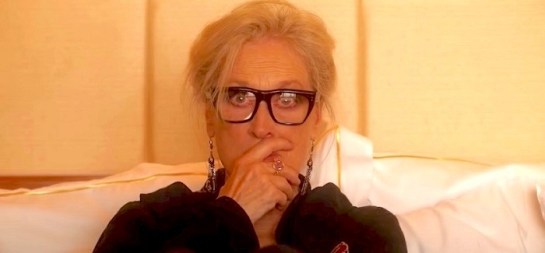
Meryl Streep plays Alice, a Pulitzer Prize winning writer who is set to win a major award from her peers. The problem is the ceremony is being held in England and she can’t fly. So her agent Karen (Gemma Chan) organizes a transatlantic cruise (oops, crossing) for her client. Karen has well-meaning motives of her own. With her boss breathing down her neck, she desperately needs to get details on Alice’s long-awaited next book. Her hopes are the cruise (errr, crossing) will give Alice time to finally finish her manuscript.

Alice agrees to go but her only condition is that she can invite some friends along. So she calls two old college pals she hasn’t seen in years in hopes of reuniting the “Gang of 3“. Both agree to come – Susan (Dianne Wiest), an easy-going women’s advocate from Seattle and the cash-strapped Roberta (Candace Bergen), a testy Texan who works in a Dallas department store selling lingerie. Alice also invites her nephew Tyler (Lucas Hedges), a university student in Cleveland. The final piece is Karen who secretly books herself a cabin to keep an eye on Alice and her writing progress.

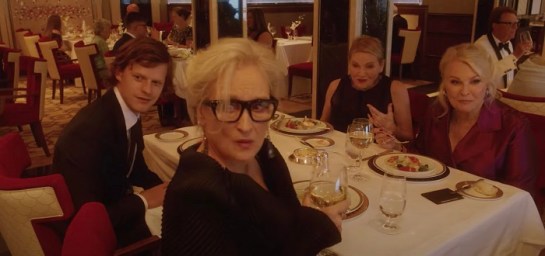
Each board the Queen Mary 2 traveling from New York to Southampton, each with their own hesitations and expectations for the trip. The tightly wound Alice, the even keel Susan, and the surly Roberta finally get together for dinner in what plays like an awkward first meeting more than a reunion of old friends. Over the course of the voyage each slowly begins to unwind over an array of fine meals, boards games, and strolls along the deck. But along with breaking the ice comes the resurfacing of old wounds in desperate need of healing.

Meanwhile Tyler becomes the semi-reluctant go-between. Karen wants Tyler to keep an eye on Alice. Alice wants Tyler to keep tabs on her two friends. Roberta has Tyler running background checks on potential rich suitors, and so on. And Soderbergh often uses Tyler as our eyes and ears, observing finer details in conversations as well as noticing particularly usual behavior. For example who is that strange man who exits Alice’s room every morning at the same time?

TALK1

Image Courtesy of HBO Max

The performances are strong especially from the three vets who bring plenty of personality to their roles. Only Hedges has trouble with the improvisation, occasionally struggling to find his words. Some of his more dialogue-heavyscenes have a strange reality show feel to them, which I guess in a movie like this could be either a compliment or a criticism. I found it a little distracting.

There are stretches when “Let Them All Talk” loses any sense of progression either for the story or its characters. It simply stalls, heavy with conversations that do little to move things forward. But that’s actually by design. The film is all about how far we will go to avoid the conversations we need to be having and how waiting too late can have its consequences. It shows how easy we turn our attention away from problems that need dealing with even if it’s with someone we call a friend. Those are admirable ideas that Soderbergh does a good job exploring. But that doesn’t always make for the most compelling viewing despite the incredible and hard-working talent on display. “Let Them All Talk” premieres December 10th on HBO Max.

VERDICT – 3 STARS

3-stars

REVIEW: “Minari” (2020)

Minariposttt

One of the most exciting and talked about features from this year’s Sundance Film Festival was Lee Isaac Chung’s “Minari”. The film won two of the festival’s top awards and earned high praise for its lead Steven Yeun. A star on the rise, Yeun followed up his well received television run on “The Walking Dead” with several impressive big screen supporting roles most notably 2018’s critically-acclaimed “The Burning”. In “Minari” the 36-year-old Yeun teams with a superb cast to tell a tender slice-of-life story that leaves an unforgettable mark.

This is the fifth film from Chung and easily his most personal so far. Inspired by the birth of his daughter, Chung began writing down memories from his own childhood in Arkansas, most of them were from when he was around 6-years-old. He then began building a narrative arc, full of autobiographical nuggets but with its own distinct story to tell. The results are sublime. With “Minari” Chung has made a quietly affecting film, one of such understated beauty and with a soothing intimacy that stirs the soul.

MINARI1

Image Courtesy of A24

Jacob Yi (Yeun) and his wife Monica (Yeri Han) came to America in the early 1970s, working briefly in Seattle before settling in California. There they had two children while making a living chicken sexing (for the uninformed like me, that’s when you separate male and female chicks). Tired of barely scratching by, Jacob moves his Korean-American family from California to rural Arkansas. That’s where Chung settles in and patiently unfolds his gentle yet bracingly authentic immigrant/family drama.

The film opens with Jacob driving a moving van and Monica close behind in their station wagon with the kids. They travel along several miles of gravel roads before finally arriving at their new home – a mobile home sitting on five acres of rugged Ozark farmland. All Jacob sees is potential and a chance at some version of the American Dream. Monica’s doubt is evident from her first startled look at the house trailer. “That’s not what we agreed on.” This sets up a crucial family conflict that simmers throughout most of the story.

As their parents struggle to plant their feet in their new life, the children offer a unique and unvarnished perspective. Their pre-teen daughter Anne (Noel Cho) seems mature beyond her age and you get the feeling she has a better idea of their situation than she lets on. Their 7-year-old son David (played by captivating newcomer Alan S. Kim) has a heart murmur but you’d never notice. Bright and precocious, David has a lively and mischievous spark and his childlike honesty offers up some of the film’s funniest moments. He has a scene-stealing charm that’s sure to leave people talking.

MINARI2

Image Courtesy of A24

Feeling overwhelmed, the couple invite Monica’s mother Soonja (Yuh-Jung Youn) from Korea to help with the kids. The arrival of the abrasive and unrefined grandma creates an entertaining shift in the family dynamic. Youn is an absolute treat especially when paired with Kim. Their characters have a wonderfully combative relationship that inevitably softens over time. Soon Youn is teaching her grandson how to play cards while he introduces her to the simple joys of pro wrestling and “mountain water” (which is actually Mountain Dew). “It’s good for you“, he earnestly explains.

Even wackier is Will Patton’s Paul, an eccentric yet strangely endearing local who spends his Sunday’s dragging a life-sized cross down miles of dirt road. But he also knows how to work the land and when he’s not exorcising evil spirits from the Yi family’s property he’s helping Jacob jump-start his Korean vegetable garden. But it proves to be hard work (ask the property’s former owner) and it begins to eat into the family’s limited funds. And as Jacob is digging a well, buying a used tractor, and courting potential buyers of his produce, Monica is at home growing more and more disillusioned with her husband’s dream.

Perhaps Chung’s most powerful creative choice comes in his consistent focus on the personal moments. “Minari” is all about relationships: a struggling husband and wife, a puckish young boy and his crass grandmother, two community outsiders building a garden together. Big things do happen but often off screen or in the background. Instead Chung relishes the intimate interactions which are so often found in the minutiae of everyday living. And while the film does deal with a Korean-American family’s assimilation into a white rural community, Chung’s beautifully realist lens is much more focused on the personal things that bring us together and sometimes tear us apart.

MINARI3

Image Courtesy of A24

I can’t help but mention a quiet but meaningful scene where Soonja takes her grandson to a creek on the edge of the family’s property. There she takes some seeds brought from Korea and plants minari along the bank (minari is an East Asian herb that can grow almost anywhere). Over time the foreign plant takes root and flourishes in the fertile Arkansas soil. It’s a small piece of story so sweetly told and ripe with meaning. It ends up being one of the film’s most poignant metaphors while highlighting one of its many thoughtful themes.

With its emotionally textured story, captivating performances, and lived-in production design, “Minari” takes us on an immersive personal journey firmly anchored in the human experience. It’s a thoughtfully subdued film yet one bursting with naturalistic beauty. Within minutes I was caught up in Lee Isaac Chung’s clear-eyed true-to-life perspective and swept away by the aching rhythm which moves us from one scene to the next. I can’t quit thinking about it. Like I said, it really leaves its mark. “Minari” is scheduled for a limited release on December 11th ahead of its full release February 12, 2021.

VERDICT – 4.5 STARS

4-5-stars

Did Warner Bros. Just Forever Change the Moviewatching Experience?

If you were anywhere close to screen yesterday you probably saw what is the biggest movie news of the year and potentially of the next few years to come. Warner Bros. announced that they will be releasing their entire slate of 2021 movies on their streaming partner HBO Max the same day as they hit theaters. Yep, that means “Dune”, “The Matrix 4”, Denzel Washington’s “The Little Things”, “Godzilla vs. Kong”, “The Suicide Squad” and many other big WB titles will be available to stream at home on their theater release date. 17 movies in total. And just like that HBO Max is a major player in the streaming game.

Now maybe this won’t have a big effect. Maybe this is just Warner offering viewers choices. Maybe this will be a “unique one-year plan” as WarnerMedia CEO Ann Sarnoff stated. On the other hand this could be a tectonic shift in the moviewatching landcape. It could be the beginning of a major change in the way movie fans consume blockbuster content. And it brings with it some obvious questions. If the decision proves profitable would WB really consider going back to the old model? Will other major studios follow? If they do can the already struggling multiplexes sustain another year? How many will be forced to close permanently? How many jobs will be impacted? As is often the case, there is a cost to convenience.

Many of us were posing similar questions earlier in the year when Universal Pictures began testing the waters at the start of the COVID-19 theater closings. Some theater chains were criticized for fighting the move by banning Universal’s films from their screens. In reality those chains understood the potential damage a streaming future would have on their industry and they took a desperate stand. It did them no good. Since then other major studios have tinkered in the streaming space. Disney put “Mulan” on their streaming platform for a “premium” price. Sony Pictures sold rights to “Greyhoud” to Apple. Netflix bought distribution rights of “Enola Holmes” from Warner Bros. Paramount sold the rights to “Coming 2 America” to Amazon. These are just some of the digital moves we have seen from studios since March.

But nothing has been quite as significant and potentially game-changing as the Warner Bros. announcement. Yes COVID-19 still lingers and too many theaters remain closed for exclusive big screen releases to be profitable. In that sense this seems like a smart and well-calculated business move. From a viewer’s standpoint the idea that people can look forward to a slate of big studio movies without the fear of delay is exciting and gives the still apprehensive moviegoers a way to watch where they feel safe.

But let’s not overlook the big unknown. How will this ultimately effect the big screen movie experience? Is it realistic to think that movie houses won’t be effected by this? Is it remotely plausible that Warner and any other studio that follows their lead will abandon this new model if it proves to be a moneymaking success? Many theaters have worked hard and gone to great lengths to show that movies can be watched safely on the big screen. But without public confidence or big movies to show, they now find themselves up a creek without a paddle. And its hard to believe that big blockbusters going to streaming is going to help their already precarious situation.

So what do you think of this huge news? Are you excited or concerned, fascinated or shocked? I’d love to hear your thoughts.