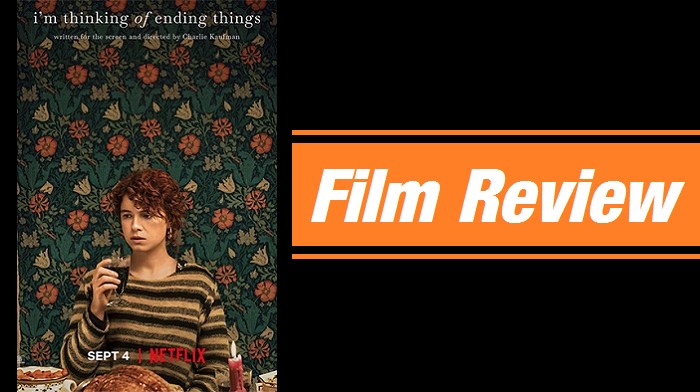
Charlie Kaufman’s enigmatic new film “I’m Thinking of Ending Things” has been one of the most intriguing titles on Netflix’s 2020 movie calendar. It’s impossible to stamp a label on Kaufman’s collective work, but you can identify some of the filmmaker’s reoccurring interests. He’s known for exploring identity, mortality and the human condition often through a surrealist’s lens. There is a self-indulgence to his work (something Kaufman himself would never deny) that allows his to create from his soul. His movies don’t always land for me, but I never doubt I’m seeing something truthful.
“I’m Thinking of Ending Things” is a thematic puzzle box. It’s a psychodrama plump with symbolism and carefully placed breadcrumbs that can’t possibly be fully digested in one viewing. You could call it a dark soliloquy of sorts; an out-of-focus meditation that becomes clearer the further it gets from reality. It wastes no time challenging our sense of perspective while steadily plowing deep into subjects that have fascinated Kaufman for much of his eight-film career.
All of that tells you the type of story Kaufman constructs, but what is it about? The meat and potatoes answer – it’s about a young woman going to meet her boyfriend’s parents for the first time. That’s the surface-level synopsis. But who goes into a Charlie Kaufman film expecting him to stick to the surface?

Photo Courtesy of Netflix
A terrific Jessie Buckley plays Lucy, or is it Louisa, or is it Ames? She’s a physicist, or is she a painter, or maybe a waitress? Get where I’m going? Probably not and that’s part of the draw. Anyway, mere minutes into the film Kaufman puts us inside the young woman’s head as she’s thinking of ending things with her boyfriend Jake (an opaquely low-key Jesse Plemons). They haven’t been together long, only six weeks. Or is it six months? Regardless, she begins to feel their relationship has ran its course yet she still agrees to take a road-trip with Jake to meet his parents.
For the first 20-plus minutes Kaufman puts us in the car with the young couple as they travel along a snowy Oklahoma highway. We listen in on their philosophical jousting, their discussions on William Wordsworth, movie musicals, and Mussolini’s train. And we’re ushered into Lucy’s wandering headspace where her melancholic interior monologues are constantly interrupted by Jake’s penchant for monotoned small talk. Not only is this extended opening a good introduction to Kaufman’s two chief characters, but it’s full of carefully planted clues (some obvious, some not) telling us that something’s off, not just with their relationship but in the world we’ve been ushered into.
The young couple arrive at Jake’s family’s farmhouse where they’re (eventually) met by his spacey mother (Toni Collette) and his listless father (David Thewlis). It’s here that the film really begins to peel back its sense of reality and Kaufman’s already slippery story shifts into a trippier and arguably meatier gear. What starts as a slightly psychotic meet-the-parents black comedy turns into a fever dream version of Jake’s life where time shifts, ages fluctuate, and the characters take on different shades of themselves. Sounds vague, right? Better that than doing the disservice of giving too much away.
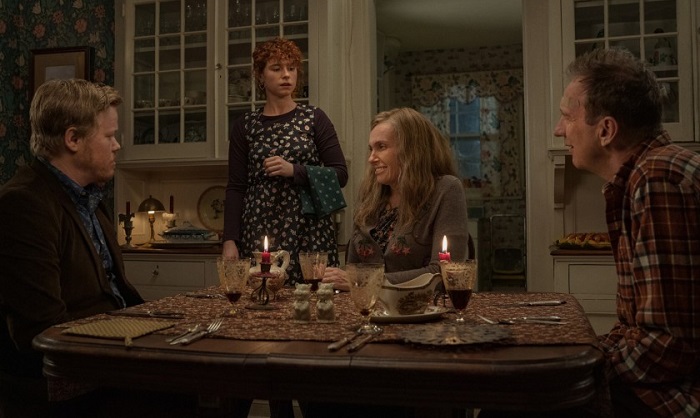
Photo Courtesy of Netflix
From the very start the young couple’s story is frequently intercut with shots of an elderly janitor (Guy Boyd). He’s a portly and solitary man who works nights cleaning a high school; alone with his thoughts as he mops the long empty halls, scrapes gum off of desks, and takes out the trash. We sense a sadness and a longing to the man yet he’s a bit of a romantic. There’s a great ‘movie-inside-a-movie’ scene where he watches a fake Robert Zemeckis rom-com in a classroom during his dinner break. The man is more than a Kaufman indulgence. He’s a story piece who has his own part in bringing everything into focus.
So many odd yet material details still stand out to me. Kaufman’s use of narrow aspect ration signifying that we’re only seeing part of the picture. Jake constantly reminding Lucy (and us) that he has chains (for his tires), just one not-so-subtle but meaningful metaphor among many. Lucy channeling Pauline Kael in a blistering two-minute takedown of the Cassavetes film “Woman Under the Influence”. A final act interpretive dance that starts out wantonly bizarre but ends up rich with significance. “Ending Things” is loaded with these types of Kaufman signatures, baffling on the surface but pertinent to what his film is saying.
Following my first viewing I didn’t know how to feel about “I’m Thinking of Ending Things”. I was fascinated by it. I was struck by the performances, especially from Jessie Buckley who should automatically be in Oscar contention. I loved Kaufman‘s faith in his audience to find the many pieces and fit them together themselves. But it wasn’t until the second viewing that things really clicked. I began to get in sync with the film’s off-kilter rhythms. I got a better grasp of its existential anxieties. I found myself chewing on every line of dialogue. And while not all of Kaufman’s past work has connected with me, his latest resonated in ways I never expected. “I’m Thinking of Ending Things” is now showing on Netflix.
VERDICT – 4.5 STARS