REVIEW: “The Dark Tower”

Towerposter

For ten years a movie adaptation of Stephen King’s wildly popular “Dark Tower” series of novels has been in the works. An impressive carousel of big names have been linked to the project – directors J.J. Abrams and Ron Howard; actors Javier Bardem, Russell Crowe, Liam Neeson, and Viggo Mortensen. But script issues and studio apprehension kept the project on the shelf.

That was until struggling Sony Pictures greenlit the project. More script rewrites were done (rarely a good sign) and Nikolaj Arcel was handed the directing reins. Things looked up with the casting of Idris Elba and Matthew McConaughey. As it turns out “The Dark Tower” needed a lot more than star power to make it worth the wait.
tower1

As someone who hasn’t read the novels I expected there to be a lot I wouldn’t get. Turns out I was right. The screenwriting team attempts to make sense of things for know-nothings like me, but their efforts range from clunky to nonsensical. For what it’s worth we get some (not all that interesting) exposition which explains things a bit. Other times we get transitions and gaps that make no sense whatsoever. But in retrospect I’m not sure understanding this particular story would cure its ills.

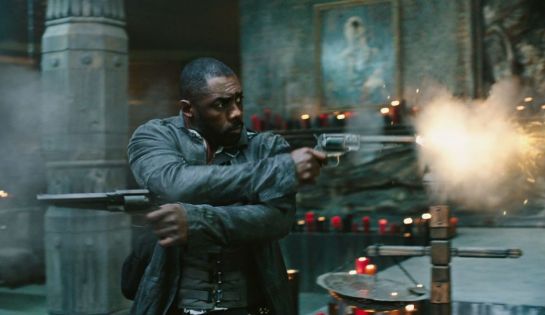
From what I can understand the film is intended to be a direct sequel to the novels. It spans two ‘worlds’ – ours, which is mainly depicted by modern day New York, and Mid-World, a sci-fi Wild West-like parallel universe. It’s there that we meet a Gunslinger named Roland (Elba), the villainous Man in Black (McConaughey), and the mysterious Dark Tower – a structure set in the center of the universe that could end both worlds if destroyed. Elba is the protector, McConaughey wants to destroy it, and so on.

In New York a young boy (Tom Taylor) has visions of Mid-World and the looming threat of the tower’s destruction. He’s chased by monsters working for the Man in Black until he finds a portal to Mid-World where he meets up with Roland. He shares his visions and the two try to foil the Man in Black’s plans.

tower2

The film is rich with all sorts of goofy concoctions. There are creatures with fake human skin masquerading as New Yorkers. There is a massive weapon powered by psychic children. I could go on. That kind of silliness could be a bit more digestible if the movie didn’t take it all so seriously. Sure, there are a handful of attempts at humor, but not enough to overtake the serious tone. It doesn’t make this unwatchable, but it consistently fed my feeelings of disappointment.

There are moments of McConaughey doing McConaughey which can be kind of amusing, but ultimately he seems miscast. It doesn’t help that his character is nothing short of dreadful. Elba is good with what little he’s given and you could say he is a reminder of the potential this film had. I would like to see him again in this role with a substantially smarter, less convoluted story and more focused direction. I’m afraid that’s wishful thinking. I can’t imagine another movie in this planned franchise seeing the light of day.

VERDICT – 2 STARS

2-stars

REVIEW: “Maudie”

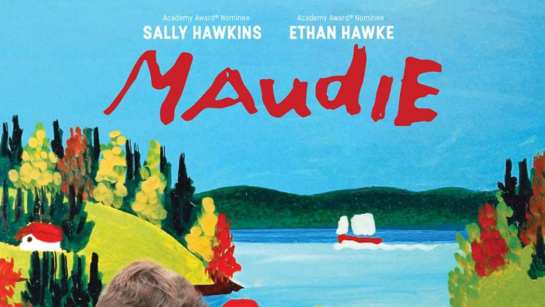
Maude poster

The heart-wrenching yet inspirational true story of folk artist Maud Lewis seems tailor-made for the movie biopic treatment. At the same time it’s a type of story that demands a sensitive and sure-handed approach. There are several examples of films that lost themselves in sentimentality and showiness when attempting to work with similar material.

Aisling Walsh’s “Maudie” falls for none of those trappings. The Irish director’s deftly handled portrait resembles one of Maud’s paintings in that it keeps things simple. At the same time Walsh never compromises the genuine emotion inextricably linked to Maud’s life and she utilizes two phenomenal performances to fill in the details.

Sherry White’s patient, poignant script features a clear-eyed focus on Maud’s unique relationship with a local fish peddler named Everett Lewis . White and Walsh want us in the role of observer, not so much on any extensive plotting, but on these two characters and their fascinating relationship which emotionally ranges from heart-crushing to uplifting.

maudie1

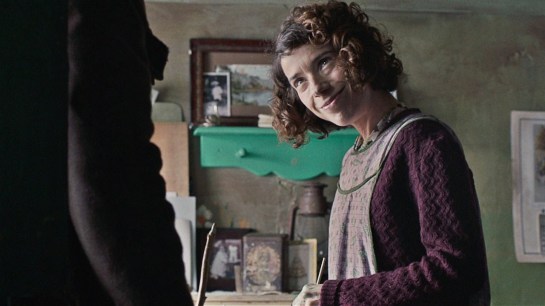
Sally Hawkins takes on the title role and gives a performance that should light up the eyes of Academy voters. Hawkins vanishes into her character and fearlessly tackles the challenges of portraying Maud’s frail body, soft voice, and irrepressible positive spirit. Hawkins captures both the debilitating nature of Maud’s rheumatoid arthritis and well as the her wide-eyed optimism and ability to see the good in the harsh world surrounding her.

We first see Maud cast off by her brother to live with her curmudgeon of an aunt in 1930s small town Nova Scotia. She sees a means of escape when Everett Lewis, a local fish peddler and jack of all trades, places a “Help Wanted” advertisement for a housekeeper. He’s played with a wheelbarrow load of grumbling temperamental snarl by Ethan Hawke. It’s another great performance from Hawke who continues to extend himself as an actor.

He eventually hires Maud as the live-in maid for his tiny one-room shack (minus the tinier loft upstairs). Everett is a tough nut to crack – a socially dysfuctional recluse who is terrified at the very idea of loving. This leads to some moments of uncomfortable cruelty often spawned from his “King of my Castle” mentality (In one particularly cruel scene Everett berates Maud letting her know she falls below his dogs and chickens in the house pecking order). But it also comes from Everett’s own awkwardness and osctracism – a bond he shares with Maud.

Maudie2

As their unconventional relationship takes a new form Maud begins to express herself through painting – on postcards, on wood planks, even on the walls of their shack. After an art-loving New Yorker (Kari Matchett) takes a liking to her paintings word quickly spreads and soon people from all over are travelling to see the little house and Maud’s artwork.

Regardless of how it may sound, this isn’t a rags-to-riches story. In fact, despite making money from her paintings, Maud and Everett lived for in their “Little House” for over 30 years. It now sits on display in the Art Gallery of Nova Scotia. Instead this is a quirky but uplifting love story ripe with inspiring life lessons – that beauty lies in the simplest of things; that genuine contentment can often lead to genuine happiness; that true love can be found in the most unexpected places – just to name a few.

Simply put “Maudie” is a delight. It is a life-affirming movie that feels both tragic and beautiful. Guy Godfree’s cinematography is superb framing shot after shot as if they were settled on a canvas. The Michael Timmins score is simple, fitting, and never manipulative. And of course White’s script and Walsh’s direction. But it all comes back to the two lead performers particularly Sally Hawkins. She brings this lovely soul to life with such heart and vivid detail. It’s a performance certain to leave an impression on any viewer and I can guarantee that by the end you will want to know more about Maud Lewis.

VERDICT – 4.5 STARS

4-5-stars

REVIEW: “Wind River”

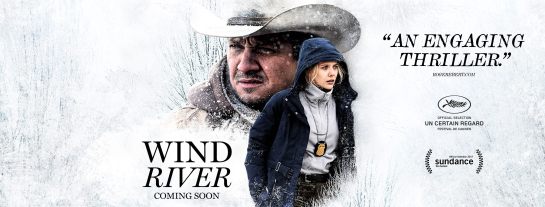
wind poster

Screenwriter Taylor Sheridan is developing an impressive reputation. His first film script was for 2015’s stellar “Sicario” and he followed it up with last year’s “Hell or High Water”.  A deep-south crime thriller, “Hell or High Water” (despite a plot hole or two) would earn him an Academy Award nomination and highlight Sheridan’s gift for telling character-driven stories with a sharp regional authenticity.

His latest film “Wind River” is yet another showcase for Sheridan’s fascinating style of storytelling. It also sees him hop into the director’s chair, something he’s only done once before with a low-budget horror film appropriately titled “Vile”.

wind2

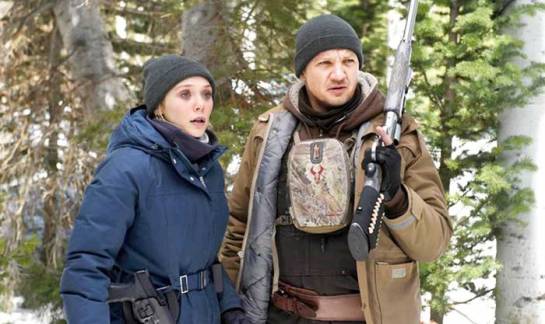
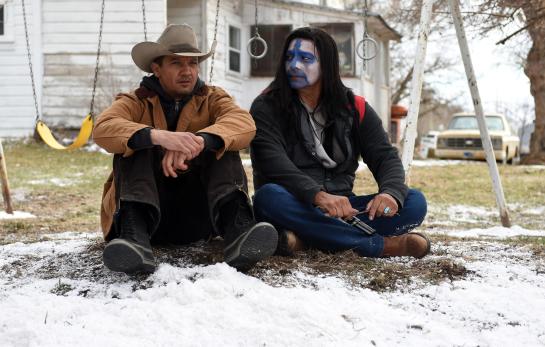
“Wind River” begins with a startling scene featuring a terrified young woman running through a snowy wooded area during the frigid cold of night. Her frozen body is eventually discovered by Cory Lambert (Jeremy Renner), a Fish and Wildlife Service tracker for the Wind River Indian Reservation in Wyoming. Lambert reports the death to Tribal Police Chief Ben (Graham Greene) who promptly calls the FBI. The relatively uninterested Feds send earnest but ill-equipped rookie agent Jane Banner (Elizabeth Olsen) to oversee the investigation.

From there the story becomes an absorbing mix of slow-boiling murder mystery and thoughtful commentary. A lot is gleaned from the rough and rugged setting. As with Sheridan’s previous two films, setting is one of the most captivating components. “Wind River” is filmed mostly on location which adds a harsh natural edge to the mystery. But the territory’s ruggedness is equally presented in another form – drugs, poverty, isolation and violence all speak to the reservation life Sheridan clearly wants to examine.

Renner and Olsen shed their second-tier Marvel superhero personas and get to play interesting real-life characters firmly grounded by Sheridan’s dialogue. Sheridan loves fleshing out his characters through well-conceived conversation. Renner is superb giving a quiet and measured performance fitting of a character with plenty of baggage to unpack. Olsen’s role resembled that of Emily Blunt in “Sicario” but just a hair less convincing. She’s tough but inexperienced and forced to learn on the fly from the situation she is thrust into. They are a good team working through local obstacles as well as federal red tape and indifference.

Wind River - 70th Cannes Film Festival, France - 19 May 2017

Sheridan’s direction matches his screenwriting – steady and assured. His knack for pacing keeps the story bumping along all while building tension and fleshing out his characters. It is sure to be too slow for some and there are certain things Sheridan shows but has no interest in exploring. Personally speaking I appreciated his focus.

Things eventually reach their boiling point leading to a finale that obliterates the film’s patient rhythm. It’s a bit jarring but inevitable and satisfying. There are a few small questions left on the table and it’s hard to determine if they are intentional or oversights. Still Sheridan has written yet another solid screenplay in his crime story trilogy and has added a strong directing credit to his resume. He remains an exciting filmmaker with a refreshing cinematic eye and his next script “Soldado” is a sequel to “Sicario”. I’m all onboard.

VERDICT – 4 STARS

4-stars

REVIEW: “Now You See Me 2”

NYSM2poster

I suppose somewhere out there was an audience anxiously awaiting a follow-up to 2013’s wildly uneven “Now You See Me”. Still, you can call it the sequel I never expected. But modern day trends seem to indicate that when you bring in over $350 million at the box office against a $75 million budget chances are good the studio will push out another one.

So now we get the shrewdly titled “Now You See Me 2” with a slightly higher budget and slightly less money made at the box office. Still, $335 million is nothing to laugh at and apparently the series has its fans. Well they should be happy. “NYSM2” is more of the same – silly, a bit kooky actually, and all over the map.

NYSM21

Roughly eighteen months after slipping through the fingers of the Feds, The Four Horseman (the pop stars of the magic world) await their next assignment from The Eye, the goofy secret cabal of magicians revealed in the first film. They get their next job but are thwarted and exposed by a mystery man who also outs their FBI insider Dylan Rhodes (Mark Ruffalo).

The Horseman (Jesse Eisenberg, Woody Harrelson, Dave Franco, and new member Lizzy Kaplan) are abducted by a weaselly, off-the-grid tech wiz named Walter (Daniel Radcliffe). He brings the crew to Macau and blackmails them into swiping a computer device called “the stick”. Director John Chu (perhaps best known for the “Step Up” movies) goes the full “Ocean’s 11” route. In other words the film is not just trying to be a heist movie. It’s trying to be a really cool one.

But there is also Morgan Freeman and Michael Caine returning from the first film. Both have their own angles, both of which intersects with Ruffalo. Add in a few new characters – Radcliffe who is pretty good and Caplan who is fine. But there is also Woody Harrelson in the second of his dual roles playing Merritt’s identical twin. It’s a wacky performance, a stunningly bad character and an even worse wig.

NYSM22

And then there is the magic – rarely ever genuine illusion. Instead the majority is glaringly computer-generated making any impressive “Presto” moments all but nonexistent. And when they do try to offer up some form of explanation it’s too absurd to be taken seriously or with humor. There is the key heist scene which is actually pretty fun. It’s preposterous beyond measure and requires some of the worst security guards on the globe. But it’s an entertaining bit if you’re able to turn off your brain.

There is some occasional good chemistry between the Horseman and there are moments when you think the movie is going to fully embrace its corniness. I wish it had. Instead the smoke-and-mirrors story flies all over the place and never firmly lands anywhere. It’s a messy movie but not quite fun enough to call a glorious mess. Perhaps it is marginally better than the first film but I could never say that with any hint of confidence.

VERDICT – 2 STARS

2-stars

REVIEW: “Macbeth”

macposter

Easily one of William Shakespeare’s most renowned plays, “Macbeth” is believed to have been first performed 1606. Since then it has been adapted to nearly every form of media. The tragedy deals with several themes but at its core it examines unbridled ambition and the destruction it brings if unchecked.

Director Justin Kurzel along with a trio of screenwriters and a fantastic supporting cast begin their telling with a couple of notable deviations from the Bard’s classic text. The first is the opening scene – a haunting overhead shot of a deceased young child in a straw bassinet laying upon a funeral pyre. The infant is surrounded by loved ones shrouded in black including the child’s grieving parents Macbeth (Michael Fassbender) and Lady Macbeth (Marion Cotillard).

mac1

Shakespeare alludes to the Macbeth’s loss of a child, but Kurzel focuses on it as an entry point to their story. It’s significant in that it adds another layer (a far more penetrating one) to the couple aside from the lust for power that eventually consumes them. Here we see the sorrow of such a loss emphasized and for the Macbeth’s the wounds never fully heal. It’s an effective focus for the story.

Another deviation is that Kurzel shows the final battle sequence spoken of by Shakespeare. Still mourning the death of his young son, we see Macbeth on the battlefield preparing his ragtag group for what’s ahead. Among his soldiers is a young boy, undoubtedly a reminder of his own. Macbeth leads his band to victory but there are heavy casualties. During this sequence we see Macbeth as a mighty soldier but war has clearly taken its toll. Fassbender’s eyes do wonders in revealing the fragility hidden underneath the rugged exterior. This is another key defining point to what lies ahead.

mac2

While still on the battlefield Macbeth and his chief ally Banquo (Paddy Considine) encounter three witches (possibly five depending on your interpretation) wandering and observing through the post-battle haze. The witches prophesy that Macbeth with soon be Thane of Cawdor and eventually King of Scotland. Banquo is told he will be a “father of Kings”. Later the sitting ruler King Duncan (David Thewlis) arrives and determines the Thane of Cawdor to be a traitor. Due to his success in battle Macbeth is given the position seemingly verifying the witches’ prophesy.

Upon hearing this Lady Macbeth begins feeding her husband’s hunger for power. Cotillard has a magnificent presence both as a manipulative and devious conniver and as a grief-stricken mother. Again, the film’s opening scene adds this welcomed bit of nuance and it is something that haunts her character throughout the movie.

mac3

The ascension to power and subsequent spiral into madness is skillfully handled. Macbeth soaks in paranoia and blood. Lady Macbeth is torn by guilt and shame. Through it all Fassbender and Cottilard shine. They both are so keenly in tune with their characters and the unique period dialogue they are given. Visually, stylish flairs are found all through the film. They drive the mood and superbly capture a cold, muddy medieval Scotland.

The true tragedy of this story doesn’t simply lie with the Macbeths. The greater tragedy is how the consequences of their actions shake the entirety of Scotland to its core. Kurzel keenly explores the classic tale while offering a few of his own original twists. Literary purists may be put off by this, but it kept me mesmerized from its heart-shattering opening scene, through a couple of slow patches, and right up to its slightly nihilistic ending. I say nihilistic but like much of the film, I guess it’s all in the interpretation.

VERDICT – 4 STARS

4-stars

REVIEW: “King Arthur: Legend of the Sword”

kingposter

As a movie fan here is a scenario I have experienced more than once: I see a trailer for a big studio picture and immediately say to myself “This movie is in trouble”. Then I learn of its $175 million production budget and I say “Make that BIG trouble”. And then critics begin dropping a slew of scathing reviews (not always a guaranteed indicator but in many cases…). Needless to say my expectations bottom out.

But then I actually see the film and it turns out to be far from the horrid experience I expected. “King Arthur: Legend of the Sword” fits into this category. Now don’t get me wrong, this isn’t a ringing endorsement. At the same time it’s far from the unwatchable dreck I was led to expect.

king1

Where to start? Guy Ritchie’s take on the Arthurian legend doesn’t follow many traditional guidelines. You could say (for better or for worse) Ritchie does his own thing. That’s good in the sense that it feels like a unique undertaking and the looniness is one of my favorite things about it. What’s not so good is that it misses much of the mythical and magical charms that has made the story somewhat timeless.

Since 2004’s forgotten and underrated “King Arthur” Warner Brothers has been hard at work attempting to bring a new film to light. They finally settled on what is supposed to be the first of a six film cinematic universe. The likeliness of that happening has dwindled. Something about losing $15 million will do that.

The film begins with Camelot under siege by the dark mage Mordred. It’s a sequence resembling a cheaper version of Peter Jackson’s battle for Minas Tirith (see “Lord of the Rings: The Return of the King”). King Uther Pendragon (Eric Bana) prevails much to the chagrin of his ambitious and devious brother Vortigern (Jude Law). Hungry for the throne, Vortigern leads a coup against his brother. Realizing the peril, Uther sends his infant son Arthur drifting down the river, baby Moses style. Then through a speedy time-hopping sequence we learn young Arthur was found by a group women and raised in their brothel.

king2

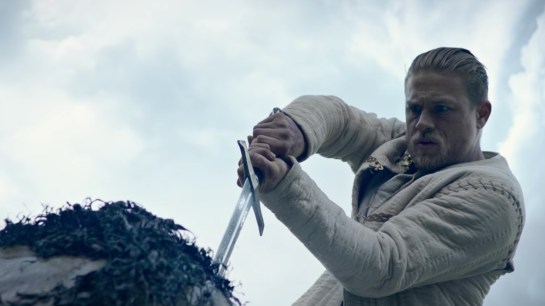
What follows is a gonzo account of Arthur’s rise, his introduction to Excalibur, and of course a confrontation with the new king Vortigern. Charlie Hunnam plays Arthur, now all grown up and with a fantastical and unwanted destiny laid out before him. Hunnam is a good actor but here he seems a bit hog-tied by the script. It’s steadily working towards him becoming the mythical sword-wielding hero, but for too long it keeps him locked in as the reluctant denier.

The action is pretty good and Jude Law is a hoot playing such a detestable slug of a human being. And the sheer nuttiness of the whole thing works in several regards. Despite its noticeable flaws, before I knew it I found myself having fun with this gonzo vision of Camelot. But is it enough to put things in motion for a full cinematic universe? I’m afraid not. It’s entertaining as its own thing, but there isn’t much to draw anyone back for another dose. Like I said, not a ringing endorsement but fun enough.

VERDICT – 3 STARS

3-stars