REVIEW: “Jake Reacher: Never Go Back”

jack-poster

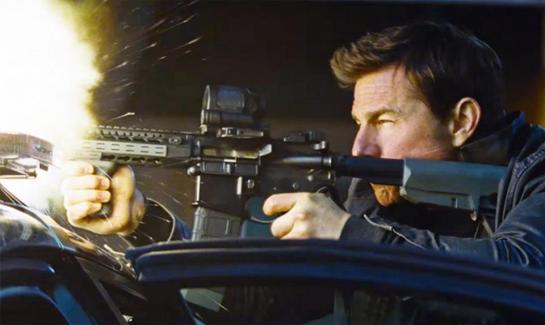
Don’t let its deceptive title fool you. You most certainly can go back. Just look at Tom Cruise, the 54 year-old ageless wonder. 2012 was the first time Cruise took on the role of ‘tough as nails’ ex-military cop Jack Reacher. Now four years later he ‘goes back’ for a second round of high energy, low monotone Reacher-style action.

Edward Zwick directs the film and has some history with Cruise. The two previously worked together on the 2003 epic “The Last Samurai”. Needless to say this is a much different picture. It follows the basic blueprint of the first movie – a no-nonsense, tough guy protagonist, some big action, and a military mystery through-line. Think of it as a big screen NCIS with a larger budget and Tom Cruise running the show.
jack2

Cruise’s Reacher is still a drifter who does his own thing but occasionally lends a hand to the military police he left behind. In doing so he develops an over-the-phone friendship with Major Susan Turner (Cobie Smulders) who now runs his old unit. Upon arriving in Washington DC to meet her for the first time, Reacher discovers she has been relieved of her duties and arrested for espionage.

Sensing an obvious set up, Reacher busts out Susan and the two fugitives set out to find out who wants her dead and why. Along the way Reacher learns he may be the father of a teenaged daughter (played by Danika Yarosh), a convenient little story thread that adds some manufactured vulnerability to our unstoppable hero.

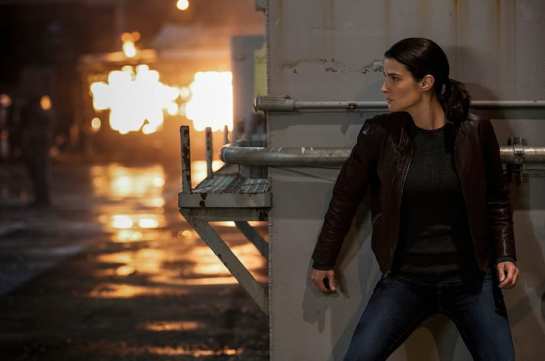
That sarcasm you may sense in my tone can be attributed to the fact that I’m still struggling with how I feel about the film. Broadly speaking I do like it and feel many are being overly critical. It is competently made by Zwick and it delivers exactly what audiences will expect. Cruise is never the problem with his movies and he does good here as well. Smulders is even better as a tough, hard-nosed woman who is a far cry from the normal action movie damsel in distress. She is a genuine action heroine and the one true refreshing element.
jack3

But at the same time, it’s hard to see this as anything more than a ‘one-and-done’ viewing. Despite the efforts of Cruise and Smulders, things never rise above predictable and/or formulaic. There is nothing about the story that will catch you by surprise. And aside from more action and a new subtitle, “Jack Reacher: Never Go Back” doesn’t offer much new for the series as a whole.

Writer Lee Child has written 21 books as part of his Jack Reacher series. “Never Go Back” is based on his 18th novel so there is still plenty of material should they decide to make a third movie. I would go see another Reacher film since I have found entertainment in both of the these installments. But unless they are willing to shake up the formula, Jack Reacher 3 will be more of the same – entertaining enough at first but nothing that will stick with you past that initial viewing.

VERDICT – 2.5 STARS

Remember this trailer? #2 – “Robocop” (1987)

Classic Trailer Flashback – “Robocop” (1987)

When the trailer was released for Paul Verhoeven’s crime/action thriller “Robocop” I can see where people wouldn’t know what to expect. Keep in mind this was the time when Schwarzenegger, Stallone, Norris, Bronson, and company were defining the action genre with tons of bullets, blood, and bodies. Naturally some would watch the Robocop trailer and expect the same. Bullets, blood, and bodies were aplenty (prior to the final edit the film originally received an X rating strictly for its graphic violence). But as it turned out “Robocop” had much more to say than people expected. Themes of police corruption, media manipulation, and authoritarianism among other things were clearly explored making “Robocop” more than your run-of-the-mill action flick.

So, do you remember the trailer for “Robocop”?

REVIEW: “Café Society”

cafeposter

With each year comes a few certainties – taxes, a new model iPhone, a Woody Allen movie. For decades now the 80 year-old Allen has maintained his ‘movie-a-year’ formula with varying degrees of success. His films have shown signs of evolving from tightly wound, exploratory character studies to more free-flowing, nostalgia-soaked wanderings. How it plays with audiences is always up for grabs.

“Café Society” is Allen’s 47th picture and you could say it’s about a lot of nothing. We nose in on the lives of a handful of people, listen to their conversations, witness their quirks, watch their unfolding relationships. That’s basically it. But there are things to glean from these seemingly insignificant interactions. Saying it’s about ‘nothing’ is a little strong, but no one will ever call it deep or profound.

cafe1

The story is set in the 1930’s and its centerpiece is a young man named Bobby Dorfman (Jesse Eisenberg). He’s the youngest son of a Jewish family from the Bronx who wants no part of his dad’s jewelry business. So he packs his bags and heads to the star-studded wonderland of Hollywood.  Once there he seeks out his uncle Phil (Steve Carell), a pompous and powerful movie star agent. Phil gives him a menial job and introduces him to his secretary Vonnie (Kristen Stewart). Bobby instantly falls for her.

Eisenberg and Stewart have a sparkling chemistry and Allen wisely milks it for much of the film’s first half. Their sprightly, youthful banter as they tour local movie palaces and quaint coffee shops is infectious. But it wouldn’t be a Woody Allen movie without some sort of weird relationship contortion which in this case leads to a pivot back to New York for the second half of the film.

cafe2

Sprinkled in among the chronicles of Bobby and Vonnie are short scenes highlighting his family. Some are dinner table conversations between his parents (wonderfully played by Jeanne Berlin and Ken Stott). There is a reoccurring neighbor issue with his sister Evelyn (Sari Lennick) and her high-strung intellectual husband (Stephen Kunken). And there are the antics of his gangster older brother Ben (Corey Stoll). The injections of the scenes can be a bit jarring, but I liked the characters and enjoyed their screen time.

Allen’s film wallows in nostalgia which is actually a strength. The set designs and costumes scream 1930’s authenticity. In the Hollywood segment we get numerous fun Golden Age name drops – Paul muni, Rudolph Valentino, Barbara Stanwyck, Ginger Rogers, just to name a few. And the New York social scene of the time bubbles with pomp and energy in the second half.

cafe3

And you can’t talk about “Café Society” without mentioning the cinematography. The film was exquisitely shot by the great Vittorio Storaro. Film buffs may remember his first American film being “Apocalypse Now”. This is Allen’s first film shot digitally and Vittorio Utilizes every ounce of the technology. It’s filled with gorgeous framing and vibrant colors that burst from the screen. It falls right in line with Allen’s recent emphasis on visually capturing location and time.

Perhaps “Café Society” strolls at its own pace and perhaps Woody Allen is in cruise control with his latter films. Still I had a lot of fun with this one. He once again drew me into his time capsule, caught me up in the nostalgia of the era, and surrounded me with characters who I simply enjoyed following. I certainly can’t defend this as some deep, layered character study. But I can call it a well-made and well acted piece of entertainment that I would say easily falls into the ‘good’ category of Woody Allen pictures.

VERDICT – 4 STARS

4 Stars

REVIEW: “The Innocents”

innocentsposter

Movies have scoured the landscapes of World War 2 telling stories from practically every perspective, or so you may think. Director Ann Fontaine proves that to be false with her powerful and understated French-Polish drama “The Innocents”, a story of a much different kind of wartime horror.

“The Innocents” is written, directed, shot, and edited by women giving it something we rarely get from war pictures – a female perspective. Based on a little-known true story, the film explores a harrowing scenario with seemingly no scar-free solution. At the same time it looks deeper into subjects such as sexual assault, motherhood, and crises of faith.

innocents1

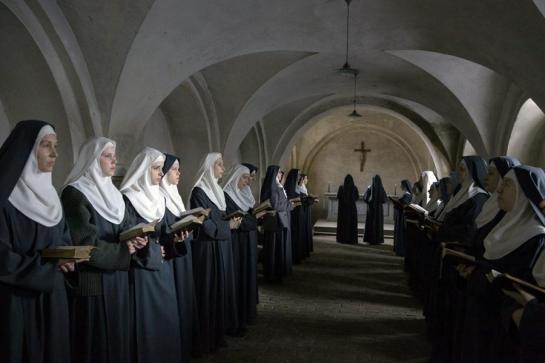
The story is set in 1945 shortly after the end of the war. Mathilde (deftly played by Lou de Laâge) is a French Red Cross nurse assigned to help in post-war Poland. After reluctantly accepting a nun’s plea for help, Mathilde follows her to an isolated convent where she discovers a young nun in labor. What follows is a quiet, tense sequence where Mathilde performs a cesarean among sisters who are unwilling to divulge details of their unusual situation.

Soon we learn of their horrific secret. The nuns had weathered persecution during the German occupation, but then the Russians arrived. Over a three-day span Russian soldiers repeatedly stormed the convent and raped the sisters resulting in numerous pregnancies. Fearing disgrace and ostracism the sisters rely on Mathilde to shelter their secret. At the same time obvious inner conflicts between their faith and circumstances add an even heavier level of complexity. For Mathilde caring for the sisters while keeping the secret from her Red Cross superiors proves to be difficult.

innocents3

A real strength of “The Innocents” is its even-handed approach to its subject matter. There is no pointed lecturing or judgements about faith, unbelief, or the decisions each influences. Instead Fontaine presents her material with a clear-eyed neutrality. She allows her story and well-defined characters to speak for themselves free of gloss or manipulation. It’s such a vital approach for Fontaine and the writing team to take. I can’t imagine the film having near the punch without its real-world grounding.

Specifically, the handling of sisterhood under stress is thoroughly compelling. Despite the nun’s best efforts, their faith inevitably crashes against the ugly, abrasive world outside their walls. Mathilde is the antithesis – an influence from outside but one representing something good. Her growing relationship with the sisters despite not sharing their beliefs is one of the film’s key undercurrents.

innocentss

And then there is Caroline Champetier’s cinematography which is something to behold. Shot after shot highlight elements of the period, many resembling classic art pieces. We especially see it in her capturing of the convent. She accentuates its cloistered, bygone look, almost as if it’s from another time. It hearkens back to Champetier’s fantastic work in the slightly similar film “Of Gods and Men”.

As you watch “The Innocents” it’s easy to recognize the many parts seamlessly working together. The smart, measured script, Fontaine’s restrained yet sure-footed direction, Champetier’s beautifully moody cinematography, the wonderful performances by the predominantly female cast (particularly Lou de Laâge). They are all vital in telling this incredibly unique story of courage amid the unimaginable. By the end it was clear to me that no character’s innocence would remain intact, but even the smallest light can offer a glimmer of hope. The film helps us remember that.

VERDICT – 4.5 STARS

4.5 STARS

REVIEW: “Spy”

spy-poster

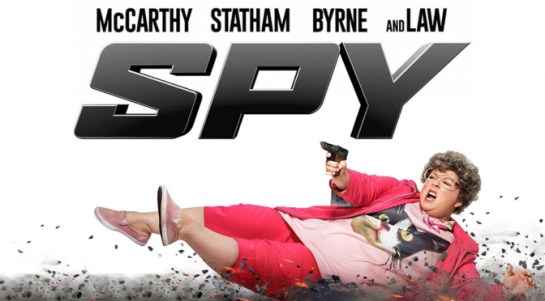
I’m curious as to whether there is any middle ground with Melissa McCarthy. She’s a comic with a very in-your-face brand who does variations of the same shtick in practically every film she makes. Now if you enjoy that you’re likely to appreciate every one of her films to varying degrees. If you don’t then you’re going to struggle with every movie she makes.

Her action/comedy “Spy” is no different. It is full-blown McCarthy bouncing back and forth between self-deprecating, ‘fish out of water’ humor to loud, obnoxious, profanity-riddled “comedy”. Fans are sure to find it entertaining. I don’t fit that description which explains why I found it tedious, juvenile, and at times unbearable.

spy3

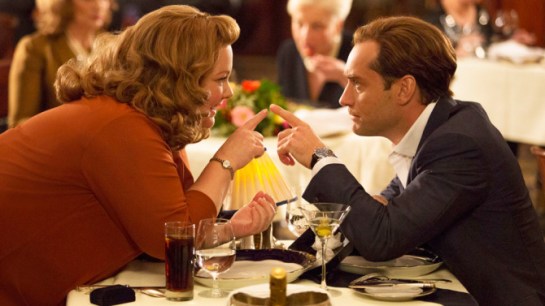
McCarthy plays her usual character – a sympathetic oddball eccentric. This time she plays a CIA Operator named Susan Cooper whose job is to sit behind a desk and relay information to debonaire field agent Bradley Fine (Jude Law). Susan aspires to be a field agent herself but lacks self-confidence. Plus she likes working with Bradley mainly due to a small but obvious crush. But he (like nearly everyone else in the film) doesn’t take her seriously which does nothing to boost her spirit.

Bradley is sent on a mission to retrieve a suitcase nuke from terrorists but things go terribly wrong. Susan is allowed in the field by her mean-spirited and reluctant boss Elaine (Allison Janney). Her job is strictly to observe, but a series of mishaps thrusts the desk-bound operator deeper into the wacky, violent spy world.

spy2

Director Paul Feig had a hit in 2011 with “Bridesmaids” but followed it with the appallingly bad “The Heat”. And this year he is credited with directing the terribly bland “Ghostbusters” reboot. “Spy” doesn’t do anything to even out his track record. There is little new here. We get the standard McCarthy weight and appearance gags. We get a vomit gag. We get body part gags. And so on and so on.

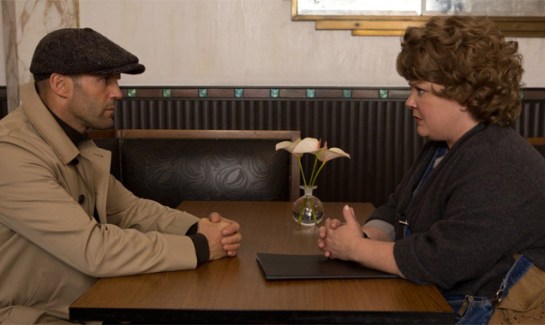
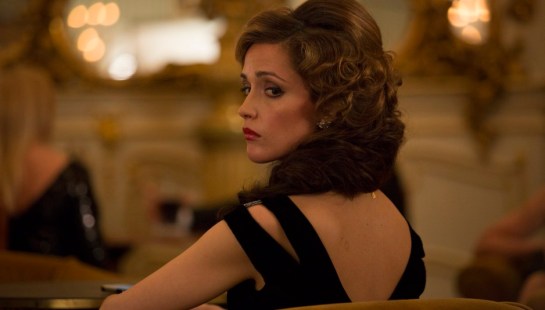
The movie does introduce a number of quirky side characters most notably Jason Statham as a belligerent and oafish field agent and Rose Byrne as the evil villainess. Both fall into their parts well. Unfortunately both characters are undercut by Feig’s puerile writing. His insistence on forcing profanity in their every sentence makes them sound ridiculous. Perhaps the one reasonably authentic character is found in Susan’s loyal friend Nancy (Miranda Hart).

SPY-04418.CR2

The story itself tries to be a globe-trotting spy spoof but its antics get tiring. It attempts to change things up midway through by giving McCarthy’s character a profound transformation. The problem is it doesn’t feel genuine or earned. Even worse I found it made Susan shallower and far more annoying.

Yes I know people loved “Spy”. I know it made a ton of money at the box office. I know it was critically praised and sits at 94% on Rotten Tomatoes. So be it. I simply don’t see the attraction. It is another in a long line of modern comedies that cling to the same methods. Much like McCarthy, if you like that type of humor you’ll probably like “Spy”. If you want something fresh, intelligent, and outside of the modern norm good luck finding it here.

VERDICT – 1.5 STARS

1.5 stars

REVIEW: “The Birth of a Nation” (2016)

birthposter

I’m not sure if any 2016 movie has drawn a more complex range of discussion than Nate Parker’s “The Birth of a Nation”. Right out of Sundance, many instantly christened it the next Best Picture Oscar winner and a direct answer to the #OscarsSoWhite controversy. Some have placed the entire weight of the Hollywood diversity cause on its shoulders. Such high expectations are hardly fair.

Adding another layer was the resurfacing of a 1999 Penn State rape charge. Parker and close friend Jean McGianni Celestin (who is given a story credit in the film) were accused of raping a fellow student. Charges against Parker were dropped but information about his defense (namely his definition of “consent”) and acts of intimidation towards the victim haven’t shed him in the most positive light. Celestin was convicted but the charges were eventually dropped on a technicality. The victim committed suicide in 2012.

Essentially this renews the age-old debate of separating the art from the artist, something I’m usually able to do (Roman Polanski’s “The Pianist” remains a favorite of mine). But I don’t dismiss those who struggle with Parker and his film mainly because a brutal rape plays a big part in the story. Ultimately your experience with “The Birth of a Nation” could very well be influenced by how these events speak to you.

birth2

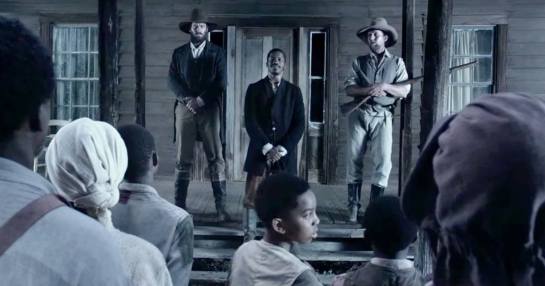
Personally I feel better equipped to examine the movie on its own merits. Controversy aside, there is a powerful story at the center of Parker’s film – a melding of fact and fiction. It’s based on the life of Nat Turner, a slave in Southhampton County, Virginia who led an uprising against white slave owners in 1831. Many have viewed Turner’s rebellion as a heroic and justified act which is clearly the perspective Parker takes. But in doing so he softens the edges of Turner’s actions which misses out on some of the more fascinating complexities of his story.

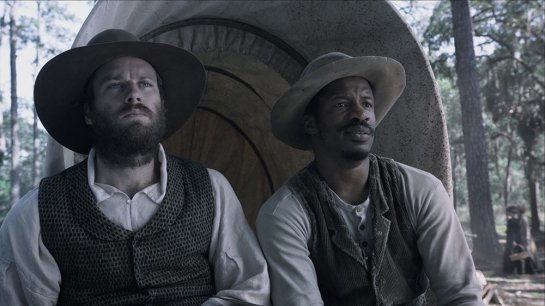
Parker (who wrote, directed, and starred in the film) first reveals Nat Turner as a young boy. A self-taught reader, Nat is given a Bible by the matriarch of his slave owning family (Penelope Ann Miller). Years pass and Nat becomes a preacher to his fellow slaves on the plantation which is now ran by Samuel Turner (Armie Hammer). When a local white minister (played in a near cartoonish fashion by Mark Boone Junior) notices Samuel’s slaves are “well behaved”, he suggests that Samuel take Nate to other plantations to preach calming messages to their slaves (for a price of course).

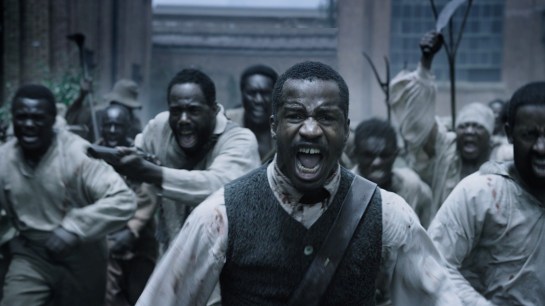
As Nat visits other plantations the true brutality of slavery is brought into focus and he realizes he is simply a tool of the slave owners. This directly challenges his view of Scripture and soon causes him read the Bible in a new way. Feeling inspiration from God, Nat puts together a violent rebellion in hopes of freeing his people and pouring out judgement on their oppressors.

birth4

“The Birth of a Nation” is told almost exclusivity from the slave’s perspective (mainly Nat’s) which offers some truly powerful moments. This allows for the ugliness to be seen without any (intentional or unintentional) gloss. At the same time Parker’s direction and storytelling is all over the map.

The early parts feel as though Parker is simply checking off plot points. There is little narrative flow. Once the film gets to where Parker wants it to be, he slows it down and more thoughtfully maneuvers from scene to scene. There are also these unusual bursts of otherworldly imagery which seem to be portraying Nat as a mythological spiritual figure of sorts. It’s an interesting idea but Parker doesn’t let it flow naturally from the story. It’s more or less forced upon us through much more conventional techniques.

There are several compelling things Parker touches on that I wish had been explored more. There is an undeniable spiritual element particularly when Nat begins to see Scripture through a different lens. I would have loved to see more of his struggle with interpretation since it eventually birthed his inspiration for the rebellion. Instead it (and several other story threads) feels terribly shortchanged.

birth1

Then there is the rebellion itself. The uprising began with a surprise killing of 50+ slave owners. Parker doesn’t hold back on the graphic brutality, but in his version Nat and his fellow slaves targeted the male slavers who we see throughout the film doing all sorts of vile acts. In reality women and children were also killed. This fact could have subverted what Parker is going for, but the inner moral conflict it surely brought would have been fascinating to explore.

While several things would have made this better, that in no way means this film is without value. Again, there is a powerful story at its core, and while sometimes conventional, several of Parker’s images and scenes are indelibly etched in my mind. But perhaps its biggest strength is how it serves as a profound reminder of a nation’s past transgressions. From start to finish “Birth” keeps you locked in and focused. Parker never loses the potency of his subject matter.

It’s no accident Parker chose “The Birth of a Nation” as his title. It’s taken directly from D.W. Griffith’s 1915 silent epic – a film praised for its groundbreaking approach to filmmaking and excoriated for its depictions of African Americans and the KKK. Parker has “reclaimed” the title and attached it to a much different picture – not a perfect one, for sure. Its uneven direction, messy script, and some heavy-handedness of its own are legitimate frustrations and while “The Birth of a Nation” strives for greatness it falls just short. Yet despite its shortcomings, there is still important and thought-provoking material here, material that deserves to be seen and talked about.

VERDICT – 3 STARS

3 Stars