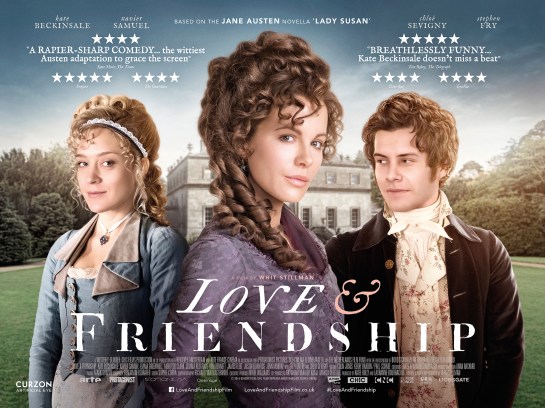
REVIEW: “Love & Friendship”

love-poster

You could almost say Jane Austen adaptations make up their own small, intimate movie genre. Obviously you have the gushy, sudsy dramas such as “Sense and Sensibility” and “Pride and Prejudice” which together have been adapted nearly twenty times in film and television. You could also include the wide range of movies that found their inspiration in Austen’s work – movies ranging from “Bridget Jones’s Diary” to the wackier “Clueless”. To venture even further into absurdity just this year we had “Pride and Prejudice and Zombies”. The title says it all.

The latest Austen film treatment may be the cleverest and best executed of the bunch. It’s “Love & Friendship”, a whip-smart period comedy named after an early Austen story but actually based her epistolary novel “Lady Susan”. It’s the fifth film from writer and director Whit Stillman and his first since 2011’s fabulous oddball campus comedy “Damsels in Distress”. “Love & Friendship” is very much a Stillman picture – intelligent, tightly focused, and refreshingly modern. That last description is especially impressive since the film perfectly fits within its late 18th century aristocratic setting.
love3

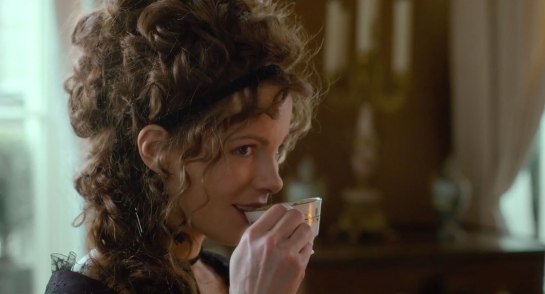
Kate Beckinsale plays the conniving, opportunistic Lady Susan. A recent widow and completely broke, she makes her way to the estate of her brother-in-law Charles (Justin Edwards) and his wife Catherine (Emma Greenwell). They agree to let Lady Susan stay with them even though they are aware of her flirty, gold-digging history. Lady Susan instantly sets her eyes on Catherine’s younger, handsome, and (most importantly) wealthy brother Reginald (Xavier Samuel).

What follows is a comical mélange of scheming and manipulation as Lady Susan works to regain her rich, high society status. In the process she encounters a number of obstacles including Reginald’s parents who are well aware of Lady Susan’s reputation. Things get even more ‘complicated’ when Lady Susan’s young daughter Frederica (Morfydd Clark) pays a surprise visit.
love2

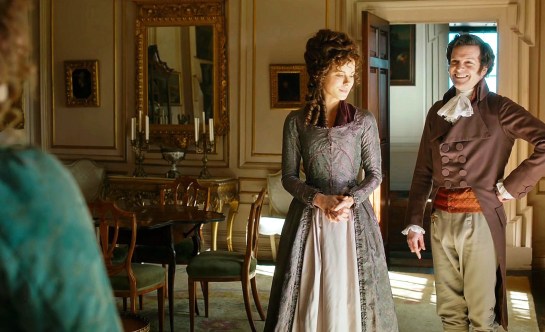
“Love & Friendship” does a remarkable job of taking a Jane Austen period drama and lacing it with Whit Stillman’s signature snappy dialogue. The costumes, the settings, and even the characters seem pulled straight from the 18th century. More importantly Stillman doesn’t disturb or shy away from the traditional Jane Austen formula. He actually embraces it and looks at it from a variety of perspectives. The results are hilarious, lively, and surprisingly fresh.

For many the biggest revelation will be Kate Beckinsale who relays every ounce of Lady Susan’s physical beauty and self-serving venom with mesmerizing precision. Armed with the character’s razor-sharp deceptive tongue, Beckinsale cuts through every male she encounters but does so with a heartless grace. Her selfish callousness towards others is most clearly seen in her moments with her one friend and confidant Alicia (Chloë Sevigny). Yet despite her character’s toxicity, Beckinsale makes Lady Susan a captivating force.
love1

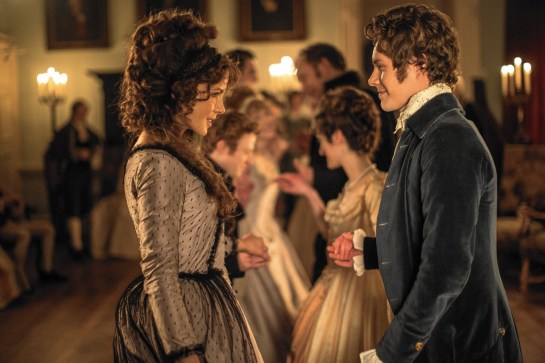
Placed around Lady Susan are a host of fun supporting characters, each portrayed through some period-perfect performances. Xavier Samuel makes quite the turn from his “Twilight” days and the accomplished Stephen Frey adds a little more weight to the cast. Sevigny is a nice fit as Lady Susan’s crony and Greenwell is equally good as the sister-in-law caught in an unwinnable situation. But Tom Bennett is the real scene stealer. He plays Sir James Martin, an extremely wealthy, well-meaning suitor who also happens to be a blithering idiot. Bennett is given the broadest comedy but the small hysterical bursts we get from him fit in nicely.

It’s safe to say that “Love & Friendship” offers a very unique take on Jane Austen’s work while at the same time feeling right at home in the author’s written world. Whit Stillman’s latest has the appearance of a stiff, snooty, blue-blooded time piece. But wrapped within its opulent gowns, neo-classical furnishings, and stately manors is one of the year’s funniest movies and another home run for this gifted filmmaker.

VERDICT – 4.5 STARS

4.5 STARS

2016 BlindSpot Series: “Cléo from 5 to 7”

BLINDSPOT LINEUP


One of most influential movements in cinema came in the form of the French New Wave. Visionary filmmakers like Truffaut, Godard, and Chabrol sought to shatter the formulas and artifices that dominated mainstream movies. These brilliant auteurs redefined the art of cinema while also developing their own distinct styles and unique techniques. Nestled comfortably in the male-dominated movement was Agnès Varda, a pioneering filmmaker who gave the era a strong female voice. Varda was known as the grandmother of the movement and one of her signature films is “Cléo from 5 to 7” from 1962.

The film is about a singer named Cléo (played by Corinne Marchand). She is a tall beautiful picture of health, but we quickly learn she is ill and awaiting test results that could have serious after-effects. The story follows Cléo as she walks through Paris shopping, meeting friends, doing anything she can to take her mind off of the news she expects to receive later that evening. Along the way we see her wrestling with mortality and struggling to maintain any sense of optimism.

CLEO1

At around the halfway point of the film we realize that Cléo is also wrestling with her own identity. She has become exactly what everyone expects her to be. Her superstitious maid treats her like a child. Her musical collaborators don’t take her talents seriously. She is treated like a toy of convenience by her boyfriend. All seem indifferent to her illness and unconcerned about her worries. Cléo takes off on her on and for the last half of the film we see her shedding layers of her old self. It’s a rediscovery of sorts in the two hours left until she is to get her diagnosis.

“Cléo from 5 to 7” is told through a subtle documentarian style – a technique often used by New Wave directors. Varda tells the story in almost real-time allowing us to gather information by simply following Cléo around. Her camera often sits and observes while other times it’s in a constant state of motion. There are some fabulous long tracking shots specifically of car rides around Paris. Then there are quiet but powerful moments where the camera focuses on Marchand’s face. Varda was known as a talented photographer and we see it reflected throughout this film.

CLEO2

Marchand is a nice fit for the role of Cléo. I loved watching her start as a beautiful but scripted human being and then transform into her equally beautiful but truer self. We see her peel off the facade she’s built on other’s expectations and Varda represents this in Cléo both physically and emotionally. The character runs the gamut of emotions which culminates in a final intensely satisfying shot of Marchand’s face. It’s a very interesting and subtly expressive performance that nicely serves Varda’s vision.

“Cléo from 5 to 7” is La Nouvelle Vague through and through. Those unfamiliar with the New Wave movement will instantly notice the artistic uniqueness and nuances that have influenced filmmakers to this day. And after so many years this film still feels like something fresh and innovative. That is a testament to Agnès Varda’s remarkable writing and direction and the pioneer vision that she and so many of these filmmakers maintained.

VERDICT – 4.5 STARS

4.5 STARS

REVIEW: “Hunt for the Wilderpeople”

hunt-poster

Taika Waititi has had his hand in many unique projects, but it was his hysterical vampire mockumentary “What We Do in the Shadows” that made me a fan. The film’s wacky mix of absurd and subtle humor was refreshing especially within its formulaic and gimmick-ridden genre.

His follow up is the equally hysterical and equally refreshing “Hunt for the Wilderpeople”. Much like his previous film, Waititi writes, co-produces, and directs this odd couple adventure comedy that so beautifully walks the line between silly absurdity and thoughtful, tender humor. Contrary to many modern comedy norms, “Wilderpeople” delicately explores several deeper themes underneath its unashamedly goofy exterior. Most importantly it does it all very well.

hunt2

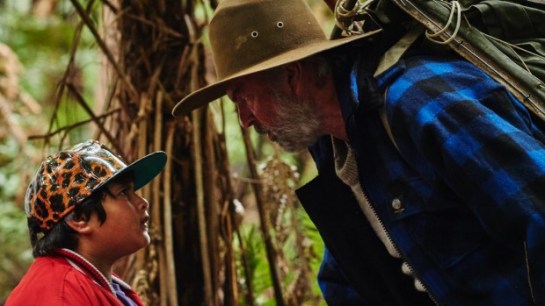
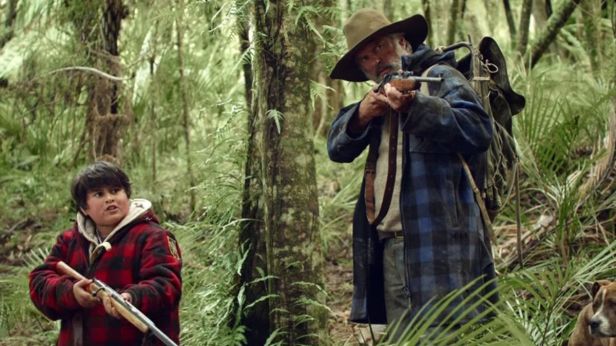
The film tells the story of two very different but equally isolated people. Ricky Baker (Julian Dennison) is a troubled 13 year-old who has been shipped from home to home by child welfare services. After several incidents in the city Ricky is given one more chance at a home life. He is sent to the countryside and new foster parents the quirky but loving Bella (Rima Te Wiata) and the burly, gruff Hec (Sam Neill).

Through circumstances that I’ll let you discover for yourself Ricky runs away into the dense bush but is eventually found by Hec. Child Services, led by the dogged, overzealous Agent Paula (Rachel House), absurdly determine that Hec kidnapped Ricky and therefore set out on a manhunt to find the two. This feeds the film’s main focus – the peculiar relationship between a young boy and an elderly man both with huge needs in their lives.

hunt1

To say Waititi has fun with the whole “opposites attract” idea is an understatement. The clashing of these two drastically different personalities allow for some truly hilarious moments. Ricky’s youthful exuberance against Hec’s grumpy desire to be left alone. Ricky’s street gangster ambitions against Hec’s bushland survivalist skills. Yet they come together through one lone emotional similarity and we get to enjoy the zaniness this unlikely pairing brings.

Much should be said about the performances which are very much essential pieces. This is young Dennison’s third project and he is such a treat delivering a fabulous multi-layered character. We see it in his spontaneous pop culture references, his penchant for writing haiku, and his random child psychology quotes. Dennison exudes a certain sweetness and naïveté that melds so well with the tone Waitiki is going for.

hunt3

Sam Neill is equally vital. He could have easily been your run-of-the-mill surly old-timer, but his performance doesn’t allow for that. He, along with Waititi’s script, blow apart any surface level perceptions we may have of his character. Hec may appear familiar, but Neill takes him in several unexpected directions. In fact the same could be said for much of Waititi’s film. It’s constantly defying expectations.

Waititi’s star is clearly shining brighter and his next film should be a challenge (Marvel’s third Thor film). But “Wilderpeople” is him making movies in his comfort zone. It is a film so clearly and perfectly attuned to his humor and sensibilities. This fun little odyssey pulls from so many directions but always maintains its balance. It’s genuinely tender and sweet but never overly sentimental. The humor ranges from subtle deadpan to big broad comedy but it always works together. All of this testifies to Waititi’s brilliance as a filmmaker and storyteller. The guy knows how to make a movie, and you won’t find a 2016 comedy much funnier than this one.

VERDICT – 4.5 STARS
4.5 STARS

REVIEW: “The Magnificent Seven” (2016)

mag-poster

It’s no surprise that Denzel Washington and director Antoine Fuqua would work together again on a new project. They certainly struck gold with the popular and the acclaimed “Training Day”. But I have to admit I was a bit surprised at their latest creative endeavor. I’m not sure why though. After all this is the age of remakes, reboots, reimaginings, re-everything else.

Their newest collaboration is “The Magnificent Seven”, a modern action crowdpleaser anchored by a fun ensemble cast. The original 1960 Western classic was based on Kurosawa’s masterpiece “Seven Samurai”. This updated film tends to pull further away from its roots but never so far as to lose its identity. It embraces the basics of the story while adding in a few details of its own. And as expected it attempts to do everything bigger most notably the furious wild western action.

mag2

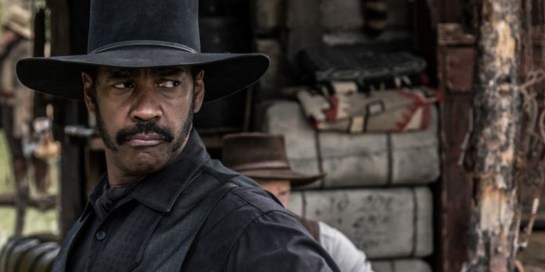
If you haven’t seen the 1960 Western, Yul Brynner led a hired band of misfits to protect a small Mexican village from a gang of violent bandits. In Fuqua’s version the Mexican village is exchanged for a small mining town named Rose Creek and Peter Sarsgaard’s Bogue  is the vile industrialist terrorizing them. Washington takes Brynner’s spot. He plays Sam Chisolm who is approached by a young woman from Rose Creek (Haley Bennett) seeking help.

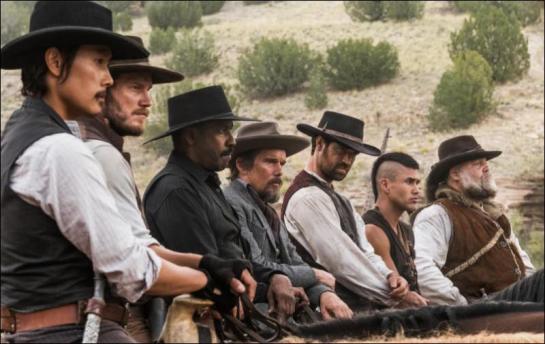
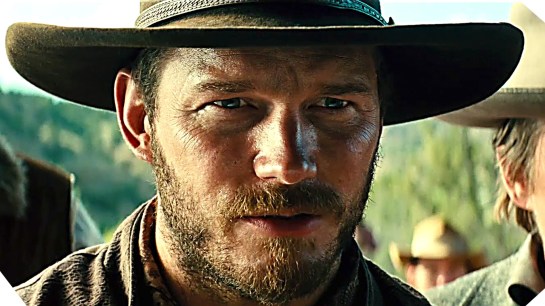
Sam agrees but first he’ll need a team of gunfighters to train the townsfolk and lead the defense against Bogue and his gang. His merry band of wild west outcasts includes a boozing gambler (Chris Pratt), an ex-confederate sharpshooter (Ethan Hawke), a deadly assassin (Byung-hun Lee), a wanted Mexican bandit (Manuel Garcia-Rulfo), a big burly tracker (Vincent D’Onofrio), and a disillusioned Comanche warrior (Martin Sensmeier).

The Magnificent Seven Movie

Fuqua, screenwriters Nic Pizzolatto and Richard Wenk do a good job of building a fun camaraderie between their characters. It’s one of the film’s key ingredients since it genuinely wants to be a buddy-cowboy picture. There is plenty of playful banter, ribbing, and jests but never too much. That’s because it’s also aiming for something more – an old school western.

Watching the movie I couldn’t help but feel a little bit nostalgic. Fuqua tips his Stetson to a number of classic western angles both narratively and visually. His use of the camera is fantastic (great cinematography from another “Training Day” alumni Mauro Fiore) and the score features some of the last work of the late great James Horner. And you’ll clearly notice Fuqua channeling from an assortment of western directors from John Ford to Sergio Leone.

mag3

Expect some fierce and energetic action especially in the inevitable final showdown (which is especially fun). Following a familiar blueprint each character is given their moment to show off their gun-twirling, knife throwing, or dynamite-chunking. What you won’t see is any deeper sense of emotional struggle between these characters. We get glimpses of it especially from one specific character but never enough to divert it from its clear desire to be a straightforward action film.

That leaves “The Magnificent Seven” open to reasonable criticism. It’s not a deep contemplative character study or emotionally heavy drama. It certainly misses some opportunities to incorporate those elements which may have made it a better film. But I’m fine with it since that isn’t what this film is aiming to be. It’s an action romp and Denzel and company pull it off nicely. They are clearly having a blast doing it and I must say I did too.

VERDICT – 4 STARS

4 Stars

REVIEW: “Bonjour Tristesse”

BONJOUR poster

While writing an upcoming blog piece I was compelled to revisit the morally murky waters of “Bonjour Tristesse”. Otto Preminger’s crafty 1958 British-American drama was based on the popular novel by Françoise Sagan. At the time the film danced precariously close to the edge of early cinema standards, causing censors plenty of headaches and heartburn.

In some ways “Bonjour Tristesse” was ahead of its time. Its style of storytelling, its willingness to look at taboo subjects, its nonjudgemental perspectives. All of these were things that would begin showing up more in films shortly after. Upon release critics didn’t necessarily see it that way and the film wasn’t particularly well received. But one of its early champions was none other than Jean-Luc Godard who two years later would make his pivotal French New Wave classic “Breathless”, a film that in some ways found inspiration in “Bonjour Tristesse”.

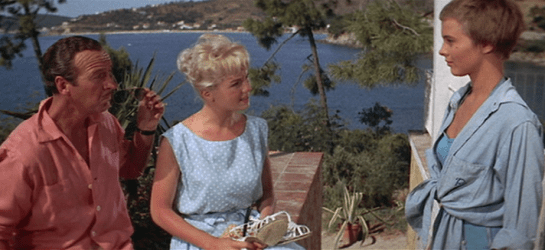
Preminger loves to play with contrasts. Look no further than to the story itself. It swings back and forth between present day and the events of a recent two-week vacation. Both periods are told from the perspective of a young teen named Cécile (Jean Seberg). In the present we spend an evening with her and her wealthy playboy father Raymond (David Niven) as they hop from one expensive nightclub to another. With them is Raymond’s blonde flavor of the evening and several different suitors vying for Cécile’s attention. All of these scenes are presented in black and white.

BONJOUR1

Contrast that with the vivid, bright colors of the vacation flashbacks. The beautiful French Riviera setting is where we get the meat of the story. Cécile and her father are staying at their oceanside villa with his latest fling – a younger, spacey beauty named Elsa (Mylene Demongeot). Their time of fun and frolicking gets a bit complicated when the cultured and proper Anne (Deborah Kerr) arrives. Ever the libertine, Raymond doesn’t hide his attraction to Anne. Meanwhile Cécile grows frustrated with the strict and starchy authority Anne imposes. The various conflicts that follow work together like clever, revelatory puzzle pieces.

The bright, colorful vacation sequences are nice to look at, but they offer more than just beautiful scenery. Through them we learn the reasons for Cécile’s obvious melancholy in the present day scenes. Hiding behind the façade of riches, parties, and the perfect vacation spot lies a subtle repugnancy and an undeniable sadness that slowly simmers to the surface as the movie moves along. Cécile’s emotions are the focus. In fact, the color and black-and-white contrast is directly tied to Cécile’s changed emotional state.

BONJOUR2

“Bonjour Tristesse” takes the audience down several winding narrative paths. There are no jarring twists or sudden diversions. Instead it deliberately and patiently unfolds. Several of the characters take on slow, chameleon-like transformations. The characters are hard to read and various actions change our perception of them sometimes more than once throughout the film. The script lays this out nicely but the performances are just as important.

David Niven is solid as always, effectively selling us his hedonism. He will often carouse about seemingly unaware of his selfishness or the effects of it. We see it in his throwaway attitudes towards his mistresses as well as the oddly affectionate relationship with his daughter. Deborah Kerr is brilliant and her performance provides a pivotal shift in tone and narrative. But it is Seberg whose light shines brightest. She is magnificent as she maneuvers from an innocent, playful pixie to a jaded young woman drowning in disappointment and melancholy. Much like the movie at the time, there were several criticisms about her performance. Personally I feel they are failing to see her performance as a deliberate and cohesive whole.

It would be a mere two years before Seberg would set the French New Wave on fire, but in “Bonjour Tristesse” she and Preminger were playing with several elements that the New Wave filmmakers would take to new levels. It meanders a bit and at times feels a little soapy, but its intelligence, craftiness, and style can’t be denied. “Bonjour Tristesse” is an undervalued and underappreciated film. It holds up magnificently and its influence alone shows the value that many often overlook.

VERDICT – 4 STARS

4 Stars

5 Phenomenal Western Shootouts

PHENOM 5

There have been so many classic western shootouts that it’s unfair to call this the top 5. But each one of these certainly capture exactly want I love about movie gunfights. Unlike a gun duel, a shootout isn’t just about having a quick draw. These five westerns flat-out let the bullets fly and their signature shootouts are ones to remember. As always, I wouldn’t call this the definitive list. But there’s no denying that these 5 western shootouts are absolutely phenomenal.

#5 – “3:10 TO YUMA” (Heading to the Train Station)

PHYUMA

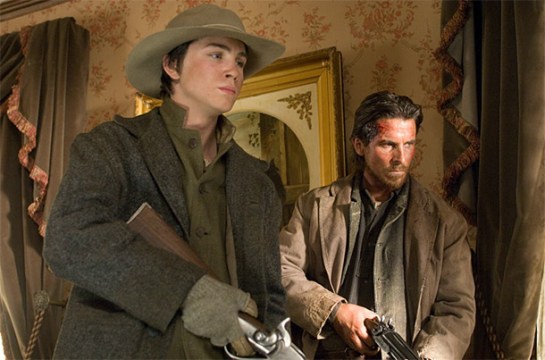
There wasn’t a lot of appreciation for “3:10 to Yuma”, director James Mangold’s remake of the 1957 western. But I loved the film especially the final shootout as Dan (Christian Bale) tries to get his prisoner Ben Wade (Russell Crowe) from the hotel to the train station and ultimately to Yuma Prison. But Wade’s gang is waiting and a firefight erupts as Dan runs through town trying to get Wade on the 3:10. The interesting dynamic between Dan and Wade make the final bullets all the more significant.

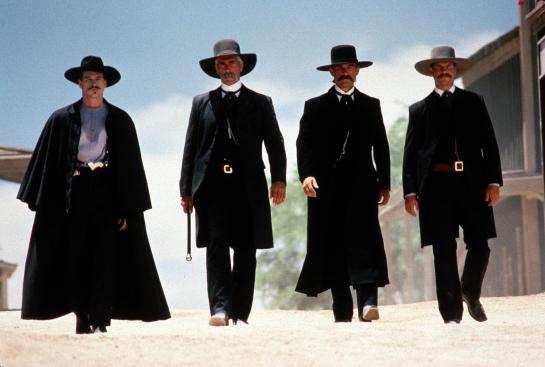
#4 – “TOMBSTONE” (Gunfight at the O.K. Corral)

PHTOMBSTONE

Wyatt Earp, his brothers Virgil and Morgan, and Doc Holliday make their way to the O.K. Corral where members of the Cowboys gang are breaking the law by carrying weapons. Of course it ends up being a fierce firefight which ignites the already existing tension between the Earps and the Cowboys. What makes this scene even better is the buildup leading to the first shot. Incredibly intense and beautifully filmed.

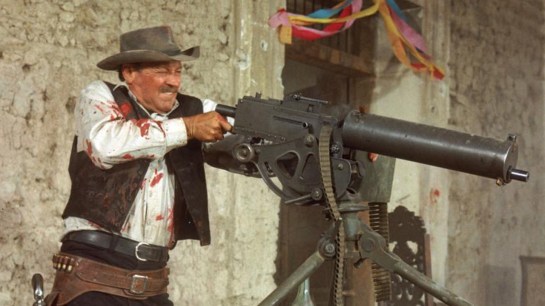
#3 – “THE WILD BUNCH” (Going Out in a Blaze of Glory)

PHWILD

This band of wanted outlaws find themselves up against a crooked Mexican general and his army in the final scene of  Sam Peckinpah’s “The Wild Bunch”. Bullets fly and the bodies pile up in what has been called one of the greatest shootouts in movie history. It’s bloody and hyper violent especially for a 1969 western. But it’s also the only way you would expect this film to end.

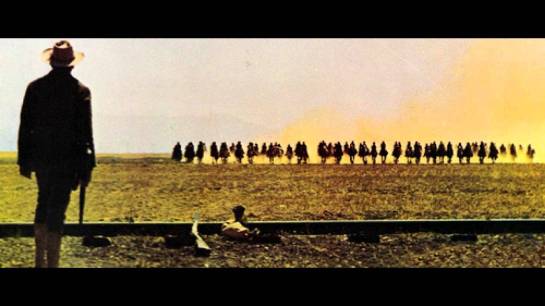
#2 – “MY NAME IS NOBODY” (Jack Beauregard Versus a Different Wild Bunch)

PHNOBODY - Copy

While “My Name if Nobody” is one of the quirkiest spaghetti westerns made. It’s also one of the best. It features a truly classic shootout even though it’s pretty one-sided. As a chance to stage his last showdown, Jack Beauregard takes on The Wild Bunch (obviously not the same as the #3 on this list), a massive gang of bandits. As they approach on horseback, Jack let’s them have it and let’s just say the results are “explosive”. It’s beautifully filmed and the great Ennio Morricone’s score makes the scene even better.

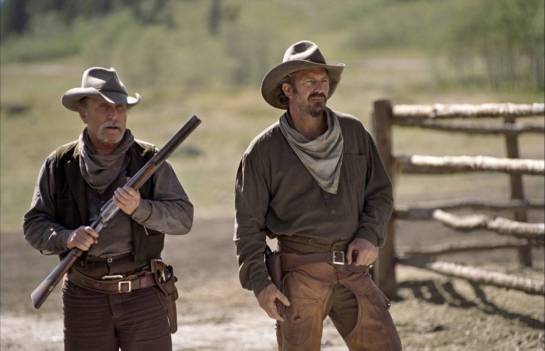
#1 – “OPEN RANGE” (Showdown Against Baxter’s Boys)

PHRANGE - Copy

“Open Range” ends with one of the most intense and realistic gunfights you’ll see as Charley and Boss take on Baxter and his gang in the middle of town. One thing that makes it so effective is the complete absence of music once the guns start firing. There is also some clever camera work that gives the scene a really slick and gritty look. Kevin Costner not only starred in the film but directed it and his eye for a shootout is impeccable. Don’t believe me? Then just give the final 15 minutes of “Open Range” another look. It’s amazing.

Agree or disagree? Do you have a western shootout that I should have included? Leave a comment below and share your thoughts or your favorite western shootout.