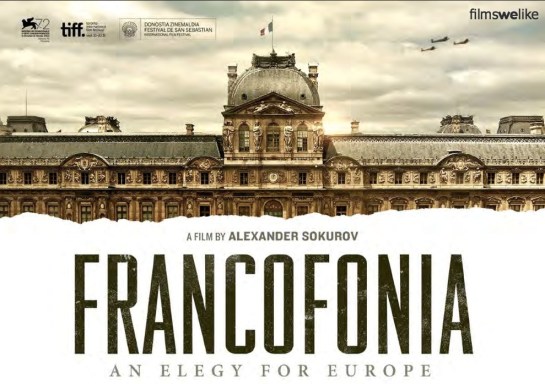
REVIEW: “Francofonia”

FRANCOposterDirector Alexander Sokurov’s love for art and culture was made evident in 2002’s “Russian Ark”. Using a single 95 minute take, this historical drama explored over 33 rooms in Saint Petersburg’s Winter Palace (now part of Russia’s State Heritage Museum). The film is impossible to categorize. It’s rich with dramatic elements while at the same time examining three centuries of Russian history.

Fast forward 14 years to “Francofonia”, a similarly difficult film to classify but equally stimulating in its exploration of art and history. This time Sokurov’s focus is on the Louvre museum in Paris, but it’s not just about the building or its history. There are several interconnected layers built around it that Sokurov comes back to again and again. The Louvre is the most important character in the film, yet it mainly serves as the anchor for Sokurov’s contemplation and reflection.
FRANCO2

“Francofonia” hops back and forth between the past and present, between fact and fiction, between historical accounts and provocative metaphors. In an almost documentarian style Sokurov’s own narration carries us through his mélange of subjects offering an assortment of information and perspectives.

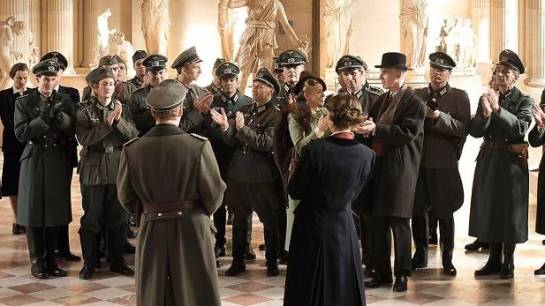
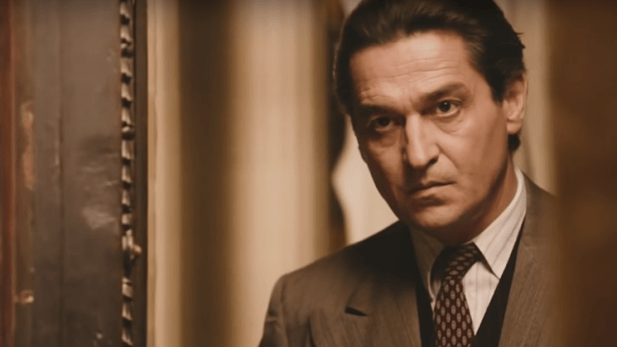
One of the film’s focal points is the relationship between the French director of the Louvre Jacques Jaujard and German officer Franz Wolff-Metternich, the Hitler-appointed overseer of French art and culture. The two met during the Nazi’s occupation of Paris during World War 2 and worked together to save and preserve the Louvre’s collection. The dramatization is presented in bites and surrounded by a medley of historical and artistic thought.
FRANCO1

Sokurov takes time to examine the origins of the Louvre, Hitler’s march into Paris, and the mindsets of Parisians and the French government. He documents the hiding of the Louvre’s paintings in different châteauxs south of Paris – a desperate attempt to keep them out of Hitler’s clutches. All of this is visualized through some incredible old reel footage and photos.

But if that weren’t enough, Sokurov also takes time for deep, thoughtful meditations on art. Some of the focus is on the art itself such as the unique European intimacy with portraits or the timelessness of early civilization pieces. Other meditations ask some compelling questions. For example why was Paris spared when so many other cities were bombed? Could it be the city was saved by none other than the glorious art itself?
FRANCO3

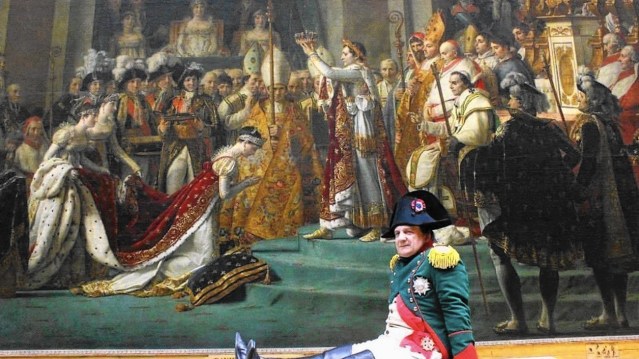
This captivating intersection between art and war is something Sokurov is eager to explore. He reveals how the art of the Louvre and war itself are historically inseparable. In addition to its relevance with the German occupation, the film shows the ghost of Napoleon roaming the museum halls reminding everyone that he was responsible for bringing much of the art to the Louvre – many pieces being spoils of his war victories.

Much more could be said about “Francofonia”. Categorizing it is nearly impossible, but breaking it down is a rewarding challenge. I think the film could best be called Sokurov’s canvass, and on it he presents a collage of thought, reason, and reflection. It is exquisitely shot from start to finish and intellectually honest in how it approaches each of its subjects. It’s certainly not a film for everyone, but I found myself absorbing every second.

VERDICT – 4.5 STARS4.5 STARS

REVIEW: “Ghostbusters” (2016)

GHOSTPOSTER

It still surprises me to see 1984’s “Ghostbusters” venerated by so many. Don’t get me wrong, I think it’s a fun movie with good characters, lots of big effects, and some really funny moments. But going back to my first viewing I never considered it to be the great film that others do. Perhaps that’s why I wasn’t up in arms when I heard the announcement of a remake featuring an all-female team. It also may be why I wasn’t excited for the remake. Well, the crummy trailers didn’t help either. Sadly the trailers and the movie have a lot in common.

Now before I’m accused of mean, closed-minded misogyny remember, I’m no Ghostbusters fanboy or apologist. There are certainly those who have instantly dismissed the movie due to its female leads. But there are also those who have lashed out at any criticisms of the film regardless of their validity. The truth is the movie just isn’t that good. Not because women were cast. Not because of sexism.

ghost1

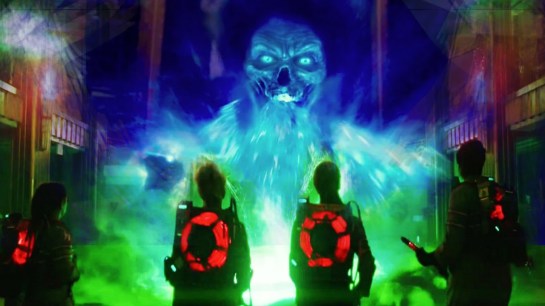
Paul Feig co-writes and directs what turns out to be run-of-the-mill popcorn movie fare. Pieces were in place for what could have been something fun and original. Instead it follows a fairly traditional summer blockbuster blueprint – (1)origin story, (2)buildup, (3)loud, unwieldy, CGI-heavy finale.

There are moments where this new Ghostbusters shows promise. The first 30 minutes or so does a pretty good job of setting up the characters and showing how they come together. To the credit of the ladies, they do their best with what they are given, some better than others. There is also a really fun performance by Chris Hemsworth. In a funny bit of satirical gender swapping, Hemsworth plays an air-headed but good looking secretary. The film has a lot of fun with that.

ghost2

As for the new Ghostbusters, Kristen Wiig is particularly good and her quirky self-effacing humor is a perfect fit for her character. Melissa McCarthy is surprisingly dialed-back and I enjoyed the calmer variation of her usual tiresome schtick. Kate McKinnon has some really funny moments but she is also letdown by the script on several occasions. Leslie Jones is dealt the worst hand from the writers. Her character is paper-thin and given some of the worst lines in the entire movie. But again, the ladies give it their all.

Here’s the thing, you can have the most committed cast, but that means nothing without a good script. Feig and co-writer Katie Dippold do a good job of developing the team’s camaraderie but not much past that. For every mildly amusing joke there are five that fall flat and some that are simply cringe-worthy. Storywise there really isn’t much to it once you get past the origin stuff. The Ghostbusters form. Everyone’s skeptical. Ghosts attack. Ghostbusters save the day. Basically everything outlined in the trailer.

ghost3

Andy Garcia shows up now and then as the New York City mayor, and there is an uninteresting villain (Neil Casey) tossed in to no effect. They offer little to the story which noticeably starts losing steam about halfway through and culminates in a long, effects-heavy ending which looks good but that’s about it.

So what to make of “Ghostbusters”? While it may have been the most unfairly maligned film of the year prior to its release, it may also end up being the most overhyped movie of the year. Some people wanted the film to fail and never gave it a chance from the start. Others want it to succeed so bad that they are impervious to the film’s obvious flaws. But that stuff aside, it really is a shame. Instead of doing something memorable with the great chemistry we see from the cast, “Ghostbusters” settles for being another in a long line of mediocre 80’s movie remakes.

VERDICT – 2 STARS

2 Stars

REVIEW: “The Conjuring 2”

conjuringposter

In 2013 “The Conjuring” came along like a breath of fresh air in an otherwise bland and stale horror genre. The film used some familiar approaches, but it also featured a good, creepy story and two very compelling characters. It was a wonderful horror picture and a surprise box office hit. With a modest $20 million budget the film managed to earn $320 million which pretty much guarantees a sequel in today’s Hollywood.

Now it is 2016, the horror genre is still pretty bland and stale, and along comes “The Conjuring 2” to give it another swift kick in the pants. James Wan returns to direct and co-write this second installment of the terrifying adventures of paranormal investigators Ed and Lorraine Warren. This time he is give $40 million and already the film seems on track to bring in a big return.

conjuring1

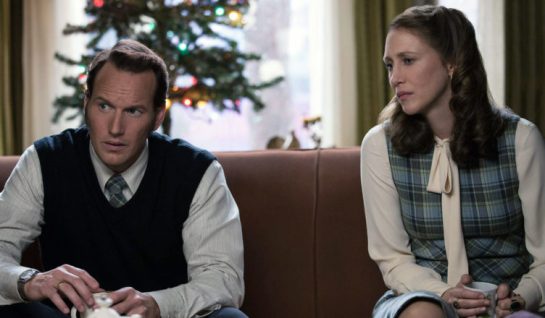
Patrick Wilson and Vera Farmiga reprise their roles as the Warrens this time six years after the events of the first film. It is 1976 and they are fresh off their most publicized case in Amityville, New York. During the encounter Lorraine experiences a horrifying vision which haunts her well after the case ends. Due to her fears the couple agree to step away from their supernatural investigations.

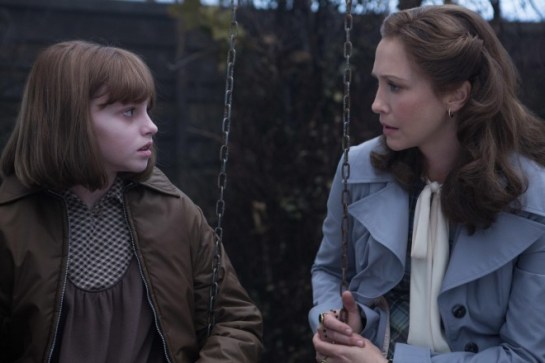
One year later a single mother named Peggy Hodgson (Frances O’Connor) and her four children believe they are being haunted by a violent spirit in their London council house. The Catholic Church asks Ed and Lorraine to go to London to see if there is any validity to the claims. Upon arrival they find that the spirit seems to have targeted 11 year-old Janet Hodgson (Madison Wolfe). The Warrens witness a series of anomalies and must determine the true cause.

The Warren characters we get may be fictionalized versions of the real people, but Wilson and Farmiga bring such personality to each. They still have the same wonderful chemistry and the script smartly manages to further explore their relationship through the events they are experiencing. Their mutual love and faithfulness is something refreshing and unique. I love these two characters and the two performances.

A surprising amount of attention is given to the Hodgson family. Some may struggle with Wan’s pacing, but he intentionally spends time developing their relationships, their social and economic struggles, and of course the frightening things that begin happening in their home. They are easy for us to care for. The writers simply don’t allow them to be disposable characters.

conjuring2

But first and foremost this is a horror movie and thankfully it is every bit as good as its predecessor. The film has its share of jump scares which Wan can build up to better than anyone. But he is more focused on the unsettling creepiness of what his audience sees. So many moments brim with tension simply based on the way Wan deliberately orchestrates the scene or moves his camera. And once again he doesn’t have to rely on blood and gore despite the film’s R rating.

“The Conjuring 2” is a superb sequel that delivers another genuinely spooky experience. It employs several familiar horror movies devices, but as with the first film it uses them in its own unique way. There is a very old-fashioned horror movie approach to these films that I adore. The sequel wisely embraces that formula while also telling another compelling story from the Warren’s casebook. I’m often hesitant when it comes to horror sequels, but if Wan and company can continue this type of quality I’m anxious to see where Ed and Lorraine go next.

VERDICT – 4.5 STARS

4.5 STARS

REVIEW: “The Secret Life of Pets”

PETS POSTER

Illumination Entertainment may not be at Pixar’s level when it comes to box office clout, but their last three animated films have certainly put them into the conversation. 2013’s “Despicable Me 2” brought in $970 million. Last year their spinoff film “Minions” made nearly $1.2 billion. Their latest is “The Secret Life of Pets” and with only five days under its box office belt, the wacky adventure comedy has already earned nearly $175 million.

Chris Renaud, one of the creative minds behind the “Despicable Me” films, directs this examination of the age-old question – what do our pets do while we are away all day? As has become the norm, an all-star cast lend their voices to an array of domesticated (and in some cases not so domesticated) members of the animal kingdom.

The film starts strong by introducing us to a host of pets in a downtown New York City apartment building. It lays out their relationships with their owners and each other while also having fun with the various identifiable pet quirks – a dog gently yelping while having a dream or a cat’s crazed infatuation with a laser pointer just to name a few.

PETS1

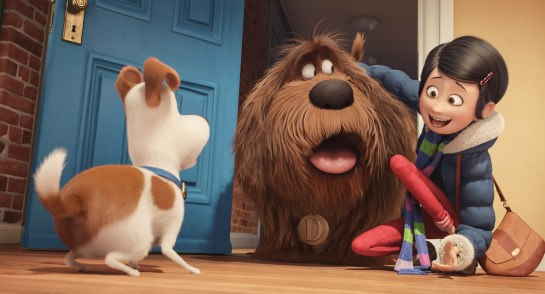
A little terrier named Max (voiced by Louis C.K.) is the lead character. His top dog status takes a hit when his owner Katie (Ellie Kemper) brings home a big shaggy Newfoundland named Duke (Eric Stonestreet). While butting heads at the park the two end up wandering too far into the city where they encounter a feline street gang led by Steve Coogan (that’s funny in itself) and are ultimately caught by Animal Control.

This is where things takes a bit of a dive. Max and Duke are busted out by an underground militant group called “The Flushed Pets”. Their mantra – “liberated forever, domesticated never”. They are led by a fluffy white bunny named Snowball. He’s voiced by Kevin Hart who is basically doing what Kevin Hart always does – giving loud, hyperactive ramblings that just aren’t that funny. And during this stretch the film backburners the fun and charming bits for more run-of-the-mill breakneck animated action.

While that portion of the story sputters, another stays true to the endearing sweetness of the first act. Realizing Max and Duke are missing, the other pets from the apartment building set out to find them led by a prissy Pomeranian named Gidget (Jenny Slate). Add to the band a plump apathetic cat (Lake Bell), a rambunctious pug (Bobby Moynihan), a calm cool dachshund (Hannibal Burress), and a directionally challenged guinea pig (voiced by Renaud).

PETS2

The camaraderie between these furry friends is fun to watch. I couldn’t help but laugh at several interactions that emphasized their unique personalities and pet-specific attributes. Renaud and company clearly have a blast playing with so many things that people (particularly pet owners) will get a kick out of.

Several other things help make this an effectively entertaining picture. Alexandre Desplat’s snazzy score amazingly keeps up and sometimes directs the film’s shifting tones. The animation is wonderfully bright and vibrant while still maintaining that silly exaggerated style that I’ve loved in Illumination’s other films. And as expected the voice acting is top-notch.

You can’t help but notice the “Toy Story” inspiration, but “The Secret Life of Pets” has a good enough premise to set itself apart. For most of the film it cleverly sticks with it. Unfortunately the lull in the middle and Kevin Hart’s unleashed performance brings it down a bit, but never enough kill the fun.

VERDICT – 3.5 STARS

3.5 stars

2016 Blindspot Series: “A Man Escaped”

BLINDSPOT LINEUP

1956’s “A Man Escaped” was the fourth feature from French cinema pioneer Robert Bresson and a showcase for his focused minimalist filmmaking. Considered by many to be Bresson’s masterpiece, the film brims with his signature stripped down presentation, free of any visual or narrative embellishment. In fact the film opens with a message from Bresson that reads “The following is a true story. I present it as it happened, without adornment”.

Bresson’s low-key style is also seen in his aversion to using movie stars in his films. He believed professional actors, much like special effects, drew attention to themselves and away from the story. He also believed professional actors conveyed too much emotion in their performances instead of letting the audience deduce it on their own. Therefore Bresson preferred to cast people to be models instead of performers.

man2

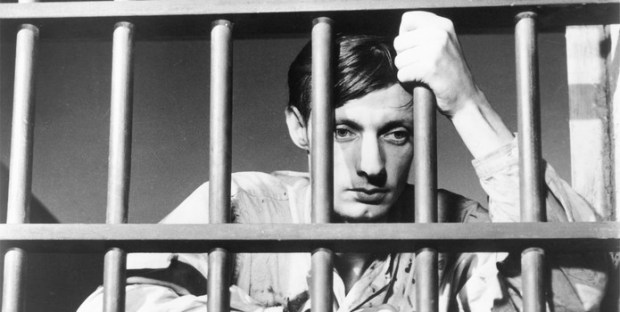
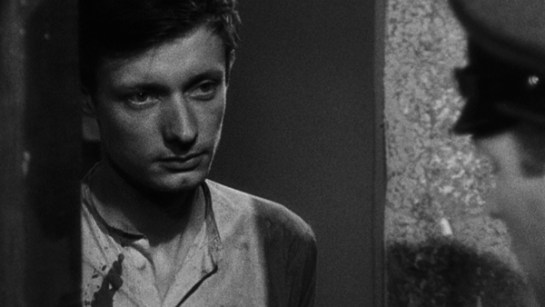
His chosen model for “A Man Escaped” was François Leterrier. He plays a French Resistance soldier named Fontaine. It’s 1943 and the film begins with a captured Fontaine being transported by Nazis to Montluc military prison in German occupied Lyon. The film is based on the true story of André Devigny and his attempt to escape Montluc prison before he is to be executed.

The story is as simple as they come yet so enthralling. With the exception of two brief scenes the entire film takes place within the walls of the prison. Fontaine is our eyes and ears. When he is in the cell so are we. When he is allowed out to wash we are with him. Then back in the cell we go. Everything we learn is from his perspective – from his brief interactions with other prisoners in the washroom, from what he sees from his cell window, or from the sounds he hears.

MAN1

The sound element is crucial to Bresson’s film. As mentioned it often provides information. A good example is the disturbing sounds of echoing machine gun fire each time the Nazis perform an execution. There are no common cutaway shots to visualize it for us. Instead it is spoken to us through the sounds. Bresson also focuses on every sound Fontaine makes as he prepares for his escape attempt. He secretly uses the few things in his room as tools and every sound he makes could tip off the guards.

Fontaine’s narration may be the most vital component in Bresson’s feeding of information. In some films narration can be a crutch. Here it cleverly unveils Fontaine’s feelings and thought processes while adding a surprising amount of depth to his character. It also serves as an important source of time. As we hear Fontaine’s reflections he often alludes to the passing of time – days, sometimes months. Every bit of narration is succinct and has purpose. It doesn’t romanticize the story or character in any way.

MAN3

Bresson frequently channeled much from his personal experiences into his movies. In the case of “A Man Escaped” it’s the cruelty he experienced from Nazis as a prisoner of war during World War 2. Certainly the bulk of his inspiration came from Devigny’s true account, but you clearly sense a personal connection between director and his cinematic canvas.

Robert Bresson was one of the most original and influential filmmakers in cinema history. “A Man Escaped” is an exhibition of his unique style and approach. Spiritual undertones, personal influences, and a minimalist focus are just some of his characteristics highlighted in this brilliant 1956 classic.

VERDICT – 4.5 STARS

4.5 STARS

REVIEW: “Zootopia”

ZOOPOSTER

I think it has become abundantly clear that Pixar isn’t Disney’s only animated money maker. Recently Walt Disney Animated Studios has blown away the box office. It should be said that their films always make money, but their last three animated features have made just under $3 billion. Those films include 2013’s “Frozen”, 2014’s “Big Hero 6”, and now this year’s surprise mega-hit “Zootopia”.

“Zootopia” was predicted to perform well, but no one expected it to break numerous box office records. It shattered projections and has earned over $1 billion globally. Not only did people come out to see it, but most critics lauded it with some even calling it one of the best animated films ever made. That is hefty praise especially for a movie I could never fully embrace.

ZOO1

There are two sides to “Zootopia” that provoked two different reactions from me. Let’s start with the good. In part “Zootopia” is a fun, playful buddy cop film that also tells a touching story of a young bunny setting out to accomplish her dreams despite the numerous obstacles thrown her way. Ginnifer Goodwin plays Judy Hopps, a young country rabbit who sets out to accomplish her dream of being a police officer in the metropolis of Zootopia. But everyone tells her she can’t do it, she’s too small, that no rabbit has ever made the police force.

Judy presses on against a barrage of opposition, graduates from police academy, and lands a job at a Zootopia precinct. But even there she faces a bigotry that lands her on traffic duty. Themes of sexism and prejudice resonate and are handled smartly and effectively. When the film keeps this lean focus it can be surprisingly and subtly thought-provoking.

ZOO2

Unfortunately the film doesn’t maintain its subtlety. In fact it obliterates it. It becomes so ridiculously heavy-handed in its indictments of intolerance, prejudices, and stereotyping. It doesn’t allow for you to think about and chew on their message. It spells everything out in the most obvious ways. At times it feels like they are presenting political talking points instead of a movie script.

And this isn’t an issue found in scattered instances. It’s a drum the writers and directors beat over and over again. They don’t just hit you over the head with their social message. They bludgeon you to death with it. And the problem isn’t that they have a message. It’s that their lack of subtlety and tact subvert the power of it. It resonates early in the film. Later it begins to feel like a big lecture emanating from almost every pore of the story.

ZOO3

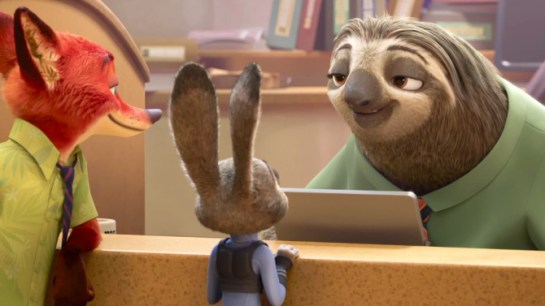
Thankfully we do find moments where we can catch our breath. The central relationship between Judy and a con-artist red fox named Nick (slickly voiced by Jason Bateman) is a lot of fun. There are also some really funny moments. A hysterical bit from the extended trailer involving sloths and the DMV is still laugh-out-loud hilarious. Also seeing Idris Elba playing a cape buffalo police chief is inherently funny.

Clearly “Zootopia” has several things going for it. The humor often hits its mark. Judy and Nick have a sparkling relationship. The deeper themes are provocative and absorbing when wisely explored. Negatively the animation doesn’t blow you away and things can occasionally get a little silly. But those aren’t the biggest problems. The collection of seven writers and two directors get so caught up in their statement that it nearly smothers the message. We aren’t allowed to glean much for ourselves or come to our own conclusions. Instead it becomes a relentless social politics lecture with a handful of breaks in between.

VERDICT – 2.5 STARS2.5 stars