REVIEW: “BEFORE SUNRISE” (1995)

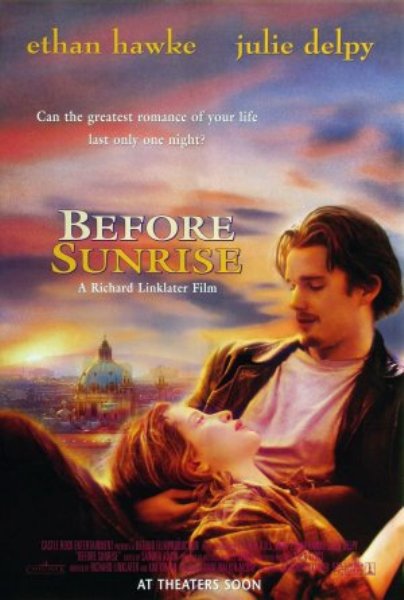
It’s gotten to where it is really difficult to find a good romantic drama or a good romantic comedy out of the host of mediocre to bad films that Hollywood churns out these days. So many of these movies employ the same stale formulas and the same conventional approach to storytelling. Richard Linklater’s “Before Sunrise” is an intelligent and fresh romantic drama that is anything but conventional. Linklater wrote and directed this story of two strangers who meet, take a chance, and truly connect.

“Before Sunrise” is built around an extremely minimal plot. Jesse (Ethan Hawke) and Celine (Julie Delpy) meet while on a train from Budapest to Vienna. Jesse is an American heading to Vienna where he is to catch a plane to the United States. Celine is a student at the Sorbonne in Paris and is returning after a trip to visit her grandmother. The two enjoy a conversation and they both sense a connection between them. The train arrives at Vienna in the early evening and Jesse’s flight doesn’t leave until the next morning. So he convinces Celine to skip her connecting train to Paris the spend the night with him walking through the streets of Vienna.

The rest of the movie follows them as they simply walk and talk. As they stroll through some of the city’s streets, cemeteries, and parks, they share more and more about each other – their beliefs, their pasts, their outlooks, their fears – and we the audience learn who they both are with each passing conversation. Even more, we watch as a spark of attraction turns into romance as the night continues. What’s even more interesting is watching the two pour their hearts out to each other as their time together begins to run out. There is an awareness between them that once she boards the train and he heads to the airport they may never see each other again. Linklater translates that reality to the audience very well and it’s a lot of what drives the second half of the film.

Both Ethan Hawke and Julie Delphy give great performances in a film requiring a lot of dialogue, some delivered through very long takes. The script almost feels as though it were written with them in mind, particularly Hawke, when actually Linklater had a hard time finding the perfect actors for the part. Hawke and Delphy work off of each other wonderfully and it’s their natural genuineness mixed with a perfect handling of the characters that sells both them and their romance. While Linklater brought aboard Kim Krizan to add a solid female influence into the story, it’s also said that both Hawke and Delphy contributed to the script. I think that’s another key reason that they work so well with the material.

Now there’s no denying that “Before Sunrise” is very talky and on the surface there isn’t a lot that happens. And even though I loved the glimpse into Vienna’s culture, Linklater – while certainly using it to a degree – doesn’t make the city and the culture a key player in the film in the same way as say Woody Allen did with Paris. It’s truly a movie about two strangers connecting and talking. Now as I mentioned, there is a meatier subtext and a more grounded and authentic look at spontaneity, personal reflection, and romance. But I can see where Linklater could have used the Vienna setting more to the movie’s advantage.

Overall, “Before Sunrise” is honest and straight-forward. There are no false moments or pretenses from the film, the characters, or the story and that’s one of the things that makes it work so incredibly well. You believe in the characters and you believe in their romance even though it’s based on one small spontaneous act. Watching these characters unfold was a delight and the ending didn’t undo what the rest of the movie accomplished. “Before Sunrise” may not be for everyone, but it’s a truly romantic yet in some ways sad look at two individuals who aren’t nearly as assured as they let on to be.
VERDICT – 4 STARS

REVIEW: “Big Miracle”

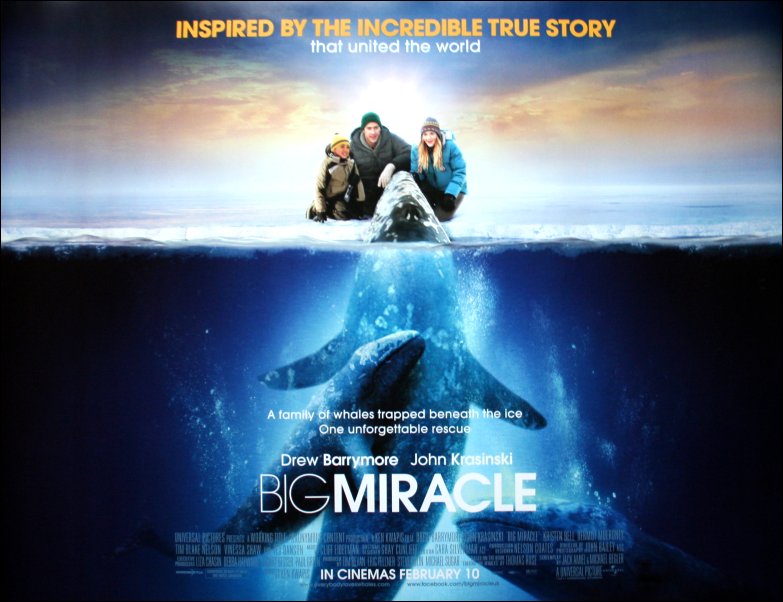
The “incredible true story” of three California gray whales trapped in ice in The Arctic Circle certainly has all the ingredients for a feel-good family film. But as with many of these types of pictures, they are often burdened with shallow characters and even shallower writing. Unfortunately “Big Miracle” falls well short of the potentially good subject matter. It’s yet another case of taking a surefire gimme of a story and completely missing the mark.

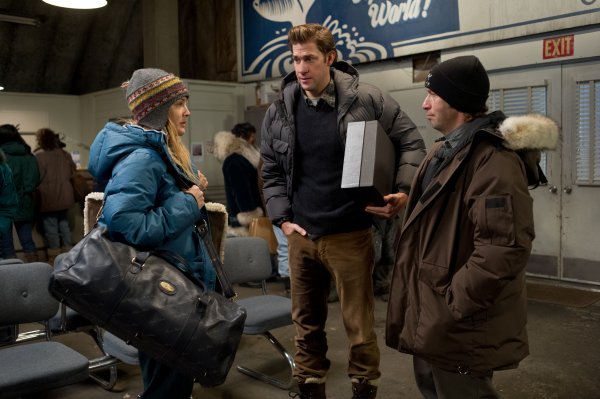
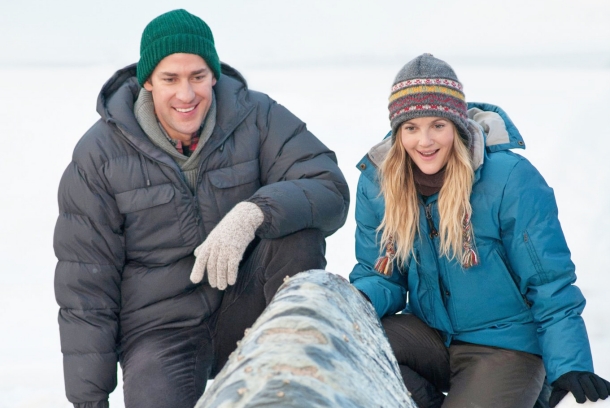
“Big Miracle” is a movie with a message but it also tries to play it both ways. Drew Barrymore stars as Rachal Kramer, a rather rabid Greenpeace environmentalist who is immediately drawn to the news story of three whales trapped in ice off the coast of Alaska. The story is reported by Adam Carlson (John Krasinski), a local reporter who hopes to use the story as a way to climb the TV journalism ladder. Rachel and Adam know each other and we learn that they have a history. Her more dogmatic approach to the whales’ plight clashes with his career boosting motivations and, as you will see coming a mile away, he must decide what’s more important, the lives of the whales or his own selfish ambitions.

We also get several stereotypical characters that Hollywood never gets tired of using. We get the blonde reporter who is beautiful but all about the story first. We get evil politicians who, by the film’s depiction, hates the whales and the environment and are only interested in fattening their pockets and increasing their approval ratings. We get a macho National Guardsman who is straight-laced and by the books and even a mean old oil executive. Oh, and throw in some local whale hunters and the obligatory “cute kid” to round things out. All of these people are brought to the light by our compassionate environmentalist heroine.

Now there’s nothing wrong with making a movie with characters who are environmentalists and there is certainly nothing wrong with making movies with a good message about taking care of the environment. Some movies have done it right, others bludgeon you to death with it (see “Avatar”). But in “Big Miracle”, Barrymore’s character is just whiny and grating. Now to be fair, the movie does try to show her as someone who doesn’t quite understand the big picture. The local Inupiat whale hunters make a case that hunting is their way of supporting their families. It provides food and other necessities. The movie uses a couple of scenes that attempts to show both sides of the argument. I don’t know if this was an honest attempt at representing all bodies of opinion or if it was just an attempt to not seem so heavy-handed with their main message. Either way the supposed friction between the two sides feels terribly contrived.

The movie also isn’t helped by some pretty lame dialogue. Rachel is constantly making overly dramatic and at times down right silly statements, my personal favorite being “Ronald Reagan killed the whales!” So many characters speak in ways that are true to the typical caricatures they portray. Throw in several of the gimmicks used with these types of movies and in the end you really don’t have anything that impressive or memorable.

“Big Miracle” does have a pretty amazing story at it’s core and to be fair you do get glimpses of it. The idea of people coming together from different viewpoints both environmentally and politically is certainly a good message. Also the movie does manage to keep you interested in the whales and whether or not they’ll survive their horrible predicament. While the ending offers no real surprise, it’s still fairly successful in packing a little emotional punch.

That being said, “Big Miracle” still has too many flaws to make it worth recommending. It feels like a film dedicated to an overused formula, a formula that quite frankly I’ve grown tired of. It’s also another example of a “family film” that still feels the need to slip in an assortment of profanities and even uses the always annoying ‘kid cursing’ attempt at humor. Throw in the cheesy dialogue, boring caricatures, and uneven direction and you have a movie that fails to execute even with the good story it has to work with.

VERDICT – 2 STARS

REVIEW: “BATTLE OF THE BULGE” (1965)

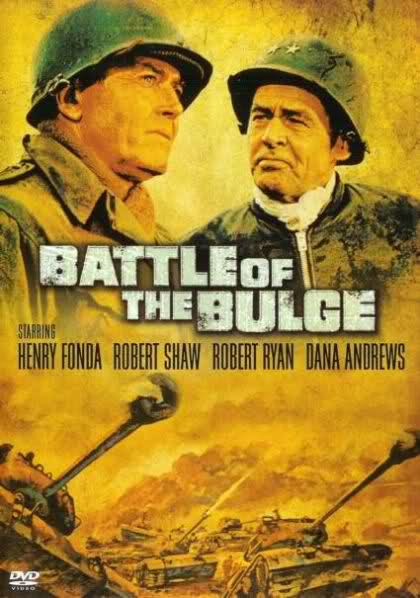
Ken Annakin’s “Battle of the Bulge” from 1965 is another solid entry into the field of War World 2 films. Over the Memorial Day weekend I had the opportunity to finally catch up with the entire film. “Battle of the Bulge” (the movie) has an interesting history. It was met with a wide range of opinions, mostly positive but plenty of negative. Some criticized the film for it’s obvious historical inaccuracies. Others griped about it’s overly talky and bloated script. There certainly is some merit to these and other criticisms, but I found the movie to be a solid war picture despite it’s overly long running time.

“Battle of the Bulge” is the telling of the German’s last-ditch offensive through the heavily forested mountain regions of Belgium in the later days of World War 2… at least the title of the film suggests that. It could be better described as loosely based on events surrounding the bloody, costly, and complicated battle. The film doesn’t depict any particular real-life figure during the war. It’s clearly intended to be a drama set during wartime. This is something some people took issue with but I don’t think the movie ever pretends to be something it’s not. Perhaps it could have chosen a different title for the film, but historical accuracy doesn’t seem to be a goal. That said, the movie does attempt to capture elements from the real 50 day battle. Some of the attempts work more than others.

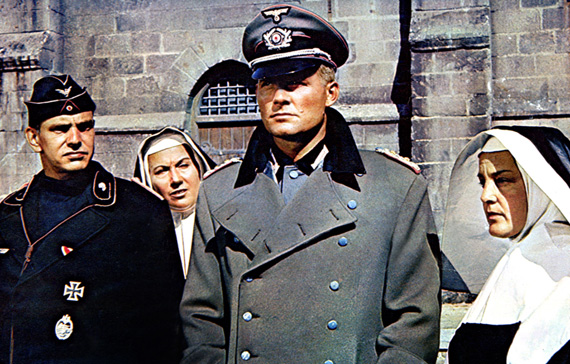
The film’s centerpiece seems to be Colonel Hessler (Robert Shaw), a German officer put in charge of a large group of new King Tiger tanks. His mission is to slam into and push back the Allied lines which are slowly hemming the Germans in. The Americans believe the Germans are undermanned and out of resources and incapable of a worthwhile offensive, everyone except Lieutenant Colonel Kiley (Henry Fonda). During an overhead recon flight, Kiley noticed German tanks in hiding which leads him to believe the Germans are planning an attack. His suspicions are dismissed by General Grey (Robert Ryan) and the Americans are caught unprepared when Hessler and his tank division hit the Allied lines.

Hessler seems loosely based (there’s that description again) on the real-life Nazi Joachim Peiper. Peiper was a shrewd and brutal field officer with close personal connections with Himmler. During The Battle of the Bulge, Peiper was to lead a division of the new King Tigers. The tanks were heavily armored but they were gas guzzlers (it’s said the went about 1/2 mile per gallon of fuel). We see some of this with the movie’s Hessler character. He is a shrewd and dedicated German and we definitely see the fuel issue play a key role in how things turn out. But Peiper was a high-ranking SS Nazi and was convicted of war crimes for the brutal massacre of American prisoners and civilians who he came across during the battle. Hessler isn’t an SS officer and seems to be angered when he hears of a massacre that took place elsewhere during the offensive.

On the American side we send a lot of time with Lt. Col. Kiley as he tries to persuade the higher-ups of the upcoming attack and later as he plays a key role in trying to figure out Hessler’s ultimate strategy. We also spend time with Major Walenski (Charles Bronson) and his soldiers who find themselves face-to-face with Hessler’s forces on more than one occasion. Some of my favorite moments in the film revolved around Walenski and his men. I guess that’s why I was a little let down by the way he just drops off the map later in movie. Once he disappears, we never see him again. Telly Savalas plays Sgt. Gruffy, a tank commander who has a little business on the side. The movie tries to build a little story around him but it’s pretty flimsy. I did enjoy the short side-story about a green, by-the-books Lt. Weaver (James MacArthur) and the seasoned Sgt. Duquesne (George Montgomery). When things go bad for the two Weaver flaunts his rank while Duquesne relies on his field experience. It’s a familiar dynamic but one that I enjoyed.

But the complaints about the movie’s script are legitimate. There were instances where it felt like we were seeing the same thing over and over. The American leaders would discuss what the Allied game plan should be. Then we would switch to Hessler and his heads talking about a better course of action for them. Then we would do both all over again without making any progress in between. There were also some scenes that could have been edited better. For example, there is a cool scene where the Allies are sending guns via train to the front line to stop Hessler’s advance. The camera is put on the front of the train as it races to it’s location. But the coolness wears off as the scene just keeps on going and going. There were also several scenes features rolling tanks that seem to go on forever. A little better editing could have cut out some wasted time on scenes like these.

And while I don’t think the movie should be dismissed simply because it’s not historically accurate, I can see where some may not be as fond of it due to certain out-of-place details. For example, the location of a big tank battle close to the end almost resembled Arizona more than Belgium. It didn’t at all feel connected to the real environment in which they fought. In fact, much of the Battle of the Bulge was fought in snowy, hilly areas with thick forests. We see small bits of that here and there but it completely disappears later in the film. Now I perfectly realize that this is something that only someone interested in the history behind the battle would fuss about. And while it would add so much more to the film for someone like me, it really isn’t something that killed my enjoyment of the picture.

On the flip side, “Battle of the Bulge” is a visual delight. The film is filled with huge detailed set pieces and wide screened action sequences that feel completely authentic. The camera work is fantastic and there are times where the carefully crafted angles blew me away. Jack Hildyard, the Oscar-winning cinematographer for “Bridge on the River Kwai”, handles the same duties here and his work is fantastic. The movie is immediately set apart by it’s visuals and they only get better as the film progresses.

Yes “Battle of the Bulge” is long and sometimes talky. No it’s not a movie to watch in order to learn the real details of this historical and important battle. But in terms of cinematic entertainment, the movie works. The performances are good especially from Shaw and Bronson and it’s visual presentation can stand with any other war picture. “Battle of the Bulge” may not be the best World War 2 movie, but it’s certainly a satisfying film that captures a lot of the action and spirit you want. It’s definitely worth checking out.

VERDICT – 4 STARS

REVIEW: “Battle: Los Angeles” (2011)

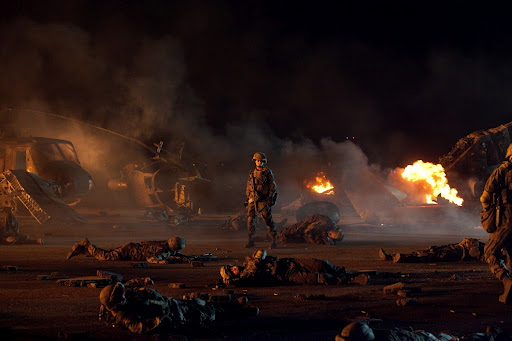
When reviewing a film I always try to consider what kind of movie the filmmakers intend to make. It’s especially important to employ this philosophy when reviewing a movie like “Battle: Los Angeles”. I enjoy all kinds of movies including those that are intellectually challenging, emotionally stimulating, or even the proverbial mindless popcorn picture. “Battle: Los Angeles” is very honest about it’s intent and never pretends to be something it isn’t. It could best be described as “Black Hawk Down” meets “Independence Day”. It takes realistic, gritty military combat and mixes it with the alien invasion angle. It’s a loud, simple, explosion filled action film that does succeed to a degree.

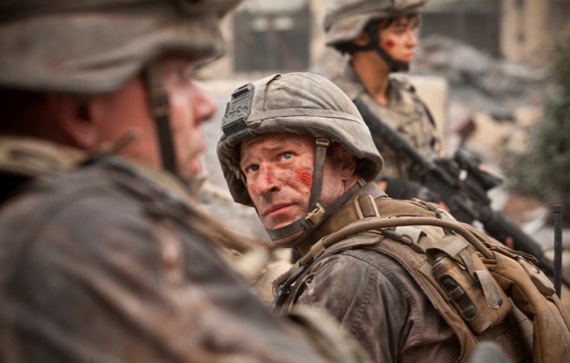
In some ways it resembles a video game, not only by it’s title but also by it’s look and feel. What’s funny is that many modern video games have more plot than “Battle: LA”. It’s a very basic story. A staff sergeant (Aaron Eckhart) and his new platoon are sent into the alien infested Los Angeles battle zone to help escort out a small group of stranded civilians. That’s really it. It starts with a very brief introduction to the platoon but almost immediately the first attack occurs and the action takes off, only occasionally slowing down for small doses of character developing dialogue. While they try to add some degree of depth to the characters, other than Eckhart’s, none are all that interesting.

The movie also uses every military cliché you can think of. Whether it’s the personalities in the platoon or the contrived dialogue, you name the cliché, it’s used here. We’re also offered very little in regards to explanation. We hardly know anything about the alien invasion even though we do gather tidbits of information through brief glimpses of CNN newscasts (which I actually liked). The movie vaguely informs us that the alien’s objective is to steal our water and we get a little information about how they function. But to be honest, in this type of film is it really that important? Obviously the filmmakers think not.

“Battle: LA’s” action is it’s bread and butter and it’s largely impressive. Director Jonathan Liebesman used handheld cameras to give his film the familiar documentary feel while recreating the chaos and intensity of war. It’s nothing we haven’t seen before but it works more often than not. While a few scenes are a little disorienting it’s very effective most of the time. The CGI is generally good and especially shines in the large-scaled shots of the city and in images showing the massive destruction from the battles. The look of the aliens is serviceable but I was never blown away by them or their technology. There are some fierce action sequences particularly a frantic battle on a freeway and the final battle which I won’t give away. For my money, these scenes worked pretty well.

Aaron Eckhart is well cast as the combat-seasoned staff sergeant and the only remotely interesting character. Michelle Rodriguez plays the exact same type of role she always plays. The other performances range from fairly good to pretty bad. But then again this isn’t a performance driven picture, right? The bigger problem is the actors aren’t given much to work with. They also aren’t asked to do much more than shout and shoot so judging acting performances in this type of picture is pretty pointless.

“Battle: Los Angeles” isn’t a perfect film but it’s an honest one. It’s aim was to be a pre-summer popcorn action movie and it hits it’s mark. The trouble is the plot is paper-thin, the aliens aren’t that menacing, and it’s loaded with pointless, forced, and clichéd dialogue.. But the action is intense and it’s shot and edited in a way that pulls you into the combat. Even with it’s shortcomings, it manages to be a fairly entertaining getaway, but it’s not one that will stay with you very long.

VERDICT – 2.5 STARS

REVIEW: “The Boy in the Striped Pajamas”

PJsPOSTER

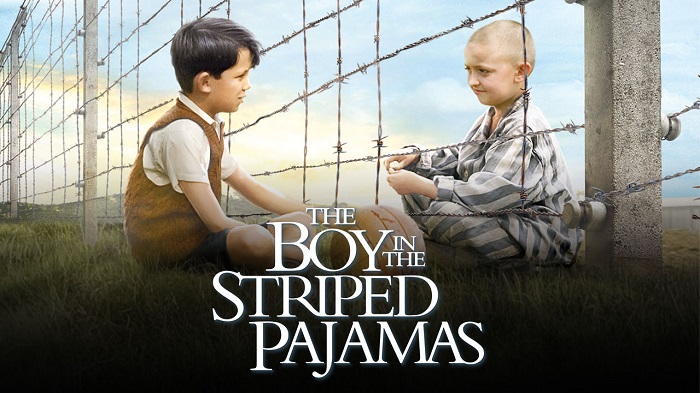
Obviously there have been several powerful films that have dealt directly with the Holocaust. “The Boy in the Striped Pajamas” is a unique look at this murderous and genocidal scar on world history. It’s based on John Boyne’s 2006 novel of the same name and looks at the subject through the eyes of an 8-year-old boy. It’s a tender but crushing tale of the loss of innocence as we watch this young boy discover the truth about the world around him. Some critics have said it exploits or trivializes the Holocaust with others going as far as to call it offensive. I found it to be a careful yet devastating drama that ultimately succeeds in the end.

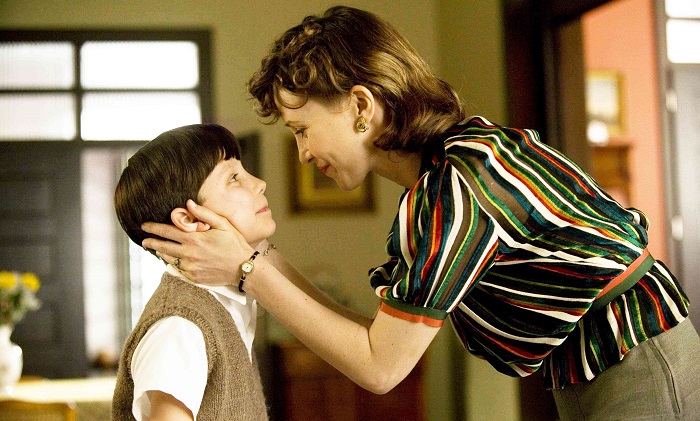
Asa Butterfield, better known for his more recent starring role in “Hugo”, plays Bruno. His father Ralf (David Thewlis) is a Nazi SS officer who gets a new assignment requiring him to move with his family from Berlin to the countryside. Bruno’s mother Elsa (Vera Farmiga) supports her husband’s decision. But Bruno finds himself alone and missing his friends back in Berlin. His loneliness and boredom spurs his curiosity and he begins noticing several interesting things about his new location. One is a mysterious “farm” in the distance that he sees from his bedroom window but is forbidden to visit or ask about. He’s also intrigued by a house servant who he notices is wearing what looks like striped pajamas. Of course we know the servant is Jewish and a captive, but through young Bruno’s eyes things are more confusing.

PJ1

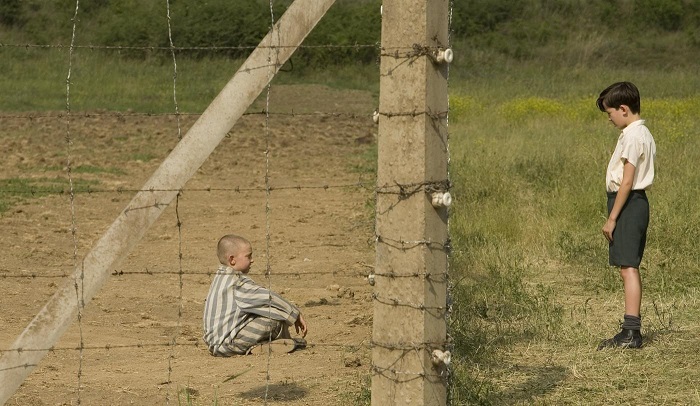
One of the most engaging things about the movie is that writer and director Mark Herman is able to keep us inside of Bruno’s head even though we know exactly what’s going on outside of his knowledge. I found the film to be very effective at conveying the feeling of discovery as Bruno learns more. Perhaps his biggest lessons come not from his twice-a-week tutor who bombards him with all sorts of Nazi propaganda and revisionist history, but from a young Jewish boy. Bruno encounters the boy after sneaking away from his house and stumbling across the “farm”. Of course it’s actually a Nazi execution camp and the boy, named Shmuel (Jack Scanlon), sits on the other side of an electrified fence. The two quickly develop a friendship. It is Shmuel who begins to shed light on what this “farm” really is and causes Bruno to question both his father and his cause.

The movie never loses sight of the fact that Bruno is only 8-years-old. He struggles with what he’s seeing and his attempts to reconcile certain things with his desire to see his father as a good man is heartbreaking. Even when his mother finds out why they’ve moved to the country and furiously confronts Ralf, we still witness these things through Bruno’s child-like reasoning. But there is an emotional balance. While we spend most of our time with Bruno, we know of the atrocities that are taking place almost entirely off-screen. Yet these atrocities are relayed to us very well in often subtle ways.

PJ2

The performances throughout the film are fantastic. Farmiga is one Hollywood’s better actresses and she shows that here. I also appreciated Thewlis’ portrayal of a man who often times puts his role of father in complete subjection to his duties as a Nazi soldier. But it’s young Butterfield who gets the vast majority of the screen time and he is quite good. He draws a lot of sympathy and emotion  and it’s always great to see a young actor able to pull that off. I also enjoyed his scenes with young Scanlon. While Butterfield is better in their scenes, they both handle the material nicely.

I can see where “The Boy in the Striped Pajamas” may put off some people. It’s hard to watch especially as everything comes to a head at the end of the film. In fact, it’s a movie I’m in no rush to see again. That isn’t due to any major shortcomings with the picture. It’s due to the film’s intense emotional punch that stuck with me for several days. I was incredibly moved and while there are some legitimate questions that could be asked about the story, the movie’s main point resonated with me. “The Boy in the Striped Pajamas” asks several powerful questions about war, family, and morality. It also gives us a glimpse into a part of our world’s history that is still hard to look at but should be reckoned with.

VERDICT – 4 STARS

4-stars

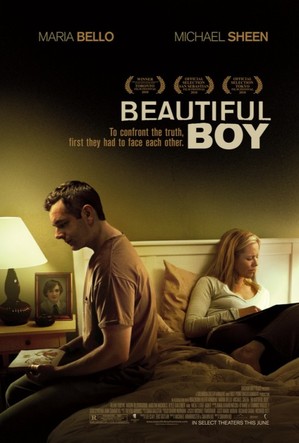
REVIEW: “BEAUTIFUL BOY” (2010)

It’s hard to know how to take some movies inspired by real-life tragic events ripped from the newspaper headlines. They can sometimes be sobering and enlightening while others can be exploitative and irreverent. “Beautiful Boy” is a crushing drama that deals with the agony of a school shooting but from a different point of view. It’s obvious similarity to the 2007 Virginia Tech massacre is not by accident. Director and co-writer Shawn Ku’s connection to the college not only helped inspire the story but is one reason this intense subject matter is handled with such care and respect. The thrust of story doesn’t center on the horrible event itself. Instead its focus is on the devastating effects the massacre has on the shooter’s parents.

Maria Bello and Michael Sheen play Kate and Bill, a disconnected married couple on the road to separation. The one single thread holding them together is their son Sam (Kyle Gallner). Sam is a college freshman who has struggled adjusting to campus life. Sam calls home one night trying to hide his despondency from his parents. Bill and Kate attribute his emotion to the pressures of college life. But the next morning police arrive at their home to inform them that Sam has opened fire at his school killing 17 people before taking his own life. This all happens early in the movie while the rest of the film explores the brutal effects it has on Bill and Kate’s already strained relationship.

While Sam’s actions play a key role in the story they serve more as a backdrop. We don’t get inside Sam’s head and really examine his motives and some may have a problem with that. But it’s no problem for me since the movie’s intention is to look at a marriage on the brink of dissolution. Both Bello and Sheen deliver grounded performances that often times result in scenes driven by realistic, raw emotion. Their son’s acts cause them to face issues simmering beneath the surface of their marriage and their reactions feel natural and true. You watch as the chasm between them grows wider yet no one understands what they’re going through except each other. It’s an interesting dynamic that works more often times than not.

The movie does require the audience to automatically connect with Bill and Kate. We never get much insight into their relationship prior to the shooting. We see their relationship is strained but it’s hard to connect with them other than through their emotional devastation brought on by the loss of their son and the horrible circumstances surrounding it. I really felt for them especially as we see them deal with things such as the media camped out on their lawn, having to issue a public statement, and the stares of curious neighbors and co-workers all on top of their personal loss. But their relationship could have been easier to invest in if we were given more early in the film.

The movie also has an inconsistent visual style. At times it seems to be intentionally striving for a more artsy look with quick camera sweeps and strategic camera angles. Other times it looks very generic and by-the-book. I also wasn’t a big fan of the rather drab color palette. The movie seems soaked in blues and grays. Obviously this was intentional and I’m sure it was meant to convey the overall mood of the picture. But it was a little too much for me.

Even with its flaws “Beautiful Boy” can be a powerful film that handles some tricky and weighty subject matter with care and compassion. It was certainly a different approach seeing this type of horrifying event through the eyes of the parents and while their marriage isn’t opened as much as I wished, it’s impossible not to moved by the emotional distress this couple faces. Shawn Ku handles the material seriously and truthfully and some fine performances from Sheen and Bello help make up for the film’s shortcomings.

VERDICT – 3.5 STARS