2016 BlindSpot Series: “Cléo from 5 to 7”

BLINDSPOT LINEUP


One of most influential movements in cinema came in the form of the French New Wave. Visionary filmmakers like Truffaut, Godard, and Chabrol sought to shatter the formulas and artifices that dominated mainstream movies. These brilliant auteurs redefined the art of cinema while also developing their own distinct styles and unique techniques. Nestled comfortably in the male-dominated movement was Agnès Varda, a pioneering filmmaker who gave the era a strong female voice. Varda was known as the grandmother of the movement and one of her signature films is “Cléo from 5 to 7” from 1962.

The film is about a singer named Cléo (played by Corinne Marchand). She is a tall beautiful picture of health, but we quickly learn she is ill and awaiting test results that could have serious after-effects. The story follows Cléo as she walks through Paris shopping, meeting friends, doing anything she can to take her mind off of the news she expects to receive later that evening. Along the way we see her wrestling with mortality and struggling to maintain any sense of optimism.

CLEO1

At around the halfway point of the film we realize that Cléo is also wrestling with her own identity. She has become exactly what everyone expects her to be. Her superstitious maid treats her like a child. Her musical collaborators don’t take her talents seriously. She is treated like a toy of convenience by her boyfriend. All seem indifferent to her illness and unconcerned about her worries. Cléo takes off on her on and for the last half of the film we see her shedding layers of her old self. It’s a rediscovery of sorts in the two hours left until she is to get her diagnosis.

“Cléo from 5 to 7” is told through a subtle documentarian style – a technique often used by New Wave directors. Varda tells the story in almost real-time allowing us to gather information by simply following Cléo around. Her camera often sits and observes while other times it’s in a constant state of motion. There are some fabulous long tracking shots specifically of car rides around Paris. Then there are quiet but powerful moments where the camera focuses on Marchand’s face. Varda was known as a talented photographer and we see it reflected throughout this film.

CLEO2

Marchand is a nice fit for the role of Cléo. I loved watching her start as a beautiful but scripted human being and then transform into her equally beautiful but truer self. We see her peel off the facade she’s built on other’s expectations and Varda represents this in Cléo both physically and emotionally. The character runs the gamut of emotions which culminates in a final intensely satisfying shot of Marchand’s face. It’s a very interesting and subtly expressive performance that nicely serves Varda’s vision.

“Cléo from 5 to 7” is La Nouvelle Vague through and through. Those unfamiliar with the New Wave movement will instantly notice the artistic uniqueness and nuances that have influenced filmmakers to this day. And after so many years this film still feels like something fresh and innovative. That is a testament to Agnès Varda’s remarkable writing and direction and the pioneer vision that she and so many of these filmmakers maintained.

VERDICT – 4.5 STARS

4.5 STARS

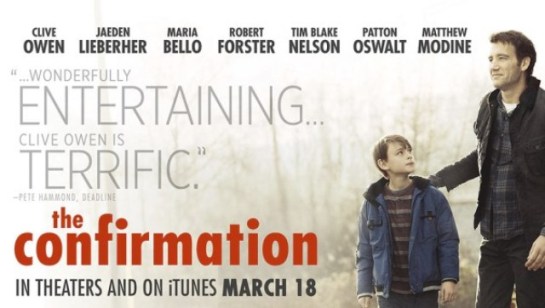
REVIEW: “The Confirmation”

confirmposter

Bob Nelson’s first splash in the world of cinema was a big one. Director Alexander Payne was asked to find a director for Nelson’s original screenplay “Nebraska”. Payne was so impressed with the script he petitioned to direct the film himself. “Nebraska” would go on to receive six Academy Award nominations including one for Nelson. Not a bad feature film debut.

“The Confirmation” is Nelson’s second feature length screenplay and his directorial debut. Much like with “Nebraska”, Nelson grounds “The Confirmation” in no-nonsense, real world drama and just the right amount of dark humor. In many ways this story feels familiar, but there is an unglossed earnestness to every dramatic detail and a genuine, raw emotional undercurrent that makes it strikingly unique.

confess2

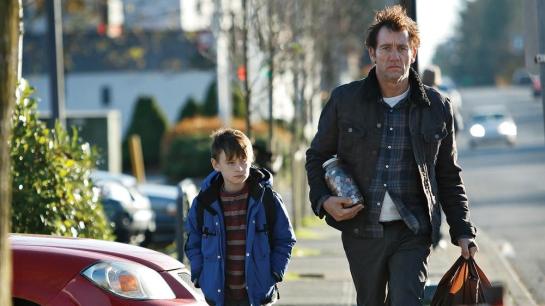
Clive Owens (one of the most underrated actors working today) plays a down-on-his-luck carpenter named Walt. Since his divorce Walt has struggled to make ends meet as an independent construction contractor. He can’t find a job and his wife Bonnie (Maria Bello) has threatened to revoke his visitation rights to their son Anthony (Jaeden Lieberher) if he doesn’t get his drinking under control.

Bonnie asks Walt if he can keep Anthony for a night while she and her husband Kyle (Matthew Modine) go on a church couples retreat. Walt agrees and the story follows their eventful 24 hours together. It revolves around a box of tools stolen from Walt’s truck. The two set out around town to find them encountering a motley assortment of people along the way. Most importantly it offers Walt and Anthony a much needed opportunity to reconnect.

While Walt is a major player it could be said this is a story about Anthony and his head-on collision with real life. Nelson shows us so much of the film through Anthony’s eyes. The movie starts with him at confession unable to list a single sin. He truly is a good boy but while navigating an array of moral gray areas with his father Anthony breaks nearly every commandment. This opens him up to the realities of the world and also of himself.

confess1

This is Lieberher’s second father/son movie of 2016. He was alongside Michael Shannon in the superb “Midnight Special”. Both roles require a very specific demeanor which Lieberher has no trouble with. He also maintains a wonderful rapport with Clive Owen. There is a striking similarity between the two performances. Both are authentic and unobtrusive, never relying on artifice or show.

Perhaps my greatest compliment for Nelson is this – every second we spend in his film feels like we are in the real world. Nothing feels fabricated. Nothing feels manipulative. It’s impressive because so many filmmakers could take this same concept and fill it to the brim with sappy melodrama and overblown sentimentality. Nelson is smarter than that and his movie reflects it.

VERDICT – 4.5 STARS4.5 STARS

REVIEW: “The Conjuring 2”

conjuringposter

In 2013 “The Conjuring” came along like a breath of fresh air in an otherwise bland and stale horror genre. The film used some familiar approaches, but it also featured a good, creepy story and two very compelling characters. It was a wonderful horror picture and a surprise box office hit. With a modest $20 million budget the film managed to earn $320 million which pretty much guarantees a sequel in today’s Hollywood.

Now it is 2016, the horror genre is still pretty bland and stale, and along comes “The Conjuring 2” to give it another swift kick in the pants. James Wan returns to direct and co-write this second installment of the terrifying adventures of paranormal investigators Ed and Lorraine Warren. This time he is give $40 million and already the film seems on track to bring in a big return.

conjuring1

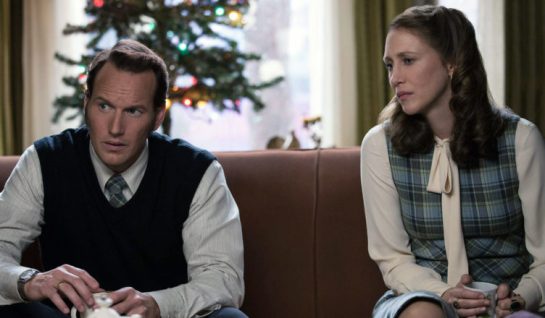
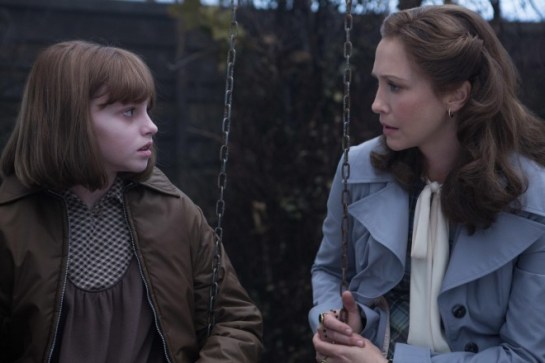
Patrick Wilson and Vera Farmiga reprise their roles as the Warrens this time six years after the events of the first film. It is 1976 and they are fresh off their most publicized case in Amityville, New York. During the encounter Lorraine experiences a horrifying vision which haunts her well after the case ends. Due to her fears the couple agree to step away from their supernatural investigations.

One year later a single mother named Peggy Hodgson (Frances O’Connor) and her four children believe they are being haunted by a violent spirit in their London council house. The Catholic Church asks Ed and Lorraine to go to London to see if there is any validity to the claims. Upon arrival they find that the spirit seems to have targeted 11 year-old Janet Hodgson (Madison Wolfe). The Warrens witness a series of anomalies and must determine the true cause.

The Warren characters we get may be fictionalized versions of the real people, but Wilson and Farmiga bring such personality to each. They still have the same wonderful chemistry and the script smartly manages to further explore their relationship through the events they are experiencing. Their mutual love and faithfulness is something refreshing and unique. I love these two characters and the two performances.

A surprising amount of attention is given to the Hodgson family. Some may struggle with Wan’s pacing, but he intentionally spends time developing their relationships, their social and economic struggles, and of course the frightening things that begin happening in their home. They are easy for us to care for. The writers simply don’t allow them to be disposable characters.

conjuring2

But first and foremost this is a horror movie and thankfully it is every bit as good as its predecessor. The film has its share of jump scares which Wan can build up to better than anyone. But he is more focused on the unsettling creepiness of what his audience sees. So many moments brim with tension simply based on the way Wan deliberately orchestrates the scene or moves his camera. And once again he doesn’t have to rely on blood and gore despite the film’s R rating.

“The Conjuring 2” is a superb sequel that delivers another genuinely spooky experience. It employs several familiar horror movies devices, but as with the first film it uses them in its own unique way. There is a very old-fashioned horror movie approach to these films that I adore. The sequel wisely embraces that formula while also telling another compelling story from the Warren’s casebook. I’m often hesitant when it comes to horror sequels, but if Wan and company can continue this type of quality I’m anxious to see where Ed and Lorraine go next.

VERDICT – 4.5 STARS

4.5 STARS

REVIEW: “Calvary”

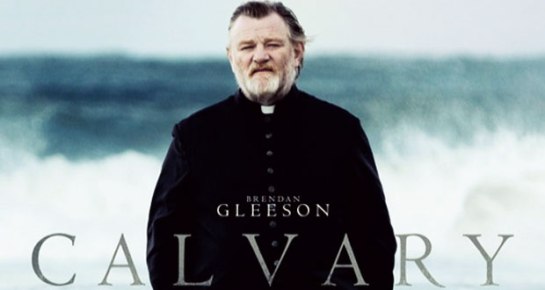
Calvary poster

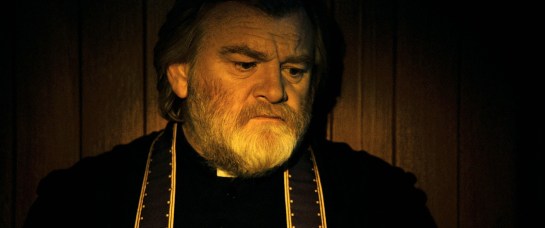
The opening scene in “Calvary” wastes no time conveying the tone of the film – bleak, cynical, and disturbing yet with an odd touch of subtle dark humor. The scene opens with a shot of Father James in a confessional. The camera never leaves his face. He is listening to a parishioner talk about the horrible sexual abuse he experienced as a child at the hands of a now deceased priest. He says he is going to kill Father James in one week because killing a “good priest” would be a much bigger shock to the Catholic Church. The scene ends.

This brilliantly unsettling opening sets the framework for writer and director John Michael McDonagh’s stinging Irish drama. The story moves through what may or may not be Father James’ final week on earth. He spends the time going about his normal work in his Irish coastal town – tending to the church and tending to his flippantly immoral and ungrateful flock. We also see him getting a few personal things in order, you know, just in case.

Calvary1

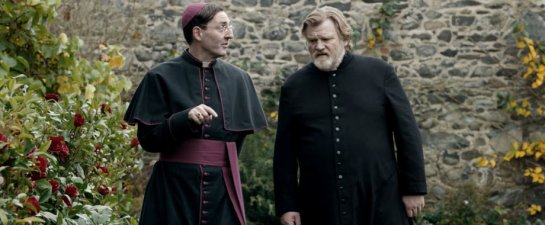
Father James is played by Brendan Gleeson, an actor so naturally gifted and perfectly cast. Father James is an earnest and faithful man of the cloth. He is a man of integrity which allows him a degree of respect from the community. But at the same time that same virtue and integrity is what they hate about him. It clashes with their shameful and unrepentant lives. His encounters and conversations with these people make up the bulk of the story.

One by one we meet these townsfolk each with their own level of vileness. A fantastic supporting cast flesh out these heathens and ingrates. Chris O’Dowd plays a local butcher and abusive husband. His wife (Ola O’Rourke) is no saint. She shamelessly flaunts her affairs, her latest being with a cocky Ivorian (Isaach de Bankolé). Aidan Gillen plays a disgustingly calloused athiest doctor and Dylan Moran plays a lonely, pompous, and self-absorbed millionaire.

There are a handful of other characters that round out this motley crew of miscreants. All of them view Father James as a walking joke – a punching bag for their cruel and merciless ridicule and mockery. These are really bad human beings and we begin to wonder how much Father James can take. He truly is a good man (McDonagh stated he wanted to make a film about a good priest). We often see him bewildered by the gall of these people and it feels as if he wears down a bit more with each encounter.

Calvary2

Thankfully there are a few small rays of light among the downers. Father James has the opportunity to reconnect with his daughter Fiona (Kelly Reilly). The two haven’t been close since her mother died several years earlier. Repairing the fractured relationship would feel a void in both of their lives. For James moments with Fiona are like a refuge and an escape. In a way it is for us too. These scenes give us (the audience) a slight break from the ugliness.

And then there is the mystery of who wants to kill Father James. Is it one of the people he encounters throughout the final week he is given to live? In a clever narrative maneuver McDonagh makes it clear that James knows who has threatened him. But we do not. So we also watch these encounters and conversations with a slight deductive eye. This isn’t the main focus of the story yet it’s a fun and crafty way to engage the audience even more.

Calvary3

“Calvary” is indeed a movie of conversations, one right after another. This could make some a little wary but it shouldn’t. McDonagh’s writing is just so good and each conversation seems important to the story and full of meaning. There is also some gorgeous imagery in the form of landscapes, ocean views, and green-coated mountains. It’s magnificent to see but it also serves as a sharp reoccurring contrast between the beauty of the scenery and the ugliness of the people living there. McDonagh offers several creative touches like this which douses his film with grit and energy.

And it all comes back to Gleeson, the veritable linchpin of this layered but slyly simple character study. The man strikes every note with an unmistakable honesty that comes through in each thoughtful response, in each perplexed expression, and each tired and weary sigh. There is a gelling, a chemistry if you will, between Gleeson’s approach and McDonagh’s script which gives us a realistic and sturdy anchor within the film’s almost otherworldly vileness. That clash is just one of the film’s many compelling components.

VERDICT – 4.5 STARS

4.5 STARS

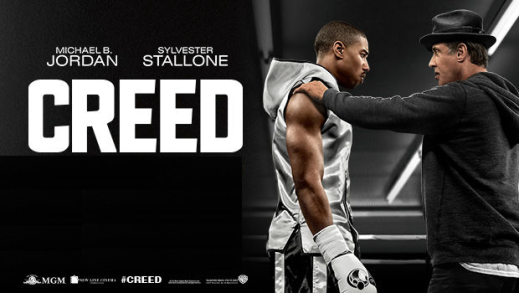
REVIEW: “Creed”

CREEDPOSTER

If you had told me at the start of the year that I would pay money to go see a “Rocky” spin off with old man Stallone training the son of Apollo Creed I would have laughed in your face. Nothing about that concept sounds appealing. If you would have told me I would not only see the movie but thoroughly enjoy it, I would have called you insane. Yet despite my closed-minded skepticism “Creed” turned out to be one of the bigger surprises of 2015.

A ton of credit can go to the film’s director and co-writer Ryan Coogler. You may remember him from 2013’s “Fuitvale Station”. Coogler reunites with his Fruitvale star Michael B. Jordan to give us a film that is one part spin-off and one part sequel to 2006’s “Rocky Balboa”. On paper this sounds like an all-around bad idea but Coogler does something special. Much like Fruitvale there is an earnest dedication to telling its story through human lenses. There is such a genuine humanity to the film that even when we get the big crowdpleasing moments, they feel completely earned.

Creed1

The movie begins by introducing us to Adonis “Donnie” Johnson (Jordan), a young man living in the shadows of a troubled childhood. He is the son of the late boxing great Apollo Creed and born from an extramarital affair. Apollo’s widowed wife (Phylicia Rashad) finds Donnie in a juvenile facility and takes him in. She gives him a plentiful life and helps him get a good job with a promising future.

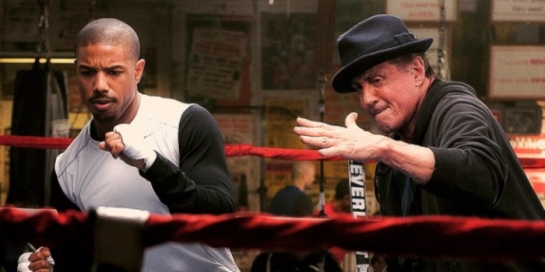
But there is a perpetual inter-turmoil inside of Donnie. He is filled with anger and angst that he releases through fighting. First it’s small-time fights in Tijuana, Mexico, but later he quits his job to go pro in hopes of carving out a name for himself. He heads to Philadelphia to seek out his father’s close friend Rocky Balboa (Stallone). He asks Rocky to train him but the aged former champ turns him down. Donnie’s persistence combined with loyalty to an old friend leads Rocky to take the young fighter under his wing.

You could say Coogler is simultaneously telling two different stories. Donnie’s is a search for his own identity. He wants no part of his father’s legacy and he keeps him a secret. He wants to make his own name and plow his own path. But at the same time he needs guidance and stability in his life and in the ring. We genuinely like the guy because he is an underdog. That’s why audiences first embraced Rocky way back in 1976. Jordan has the same charm and authenticity to win us over.

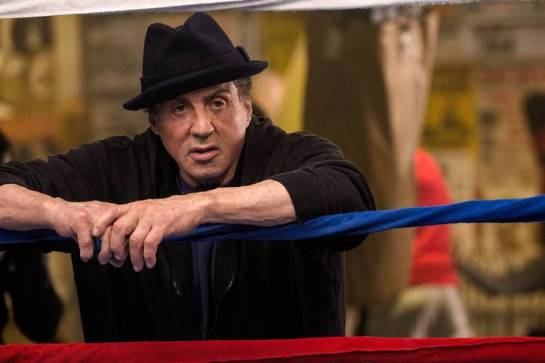
But there is also the story of Rocky. Gone is his swagger and larger-than-life persona. Replacing it is a melancholy contentment with where he is at in this stage of his life. He’s tired, older, grayer and Stallone wears it truthfully and without an ounce of show. The physicality is gone yet Sly is given a lot more to do. It’s a deeper and dramatically meatier role and I would call it easily one of the best performances of his career.

Boxing is certainly a key part of this film, but it mainly serves as a support for the true meat and potatoes. Coogler is interested in his characters and their relationships. Every boxing scene whether training or an actual fight tells us more about Donnie or it builds up his relationship with Rocky. Then there are other characters like a local musician (Tessa Thompson) who Donnie falls for. She opens up an entirely different side of Donnie. But these relationships work because Coogler takes his time and allows them room to grow and breathe.

Creed3

Coogler also shows a remarkable technical ability especially for a young filmmaker. There are so many things I liked about his presentation. There are several fabulous tracking shots that cleverly use lighting or darkness to give the appearance of long takes. And how many boxing sequences have we seen over the years? Yet Coogler’s slow-moving camera and his knowledge of when to pull the camera back and keep it still result in some exhilarating boxing scenes.

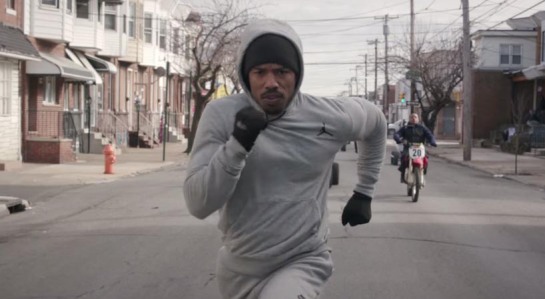
There are other impressive touches such as the way he shoots Philadelphia and the handling of the music (often teasing us with variations of Bill Conti’s original “Gonna Fly Now”). It all works to service the characters and their stories. “Creed” has its clichés and its big mandatory crowd-pleasing moments, but even they are handled well by a confident filmmaker who is a true rising talent. For Coogler this is a step up from the admirable “Fruitvale Station”. For Jordan it’s a bold ‘getting back on track’ after “Fantastic Four”. And for the 69 year-old Stallone it could equal and invitation to the Oscars. Now that would certainly bring a smile to my face.

VERDICT – 4.5 STARS

4.5 STARS

REVIEW: “Cop Car”


COP POSTER

Over time I’ve come to realize that often the best thrillers aren’t bigger budgeted movies with an attention grabbing cast. No, often the best thrillers are small budget pictures that take a strong concept and build on it with a smart, focused, and economical script. Look no further than last year’s fabulous “Blue Ruin”. In that same mold, this year we get “Cop Car”, a crafty, early Coen-esque styled thriller that earns its feelings of danger and discomfort.

“Cop Car” is directed and co-written by Jon Watts. He may not be a familiar name but that could change as he is slated to direct the next re-rebooted Spider-Man film. While that project doesn’t excite me, “Cop Car” certainly did. Within a tight and fluid 85 minutes, Watts spins his minimalist yarn across the expansive fields and long straight roads that surround his hometown of Fountain, Colorado. With a stressful patience he unfolds his story that starts with adolescence mischief but ends up in a much darker place.

Cop Car1

The story begins with two 10-year old boys Travis (James Freedson-Jackson) and Harrison (Hays Wellford) crossing a large field playing some weird game involving cursing (Not a good start for me as I normally hate when filmmakers require young children to spout obscenities). It appears as if the boys may have run away from home as they make a number of boyish miscalculations. One figures they have already walking 50 miles while the other speaks of rationing their Slim Jim beef jerky.

Neither Jackson or Wellford come across as trained young actors which is both good and bad. In some early scenes you sense the strong pull of the director while in others the children’s natural curiosity and playfulness play out perfectly. We see the latter when the boys stumble across a Quinlan County sheriff’s car in an isolated, sparsely wooded area. Their curious nature gets the best of them and soon they are driving the car across open fields and rural roads, screaming and laughing in a mix of childlike mischief and pre-teen rebellion.

They are impervious to the real trouble they are in. In one scene that highlights their puerile logic, the boys ponder what they will do if caught with the car. One innocently and sincerely says ” We’ll just tell them we’re cops”. But the cop car belongs to Sheriff Kretzer. He’s played Kevin Bacon armed with thick mustached mug and a shady air about him. From the very first glimpse of Bacon we know his character is no good and we know the boys have stumbled into a dangerous mess. When finding his car missing, Sheriff Kretzer panics and sets out to get his car back at any cost.

COP2

“Cop Car” has its share of darkly funny moments that can be both humorous and unsettling. About midway through the film the story takes on a more serious and sinister tone and the humor becomes scarce. And I’m convinced that neither Jon Watts nor co-writer Christopher Ford (also known for the much tamer “Robot and Frank”) have children because of the torturous emotional wringer they run the kids through during the film’s second half. This isn’t necessarily a criticism. It just amps the tension up to panic-inducing levels for parents.

The movie ends on just the right note by leaving several specifics up in the air and several questions swirling in our minds. The story’s intensity boils to what seems like a satisfying crescendo only to hit us with a new set of stakes and then leave us on an emotional edge. It’s a satisfying conclusion to a solid movie that navigates a few hitches to still give us a potent, edge-of-your seat thriller. And then there is that tenacious performance from Kevin Bacon – one of my favorites of the year.

VERDICT – 4 STARS
4 Stars