REVIEW: “The Defiant Ones”

Classic Movie Spotlight

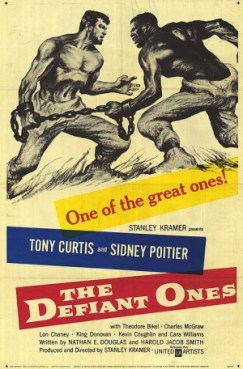
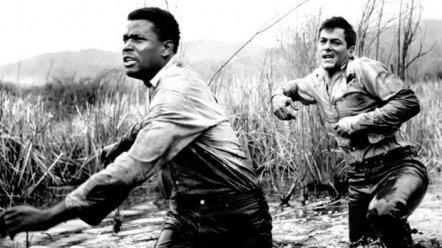
DEFIANTStanley Kramer’s “The Defiant Ones” opens with a prison transport truck on a dark and rainy night. The guards in the cab are distracted by two fighting prisoners which causes them to lose control and roll into the ditch. With a heavy rain falling two men stumble out of the prison truck. They take off running, shackled together arm to arm, a white man and a black man. Each have their own prejudices and each have a hatred towards the other. The question becomes will they escape the law or will they kill themselves first?

Kramer was known for making what some call “message movies”. Throughout his acclaimed career he addressed a number of social and political issues. “The Defiant Ones” takes a candid look at racism through two fascinating characters and a story that allows for a pointed but entertaining approach to the subject. Tony Curtis and Sidney Poitier handle the two lead roles and it doesn’t take long to see that these two men hate each other. Constant insults and unflattering nicknames such as “Colored” and “Joker” make up the bulk their early conversations.
DEFIANT1

The shackles that bind them together serves as an interesting metaphor. I won’t spoil it by going into detail but it was clearly the intent of Kramer and writers Harold Jacob Smith and Nedrick Young (Young had been blacklisted at the time. In fact both writers won Oscars for the film and Young’s award went to his pseudonym Nathan E. Douglas). On one hand the movie is a thriller about two escaped convicts and the manhunt to find them. But the social aspect can’t be ignored and unlike some of the more heavy-handed approaches that we see, “The Defiant Ones” looks at this subject through a smart and effective lens.

Tony Curtis wasn’t the first choice to star in the picture. Kramer insisted that Poitier be his man but conflicts involving Robert Mitchum and Marlon Brando, both in the running to star in the film, made that a problem. Mitchum eventually turned down the role and Kramer maneuvered his filming so that Brando had to drop out due to prior obligations. This opened the door for the casting of Curtis. I’ve always been mixed when it comes to Tony Curtis but he delivers a fantastic performance. His character’s arrogance and unbridled racism is the catalyst for the animosity between the two. Curtis slides into the role and sells it nicely.

DEFIANT2

But Kramer’s main choice Sidney Poitier was the real standout for me. Poitier is often looked at as a pioneer for African-Americans in the film industry. He certainly is that. But he was also a brilliant actor and we see it in this film. Poitier portrays a tough and rugged guy who has clearly been hardened by his experiences. There isn’t an ounce of insincerity from Poitier and I found his character compelling from the start. Both he and Curtis received Best Actor Oscar nominations (both would lose to David Niven for “Separate Tables), but for me Poitier is the highlight of the picture.

“The Defiant Ones” is also a visually stunning film thanks to Sam Leavitt’s Oscar-winning cinematography and Kramer’s sharp direction. A strong supporting cast featuring Theodore Bstraight ikel and Cara Williams (both of whom also received Oscar nominations) add even more quality. This is a smart and crafty movie that manages to be reflective and insightful. But it’s also highly entertaining as a thriller and it rarely takes its foot off the pedal. It hooked me from the opening scene.
VERDICT – 4.5 STARS

REVIEW: “The Darjeeling Limited”

DARJEELING POSTER

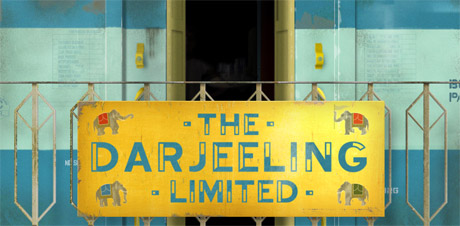
I’m a huge Wes Anderson fan so whenever he makes a film I take notice. But oddly enough his 2007 comedy/drama “The Darjeeling Limited” is one I still needed to see. In true Anderson style “The Darjeeling Limited” has a quirky sense of humor and it dabbles in several of the filmmaker’s familiar themes. It also features some of Anderson’s acting staples including his old college buddy Owen Wilson, Jason Schwartzman, Adrien Brody, and Bill Murray. And while some people consider this some of Anderson’s lesser work, I think it’s a movie that captures what I like about his films while carving out its own unique path.

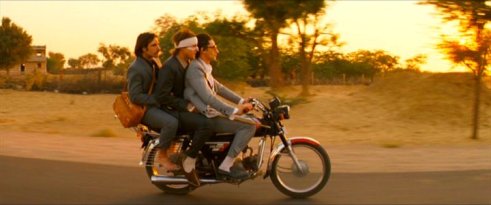
In this offbeat concoction the opening scene is important. In India a businessman (Murray) tries unsuccessfully to catch his train as it departs the station. While he fails another man, encumbered by heavy luggage, just manages to board the train as it heads down the tracks. This short sequence is a microcosm of the entire film. It’s strange, funny, well shot, and filled with meaning.

DAJEELING1

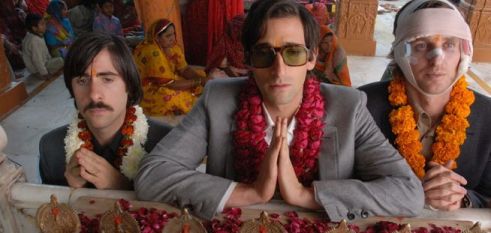
The man who made the train is Peter (Brody). He is onboard the Darjeeling Limited passenger train to meet his two brothers, the controlling and downright anal Francis (Wilson) and the brokenhearted and obsessive Jack (Schwartzman). The three haven’t seen each other since their father’s funeral and Francis sets up the reunion in hopes of bringing them closer together. The train trip across India is framed as being a spiritual awakening of sorts but Francis may have something else as his motivation.

The movie pulls many laughs from these odd personalities, but that shouldn’t come as any surprise. Wes Anderson’s wacky cinematic worlds routinely feature idiosyncratic people with an assortment of troubles and in various states of despair and melancholy. His humor can be a bit prickly. By that I mean it isn’t easy for some viewers to cozy up to. Personally I love his unique brand and we get plenty of it in this film. But there is also a strong dramatic thread that runs throughout the film and really shows itself in the last act. This mix of well executed comedy and heartfelt, meaningful drama is what drives the picture.

Considering the amounts of dry kooky humor, it may surprise some people to find this much heart. But Anderson has always had a knack for that. He’s always dealing with family troubles as well as feelings of isolation and despondency. We certainly get that in this film. There is symbolism scattered throughout the film that deals on more emotional levels once they are realized. For example, take the aforementioned luggage. Anderson takes something simple like luggage, weaves it throughout the narrative, and uses it to make one of the movie’s more effective points. These treats are clever and satisfying.

Darjeeling2

I also must give credit to Wilson, Brody, and Shwartzman. These guys work so well within Anderson’s narrative style which probably explains why he keeps going back to them. The three offer great subtlety in their humor and watching them play off each other is a lot of fun. But they also dial it back when the story calls for it which is vital. Theres some good supporting work from Amara Karan as a train stewardess, Wallace Wolodarsky as Francis’ “assistant, and Waris Ahluwalia as the Darjeeling’s chief steward. Bill Murray has a brief but fun role and Anjelica Huston has a small yet important appearance. There are also some nice cameos from Natalie Portman (remember Hotel Chevalier?) and Irrfan Khan.

“The Darjeeling Limited” is soaked with Wes Anderson’s style. Whether it’s the humor and storytelling or his visual methods which include panning cameras, use of colors, or his particular use of music. There are a few lulls that the film experiences particularly in the second half. They never last long but they are noticeable and maybe they do keep this from being some of Anderson’s best work. Regardless I’m still a big fan of this film. I laughed a lot and I really responded to the emotional tugs we get later on. In the end it’s yet another example of why I love Wes Anderson movies.

VERDICT – 4 STARS

REVIEW : “The Descendants”

DESCENDENTS POSTER

“The Descendants” is a film from director Alexander Payne that first came out Oscar ripe. It’s a heavy story that deals with several conflicting emotions that flow from situations that are all too real for many people. It can be a difficult film to watch at times but it can also be quite moving. I can certainly understand the reason for the Oscar buzz it received mainly due to some incredible performances. But the movie both underplays and overplays some parts of the story which for me held it back a tad.

The story follows Matt King (Clooney), a husband and father of two who lives in Hawaii. He’s a rich man who gained his wealth by being a descendant of Hawaiian royalty. He is the sole trustee of 25,000 acres of pristine virgin land on the island of Kauai. But Matt tries to stay grounded. He works as a lawyer and uses that salary to support his family while employing his father’s perspective that you should always work for your money. Matt and his cousins have entertained offers for the land. Some want to sell it to a huge group from Chicago while others want to sell to a local Kauai developer. Matt has the final say and must weigh the wishes of his family with what’s best for the community. We learn most of this in the first few minutes of the movie through expository voice-overs. In many films this could be seen as a crutch but here it works surprisingly well and gives us key elements to the story which sets up what’s to come.

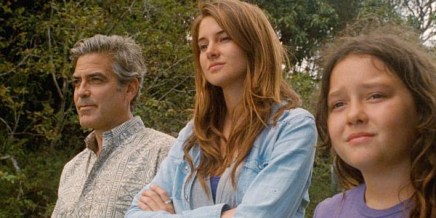
But within the first few minutes of the film it’s revealed that Matt’s wife has had a serious boating accident which leaves her comatose in an intensive care unit. Things look bleak and Matt struggles to bring together his two daughters. One is the impressionable 10 year old Scottie (Amara Miller) and the other is the bitter, irreverent 17-year old Alex (Shailene Woodley). To make matters worse, Matt finds out that his wife has been cheating on him with a younger real estate agent. The story takes Matt on an emotional roller coaster as he tries to balance feelings of anger and betrayal with the reality of his wife’s current state. There is a unique complexity to the story and while there is a lot going on emotionally, Payne makes everything feel genuine and authentic.

DESCENDENTS1

While “The Descendants” does keep everything feeling reel, it does overplay a vital element to one of the film’s key relationships. Matt struggles and at times looks inept when it comes to parenting. This was never more clear than in his relationship with his older daughter Alex. Payne certainly portrays her as angry and rebellious but I felt he terribly overdid it. I was particularly turned off by her constant vulgarity and irreverence. Even as their relationship supposedly grows stronger, we see her or her airhead boyfriend speak to Matt as if they were drinking buddies. Woodley gives a brilliant performance but I never completely appreciated her character mainly due to some shoddy writing which kills the otherwise wonderful moments between the two. Her character never truly evolves as I had hoped.

And while it overplays that particular relationship I felt it underplayed the relationship between Matt and his wife. To be fair, we do get all the information we need and I had no trouble understanding the relationship between the two. But I couldn’t help but wish for more. We never see them together before the accident. All of the details of their marriage is brought out through conversations with neighbors and family. It’s a smart method of storytelling and I guess it worked well enough. But the nitpicker in me really would have liked to have seen more.

Descendents2

One of the most important lines in the movie occurs during a conversion Matt has with another character. Matt is told “Everything just happens”. This seems to be a main point that Payne tries to make with this film and we see it throughout the picture. But I couldn’t buy into that premise. I go back to Matt’s relationship with his daughter. Alex’s attitude and disrespect didn’t just happen. She is a product of her parents poor parenting. His wife’s affair didn’t just happen. Her poor decisions and lack of self-control led to the adultery. If “Everything just happens” is a main point as many have said, Payne never sold me on it.

As I mentioned, their are some fantastic performances here. Clooney is controlled and reserved and delivers one of his best performances. I’ve already mentioned the great work from Woodley but young Miller is also quite good. With the exception of the peculiarly cast Matthew Lillard, there are several brief but strong performances from actors like Robert Forster and Beau Bridges. I also loved the use of Hawaii as a location. We do get small glimpses at its island beauty but for the most part Payne treats it as a real place where people live – a community with all the same trials and troubles as any other state. The mix of uniqueness and commonality was very effective.

There is a lot to like with “The Descendants”. It deals with some weighty subject matter in a real and thoughtful way. It shows glimpses of greatness even though it’s brought back down by some poor creative direction that strips one of the more intriguing characters of much of her likability. But I found myself caring about what happened to these people. It’s strong stuff and “The Descendants” handles it all well. It’s a film with a great concept and some great moments. Unfortunately a few speed bumps in the script keep it from being a truly great film.

VERDICT – 3.5 STARS

REVIEW: “Despicable Me 2”

DESPICABLE POSTER

Being the lukewarm animated movie fan that I am, imagine my surprise when “Despicable Me” ended up being one of my favorite movies of 2010. I championed the film, recommending it to anyone who would listen and making my case for how it was considerably better than that year’s animated juggernaut “Toy Story 3”. “Despicable Me” would go on to be a surprise hit eventually earning over $540 million at the box office. Now if that doesn’t guarantee a sequel I don’t know what does.

Well now it’s three years later and this summer we get “Despicable Me 2”. Many of the same people are back this time around including the directing team of Pierre Coffin and Chris Renaud, the writing team of Cinco Paul and Ken Daurio, and of course the voice talents of Steve Carell, Kristen Wiig, Miranda Cosgrove, and Russell Brand. Joining them this time is Benjamin Bratt and Steve Coogan. So all of the pieces are in place for a great sequel, right? The same talented cast and crew and a very successful foundation to build it on. But does it succeed or does it commit some of the same cardinal sins that many sequels have in the past?

DESPICABLE 2

Well I definitely loved revisiting these characters. Gru (Carell) is enjoying his time away from villainy fathering Margo (Cosgrove), Edith (Dana Gaier), and Agnes (Elsie Fisher). The film starts with what’s probably my favorite scene – a backyard birthday party for the unicorn loving Agnes. Here we are quickly reintroduced to the minions. In fact we see a lot more of them in “Despicable Me 2”. It’s pretty clear that the filmmakers noticed the huge popularity of the happy yellow henchmen and gave them bigger roles. Honestly, I was just fine with that. They’re just so darned funny and most of the movie’s biggest laughs feature them. We’re also introduced to Lucy Wilde (Wiig), a perky Anti-Villain Agent. This is a bigger and entirely different role than Wiig had in the first film.

All of these characters are a lot of fun and watching how the story employs them is a hoot. But not every character works so well. Benjamin Bratt voices a mysterious Mexican restaurateur who, weight gags and dance skills aside, never adds much to the film. It’s a pretty important role that was originally set to be played by Al Pacino. But it isn’t Bratt’s work that dulls the character. He’s just so unevenly written. He’s never that interesting and when he’s finally opened up, he doesn’t leave much of an impact. In fact I would argue that he slows things down a bit.

That kind of leads into my bigger gripe with “Despicable Me 2”. In the first film I never felt myself drifting away or struggling to focus my attention. I did here. The middle of the film is full of funny moments but there are also times where it feels like every other animated movie. Its silly slapstick and overwrought dialogue came across as more formulaic than fluid, something I never got from the first picture.

DESPICABLE 2 2

But as I said, it isn’t as if the middle of the film doesn’t have its high points. In fact, the movie itself has several high points. One of the great things about this series is how it surrounds some pretty real and heavy subjects with humor and it does it responsibly. It also features a particular sense of humor that is broad enough for the entire family. I really appreciate that. I love the quirky and offbeat comedy that’s mixed within the usual animated slapstick. Quirky also defines the animation itself. I absolutely love the look of the film, the locations, and especially the characters. Whether it be an accentuated neck, pointy nose, or frazzled hair, many of the characters crack me up just with their look.

But my biggest pleasure is in the heart that this film has. While it does get pushed aside at times, “Despicable Me 2” still has enough of the heart that made the first film such a treat for me. I just wish the movie had kept the same consistency and uniqueness. Still, it’s loaded with laughs and it was great to spend more time in this wacky world with these wacky characters. Minions for life!!!

VERDICT – 3.5 STARS

REVIEW: “Drive”

DRIVE poster

The opening scene of “Drive” is a slick and stylistic introduction to what the rest of the film aims to be – a tense yet deliberate car driving action picture. The opening scene happens to be one of the film’s best and its one of the few scenes that could be called memorable. But that’s not saying “Drive” is a bad movie. It has several things going for it. But underneath the crafty and stylish surface lies a fairly simple and conventional action thriller. From its lead character to the story development, everything moves along at a pretty measured pace with a straightforward narrative. Yet in the end I never connected with it like many others have.

Ryan Gosling plays a movie stunt driver who moonlights as a getaway wheelman for an assortment of shady characters. He’s only refered to as “the driver” or “the kid”. Gosling’s dialogue is sparse and he is required to reveal his character mainly through expressions and actions. We never get any background information on him and his character really isn’t fleshed out all that well. But in a way I liked that. I liked drawing my own conclusions based on his associations, occasional turns towards violence, and his compassion for Irene (Carey Mulligan), a neighbor from his apartment building with whom he begins a relationship. Their relationship consists of several scenes of the two looking and grinning at each other along with the occasional afternoon drive. Irene is raising her young son while her husband is away in prison and the driver is instantly attached to them both.

Drive1

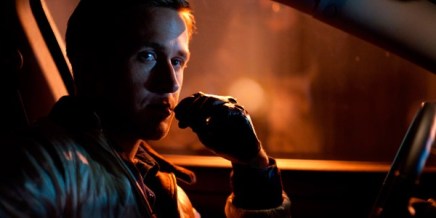
Mood lighting + a toothpick = The Goz

Their growing relationship hits a speed bump when her husband Standard (Oscar Isaac) gets out of prison. Standard genuinely wants to turn his life around but some old debts make that a little hard. The driver agrees to help Standard mainly due to his affection for Irene and her son. Albert Brooks is good as mob guy Bernie Rose who, along with his partner Nino (Ron Perlman), are tied into Shannon (Bryan Cranston), a garage owner who supplies the driver with getaway jobs. Brooks’ character is the prototypical mob “bad guy” but with his own idiosyncrasies. He provides some fantastic scenes but unfortunately he all but disappears through the middle of the film. That’s a shame because I would love to see him get a little more screen time.

As I mentioned, “Drive” and its story are pretty straightforward. There’s not much that broadsides you nor is there anything that calls for your extra attention. There’s nothing especially unique and there aren’t any big surprises with the exception of a couple of brutally violent scenes that can be quite jarring. Speaking of the violence, it’s implementation into the movie is actually quite strange. The more graphic scenes of violence tend to involve lower level characters but what should be the more important scenes seem to be depicted through shadows, quick cut-aways, or far off camera shots. I feel this was obviously a stylistic choice but I found it more puzzling than engaging.

DRIVE2

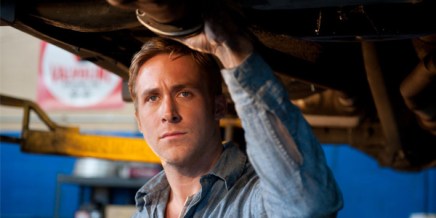
A look we see about 150 times in “Drive”

Speaking of style, “Drive” looks fantastic. Director Nicolas Winding Refn cleverly uses light and camera angles to give the picture its own unique look. The driving scenes from inside the car look great with Refn transitioning from one camera angle to another with an artistic flare. And yet with all he’s trying to do, he never loses control of his camera whether in a high-speed car chase or a conversation at the dinner table. I also loved his use of sound. Many times he cuts the music and just let’s the natural sound effects carry the scene. “Drive” is just an all-around technically impressive picture.

While it seems I’ve been a little hard on “Drive” and it’s almost run-of-the-mill action movie storyline, I was drawn to many things in the picture. The opening scene does an amazing job grabbing its audience and immediately getting them involved. And while the story may lack a real feel of originality, I see it more as an homage to not only several particular films but to a specific style of movies. I also found myself interested and invested throughout. I think the performances are uniformly strong. Gosling is given the most restrictions but he manages to do a nice job. Carey Mulligan is wonderful as always and Brooks, Cranston, and Isaac are particularly good. Like I said, there’s plenty to like about “Drive”.

VERDICT – 3.5 STARS

REVIEW: “Duck Soup”

Classic Movie Spotlight

duck_soup posterI think it would be safe to say that the Marx Brothers had a brand of humor that was uniquely their own. In a variety of ways Groucho, Harpo, Chico, and Zeppo Marx influenced the comedy genre like no others. Their chaotic and anarchic comedy is centered around rapid-fire quips and ingenious slapstick that’s as well choreographed as any fine dance or ballet. Some of today’s audiences haven’t had the same appreciation for the Marx Brothers and many moviegoers raised by modern cinema may be tempted to dismiss their style of humor. But I stand with the many who believe that the brothers were some of the greatest comic geniuses ever to grace the big screen.

Many believe “Duck Soup” to be the Marx Brothers’ greatest film. While my affection for several of their other movies keeps me from emphatically agreeing, I don’t mind saying that “Duck Soup” is right there in the conversation. The movie features two significant finales for the brothers. This was their last movie to include Zeppo Marx and it was their last production for Paramount Pictures. Many consider the Paramount days to be the best for Marx Brothers movies. But serious contract disputes sunk the relationship between the two sides and after “Duck Soup”, the final movie of a five picture contract, the brothers moved to MGM.

As with most of the Marx Brothers movies, summarizing the plot of “Duck Soup” can be an exercise in futility. There’s no dense or intricate narrative in the film. It’s simply a basic story that allows Groucho, Harpo, and Chico to showcase their comedic chaos. Groucho plays Rufus T. Firefly, the appointed leader of a small country named Freedonia. Freedonia is in a vulnerable position due to economic hardships and poor leadership. Why anyone would expect things to change with Firefly in charge is beyond me! Groucho is exactly as you would expect. He hurls sarcasm and insults at Mach 5 speed and his idiocy when it comes to running a country only makes things worse for Freedonia. But what’s worse for them is hilarious for the audience. Groucho is in top form and its a challenge just to keep up with his humor.

DUCK SOUP 1

The neighboring rival country of Sylvania sees blood in water and they believe the time to take control of Freedonia has come. Their ambassador Trentino (Louis Calhern) sends two spies Chicolini (Chico) and Pinky (Harpo) to infiltrate Firefly’s regime. Another dumb move. Obviously the two numbskulls botch the operation and turn things upside down. Before long the two countries have declared war and things go completely insane. In other words, its exactly what you would expect from an effective Marx Brothers picture.

Zeppo appears as Firefly’s secretary chief, Bob Roland. After playing his usual straight man role in the first five Marx Brothers films, he would quit acting after “Duck Soup” to make his fortune in engineering. Also a Marx Brothers favorite Margaret Dumont plays her familiar wealthy, aristocratic widow role. As always she plays the straight face in the middle of the brothers’ madness and she takes the brunt of Groucho’s jabs and insults. Dumont is certainly a supporting character but her roles are always vital to making much of the comedy work. That’s definitely the case in “Duck Soup”.

The film has several signature scenes none more well known than the mirror sequence. In it Harpo, decked out as Groucho, pretends to be his reflection in a busted out mirror. He matches Groucho’s every movement and expression in a scene featuring some mind-blowing choreography. There’s also a fantastic sequence where Chico and Harpo fight it out with a lemonade vendor battling them for sidewalk business. It’s a sequence that could be construed as Marx Brothers cruelty. In fact I’ve heard that argument but I think that’s taking the scene way to seriously. It’s a hysterical part of the film. Then there is Harpo’s penchant for clipping things with his scissors. Whether it’s tuxedo tales or feathered pens, he clips anything he gets a chance to.

I could go on and on about the numerous funny lines and hilarious gags. “Duck Soup” may have more Marx Brothers zaniness than any of their other pictures. For anyone not familiar with these early comic legends this is a great entry point. Just be prepared. The humor is relentless but it keeps me laughing from the opening to the closing credits. The boys made some fantastic films after “Duck Soup” but here they’re at their peak. And for me this 1933 comedy succeeds where the vast majority of modern attempts fail. It’s incredibly funny and it carves out for itself a spot as a true classic.

VERDICT – 5 STARS

5 STARSs

5STAR K&M