REVIEW: “The Hobbit: The Desolation of Smaug”

HOBBIT poster

Excitement, intrigue, skepticism, and division. These are just some of the words that describe the reactions to Peter Jackson’s “The Hobbit” trilogy. Was there enough material to stretch out into three films? Was there enough character depth? I’m certain you’re familiar with all of these debates and concerns. With the tablesetting done in the first film, the attention now turns to the second installment. In many ways this is the film that will tell whether the trilogy decision was a mistake. With the first movie set around introduction, does the second film have enough meat-and-potatoes to satisfy an audience especially considering Jackson’s format of near 3 hour movies.

The short answer to that question is an emphatic yes. “The Desolation of Smaug” is another huge sprawling Middle-Earth epic loaded with special effects and ambition. Better yet, it’s actually a nice step up for the trilogy. The film carries with it a true sense of adventure and I felt a much greater sense of urgency and peril than in the first film. These were big reasons why I really liked “The Desolation of Smaug”. While the first Hobbit picture was a fun and entertaining experience, I felt it lacked the big dynamic threat or plot driving exigency. That’s certainly not the case here.

HOBBIT1

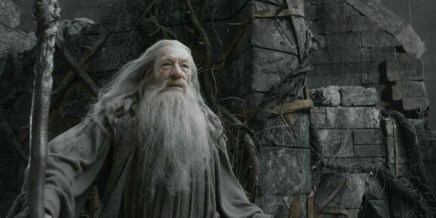
After a strange but brief opening flashback, the story picks up right where the last film left off. Gandolf, the hobbit Bilbo, Thorin Oakenshield and his twelve fellow dwarves continue their quest to retake their home within The Lonely Mountain. Hot on their trail is the pale orc Azog and his troops. Their journey takes them through cursed forests, ancient runs, and expansive mountains. They encounter skinchangers, giant spiders, elven warriors, and of course a deadly fire-breathing dragon named Smaug. The urgency grows, the stakes get higher, and by the end we are set up for what should be a tremendous final chapter.

I have to admit I was really surprised at just how well the story moves along and how much ground is covered. I’ll admit there were a couple of points where things slowed down a tad and Jackson does buy some time while his camera pans around admiring the beautiful scenery or impressive set pieces. But as a whole these things didn’t bother me. The story is compelling and the excitement moves from one great action sequence to another. The best is an amazing barrel escape down a white rapid river as an army of orcs attack our heroes from the shores. It’s an incredible spectacle to watch.

HOBBIT3

I think the decision to include sections from Tolkien’s “The Return of the King” appendices was a key reason this worked. Having read neither “The Hobbit” nor the “Lord of the Rings”, I can’t say how well the film melds the contents of both books. But from a cinematic standpoint the appendices do a great job of not only adding more content and weight to the story but also connecting it to the three “Lord of the Rings” films. Some have taken issue with this creative choice but for me it worked very well and it helps bring together Jackson’s massive cinematic universe. There is a clear link being formed between the two trilogies which go beyond simple references. Old favorite Legolas (Orlando Bloom) has an action-packed presence in this film. The true corrupting influence of the ‘one ring’ begins to surface. And there are several other cool connections that I wouldn’t dare spoil.

Once again the characters of the story are a real treat. Ian McKellen is great as always although he is given a few too many overly dramatic lines. You know the ones – the camera zooms in on his face and he utters an intense one-liner about the peril that lies ahead. Martin Freeman hits another home run as Bilbo. There is a real transformation (both good and bad) going on in the character and Freeman’s performance wonderfully captures that. But perhaps my favorite performance again comes from Richard Armitage as Thorin. This strong but emotionally driven character is tough as nails but he is constantly trying to reign in his sorrow, anger, and thirst for revenge. It’s a great character and a great performance.

HOBBIT2

But there are also some really good new characters introduced. Evangeline Lilly plays Tauriel, a headstrong elf who can certainly hold her own. Then there is Luke Evans who plays Bard, a single father who finds himself thrust into the middle of Thorin’s quest. Both have significant roles and add a lot to the picture. I also like Lee Pace’s small but intriguing part as an Elvenking from Mirkwood. And then there is Benedict Cumberbatch who voices Smaug the fearsome, treasure-hoarding dragon. There simply couldn’t have been a greater choice than Cumberbatch. Then you have the twelve other dwarves. Thankfully we do see an expanded role for a couple of them, but unfortunately the majority of them remain indistinct making empathy for them rather tough.

So let me get back to the original debate. Could “The Hobbit” story be told in two films? Probably so. Am I glad they expanded it to three by adding content from “The Lord of the Rings”? Absolutely! “The Desolation of Smaug” is a solid answer to the questions and criticisms thrown its way. The special effects are superb, the action sequences had my heart racing, the stakes are high, and we spend more time with these wonderful characters. On the flip-side there are a couple of lulls and the indistinct tag-along dwarves still bug me. But those gripes do little to hurt the overall experience and Peter Jackson has me hooked for what the third installment will bring. It should be a blast.

VERDICT – 4.5 STARS

REVIEW: “The Hunt”

HUNT POSTER

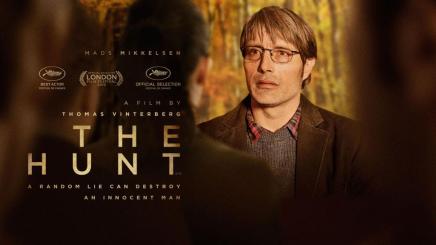
I’m a huge fan of Danish actor Mads Mikkelsen. Known as one of those familiar faces, Mikkelsen is an immensely talented actor who has shown a tremendous range. He’s tackled everything from period action pictures to emotional dramas; mythological fantasy to being a James Bond villain. He’s an undeniable presence in whatever he is in and his success, particularly in his native Denmark, is well deserved.

All of that should help explain my excitement for his film “The Hunt”. Original released overseas in 2012, “The Hunt” received a great response with most of the praise going to Mikkelsen’s performance. In fact, Mikkelsen would go on to win the Best Actor award at the 2012 Cannes Film Festival. With all of that in mind and with my expectations through the roof, naturally I was expecting something special and that’s exactly what writer-director Thomas Vinterberg gives us.

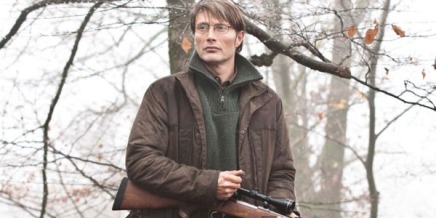
HUNT 1

“The Hunt” is that rare film that aims to engage us emotionally while at the same time challenging those very emotions. It spurs self-inspection and analysis by casting spotlights on some ugly but very real elements of society. It causes us to question how we would feel or respond amid certain difficult situations. And it’s all woven within the fabric of a riveting narrative that is some of the best storytelling I’ve seen in a while. It’s a story that’s uncomfortable and may cause us to squirm, but sometimes that’s exactly what we need to do.

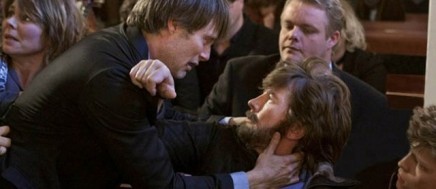
Mikkelsen plays Lucas, a divorced kindergarten teacher living in a close-knit Danish town. When Lucas angers a 5-year old student (who also happens to be the daughter of Lucas’ best friend) the young girl goes to the kindergarten supervisor and accuses Lucas of sexual misconduct. Of course the supervisor must act but she does so under the presumption of absolute guilt. Her constant mishandling of the situation sparks an inferno of canards and assumption which sweeps through the town fueling a vitriolic reaction from the community. There’s no hunt for truth. Lucas becomes the hunted and there is no fact or clue that will pull him out of some people’s crosshairs.

“The Hunt” creates a striking antithesis. On the surface we see a lovely tight-knit community during the holiday season. Festive family get-togethers and Christmas parties create an aura of small town charm. But underneath lies a conflict rooted in reality that sees otherwise decent people doing and saying horrible things. It would be easy to say we hate these people, but as heinous as their actions are, would we have acted or thought differently when faced with such an emotionally charged situation? That’s a question the movie tackles head-on.

HUNT2

The utterly brilliant screenplay is both smart and provocative yet even it needed a capable lead actor to make it truly effective. Mads Mikkelsen more than fulfills that need. It’s a very restrained performance but also one of the most powerful in recent memory. The layers of persecution brought by the town’s rush to judgement takes more and more of a toll on Lucas and Mikkelsen draws out every detail with absolute precision. It’s a master class in dramatic acting and easily one of the best performances of the year. There is some good supporting work as well but Mikkelsen is the true star of the picture.

“The Hunt” can be difficult to watch. It’s confrontational and unflinching. Yet its thought-provoking questions are soaked in realism and relevance. But this is also a film made with expert craftsmanship. The script is intelligent and penetrating. The pacing is perfect. The camerawork is vivid and fluid. Then there is the lead performance from Mikkelsen – a true highlight of the movie year. It took me a while to finally see “The Hunt” but it was well worth the wait. It’s not a film that will leave you with the warm and fuzzies, but it does cut to the heart and it is expert filmmaking through and through.

VERDICT – 4.5 STARS

REVIEW: “Haute Cuisine”

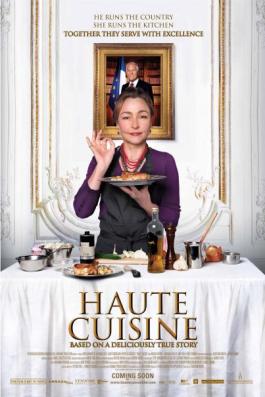
Haute_Cuisine Poster

I’m not a person who cares about cooking shows or who spends a ton of time watching The Food Network. But if you do then I can imagine that you will find a lot to like in the new French film “Haute Cuisine”. But you don’t have to be a food aficionado to find enjoyment in director Christian Vincent’s tasty concoction. There’s a lot to like despite its few structural issues that ultimately keep it from being even better than it is.

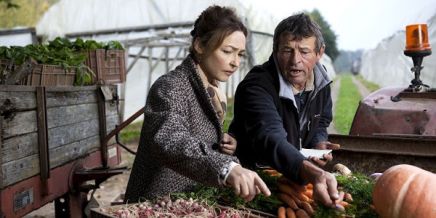
“Haute Cuisine” is loosely based on the true story of Danièle Delpeuch and her surprise appointment as private chef to French President François Mitterrand. Here the lead character is Hortense Laborie (Catherine Frot), a well regarded chef living on the French countryside. She is brought to Paris where she reluctantly accepts the President’s appointment as his private chef. Once there Hortense faces a variety of obstacles including the male-dominated main kitchen, overly concerned Presidential staffers, and a ridiculous level of formality.

We are told her story through a bit of fractured storytelling. The movie starts with Hortense preparing her last meal of sorts for the workers at a French Research facility in Antarctica. A snoopy Australian reporter learns that she was once the private chef to the French president. Believing there must be a scandalous reason for her move from luxury and prominence to austerity and isolation, the reporter begins seeking out the story which we are told via flashbacks.

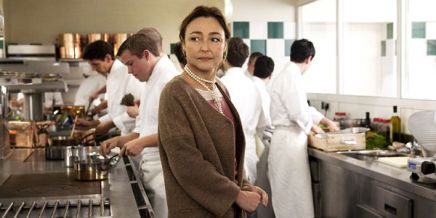
HAUTE1

Hortense is a confident and spunky woman. She takes her cooking seriously whether at a remote station or the royal palace. Back in Paris this quickly annoys some people yet endears her to others. As the flashbacks started I remember fearing that the movie was about to fall into a familiar, overused formula. Actually it never does. Hortense never becomes one of those ‘fight the system’ comic characters that we get in a lot of American movies. She’s very different than that and she maintains a sympathetic and relatable personality through the entire picture.

Another plus is that the film doesn’t fall into the customary biopic trappings. It’s certainly based on a true story, but it clearly wants you to know it is its own story. Even the character’s name changes separate it and helps free it from the constraints that strict biographical movies are held by. I really liked that.

But without a doubt the film’s greatest strength is found in Catherine Frot. She is simply fabulous and gives one of my favorite performances of the year. In one scene she has her character commanding the kitchen. In the next scene we see her shuttering under the pressures of her new responsibilities. Frot easily sells it all through her genuine and measured performance.

haute-02

Unfortunately “Haute Cuisine” does have a few blemishes that I just couldn’t give passes to. First, the storytelling is a bit clunky specifically in the opening and ending of the flashback story. She arrives in Paris and is more or less tossed into her new position with very little explanation or buildup. That’s not a big deal because the movie is focused on a specific time frame. But I did find it a bit jarring. The wrapup of the flashback story was somewhat worse. It basically just ends with several questions up in the air and a couple of character loose ends. The film also features A LOT of gastronomic lingo that die-hard food fans will probably love. And I do mean A LOT! I often had no clue what they were talking about which was a little frustrating.

Aside from those gripes “Haute Cuisine” really worked for me. And while the flashback conclusion may have left me wanting more, the film’s main ending was fantastic and left me completely satisfied. This is a film full of charm, a touch of humor, and one great performance from Catherine Frot. It may not be saying anything big or provocative, but it certainly accomplishes what it sets out to do.

VERDICT – 3.5 STARS

REVIEW: “House at the End of the Street”

House-at-the-End

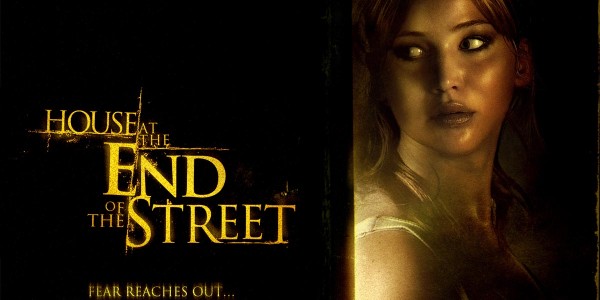
Am I starting to sense a trend here? Have you noticed that after getting some serious critical acclaim a number of young actresses are immediately running out to do soft PG-13 horror pictures? After really finding her way onto the critics radar with “Martha Marcy May Marlene”, Elizabeth Olsen quickly followed it up with “Silent House”. After making a huge splash in 2011 and giving what may end up being an Oscar-winning performance in 2012’s “Zero Dark Thirty”, Jessica Chastain started off 2013 with “Mama”. And then there’s “House at the End of the Street”. Jennifer Lawrence first wowed critics with “Winters Bone” and then blew up the box office with “The Hunger Games”. She followed it by dipping her toes into the horror genre with a film that’s decent enough and relatively harmless, but that still feels like a quick money draw from her recent success.

Lawrence plays Elissa Cassidy, a high school student who moves to a small wooded town with her recently divorced mother Sarah (Elisabeth Shue). They get a great deal on a beautiful home and they later find out why. It seems the property values have gone down following the gruesome murders of a couple in the house next door. Elissa and Sarah begin to find out more about the murders from the locals. But there is the question of what is fact and what is just gossip? They learn that the couple’s son Ryan (Max Thieriot) is living alone in the house. He’s been ostracized by many in the community and he’s the subject of so many rumors and speculations. He becomes the centerpiece of much of the film’s mystery.

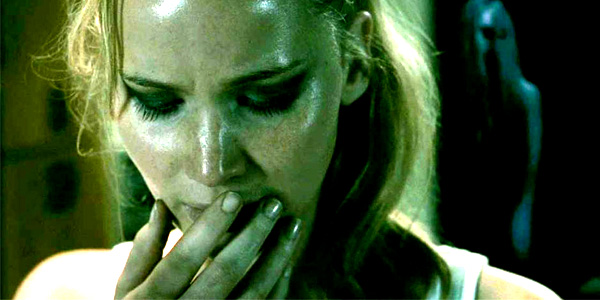
Obviously Jennifer Lawrence is the real draw here and as you would expect she does a good job. But I have to say this isn’t challenging material. She does a lot of the same old stuff that you would expect from a movie like this. About the only opportunity she gets to flex her acting muscles are in the scenes with Shue. Elissa and Sarah don’t have the best relationship and the film’s better dramatic moments are when these two are hashing it out. Unfortunately we don’t get to much of it. As good as these moments are, they’re just thrown in here and there and they feel like an afterthought.

house_at_the_end_of_the_street1

While “House at the End of the Street” is advertised as a horror movie and it does have its moments of standard horror fare, in many ways it feels more like a thriller – not a great one, but a thriller nonetheless. Other than a couple of sudden blasts of loud music, the film doesn’t have any genuine scares. And it never really succeeds in creating the tense and creepy atmosphere it shoots for. But this isn’t a terrible movie. I actually found myself interested in the secrets and twists surrounding the murders in the house next door. The story also remains entertaining despite some obvious plot holes and unintentional silliness. I was never bored and I appreciated some of what the filmmakers were trying to do.

I think the biggest problem with “House at the End of the Road” is that it’s an aggressively average movie. There’s not one thing that it does exceptionally. On the other hand there are very few egregious and crippling flaws. It’s not a horrible movie but it doesn’t do anything to set itself apart. That’s why it’s a decent movie to check out on DVD on a rainy day. But expect to have forgotten all about it the next day. It’s a ‘one-and-done’ film in my book but it’s a fairly entertaining one. It just has no staying power and it won’t challenge you with anything bold and new. It turns out to be more of the same and that’s a shame.

VERDICT – 2.5 STARS

“Holy Motors” – 2 STARS

Holy Motors posterHow on earth do you begin to review “Holy Motors”. To be perfectly honest, it’s a movie that I had to think about for a few days before even attempting to review it. Now in some ways that could be considered a good thing. It usually means that the film is original and that it prompts thought and reflection. This film certainly does that. But I kept battling with a key question : What is “Holy Motors?” Is it science fiction? Is it experimental? Is it allegorical? What is it that “Holy Motors” wants to be? I’ve yet to be able to even vaguely answer this. Now to be clear, it’s not an issue of knowing all the details and having everything about the movie figured out. It’s about a movie that came across as jarring and disjointed to the point of incoherency and in the end I couldn’t connect with it despite its impressive artistry.

My pal Ruth over at Flixchatter accurately points out that the nature of experimental cinema is that it’s often incoherent. She’s exactly right and for me this was the case with “Holy Motors” (you can find Ruth’s fantastic review here). I don’t doubt for a moment that writer and director Leos Carax has cryptic themes and underlying commentary hidden throughout this film. But to be honest I found the focus on bizarreness and lunacy to be distracting to the point of subverting any intended point or message. And then there’s the possibility that there isn’t meant to be a profound and provocative message at all. Maybe the entire seemingly plotless exercise is more of an attempt at artistic expression. If that’s the case the movie does work on some levels. But even that’s undone but some of the wildly outlandish concoctions that Carax puts together.

HOLY1

As I hinted at we get little in terms of story. The movie follows a man known only as Oscar (Denis Lavant). He’s driven around Paris in a white stretch limo by Céline (Édith Scob). She takes him to different “assignments” scattered throughout the city. While traveling from place to place, Oscar is given a file and then, with a crazy assortment of makeup, prosthetics, and costumes undergoes a physical transformation in preparation for the next “assignment”. Throughout the night he takes on the appearance of a motion capture performer, a streetwise gangster, a sickly elderly man, and a maniacal flower eating leprechaun to name a few. We watch each of these “assignments” play out, some which are pretty intriguing and others that completely turned me off.

Contributing to the confusion is the fact that there’s no real connection between any of these individual “assignments”. It’s essentially a handful of shorts and if you like that sort of thing you’ll like “Holy Motors”, that is assuming all of these “shorts” work for you. Well, experimental cinema isn’t my favorite and several of these shorts didn’t work for me so obviously “Holy Motors” didn’t either. And I could never shake the feeling that Carax was simply trying to be as weird as possible during certain moments of the film. Now this led to a few mildly amusing moments but it also led to moments where I found myself drifting further away from the film. And then there are times when it moves from being absurd to borderline offensive. But considering how difficult it is to understand what Carax is doing, it’s hard to judge.

Holy2

I don’t want to end this without giving the movie credit for some things it does well. First off Denis Lavant is fantastic. Carax wrote the part with him and only him in mind and you can see why. He’s a multi-talented performer and he’s also a strong actor. Some of the film’s best scenes are the conversations between him and Scob. The film also looks fantastic. The camera work and the slick editing give it an amazing visual appeal. There were also two of the “assignments” that I found to be quite effective. One involves him posing as an elderly man on his deathbed. Another sees him involved in a rooftop musical number with pop star Kylie Minogue. And speaking of music, perhaps my favorite scene in the entire film has Oscar and a band of other musicians performing an accordion jam while walking around the inside of a cathedral. It’s absolutely amazing even though I have no clue where it fits in with everything else.

As I scoured the different reviews for this film I kept seeing descriptive words such as strange, deranged, bonkers, bizarre, gross, madness, weird, frustrating, and soulless and these were all from the positive reviews. Again, if you’re into this you’ll probably have fun with “Holy Motors”. If characters and plot are important ingredients for you, then you’ll probably start checking out before the halfway mark. In the end I guess I can see where some people would enjoy “Holy Motors” and I definitely see where critics would fall all over themselves praising it. But I found it to be a self-indulgent, intentionally strange and incoherent picture that wastes some really good talent. For every one moment where I was impressed with the film there are three or four that had me rolling my eyes or scratching my head. Personally, that’s not the moviegoing experience I’m looking for. But who knows, maybe a second viewing would clear some things up for me.

“Hitchcock” – 4 STARS

HITCHCOCK POSTER

You know, I just love movies about making movies. That’s one reason I thought the movie “Hitchcock” would be right up my alley. Another reason is that it’s about one of cinema’s greatest directors – Alfred Hitchcock. Yet another reason I was interested was because of the fantastic cast specifically Anthony Hopkins as Hitchcock and Helen Mirren as his wife Alma Reville. These and several other yummy ingredients had me really hungry for this film and after seeing it I can say that it’s quite satisfying.

But enough with the gastronomical analogies. “Hitchcock” takes place during the filming of arguably the director’s most popular and groundbreaking film “Psycho”. The movie begins just after the release of Hitchcock’s wildly successful “North By Northwest”. He still owes Paramount Pictures another film but he’s struggling to find the right one. He also feels that the studios and press believe he is past his prime and he wants to pick a bold project that will prove otherwise. He finds himself attracted to a Robert Bloch novel titled “Psycho”. He convinces Alma and his agent Lew Wasserman (Michael Stuhlbarg) that it’s the right choice but he has a harder time with Paramount president Barney Balaban (Richard Portnow). They finally reach an agreement where Hitchcock agrees to fund the picture for 40% of the profits and a Paramount distribution.

HITCHCOCK1

It’s really fascinating to watch the behind-the-scenes process and how Hitchcock labored to make “Psycho”. But a bigger and even more enjoyable part of the movie focuses on Hitchcock’s relationship with his wife. Hopkins and Mirren are a joy to watch. The two veteran performers dissect this marriage with surgical precision, bringing out so many interesting aspects of it. There’s a clear love that they both share for one another, but there’s an equally clear strain on their marriage brought on by the financial stress of funding the movie and by Hitchcock’s own negligence, pride, and fear of failure.

Hitch is betrayed as a self-assured man on the outside but he clearly has uncertainties on the inside. He has a wandering eye for his leading ladies and has a tendency to overindulge in food and drink – something Alma stays on him about. Alma is a talented writer herself and her uncredited contributions to Hitchcock’s creative process prove vital. Her growing frustrations lead her to begin her own collaboration with fellow writer Whitfield Cook (Danny Huston), something Hitchcock disapproves of. All of these pressures begin to wear on Hitch and ends up threatening the completion of “Psycho”.

As I alluded to, one of the real strengths of this picture are the performances. Mirren rightfully earns her award nominations that she has received. Hopkins does a fine job fleshing out this complex director under a coat of heavy prosthetics. He nails all the mannerisms and postures and his speech is almost perfect. But there’s one thing I struggled with. I never could quite get past that I was watching him do Alfred Hitchcock. Take Daniel Day-Lewis’ performance in “Lincoln”. I was so drawn in by his work that I forgot I was watching an actor play Abraham Lincoln. I never quite got to that point here. Don’t misunderstand me, it’s not a bad performance by any means. But I never completely bought into the idea that I was watching Hitchcock on screen.

????????????

I also have to mention the other supporting performances that I really enjoyed. I’ve liked Michael Stuhlbarg since seeing him in the Coen brothers film “A Serious Man”. He’s good here too. I was also impressed with Jessica Biel as Vera Miles. She’s an actress I normally don’t care for but she gives a nice subtle performance that works really well. But an even bigger surprise for me was Scarlett Johansson as Janet Leigh. I’ve never been completely sold on Johansson as an actress but I love the Janet Leigh she portrays. She’s beautiful and sexy but she’s almost a stabilizing influence on Hitch. She’s a lot of fun to watch in the role.

“Hitchcock” has a hard time escaping that biopic feel but it’s still a really good film. I think my love for the director’s movies and my particular affection for “Psycho” added a sense of nostalgia to my viewing, but there’s a lot more to this picture than just that. There are many clever little inclusions that go hand-in-hand with Hitchcock. For instance look closely and you’ll find his shadowy silhouette that fans of his will instantly recognize. Then there’s the cool opening and closing of the film that hearkens back the “Alfred Hitchcock Presents” days. These nifty treats fit in well with the solid script and wonderful performances and anyone with the slightest interest should come away well pleased.