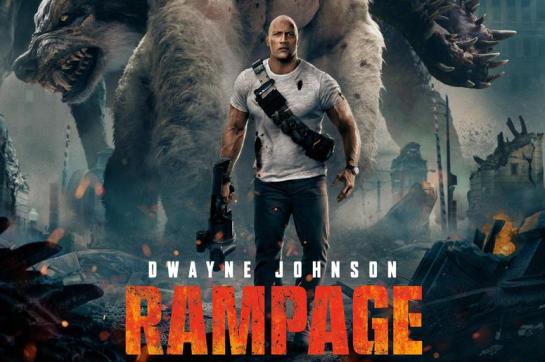
I wonder how people know that Dwayne “The Rock” Johnson’s monster-thriller “Rampage” is actually based on a video game first released to arcades in 1986? I remember it well. As someone who spent a lot of time as a kid in that lively arcade culture, I was never the biggest fan of the “Rampage” video game. I can honestly say I like the movie adaptation even less.
Johnson is a hardworking guy as evident by his fifteen feature films since 2013 (mostly big-budget blockbusters) in addition to his ongoing HBO television series. Most of his movies are built around his infectious personality and charisma. Admittedly I often find that to be enough for me to enjoy his movies to some degree. Despite all the charm Johnson musters, it still isn’t enough to save “Rampage” from its plethora of problems.

The setup goes like this: a mutated lab rat destroys a space station owned by Energyne Corporation sending debris crashing through Earth’s atmosphere. Some of the wreckage is contaminated by a mysterious pathogen which causes mutations upon impact with the surface. By mutations I mean a giant alligator in Florida, one mean flying wolf in Wyoming, and a gentle albino gorilla in San Diego.
The gorilla’s name is George and he resides in a wildlife sanctuary after being saved from poachers by his beefy Primatologist buddy Davis Okoye (Johnson). As with the other mutations, George begins to grow at an alarming rate and quickly becomes more aggressive. Okoye is contacted by an ex-Energyne geneticist (Naomie Harris in a thankless role) who reveals the nefarious plans of the company’s diabolical CEO (an on the nose Malin Åkerman). You guessed it, the pathogen will be sold as a biological weapon to the highest bidders.
The tonal gymnastics kicks up a notch when Davis tries to stop a now free roaming George, tries to stop the monster-sized wolf and gator, and tries to stop an evil corporate head. That’s a lot of stopping to do even for The Rock. During this chunk of the movie things constantly bounce around between playful and ultra-serious. Jeffrey Dean Morgan shows up in full-blown Negan mode (see “The Walking Dead”) as a secret government agent who’s not buying into Davis’ story. Morgan is obviously having fun and his character adds some much-needed levity.
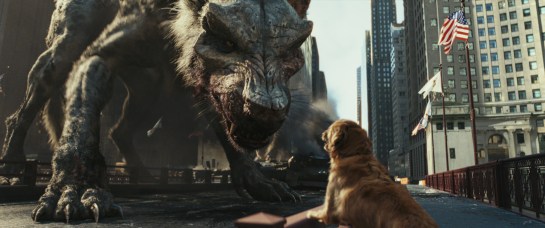
“Rampage” sports some nice special effects but there isn’t much past that. As much as I tried to connect, the film was too much of a slog. Aside from Morgan most of the humor falls flat (a reoccurring lazy and unfunny gag between Davis and George must have been ripped from “Every Which Way But Loose”. It was funnier in the Clint Eastwood picture). Even worse, the characters are uninteresting and there is no suspense whatsoever.
This is the third film director Brad Peyton has done with Dwayne Johnson and easily their weakest collaboration. But it’s not all on Peyton. The bulk of the problems with “Rampage” lie with the script. Four writers are credited (or to blame, depending on your perspective) with putting this hodgepodge together. It simply doesn’t work on so many levels. And if someone like me with a deep affection for old-school creature features can’t find much to get excited about, that’s not a good sign.
VERDICT – 1.5 STARS