REVIEW: “Rambo: Last Blood”

RAMBOposter

What a crazy 37 years it has been for Sylvester Stallone’s John J. Rambo. In 1982 he battled PTSD and a backwoods sheriff in upstate Washington. In 1985 he went back to Vietnam at the behest of crooked Washington bureaucrats. In 1988 he traveled to Afghanistan to fight the Soviets and save a friend. In 2008 he led a group of mercenaries into war-torn Burma to rescue a Christian missionaries. He’s done a lot, seen a lot, killed a lot.

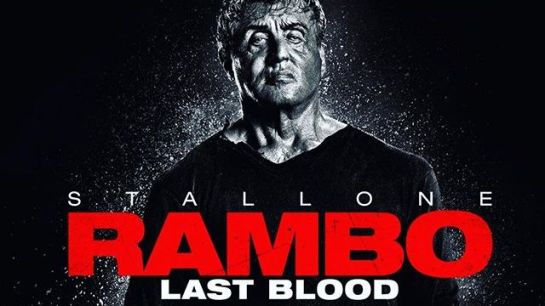
And just when you thought Rambo’s cinematic tour of duty was done, the 73-year-old Stallone dusts off the character for one final fight (at least that’s what the title implies). “Rambo: Last Blood” doesn’t send the war-scarred vet too a far from home. This time the story has him bouncing back and forth between his dusty ranch in Arizona and Mexico.

RAMBO1

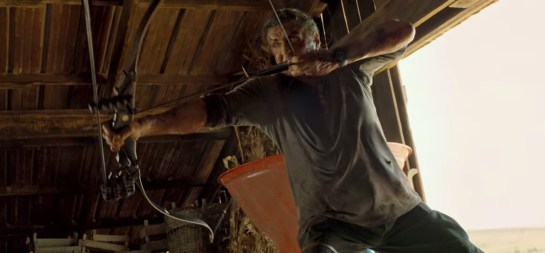
Eleven years after the events of the not-so-great 2008 film Rambo has found a semblance of peace on his family’s old home place. He lives there with his housekeeper (Adriana Barraza) and her granddaughter Gabriela (Yvette Monreal) who he has raised as his own daughter. But Rambo and happiness have never went together so you know his retirement from one-man armying is doomed from the start.

When Gabriela learns the whereabouts of her birth father in Mexico, she goes against Rambo’s wishes and sneaks south of the border to find him. In the most predictable of turns she is snatched up by human traffickers working for a local drug cartel. To no surprise Rambo doesn’t take it sitting down. He heads to Mexico to rescue Gabriela stoking a war with the cartel in the process.

Full disclosure, I’m a big fan of the first three Rambo movies. They were silly, bombastic, and a ton of fun. They were full of energy, big action, and really driven performances from Stallone. The forth film came some twenty years after “Rambo III” and went in a grittier, gorier, and more joyless direction. “Last Blood” falls more in line with the last film instead of the original three. It’s darker, bloodier, and Stallone looks completely worn out.

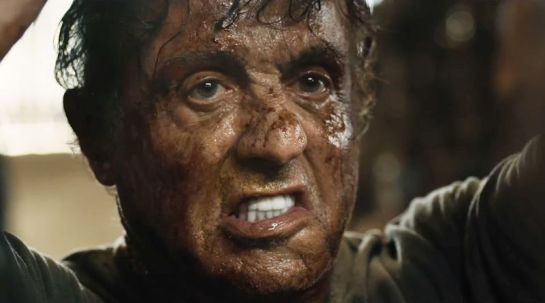
To be fair, Rambo is supposed to be worn out considering the life he has lived. We see a little of that during an early and brief PTSD sequence that is unfortunately dropped and never revisited. That’s a story thread I wish had been explored. But Sly’s performance itself seems drained of all energy and emotion. He (not just his character) looks tired. Admittedly it’s still good to see him back in the role even if he lacks the zest you expect.

RAMBO2

The most noticeable thing about “Last Blood” is how its story really doesn’t resemble anything else from the franchise. It particularly lacks the big action moments the others films are known for. Yes there are a few sudden bursts of graphic violence but nothing that will stick with you. And it’s especially true for the final ten minutes which is this frantic blood-soaked collage of grisly kills that’s over in a snap. Little buildup, extremely rushed, and it ends with this absurdly gruesome moment that’s completely out of sync with the better films of the franchise.

Surprisingly I liked the setup of “Last Blood” more than the payoff. The movie deals with some pretty heavy subject matter and despite not giving it the emotional weight or depth it deserves, it’s still pretty effective table-setting. Yes, the predictable cries of xenophobia are out there which some may find cathartic in today’s politically-charged climate. But a more level-headed look at the film finds its problems lie elsewhere. And unfortunately there are plenty of them.

VERDICT – 2.5 STARS

2-5-stars

REVIEW: “Rust Creek” (2019)

rustposter

Darned GPS! You just can’t trust those things. That’s one of the earliest takeaways from “Rust Creek”, a new survival picture which right out of the gate feels like something we’ve seen several times before. But it doesn’t take long to see there is a lot more to this little independent gem than meets the eye.

Turns out “Rust Creek” is a delightfully harrowing thriller from director Jen McGowan. She along with screenwriter Julie Lipson take a fairly well known basic premise and inject it with a surprisingly restrained tone and genuine human empathy. With a fantastic use of character and setting, McGowan creates a tense atmosphere full of dread and suspense.

rust1

Hermione Corfield plays Sawyer, a college student who decides to skip Thanksgiving with her family for a job interview in Washington DC. Along the way her GPS reroutes her around road construction, miles down a rural highway, and deep into the Kentucky hills. When she stops to get her bearings two local yokels (Micah Hauptman and Daniel R. Hill) pull up, a bit concerned about her presence in ‘them thar hills’. A scrap ensues leading Sawyer running through the cold woods with the bumpkins on her trail.

So far it sounds like fairly familiar territory, but McGowen keeps it from being too conventional. For instance Sawyer is instantly portrayed as a strong young woman with plenty of fight in her. That’s always welcomed but you can ride it too far. Instead we see that (like most of us) her strength has limits. For instance she’s no deep-woods survivalist. Soon nature and the elements take their toll both physically and psychologically. Still she is no ‘damsel in distress’. Even when there is the appearance of submission to her situation you can see the wheels turning in her head.

Corfield is a big reason it works so well. After memorable bit parts in “Mission: Impossible – Rogue Nation” and “Star Wars: The Last Jedi” this is the first leading role for the 25-year-old English actress. She’s more than able to handle the demands of the part which asks her to carry most of the load. Much of the film’s first half sees her leaning on physicality and expression while the second half gives her more dialogue to work with.

rust2

This is also where the film works the hardest to defy traditional stereotypes. Sawyer is unknowingly rescued by a meth cooker named Lowell (Jay Paulson). This unexpected dynamic leads to some interesting perspectives on rural poverty, the meth epidemic, and several other social issues. A local sheriff (Sean O’Bryan), who is set in his backwoods ways of doing things, adds yet another wrinkle to Sawyer’s situation.

At a key point “Rust Creek” surprisingly pivots from its seemingly conventional survival-thriller mold to a more dialogue-driven character exploration. It can be a slow boil but most importantly it never loses its suspense. McGowen makes sure her film offers us constant reminders of the looming dangers to Sawyer making it easy to invest in her and her plight. That’s a mark of a good thriller.

VERDICT – 4 STARS

4-stars

REVIEW: “Replicas” (2019)

replicas poster

2019 gets off to a weird start with “Replicas”, a sci-fi thriller with barely a speck of science-fiction and even less in terms of thrills. It’s not the abysmal film that a mere surface glance would lead you to expect. It’s just a hard movie to figure out mainly because it seems constantly unsure of itself. Is it a morality tale, a horror film, a dark comedy? Heck if I know.

Keanu Reeves stars as a neurochemist(?) named William Foster who has recently relocated his family to Puerto Rico to be closer to his employer’s state-of-the-art biomedical research lab. He’s nearing a breakthrough on his pet-project – to copy the human mind of a dead “donor” and transfer it into a synthetic brain. His boss at Bionyne (the kind of shady high-tech lab name you would expect in a movie) is breathing down his neck to get results or the stockholders will pull funding and shut him down.

replicas1

After a terrible tragedy strikes his wife Mona (Alice Eve) and their three children, William slowly descends into mad scientist mode. With the help of his Bionyne assistant (Thomas Middleditch), William attempts to bring his family back to life by doing what any of us would do – smuggle millions of dollars worth of lab equipment into your basement and conduct the same experiment on your family that has failed with every other attempt. What could go wrong?

“Replicas” tries to ask some weighty questions particularly about morality in the face of tremendous grief and loss. But it’s hard to wrestle with those moral quandaries when everything gets so blasted silly. And the movie doesn’t make the most of some of its better ideas. For example, at one point William forces himself to make an intensely painful choice with potentially huge ramifications. As with several other things, the film never gets much mileage out of it.

replicas2

Then there is the lead performance we get from Keanu Reeves. I don’t know what to say other than it’s strange and at times hilariously off-key. From the very start he seems miscast and out of place. It’s actually pretty entertaining trying to figure out what exactly he’s going for. We get steady shades of Neo, John Wick, and even Ted Logan. And then you have John Ortiz as William’s dogged boss. It’s as if he’s constantly winking at us and subliminally saying “This is some crazy stuff, right?”

I really shouldn’t be too hard on Keanu. To be honest his off-kilter performance is one of the things that makes “Replicas” kinda fun. And even though I did find it strangely entertaining, it’s just too scattered and a little too goofy to get behind it. There are plenty of other ‘playing God’ movies that do this whole ‘bring ’em back from the dead’ thing better.

VERDICT – 2 STARS

REVIEW: “Roma”

Roma small

From the very first frame of “Roma” you know you are seeing something unique to modern filmmaking. Not necessarily unique to cinema as a whole. As I watched, flashes of Fellini and Tati constantly came to mind. But seeing this level of visual and narrative craftsmanship is a rarity these days.

Alfonso Cuarón’s intensely personal “Roma” is a semi-autobiographical reflection on growing up in early 1970s Mexico City. The film’s title is a reference to the West-Central neighborhood Colonia Roma and Cuarón puts a ton of effort in capturing its energy and vibrancy. It truly is a movie of detail with each gorgeous black-and-white shot framed like a richly detailed memory begging to be examined. It’s a tapestry of individual compositions skillfully woven together by a narrative that has far more heart than it may first appear.

Roma1

The film focuses on Cleo (Yalitza Aparicio), a maid and nanny for a bustling upper-middle class family. Cuarón isn’t as much interested in narrative as he is conveying Cleo’s personal story – her life, her nature, her routines. Much like Xavier Beauvois’ “The Guardians” from earlier this year, Cuarón puts a visual emphasis on her work, capturing every chore and the effort she puts into each of them. It may sound mundane but Cuarón is deftly building her character despite the absence of a traditional narrative.

This family is a significant part of Cleo’s life. In fact there are only a handful of scenes where she is apart from them. Whether taking the kids to school, making an unexpected hospital visit, spending New Year’s at a countryside hacienda, or (in one of the film’s very best scenes) buying furniture in 1971 as the bloody clash between protesting students and Los Halcones erupted. Through Cuarón’s eyes and unknowingly to her, Cleo is a stabilizing force for this family especially when they threaten to unravel after a family crisis. And on a smaller scale the turmoil that festers within their home is an interesting mirror image of the societal unrest outside. It’s a striking metaphor that doesn’t go unnoticed.

ROMA

The Cleo character is inspired by Cuarón’s childhood nanny Liboria “Libo” Rodríguez. She worked for his family for decades and they maintain a close relationship to this day. She has even made cameos in his other Mexican-made films. One of the many things Cuarón’s camera does is accentuate the very essence of her character – her humility, her compassion, her insecurities. But just as important is the way he captures her experience. In many ways Cleo is defined by her experiences and she is much more than simply an avatar for Cuarón’s memories.

Cuarón also uses his cinematic canvas to paint an energetic portrait of the political and social landscape of the time. The film bursts with vibrant street sounds of kids playing, the shouts of vendors, and honking car horns. He uses the canvas to illuminate different areas in and around the city – the family’s cozy residential area, the lively downtown, the muddy slums on the outskirts of the city. And none of these arresting images wastes an inch of the screen.

Roma3

It’s hard to find a beef with “Roma”. It’s such a stunning and intimate work from a filmmaker invested in every facet of the production (Cuarón served as director, writer, cinematographer, co-editor, and co-producer). A couple of scenes did clash for me and felt yanked from another film (the man in a ghillie suit singing in front of a forest fire and a character practicing martial arts with a shower curtain rod while fully nude instantly come to mind). I searched but still haven’t found satisfying answers to those creative flairs.

Mild quibbles aside, you can’t watch “Roma” without seeing the heart of the man behind it. A big deal has been made about Netflix distributing it through their streaming service and limiting its theater run. I would much rather see “Roma” on the big screen, but as with so many films of this type, smaller markets are often left out in the cold. Netflix offers a chance for anyone to see it, and I see that as a good thing.

VERDICT – 4.5 STARS

4-5-stars

REVIEW: “Ready Player One”

ReadyPoster

In “Ready Player One” the world has become a pretty crummy place. Energy shortages, economic stagnation, and overpopulation has turned many of the world’s cities into slums. Aside from widespread poverty it has also resulted in cases of social unrest (my personal favorite being ‘The Bandwith Riots’).

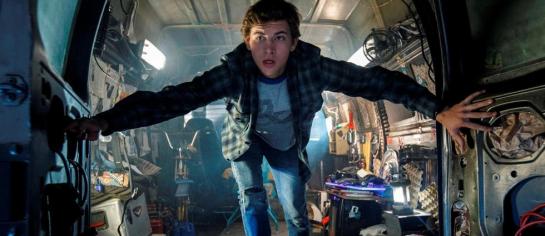
One of the stricken cities is Columbus, Ohio. Orphaned 18-year-old Wade Watts (Tye Sheridan) lives with his Aunt Alice (Susan Lynch) in a poor neighborhood known as The Stacks. Like everyone else, Wade escapes the harshness of life through the OASIS, a massive virtual reality playground of interconnected worlds. It was the brainchild of sheepishly eccentric James Halliday (the always wonderful Mark Rylance) who posthumously reveals that an Easter Egg is hidden deep within the OASIS. Whoever finds the virtual three keys can unlock the Egg and gain full control of Halliday’s fortune and the OASIS.

Ready1

These are the worlds director Steven Spielberg plays in – both real and virtual. It was first conceived through the creative mind of Earnest Cline whose award-winning 2011 novel has been a phenomenon in itself. Cline joins writer Zak Penn in adapting his story to the screen and Spielberg takes it and runs. The CGI is as endless as the opening narration but it does allow Spielberg to do some pretty crazy things. Look no further than an homage to “The Shining” which is nothing short of fabulous. But by the third act CGI fatigue had set in.

Wade, an unabashed Halliday enthusiast, begins scouting for clues within the OASIS. His hunt for the first key leads to an elaborate vehicle race through virtual Manhattan. It’s an extraordinary sequence featuring Bigfoot (the monster truck, not Sasquatch), the 1933 King Kong, Jurassic Park’s T-Rex, and a DeLorean time machine for starters. Wade encounters and quickly falls for fellow racer Art3mis (Olivia Cooke). The two reluctantly ‘clan up’ to find the keys and keep the Oasis out of the wrong hands.

Ben Mendelsohn provides the story’s antagonist, an evil corporate head who wants the OASIS for himself. Mendelsohn is a good actor who can do these kinds of roles in his sleep. But he feels a little off here. Maybe bland is a better word. I don’t think it’s Mendelsohn’s doing. It’s more of a script issue and indicative of the lack of depth we get in several of the supporting characters.

Ready2

The story delves into several obvious themes: the haves versus the have-nots, self-identity, etc. But it’s most effective as straight-up pop culture science fiction. It’s essentially a virtual treasure hunt where the characters are searching for three keys while I was hunting for as many culture references as I could find. And there are a ton of them. You could say “Ready Player One” is relentlessly nostalgic and that turns out to be a positive. There are moments when the nostalgia is all that keeps the film afloat.

It’s hard not to be impressed by the sheer volume of pop references scattered throughout the hefty 140 minute running time. The Iron Giant, Hello Kitty, Saturday Night Fever, Freddy Krueger, Mortal Kombat, even Buckaroo Banzai! I’m sure someone out there has compiled a list. For me that was the fun of “Ready Player One” and it’s what made the movie stand out. It’s threaded throughout the story just enough to keep me interested. But if you happen to look past the nostalgia for something more, you may have a hard time finding it.

VERDICT – 3 STARS

3-stars

REVIEW: “Rampage” (2018)

RampagePoster

I wonder how people know that Dwayne “The Rock” Johnson’s monster-thriller “Rampage” is actually based on a video game first released to arcades in 1986? I remember it well. As someone who spent a lot of time as a kid in that lively arcade culture, I was never the biggest fan of the “Rampage” video game. I can honestly say I like the movie adaptation even less.

Johnson is a hardworking guy as evident by his fifteen feature films since 2013 (mostly big-budget blockbusters) in addition to his ongoing HBO television series. Most of his movies are built around his infectious personality and charisma. Admittedly I often find that to be enough for me to enjoy his movies to some degree. Despite all the charm Johnson musters, it still isn’t enough to save “Rampage” from its plethora of problems.

Rampage2

The setup goes like this: a mutated lab rat destroys a space station owned by Energyne Corporation sending debris crashing through Earth’s atmosphere. Some of the wreckage is contaminated by a mysterious pathogen which causes mutations upon impact with the surface. By mutations I mean a giant alligator in Florida, one mean flying wolf in Wyoming, and a gentle albino gorilla in San Diego.

The gorilla’s name is George and he resides in a wildlife sanctuary after being saved from poachers by his beefy Primatologist buddy Davis Okoye (Johnson). As with the other mutations, George begins to grow at an alarming rate and quickly becomes more aggressive. Okoye is contacted by an ex-Energyne geneticist (Naomie Harris in a thankless role) who reveals the nefarious plans of the company’s diabolical CEO (an on the nose Malin Åkerman). You guessed it, the pathogen will be sold as a biological weapon to the highest bidders.

The tonal gymnastics kicks up a notch when Davis tries to stop a now free roaming George, tries to stop the monster-sized wolf and gator, and tries to stop an evil corporate head. That’s a lot of stopping to do even for The Rock. During this chunk of the movie things constantly bounce around between playful and ultra-serious. Jeffrey Dean Morgan shows up in full-blown Negan mode (see “The Walking Dead”) as a secret government agent who’s not buying into Davis’ story. Morgan is obviously having fun and his character adds some much-needed levity.

RPG202_166.tif

“Rampage” sports some nice special effects but there isn’t much past that. As much as I tried to connect, the film was too much of a slog. Aside from Morgan most of the humor falls flat (a reoccurring lazy and unfunny gag between Davis and George must have been ripped from “Every Which Way But Loose”. It was funnier in the Clint Eastwood picture). Even worse, the characters are uninteresting and there is no suspense whatsoever.

This is the third film director Brad Peyton has done with Dwayne Johnson and easily their weakest collaboration. But it’s not all on Peyton. The bulk of the problems with “Rampage” lie with the script. Four writers are credited (or to blame, depending on your perspective) with putting this hodgepodge together. It simply doesn’t work on so many levels. And if someone like me with a deep affection for old-school creature features can’t find much to get excited about, that’s not a good sign.

VERDICT – 1.5 STARS

1-5-stars