REVIEW: “The Sundowners”

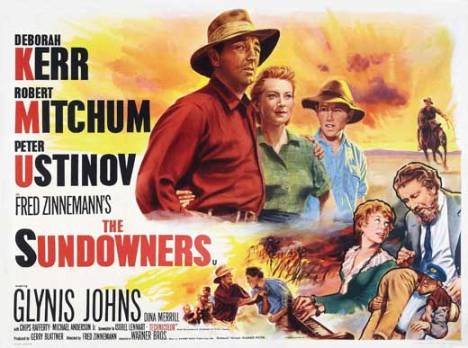
SUNDOWNERS poster

What is a sundowner you may ask? In this film from 1960 one character defines a sundowner as “someone whose home is where the sun goes down.” It was an Australian term used for roamers who traveled across the countryside taking one job at a time. They would pitch their tent wherever they were at the end of the day and that was their home for the night. Richard Zinnemann’s film follows a family of sundowners who move from place to place taking sheep herding jobs. The film bombed in the United States but did well overseas and would go on to earn five Oscar nominations including one for Best Film.

Robert Mitchum plays Paddy Carmody, a nomad at heart who has no desire to settle down in 1920s Australia. He is perfectly content with being constantly on the move and working small jobs here and there. But over time Paddy’s insatiable wanderlust begins to clash with the desires of his wife Ida (Deborah Kerr) and his teenaged son Sean (Michael Anderson). They believe the time is come to consider settling down. They’ve grown tired of constantly being on the go and Sean is at an age where he wants to experience life and set out on his own path. Paddy’s stubbornness and his family’s patience provide the film its central contention.

SUNDOWNERS1

Some critics pointed out that there isn’t a lot of plot in “The Sundowners”. That’s essentially true although the film’s intent is to be a sprawling tale of the family’s lives, love, and rugged endurance. We follow them along the Australian backcountry as they drive a large herd of sheep, contend with a sweeping wildfire, and live off what the land provides. This allows for some truly beautiful, sweeping scenes that vividly capture the Australian countryside. The film was originally set to be shot in Arizona, but Zinnemann petitioned hard to spend the extra money and shoot it on location. It was a good decision. The landscapes are anaccurate setting and the story feels perfectly in place. And some scenes, like the aforementioned wildfire are shot with such tenacity and skill. Simply put, the movie looks great.

The family encounters several interesting people along the way. They hire and befriend an Englishman and fellow roamer named Rupert. Peter Ustinov would receive an Oscar nomination for the role. There are also several other interesting faces that pop up when Ida convinces Paddy to take on a stint at a sheep shearing station. She hopes the time in one place will soften him to the idea of settling down here. It’s at this remote station that their family dynamic takes some dramatic turns which sets up the rest of the film.

SUNDOWNER2

As for the performances, Mitchum is rock-solid as always. His Paddy is a tough, salt-of-the-earth fellow, but one whose stubbornness threatens to alienate the family the holds most dear. Mitchum fits right into the character although his Aussie accent is a bit erratic. Kerr is as brilliant as always. Her Isa puts off tough and rugged pioneer vibes but also maintains a distinct femininity. Kerr would earn one of the six Oscar nominations of her career for this role. Amazingly she never won an acting Oscar but the Academy did give her the honorary “Whoops, We Screwed Up” award in 1994. The supporting work was uniformly strong and it too gained critical praise.

“The Sundowners” does run a tad too long and there is an occasional lull or two. The absence of a more defined plot may be an issue for some as well. But the movie does a great job of selling its characters and drawing us to them. I really liked the family and I wanted to see how their story plays out. I also appreciated how grounded the story feels. The film never embraces the sentimentality that many family dramas are consumed by. It just wants us to get to know these people and to experience the life they live. Personally that was enough for me.


VERDICT – 4 STARS

REVIEW: “Short Term 12”

SHORT TERM POSTER

“Short Term 12” opens up with a great scene featuring a supervisor from a group home for troubled teens telling a story involving a past patient to a new employee. We are dropped into this conversation as an observer and we get a brief introduction to the main characters. But without a moment’s notice the scene changes dramatically. A young boy bursts through the door and takes off towards the front gate. He’s screaming, waving his hands, and clearing he is deeply upset. The workers subdue him and the emotionally complex setting of “Short Term 12” is realized.

The movie is written and directed by Destin Daniel Cretton who was inspired by his real-life experiences of working in a group home for teens. He first made this into a 2009 short film, but later developed it into a feature length picture. This was only Cretton’s second feature length movie which makes his accomplishment all the more impressive. You see, “Short Term 12” is a really good movie and much of its strength and potency can by traced back to Cretton’s pen and his raw use of the camera which perfectly captures the tone and intensity of his setting.

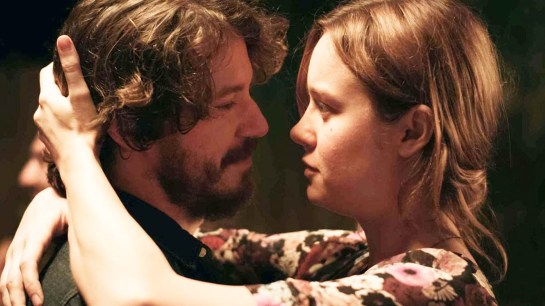
Short Term 12Brie Larson and Keith Stanfield

Brie Larson is unquestionably superb as the lead character Grace. She is a supervisor at the teen group home (called Short Term 12). She works alongside her boyfriend Mason (John Gallagher, Jr.) to both mentor and council a group of teens with an assortment of problems. Along the way we are introduced to them and watch as Grace interacts with them on both procedural and personal levels. Larson’s performance blew me away and there is such a natural quality to what she’s doing as an actress and within the character she is portraying. We also get some interesting scenes between Grace and Mason away from the home. At first these moments seem flimsy but they really payoff later on as the story develops.

Grace never lacks control and she is a compassionate professional when it comes to taking care of these kids. But she is especially invested in a new resident, a troubled young girl named Jayden (Kaitlyn Dever). This is where we see a different side and an interesting turn in Grace. There is a stunning and vivid dichotomy within her. She is a strong and determined woman, but she is also scarred and emotionally fragile. This adds an entirely new layer to the character and the film that I really responded to.

SHORT2

At no point does “Short Term 12” feel fabricated or overly melodramatic. There is a stinging realism that permeates the entire picture. It constantly draws out raw emotion from its characters and the situations and circumstances are believable and often times troubling. There are a couple of characters than dance dangerously close to stereotypes and their stories take some fairly predictable turns. But overall the film sucks you in and exposes you to truths about these teens and the people gifted with the patience and will to help them.

I tip my hat to Destin Daniel Cretton for crafting a movie that doesn’t lose itself in the typical Hollywood contrivances and forced melodrama that we get these days. I also applaud Brie Larson who not only showed she can act, but she gives an incredible performance that is grounded and always feels true. There are waves of emotions that flow throughout the movie and the story keeps you thoroughly invested. “Short Term 12” is another great example of the strength of independent cinema and the impact these films can have on the movie-making landscape.

VERDICT – 4 STARS

REVIEW: “Sarah’s Key”

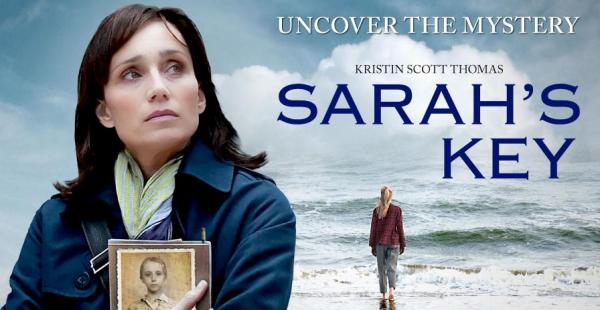
SARAHS KEY POSTER

Movies depicting the Holocaust and the plight of the Jewish people during the Nazi reign can be some of the most potent and emotional movies to watch. There have been several films that have taken a broader look at the subject while others choose to tell more personal stories. Either way, I remain fascinated at how skilled filmmakers can still remind us of this deep and devastating scar on our world’s history through truly powerful cinema. “Sarah’s Key” is another example of that. This film may not carry the weight of bigger Holocaust pictures, but it tells a stirring and sobering story that I really responded to.

The movie jumps back and forth in time and tells two interconnected stories. The first takes place during the Vel’ d’Hiv Roundup in Paris on July 16th 1942. It was the early morning mass arrest of over 13,000 Jews by French Police in a broader effort to placate the Nazis. The arrested Jews, of which nearly 10,000 were women and children, were taken to internment camps and eventually to Auschwitz for “extermination”. What made this even more despicable was the complicity of the French government and police, something France had failed to publicly own up to until 1995. It’s in this environment that we’re introduced to young Sarah Starzynski.

SARAHS KEY 1

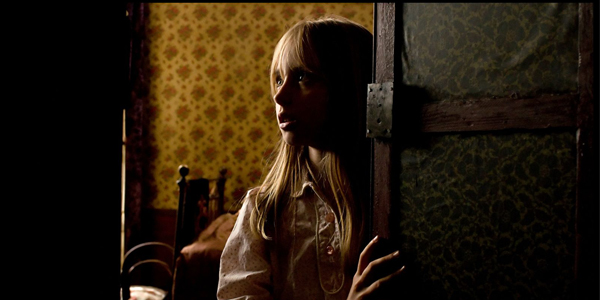
I found Sarah’s story to be the most interesting and certainly the most powerful. While playing under the covers of her bed, Sarah (Mélusine Mayance) and her little brother Michel are startled by a loud knocking on the front door. It’s a French policeman there to take them into custody as the roundup begins. Before Michel can be noticed Sarah hides him in a closet and makes him promise not to leave. She locks the door, hides the key in her pocket, and is soon taken away with her parents.

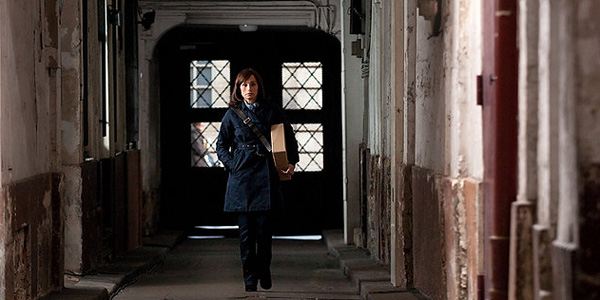
The other story starts in Paris in 2009 when an American journalist named Julia (Kristin Scott-Thomas) and her French husband Bertrand (Frédéric Pierrot) inherit an apartment from his grandparents. It turns out the apartment came into the family over 65 years earlier, around the same time as the Vel’ d’Hiv Roundup. Julia had recently wrote a piece on this sad part of French history so naturally she wants to know more about the house’s history.

We are told both of these stories in chunks. Co-writer and director Gilles Paquet-Brenner does a pretty good job of moving back and forth between stories although there are some fairly awkward transitions. And I mentioned that Sarah’s story is easily the more riveting and interesting of the two but that’s not to say Julia’s story is bad. In fact I liked it. But her story is hampered by a few plot points that just don’t work within the context of this film. These are mainly found in the relationship between her and her husband. Julia finds out that she’s pregnant and we learn that she’s had some difficult and failed pregnancies in the past. Bertrand doesn’t want the baby and is perfectly content with their life the way it is. This entire dynamic ends up playing a significant role in Julia’s life and it leads to a nice moment later in the film, but overall it feels underdeveloped and quite honestly insignificant compared to the horror that Sarah and her family are facing.

SARAHS KEY

But when it comes down to it, I like the way both stories come together. It’s not as surprising or profound as it could have been but I found it to be satisfying. Julia has several good moments as she digs deeper to connect her husband’s family to the Starzynskis. But it’s the strength of Sarah’s story that makes the joining of these two narratives work. I was consumed with watching Sarah’s difficult and heartbreaking life unfold. It’s brilliantly told both visually and through the script and it never shoves too much in your face. It’s respectful and reserved yet it maintains an authentic emotional punch.

A big hunk of the movie’s success is due to some standout performances. Kristen Scott-Thomas is a fine actress and her flawless American accent and fluent French gives Julia a natural believability. She also never overplays her scenes. But even better was Mélusine Mayance as young Sarah. I know we could get into the whole ‘How much of a child performance is acting or directing’ debate, but I thought she was magnificent. Niels Arestrup is another familiar face in the film who’s always good. There’s also two relatively unknowns who are wonderful here. Natasha Mashkevich really caught my attention as Sarah’s mother and Charlotte Poutrel is great in a much smaller role as an older Sarah. In her few scenes we see a beautiful but scarred young woman and it’s clear the events of her past have left a terrible mark.

“Sarah’s Key” is a movie that completely slipped under my radar. During my recent examination of French cinema I stumbled across this picture and I am glad I did. It’s a smart and respectful story whose only fault is that it tries to do too much. With a little more culling this could have been a tighter and more concise picture. But even considering that, this is a very good movie that’s both responsible and deeply moving. It may not be listed among the best overall movies about the Holocaust, but there are parts of this film that I would put up against any other.

VERDICT – 4 STARS

REVIEW: “The Square”

SQUARE

2013 was an interesting year for documentaries. It gave us gripping and unsettling exposés, intriguing characters studies, and attention-getting activist films. But perhaps my favorite documentary of the year was the Egyptian-American film “The Square”. It comes from Jehane Noujaim and focuses on the recent Arab Spring specifically the Egyptian Revolution and the events surrounding it. “The Square” is an enthralling film told with a discerning eye and it has rightly earned an Academy Award nomination for Best Documentary.

“The Square” refers to Cairo’s Tahrir Square. It’s a location that became the central hub for a revolution. The film picks up in the spring of 2011 as the Egyptian people, tired of the corrupt and oppressive Mubarak controlled government, rise up and let their voices be heard. These people are from every Egyptian walk of life, each sharing the common desire to be free from the regime’s grasp. Change comes but it is accompanied by lies, defections, violence, and the realization that change isn’t always for the better.

Square1

What makes “The Square” so absorbing is that it’s told from the ground. Noujaim chronicles the events starting with the initial protests that led to the military overthrow of Mubarak. From there if shows the military’s dictatorial stranglehold of the Egyptian people and their violent responses to the next wave of revolutionary protests. Then there is the presence of the Muslim Brotherhood which adds more layers of complexities to the already volatile landscape. And it’s all visualized through the cameras of those present at the time. It’s vividly documented and some of the raw footage we see is incredible.

While telling this story, Noujaim introduces us to several fascinating individuals from different backgrounds who form a united bond. One young man has known nothing but Mubarak’s rule. He uses his passion to give speeches at protests and rallies in hopes of growing the revolution. Another man is a popular actor who follows his convictions and leaves his comforts to join his people in their stands against the government. And then another man who is a member of the Muslim Brotherhood and ends up torn between them and his revolutionary friends. These and several other people help put faces to this fluid and intense three years.

Square2

Noujaim chronologically lays out everything from the mindsets to the events and she does it by putting us there. But the magnificence of the film isn’t just found in the capturing of shocking scenes of military violence. We listen in on spontaneous street debates which reveal the confusion, frustration, optimism, and in some instances naïveté of the people. We also hear private discussions about tactics and organization. All of these things develop an amazing sense of place and give us an unprecedented look at the true heroes behind the revolution.

“The Square” is a remarkable piece of documentary filmmaking that is both riveting and eye-opening. It educated me from a perspective that was missing from the news articles and reports I had seen. Jehane Noujaim deserves a ton of credit for bringing this together through a style that required great skill. This could have been just another political documentary but instead it’s a gripping experience that is sure to draw you to the cause of these passionate and hungry people.

VERDICT – 4.5 STARS

REVIEW: “The Secret Life of Walter Mitty”

mitty poster

I’m no card carrying Ben Stiller fan but I was really interested to see his vision of “Walter Mitty”. This is the second film based on the 1939 James Thurber short story and some doubted it would ever see the light of day. Various versions of the script were tossed around and actors such as Jim Carrey, Owen Wilson, and Sacha Baron Cohen were all in line to play the lead role. But after years in development limbo, it was Stiller who was signed to not only star in but direct Steve Conrad’s final script.

Stiller and Conrad use Thurber’s vision of Walter Mitty as a reserved average Joe who experiences the life he wants within his vivid world of daydreams. But the movie ends up pushing that aside and goes off on its own, becoming a film about fulfillment and self-discovery realized through a pretty remarkable journey. I was fine with that as long as it served the picture well. There are moments of greatness in “The Secret Life of Walter Mitty” and there are scenes that really drew me in. But there was also something missing – something that holds the film back and keeps it from being the great movie we are often teased with.

mitty1

In this modern telling, Walter Mitty (Stiller) works in the ‘photo negative assets’ department of Life magazine. One morning the employees get news that the publication will be turned into an online-only magazine making many of their jobs “nonessential”. Acclaimed photojournalist Sean O’Connell (Sean Penn) sends the magazine a negative that he believes to be perfect for Life magazine’s final cover. But Walter misplaces the negative. So with his job on the line and the pompous transition supervisor (Adam Scott) breathing down his neck, Walter sets out on a globe-trotting adventure to find O’Connell and hopefully the negative.

Walter’s journey takes him to some gorgeous locations including Greenland, Iceland, and The Himalayans. Stiller and cinematographer Stuart Dryburgh draw us into these places sometimes with breathtaking perspective. They invigorate Walter’s journey and in some ways substantiate his personal transformation. But I also struggled with certain aspects of his adventure. There are so many obvious questions that the film prefers you not ask. And there are also an insane amount of conveniences that aid Walter’s quest. Regardless of the situation there is almost always a perfect out for him. Perhaps there is a deeper meaning to it but it isn’t hinted at from the story.

“Walter Mitty” also seems to have a small identity crisis. There are some pretty funny bits early in the film but then there is a long stretch where it takes things pretty seriously. The humor is back-burnered and it becomes a casually paced drama with a fair share of high points and lulls. It lacks a consistency that great films have but it also had an unexplainable attraction that I never could shake.

mitty2

As for Stiller’s work in front of the camera, I was really impressed. In a year featuring a number of towering performances, I wouldn’t call Stiller’s the best. But there is a legitimate sympathetic charm to what he brings to the Walter Mitty character. I was really drawn to him and personally sympathized with his perception of himself and his inadequacies. Stiller magically captures all of that. He does lose some of his attraction as his character changes towards the end but I still love this performance. I also thought Kristen Wiig was good but underwritten as the proverbial ‘girl of Walter’s dreams’ and Shirley MacClaine is good in a smaller role. Adam Scott is harder to gauge. His performance isn’t that bad but the writing makes this typical corporate bad guy a little too on the nose.

“The Secret Life of Walter Mitty” is a tough movie to score. It certainly gets points for its visual style and gorgeous locales. It also gets points for Stiller’s fine performance and the sweet infectious charm of his character. Unfortunately it is an uneven film with a few too many contrivances and the occasional lulls. But yet there is something about the movie that I can’t dismiss. It has stuck with me and left the impression that I really need to see it again. That’s usually a sign that a movie works, at least on some levels.

VERDICT – 3.5 STARS

REVIEW: “Super 8”

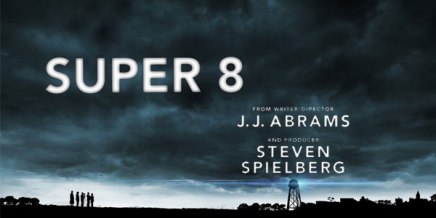
SUPER 8 Poster

“Super 8″ is a film that does so many things right. That’s why it was so disheartening to see it’s numerous flaws which are just too glaring to overlook. Crafted from the collaborative minds of J.J. Abrams and Steven Spielberg, “Super 8″ is a small town sci-fi picture that starts off strong but eventually squanders it’s momentum by turning into a run-of-the-mill monster movie that loses any sense of originality.

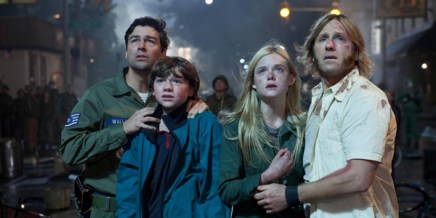
The story is fairly simple. Set in 1979 small town Ohio, “Super 8″ follows a group of kids who witness a massive train derailment while out late filming their home zombie movie on Super 8 film. It turns out the train belongs to the United States Air Force who go to great lengths to suppress any inquiries about what the train was carrying. Strange things begin to happen around town and it’s soon revealed that the military was hiding a mysterious and dangerous creature which is now on the loose. Now it may not sound like it but there is enough material there for a good movie and the first half of the film does a nice job developing the tension and mystery. But the second half of the movie goes off the rails (pun completely intended). Abrams puts more effort into being a nostalgic homage to the Spielberg pictures of old than he does into sustaining an original and unpredictable story.

SUPER 8

Clearly Abrams is tipping his hat to a style of films that many of us grew up on. In many ways, especially in the first half of the movie, he does a nice job of recreating that tone and feel. He also wonderfully captures that late 70s to early 80s period through the wardrobes, vehicles, haircuts, and some genuinely funny jokes. At times “Super 8″ also feels like a movie about making movies. Some of the best parts of the picture deals with the kids and their love and dedication to creating their own film. I also felt the movie was stronger when it was dealing with the kids, their friendships, and their family struggles at home. Once the movie concentrates on the creature story, it loses a great deal of its interest. The creature isn’t that frightening and much of what happens in the second half seems contrived. Compound that by an ending that packs little to no punch whatsoever.

“Super 8″ may be about a bunch of kids but it certainly didn’t seem aimed at kids. Personally I was a bit turned off by the pointless profanity, most of which comes from the kids. It added nothing to the picture and served as more of a distraction. The kids do deliver some genuinely strong performances, especially Joel Courtney and Elle Fanning. Their characters develop a friendship and fledgling romance that feels genuine and natural. Like everything else in the film, they are at their best in the first half of the picture.

There’s no denying that “Super 8″ has a high production value. There is some fantastic camera work and the special effects, not counting the creature, are quite good. There are tons of cool references back to 1979 and the film does feel like a picture from that time. But at the midway point it transforms into a conventional monster flick featuring potty-mouthed kids and a rather bland finale. As I said at the start of the review, “Super 8″ does many things right. I only wish the entire movie could have captured the magic that we see in it’s first 40 minutes.

VERDICT – 2.5 STARS