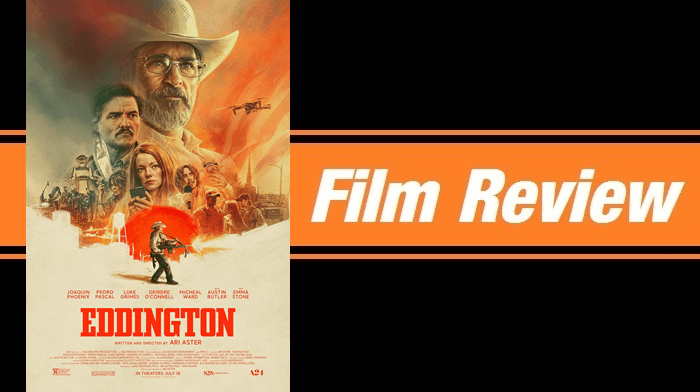
REVIEW: “Eddington” (2025)

Ari Aster’s short but attention-getting feature film career has been a fascinating rollercoaster. It began with a bang with his exceptional 2018 supernatural/psychological horror gem “Hereditary”. He followed it up with 2019’s “Midsommar” – a movie with a first half that is every bit as brilliant as his debut film and an unfortunate second half that goes completely off the rails. Things only got worse with 2023’s disastrous “Beau Is Afraid”.

Now Aster is back with his fourth film and with it we see his career pendulum swinging back mightily the other way. Aster takes a bold and provocative swing with “Eddington”, shrewdly straddling the line between satirical black comedy and a Neo-Western thriller. His story is set in 2020 during the early days of the COVID-19 pandemic. He takes an unvarnished look at the heightened paranoia and anxieties that swept through communities while spotlighting the political opportunism and obstinance that only made things more complicated.

Adding to the already tumultuous landscape were the growing tensions following the killing of George Floyd. Impassioned protests swept across the country. But several were overthrown by aggressive rioters, sometimes prompted by well-funded outside agitators eager to plunge the country into violence. Aster’s willingness to take on such fresh wounds speaks to his audacity. But what’s amazing is how well he pulls this crazy thing off.

Image Courtesy of A24

While some may try hard to put “Eddington” in their political corner, the film openly fillets the political left, right, and most everyone in between. It should be stated that Aster isn’t fence-straddling. He offers frank and truthful observations through a fable that is as thematically chaotic as the times it represents (and fittingly so). Most will remember the events with alarming clarity which may make this a difficult watch. Yet Aster mines so many darkly funny moments out of the pointed, pathetic, and preposterous scenes that unfold before us.

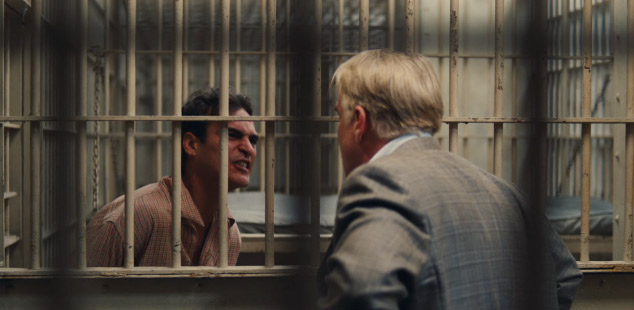
The story plays out in Eddington, a small dried-up New Mexico town with a population of 2,435. It’s where we meet Sheriff Joe Cross (an exceptionally pitiful Joaquin Phoenix), a by-the-books rural conservative who keeps the law in his quiet town with the help of his two deputies, Guy (Luke Grimes) and Michael (Michael Ward). The only thing more frustrating to Joe than mask mandates and government imposed lockdowns is his live-in mother-in-law, Dawn (Deirdre O’Connell) who rarely misses a chance to scrutinize how he handles his dissociative wife Louise (an underused Emma Stone).

Joe doesn’t see the coronavirus or the growing unrest as Eddington problems. This puts him at odds with Ted Garcia (Pedro Pascal), Eddington’s incumbent mayor who is up for reelection. Ted stands for nearly everything Joe is against. He’s a good-looking and good-talking politician who is intent on protecting his political career by staying on his liberal governor’s good side. That means imposing and enforcing mandates and policies that don’t always apply to him. Far shadier is his involvement in a massive AI data center set to be constructed on Native American land outside of Eddington.

Image Courtesy of A24

As the tensions fester between Joe and Ted, a small but growing BLM-inspired protest breaks out on Main Street. They’re spearheaded by the impressionable Sarah (Amélie Hoeferle) whose verbiage and sloganizing sounds plucked from TikTok videos rather than out of organic conviction. She’s supported by Brian (Cameron Mann) who is more smitten with her than their cause. Joe is ill-equipped to either control the crowd or empathize with their cause which only makes things worse.

Aster throws in so many other things, all ripe for critique. Conspiracy theories, misinformation, social media dependency, cult leaders (a shaggy but captivating Austin Butler is a brief delight), white middle-class radicalism, etc. With so much laid out, the budding question became how would Aster wrangle it all together? The answer – with an insanely violent Tarantino flavored exclamation point at the end. It’s a wildly entertaining finish that speaks to where our intensifying divisions could eventually lead us.

“Eddington” feels like a movie some will need to wrestle with, not just for days but perhaps years. It’s a feature that demands a level of honesty and introspection. Those unwilling will likely contort the movie to fit their political dogmas or simply dismiss it altogether. But those willing to look deeper will find a well-conceived and well-crafted satire that is both ruthlessly funny and daringly insightful. Top it off with a terrific cast (none better than Phoenix), and you have Aster’s best film since his stellar debut. “Eddington” is in theaters now.

VERDICT – 4 STARS

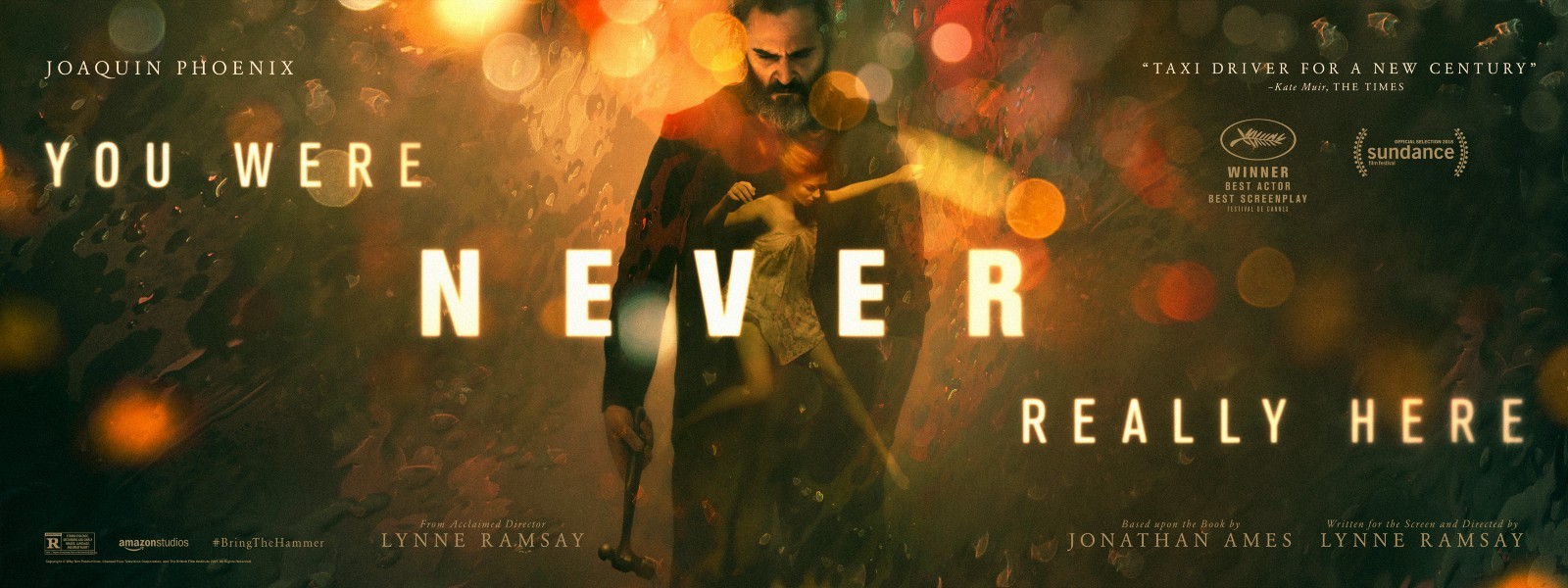
REVIEW: “You Were Never Really Here”

NEVERposter

With “You Were Never Really Here” writer-director Lynne Ramsay (“We Need to Talk About Kevin”) makes a forceful statement. Not just to her own individual talents as a filmmaker, but to the female perspective and the powerful jolt it can give a genre. By genre, I would call her latest film an action/revenge thriller although even giving it a label feels like a disservice to Ramsay and the plethora of cool ideas she is working with.

Ramsay adapts “You Were Never Really Here” from Jonathan Ames’ 2013 noir novella. At only 95 pages, the novella is both brisk and brutal, an equally fitting description of Ramsay’s movie. Not a second of the taut, economical 90 minutes is wasted and within its framework is a level of craftsmanship and unique storytelling prowess that leans heavily on mood and immersing us through our senses.

NEVER1

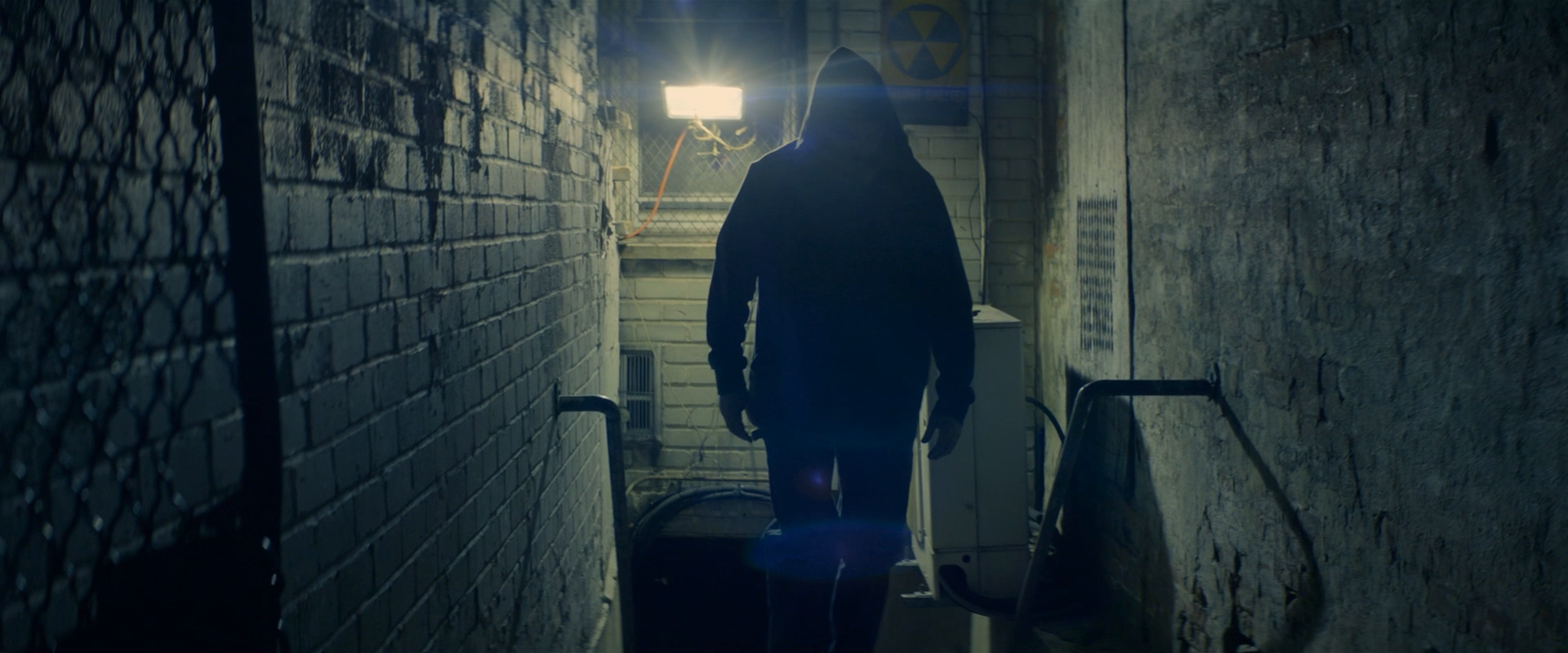
Look no further than the opening scene, a tightly edited collage of sound and images that introduces us to Joe (a burly and bearded Joaquin Phoenix). We learn he is a hired gun who specializes in retrieving the young daughters of wealthy, prominent parents from sex trafficking rings. He works off the grid and in his own moral mélange of brutality and compassion. Ramsay only feeds us bits but Joe’s scar-riddled body and glazy worn eyes speak volumes.

When not embedded in New York’s sordid underbelly, Joe cares for his elderly dementia-stricken mother (played by Judith Roberts). Phoenix, the definition of committed and uncompromising, seamlessly moves back-and-forth between these two contrasting worlds. In one scene he’s wiping off a blood-soaked hammer and shortly after polishing silverware and singing a song with his mother. And when Ramsay pushes us deeper into Joe’s head we witness suicidal impulses and traumatic flashbacks to his childhood and military service. They come in startling quick bursts making them all the more unsettling.

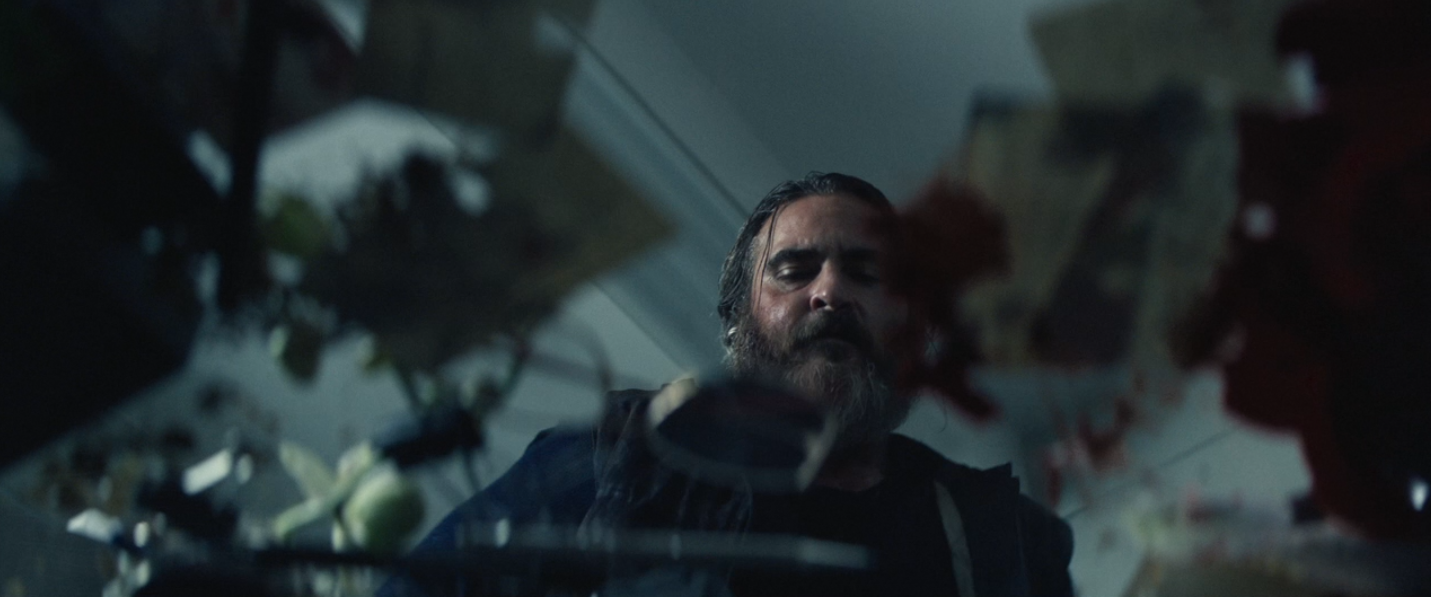
Things get even uglier when Joe takes a job to find a State Senator’s daughter (Ekaterina Samsonov) only to run face-first into unexpectedly deeper levels of depravity and corruption. The story grows darker (there is rarely any light to begin with) and the bloodshed amps up. But Ramsay doesn’t revel in the violence nor exploit it for effect. Joe, her principle subject, is a child of violence and his dark psychological journey is often defined by it. While at times graphic, most of the killing happens just off camera or from strategic perspectives – a cracked mirror on a ceiling or through surveillance cameras. It certainly doesn’t mute the savagery.

Never2

Ramsay’s style of filmmaking has a fascinating synergy with this material. She often tells her stories through vivid imagery and pulsing sound design instead of a more traditional narrative structure. This is what keeps “You Were Never Really Here” from falling in with more conventional genre pictures. Her camera works like a gritty kaleidoscope, creating and maintaining an essential mood and intensity. Jonny Greenwood’s menacing score is filled with eerie strings and synthesized chords as if pulled from the cracked psyche of its lead character. It all works together in a twisted hypnotic harmony.

At the 2017 Cannes Film Festival “You Were Never Really Here” received a seven-minute standing ovation. Awards went to both Ramsay (Best Screenplay) and Phoenix (Best Actor). I understood why after first seeing it. But it was my second viewing that I was able to fall in with the film’s unique rhythms. And while Joe isn’t necessarily a character you want to spend time with nor is this a comfortable world to be in, Lynne Ramsay keeps our eyes glued to every frame.

VERDICT – 4.5 STARS

REVIEW: “The Immigrant”

IMMIGRANT POSTER

Whenever the topic of greatest working actress pops up Meryl Streep so often finds her name at the top of the list. I do belief Streep can be really good, but I believe a strong case could be made for Marion Cotillard. She is a sensational actress who has proven herself with every role she has tackled. She does it again in James Gray’s new film “The Immigrant”. This period drama was a very personal project for Gray. In an interview with Variety he said “It’s 80% based on the recollections from my grandparents, who came to the United States in 1923.” We see this personal connection running throughout the entire film.

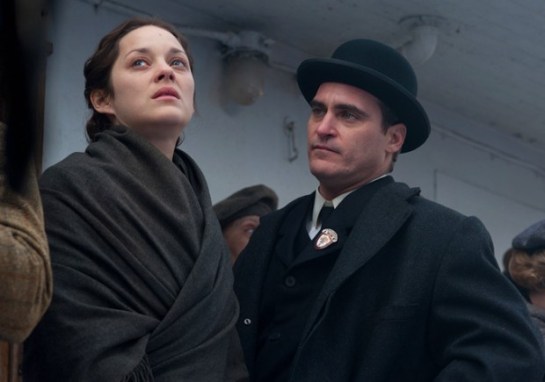
The story starts in 1921 as Ewa (Cotillard) arrives at Ellis Island with her sister Magda (Angela Sarafyan). The two have left their home country of Poland, which has been ravaged by World War I, in hopes of starting new lives. But during the processing, Magda is quarantined for a suspected lung disease and Ewa is set to be deported due to some questionable immorality that took place on the boat to America. But she catches the eye of a man named Bruno (Joaquin Phoenix) who uses his money and influence with a particular guard to free Ewa and save her from deportation.

IMMIGRANT1

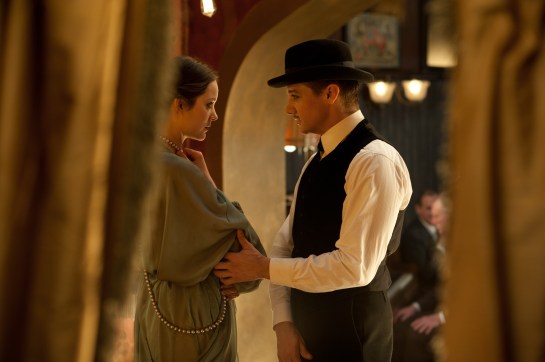
With no place to go, Ewa accepts Bruno’s offer to work for him in hopes that she can earn enough money to get her sister the medical care she needs. The problem is Bruno runs a ‘gentleman’s show’ and the women he employs are prostitutes. Bruno is charming and persuasive but he also exploits Ewa’s desperation. Ewa is torn between the moral consequences of her actions and her desire to help her sister. Things are complicated even more as Bruno develops an infatuation with her which brings with it jealousy, rage, and even violence.

The movie centers itself on its characters and the different plights of each. Ewa’s circumstances are obviously difficult and the dream of a new life seems practically unattainable. Bruno is often a despicable and detestable man, but at times we see glimpses of compassion. The reasons behind his occasional generosity is a puzzle. Is it due to a genuine love he has for Ewa or is it in the interest of making money? Jeremy Renner plays a struggling magician named Orlando. He is a cousin to Bruno but the two haven’t been close in years. He too is drawn to Ewa and he looks to be a more gentle and loving alternative. But even he shows glimpses of instability making us question who he really is inside.

These characters are magnetic of themselves but they are even richer due to the brilliant cast. Phoenix is always good and while this role doesn’t ask him to dive as deep into the character as some of his previous work, he still has moments where he just takes over a scene. Renner is also very good and he often offers some needed changes in tone which he has no problem handling. But the true standout is Marion Cotillard who once again completely immerses herself in a role. Watching her dissect her character and give her such strong emotional form is akin to watching a fine artist. It’s heavy material and Cotillard expresses it with an emotional precision that we rarely see. She also has a classic-styled radiance that fits this type of movie well and translates beautifully with the camera. Cotillard is brilliant and this is my favorite performance of the year so far.

DSC_1034.NEF

James Gray’s story is engaging and heartbreaking. His characters are interesting and compelling. But there is also a perfectly realized 1920s New York City that plays a major role in the film. Gray’s vision combined with Darius Khondji’s cinematography creates shades of the city which sometimes look bustling and vibrant but often times looks cold, harsh, and unwelcoming. It’s a portrait that walks hand-in-hand with the characters and their situations.

There are a few things in “The Immigrant” that could be picked apart and a case could be made that it has a few lulls. But for me the selling point here are these characters who I happened to latch onto instantly. It’s also a period film featuring a master class in acting by Marion Cotillard who I believe is one of our finest. She absolutely owns the screen and she leaves nothing behind. That alone makes “The Immigrant” worth seeing.

VERDICT – 4.5 STARS

REVIEW: “Her”

HER POSTER

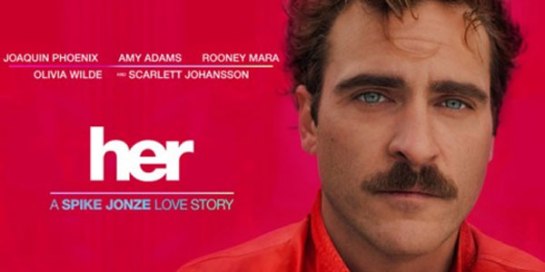
In the not too distant future of Spike Jonze’s “Her” technology has made major leaps, fashion senses have eroded, and Hollywood’s cynical views of relationships have remained the same. Loaded with ambition and lauded by many as the best movie of 2013, “Her” incorporates a familiar science-fiction concept into what is more or less a love story and relational study. But it’s far from conventional or cliché. That said, it isn’t a film free of problems which (for me) ultimately keep it from being the modern day masterpiece that some are touting it as.

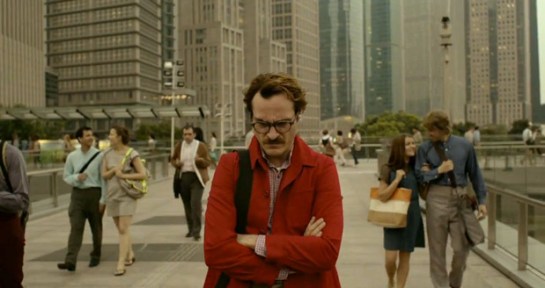
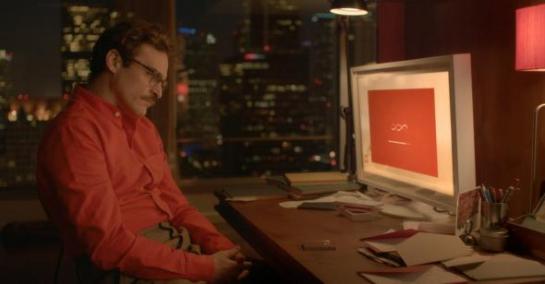
The story revolves around Theodore Twombley (Joaquin Phoenix), a nerdy introvert who works as a letter writer for people who have a hard time sharing their feeling. Theodore is a lonely soul. He’s currently involved in divorce proceedings from his first wife Catherine (Rooney Mara) and he hasn’t been able to get out of his ever-present state of melancholy. He has practically no social life and outside of his longtime friend Aimee (Amy Adams), there is no significant person in his life.

HER2

Theodore’s life takes a strange and unexpected turn when he purchases a new operating system for his computer. But this is no Windows XP. It is an adaptive artificial intelligence that evolves and takes on its own personality. The OS (voiced by Scarlett Johansson) goes by the name Samantha and soon develops a very personal and intimate relationship with Theodore. Samantha begins to fill the lonely void in Theodore’s life while he becomes her window to a new and exciting world. But the reality that she is an operating system causes him to wrestle with the legitimacy of their relationship.

The science-fiction mainly serves as a subtle backdrop with the exception of the familiar idea of computers becoming sentient. But Jonze deserves credit. He’s really doing a lot more here than first looks might reveal. He takes an interesting look at our infatuation with our gadgets and where that could perceivably lead us in the future. There is also a strong focus on communication or lack thereof. The film shows us several relationships that struggle due to the poor abilities to communicate. And speaking of struggles, prepare for a lot of them. In Jonze’s gloomy view of love, nearly every relationship struggles and has a rare hope for survival.

Her3

On the other hand, it’s the rich and unbridled conversations between Theodore and Samantha that causes their relationship to flourish. There are so many scenes of them just talking about simple things that may seem inconsequential but that are vital to making a relationship work. Phoenix is amazing and completely wraps himself up in his character. He displays an enormous range of feelings with such realistic fervor. And Johansson shows why voice work is deserving of more attention than it’s given. Her voice is sultry and sexy but it’s also warm and vulnerable. These two show a deep and growing attraction, yet even here we see Jonze use a little bait and switch.

But while I really appreciate Jonze’s originality and I love being challenged by deeper thought-provoking approaches, there were a handful of things that kept me from fully embracing this as a great film. First there is the movie’s glacial pacing specifically in the second half. The aforementioned conversations between Theodore and Samantha are good at first, but they reach a point where they no longer move the story along. The countless closeup shots of Phoenix laying on a pillow talking to Samantha well after their love has been established grew a bit tiresome. This only slowed things down for a movie that already had a calculated and deliberate pace.

HER1

The film also contains some unneeded scenes that added little to the movie. Olivia Wilde pops up as Theodore’s blind date. While her presence had a purpose, she was a very flimsy, throwaway character. There is also a weird scene where Samantha calls on a surrogate to serve as her physical body in order to be intimate with Theodore. It’s an intentionally uncomfortable scene laced with a touch of dark humor. But as it plays out things get sloppy especially with the surrogate character herself. And then there are these occasional odd tone-shattering attempts at humor. One involves a lewd act with a dead cat’s tail and the other features a cartoony video game character who suddenly spews a river of obscenities. This silly juvenile humor came across as cheap and both scenes felt completely out of place.

I wish I could toss aside those complaints because “Her” does many things right. It asks some great questions and it certainly allows for a variety of interpretations. For example take the ending. Depending on your interpretation it could be a very light and hopeful ending or a very dark and depressing one. I liked that. I love the work we get from Phoenix and Johansson and Rooney Mara’s character added a deeper emotional twist that I really responded to. But the film’s cynicism, the constant lingering of the second half, and some questionable script choices hurt my experience. It’s one of the few movies that captivated me yet had me checking my watch before it was done. Ultimately that’s a disappointing combination that pushed me away a bit.

VERDICT – 3 STARS

TOP 5 LEADING ACTOR PERFORMANCES OF 2012

Lead Actor

Today I wrap up my look back at the best acting from the 2012 movie year. We’ve looked at the supporting categories and the lead actress category. Now it’s time to look at the lead actors. Just like every other field this year, the lead actor category is loaded with great performances and with deserving actors who blew me away. It was crushing to leave some names off but I think this list sums up the category perfectly. There is a huge range of performances here covering everything from small budget independent films to monster sized blockbusters. But the one constant are the performances and these guys were great. So here are the Top 5 Leading Actor Performances from 2012 (according to me)…

#5 – JACK BLACK – (“Bernie”)

BERNIE

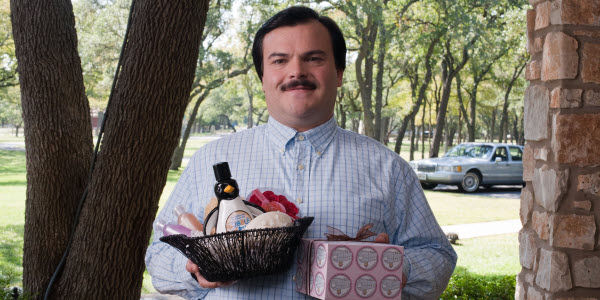
I just can’t believe I’m actually putting Jack Black on my list of top lead actor performances. Let me say for the 100th time – I’m no Jack Black fan. But I’ve got to admit that his performance as the eccentric Bernie Tiede deserves to be on this list. Black’s loud, in-your-face brand of stupid comedy just doesn’t work for me but here he really dials it back a bit. A lot of it is due to writer and director Richard Linklater but I have to giver Black a lot of credit. I loved this performance in “Bernie” and it’s a big step in the right direction for Black.

#4 – DANIEL CRAIG – (“Skyfall”)

CRAIG

Daniel Craig won’t make any critics lists and you won’t see his name down as a Golden Globe or Academy Award nominee. That’s a shame because he should be. I’ve thoroughly enjoyed his run as James Bond and his work in “Skyfall” is his best yet. Craig has all the characteristics of Bond – suave, hunky, and tough. But he tones down the cheese and brings a much more grounded and flawed character to the screen. But make no mistake, he still kicks a ton of butt. Craig packages all of this up with his “Skyfall” performance and he deserves to be mentioned with the best of the year.

#3 – JOAQUIN PHOENIX – (“THE MASTER”)

JOAQUIN

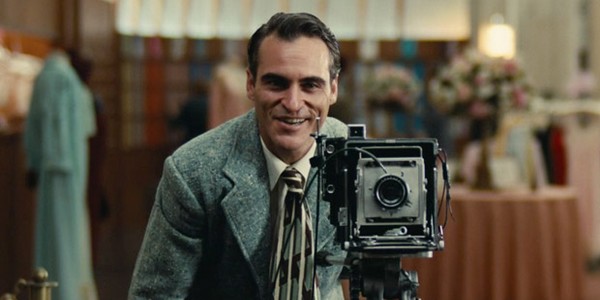
Regardless of my mixed feelings on Paul Thomas Anderson’s “The Master“, I had no mixed feelings about Joaquin Phoenix’s performance as Freddie Quell, an alcoholic World War 2 veteran battling post-traumatic stress disorder. Anderson’s script takes Freddie down several dark holes, and even though they don’t always translate well on screen, Phoenix is riveting as this deeply damaged character. All of his past recent off screen antics can sometime cloud the fact that he is a brilliant actor. He reminds of that in “The Master“.

#2 – HUGH JACKMAN – (“Les Miserables”)

JACKMAN

I have to admit, I’ll never look at Wolverine the same way. Hugh Jackman starring in a musical may surprise some people but the actor has a history on stage. In Tom Hooper’s ambitious film version of the “Les Miserables” musical, Jackman takes the lead role and knocks it out of the park. Some have questioned his singing. It didn’t bother me a bit. But it wasn’t just his singing that made this performance so strong. Jackman invests everything, both physically and emotionally, into the part and that sold me more than anything else. He’s great in this film and he deserves the praise he’s getting.

#1 – DANIEL DAY-LEWIS – (“Lincoln”)

DANIEL DL

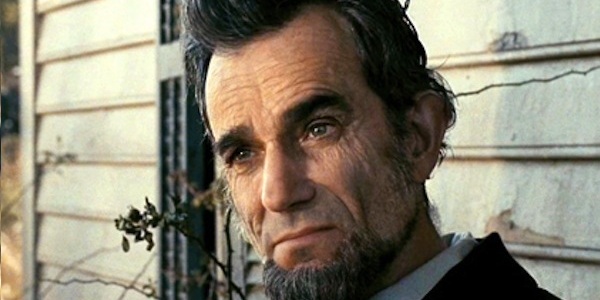
I know it’s the popular pick and I know that Daniel Day-Lewis is the front runnuer for the Best Actor Oscar. Good! He should be! Sometimes people just get it right. How could I not go with Day-Lewis in what was the most towering and immersive performance of 2012. Nobody throws every part of themself into a role like Day-Lewis. In “Lincoln” he manages to take an incredibly well known historical figure and give us something we have never seen before. His looks, his voice, his expressions – everything is unique. Day-Lewis is the best and this is yet another brilliant performance to add to his resume. If he doesn’t get the Best Actor Oscar they shouldn’t have the award.

So that wraps up my humble opinion of the four major acting categories for the 2012 movie year. It was a year that reminded us of the wealth of talent both old and new in the movies today. Here’s hoping we have just as much to talk about at the end of 2013.

REVIEW: “The Master” (2012)

The last time we saw acclaimed director Paul Thomas Anderson was in 2007 with his sensational drama “There Will Be Blood”. With it he solidified his position as a film critic favorite. Now he’s back with his next movie, “The Master”. As with every other feature film Anderson has made, he both wrote and directed this audacious drama that bounces between captivating and utterly frustrating. There are some award-worthy performances and loads of ambition, just as you would expect from a PTA feature. But while there were moments where I couldn’t take my eyes off the screen, there are others where the story bogs down in the deliberate pacing and slight self-indulgence. Nonetheless Anderson presses all the right critic’s buttons so this will has a good chance to be an awards season contender.

No one can deny Anderson’s filmmaking skills. “The Master” looks every bit of an epic, landmark film. There are a number of scenes that stand out due to their framing and camera work alone. Anderson uses several amazing tracking shots, sometimes shifting focus three or four times while still maintaining a single fluid shot. He also uses several fantastic locations which he captures through his stylish and precise lensing. I also have to mention the way he recreates America in 1950 both narratively and visually. The wardrobes, hairstyles, furnishings, etc. all fit perfectly, right down to the smallest details. Anderson takes no shortcuts on selling the audience on the period and that’s one of the reasons it’s so easy to connect with the story.

It’s in this 1950 America that we are introduced to Freddie Quell. He’s played by Joaquin Phoenix who gives the performance of his career. While not as breathtaking as Daniel Day-Lewis in “There Will Be Blood”, Phoenix is magnetic portraying a man emotionally scarred from his time in World War 2, or at least that’s what I presume. Freddie’s life is in shambles. He’s a raging alcoholic who resorts to drinking his own concoctions made from paint thinner and any other chemical he can get his hands own. He also has a twisted sex disorder that pops up here and there. His alcoholism is destroying his life and ends up playing an important part in the film. On the other hand, his sex addiction felt terribly underwritten and is only explored by adding a handful of uncomfortable scenes that quite frankly I could have done without. But as I said, Phoenix is brilliant and should be in prime position for an Oscar nomination.

Freddie ends up crossing paths with the charismatic leader of a group called “The Cause” named Lancaster Dodd (wonderfully played by Philip Seymour-Hoffman). Dodd is a self-proclaimed philosopher and intellectual with a steady and devoted group of followers. He also has a way with words which draws Freddie to him and his movement. Dodd takes a special liking to Freddie, at one point calling him his guinea pig but clearly growing more fond of him. Dodd is able to suppress Freddie’s mental issues to the point where Freddie begins to buy into his teachings. But his inner turmoil resurfaces on several occasions making him more and more conflicted.

The story often moves with an amazing rhythm and Phoenix and Hoffman share some mesmerizing scenes together. But for such a hyped picture, I was surprised to see the overall lack of plot. “The Master” features some of the best scenes you’ll see in the theaters this year, but honestly, there’s not a lot that happens within the film’s long running time. But a bigger problem with “The Master” is that for the entire film Anderson keeps the audience at arm’s length from what we are seeing. We’re never allowed to fully get to know the characters who truly are the driving forces behind the entire story. Anderson wants us to do a lot of guesswork and come to our own conclusions. But for me, a little less ambiguity and more intimacy with the characters would have been a big plus.

Overall there is a lot to like about “The Master”. Anderson’s style of filmmaking is about as good as you will find and it really stands out here. The movie looks and feels right at home in post-World War 2 1950 and the cinematography will blow you away. The film is also helped by tremendous performances from Phoenix and Hoffman and I didn’t even talk about Amy Adams’ strong work. Expect to hear all of their names when the Oscar nominations are announced. But while Anderson’s story is good, it doesn’t pack the punch that it’s going for. While it’s fascinating to watch these characters, I couldn’t help but want more. That, combined with a few pacing issues and a couple of scenes it could have done without, keep this from being the Best Picture frontrunner many are touting it as.

VERDICT – 3 STARS