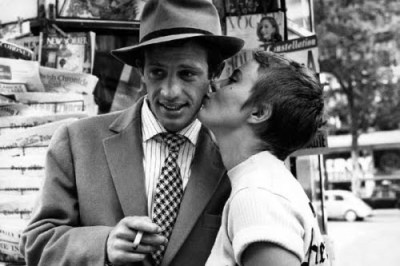
REVIEW: “OSS 117: Cairo, Nest of Thieves”

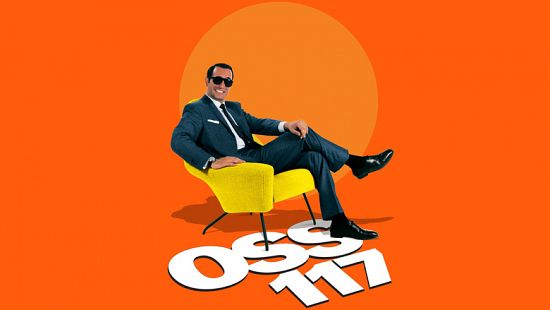
OSS 117 Poster

It may surprise some but the Oscar-winning juggernaut “The Artist” wasn’t the first collaboration between director Michel Hazanavicius and stars Jean Dujardin and Bérénice Bejo. In 2006 the three came together to make the spy thriller spoof “OSS 117: Cairo, Nest of Spies”. These two films couldn’t be any more different yet there is an interesting similarity. “The Artist” was a silent movie that paid tribute to an often forgotten era of moviemaking. “OSS 117” is a parody of the old 1950s and 1960s spy pictures particularly the early James Bond films. While quite different in production and intent, both have sharp eyes when it comes to the era of filmmaking they take place in.

Jean Dujardin plays OSS 117, a French secret agent who is a cross between Bond and Inspector Clouseau. He’s sent to Egypt to investigation the death and disappearance of fellow agent and friend Jack Jefferson, to stop all fighting between the Americans and Russians, and bring complete and total peace to the Middle East. To this ridiculously unreasonable task he simply replies “No problem”. In the first few scenes you get a good idea what kind of movie this is and what kind of character OSS 117 is. He has the suave and debonaire looks of Bond but the intelligence and deductive skills of Clouseau. As he was getting his assignment from his superior, I couldn’t figure out who the film was spoofing more, a nitwit secret agent or the French government for actually sending this guy. Perhaps a little of both I think.
oss 117

He lands in Egypt and meets with his contact, a beautiful local named Larmina (Bejo). It doesn’t take him any time to show her and us his utter stupidity as he tries to impress with his incorrect knowledge of the country and his offensive comments about it. That gets to one of my favorite things about this movie – it’s definitely politically incorrect. OSS 117 manages to unknowingly yet repeatedly put down the country, its people, and even its religion. Some of these scenes are hysterical and this is when his buffoonery stands out the most. We also quickly learn that he couldn’t recognize a clue if it were parked right behind him. There are so many leads and bits of evidence in plain sight that anyone other than our bumbling protagonist could see.

There are also several other hilarious running gags the go on throughout the film. There is his infatuation with a light switch and the effects it has in a chicken house (I’ll leave it at that), a reappearing spy who constantly calls in 117’s locations, and one gag that specifically focuses on 117’s always perfect hair. All of these worked for me. But there are scenes where the film goes a little over the top. For example, there’s an intense shootout later in the movie but not with guns and bullets. The weapons of choice? Chickens! Now I’ll be honest, I did chuckle a bit at that, but overall it felt a little too outlandish.

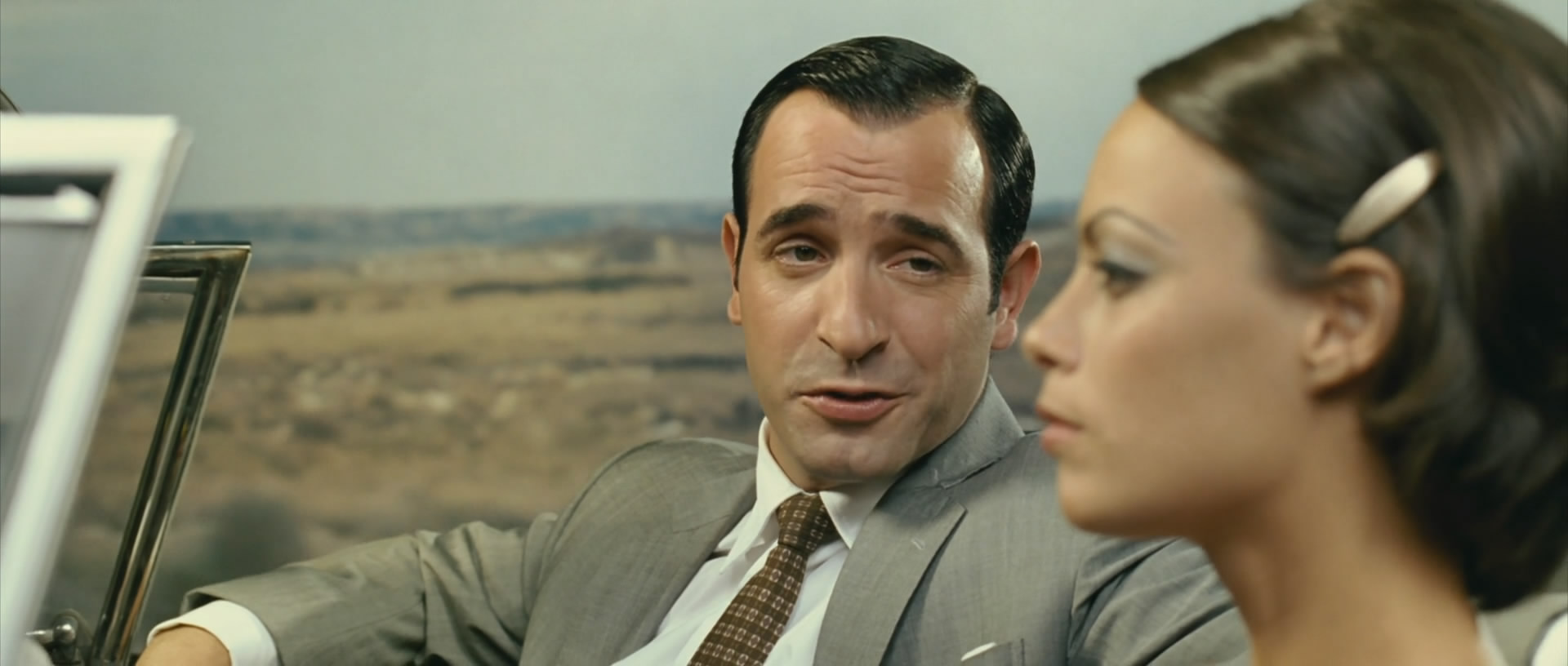
With the exception of the parody, this film looks and feels like it could have been made by the filmmakers of the late 1950s. It’s set in 1955 and Hazanavicius goes to great lengths to recreate that. He does so not just with the cars, clothing, and interior designs, but also by using the same style of special effects. I particular loved the driving sequences with the obvious rolling video screen behind them. There are also a couple of fight sequences that feel yanked right out of that period.
OSS 117 (2)

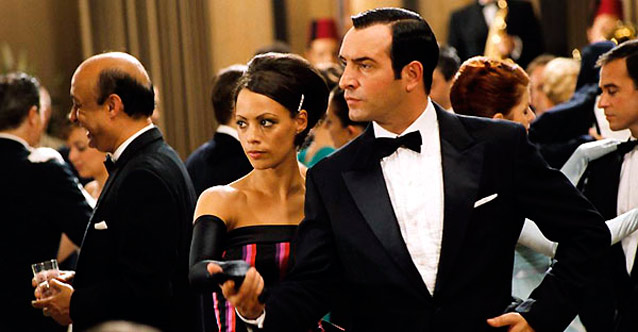
Another highlight was Dujardin. He really impressed me with his sharp sense for comedy. He’s completely believable and brings out the silly shallowness of this character who’s more interested in opportunities to wear his tuxedo and learning to smoke cigarettes. Dujardin’s wacky array of postures and facial expressions work perfectly and Bejo is a wonderful compliment. There are also several other side characters that bring in some really good laughs.

Considering the absence of good quality comedies, “OSS 117: Cairo, Nest of Spies” was a great find. I have to admit that Hazanavicius, Dujardin, and Bejo became known to me through “The Artist”. But because of the impression they made, I was immediately interested in this film just by seeing their names attached. It didn’t let me down. Now obviously this isn’t the type of comedy that everybody will respond to. But I loved the mix of subtle humor and over the top absurdity. And now I find out that Hazanavicius and Dujardin did a sequel? Sign me up!

VERDICT – 4 STARS

REVIEW: “Amour”

kinopoisk.ru

One of my most eagerly anticipated films to see has been Michael Haneke’s “Amour”. The 70-year-old Haneke is a director I’ve grown to admire even though I leave some of his films frustrated. He can seem infatuated with suffering and misery and his love for ambiguous endings can be testing. For example, after recently watching his 2005 film “Caché” I found myself growling at the open-ended finale. But soon after I found myself thinking more on the movie and what Haneke was going for. That’s when I really began to appreciate the film. Such is the case with several Michael Haneke pictures.

His latest movie is “Amour”, a French language drama that has blown critics away and garnered 6 Academy Award nominations. Haneke is no stranger to critical acclaim but make no mistake, he deserves every ounce of praise he has received for this stirring and often times devastating masterpiece. Like many of his pictures, it’s not a movie you can say you thoroughly enjoy watching. “Amour” deals with some depressing but very real subject matter and Haneke’s ability to express it all is astounding. He was able to get me so emotionally invested that I cared about every single thing I was seeing on the screen.

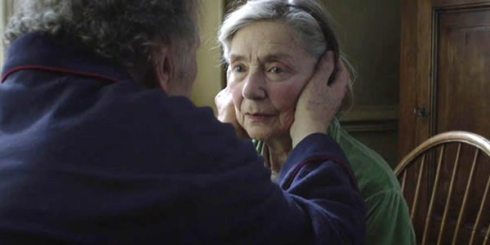
But the film would never work without its two phenomenal lead performances. Jean-Louis Trintignant and Emmanuelle Riva play Georges and Anne Laurent, a happily married couple, both in their eighties, living in Paris. We see some beautiful scenes of them together as they enjoy a night out at a concert and share conversations at the breakfast table. I instantly knew that these two people had been in love for a long time. But it’s at that breakfast table where Anne suddenly goes quiet and just stares straight ahead for several minutes. It turns out that she has what appears to be a stroke and after surgery she’s left paralyzed on her right side.

Amour1

Georges brings Anne back home to take care of her and promises that he’ll never take her back to the hospital or send her to a hospice facility. This doesn’t sit well with their daughter Eva (Isabelle Huppert) who has a few clashes with Georges over the decision. Sadly Anne’s condition worsens and Georges has to face the reality that his wife may not get better. This is difficult but reality-based stuff and the film never pulls any punches in dealing with it. We see the simplest of things become increasingly difficult for Anne and we see Georges right by her side through it all. We watch them go through something that so many others have experienced and that ability to relate is one thing that makes this such a powerful picture.

I hinted at the great performances by the two leads. Well with all due respect to every other female performance of 2012, and that includes Oscar front-runners Jennifer Lawrence and Jessica Chastain, no one gave a more stunning and committed performance than Emmanuelle Riva. She took my breath away. She gives this performance everything she has and that’s a key ingredient to making it work. There was never a moment in the film where I didn’t believe in what she was doing. And then there’s Trintignant who has a much different role but an equally essential and compelling one. He offers that same authenticity as Riva and for me watching him handle this material was a huge part of my experience.

I also have to take time to talk about Haneke’s technique. I loved how he opened the movie. We get one brief scene that sets the table for everything to come. In a sense Haneke shows his hand before playing his cards. But the true power of this film is in what follows and the opening scene allows us to put our focus where it should be. There’s also no musical score at all. This frees the movie from any potential emotional manipulation that music can sometimes bring. Haneke brings every ounce of his emotion from the characters. Now personally I would have liked a smart and subtle score but it’s absence does nothing to detract from the film.

Amour2

You’ll also notice that almost the entire movie takes place inside their Paris apartment. With the exception of the early sequence where they go to a concert, we spend the entire time in the apartment with them. During that time I felt I knew their home as well as they did. I know where their living room is. I know how their kitchen is laid out. I know their foyer, their halls, their bathroom, and their bedroom. This did a couple of things for me. It gave me a sense of place but it also relays the confinement they now experience. Anna’s illness has restricted them to the apartment where they even depend on good neighbors to get their groceries for them. Haneke also uses his familiar technique of setting his camera and then watching things unfold. Often times he’ll extend his shots which force us to take in some of the painful moments while at other times enjoying and appreciating the peaceful ones. I found this to be very effective.

And then you have the ending. As I mentioned in the first paragraph, anyone familiar with a Michael Haneke picture has to be prepared for the ending. Sometimes they’re nice and tidy but other times they can be abrupt and ambiguous. In “Amour” he ends it just right, well almost. There’s an incredibly moving moment that felt like the perfect ending to this film and essentially it is. But then he tacks on an extra minute-long scene. Now this brief final moment does carry some weight in itself and it does nothing to undo the previous scene. But it did have me wondering where it fit in chronologically. For me, he could have trimmed this scene and still have a near perfect ending. But it’s such a minor thing considering how incredible this film is as a whole.

Speaking of perfect, “Amour” is the perfect title for this film. This is a story of true love – a love between a husband and wife that only grew stronger through the many years they experienced together. It’s a love that’s taken for granted today and it’s often times treated so flippantly. But Haneke shows how precious it is and even in the face of this particular heartbreak it’s that love which shines brightest. There is an examination of cruelty and of suffering and there may be a bit of trickery going on. But for me it all came back to the deep love between this couple. I’ve thought a lot about this film since seeing it. I’ve thought about my marriage and growing old with my wife. I’ve thought about that cherished relationship that we share. Then I thought about Anne and Georges. They help us understand and appreciate the loyalty and self-sacrifice that comes with such a beautiful relationship. That my friends is amour.

VERDICT – 5 STARS

5 STARSs

5STAR K&M

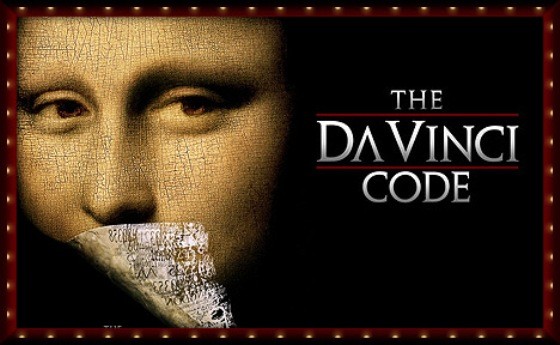
“The Da Vinci Code” – 1 STAR

DA VINCI POSTER

For the sake of full disclosure, it took two sittings for me to get through Ron Howard’s “The Da Vinci Code” and I felt that was an accomplishment. I was never interested in seeing this movie but finally caught up with it over a three day span. There were several things that pushed me away from it from Tom Hanks’ hideous hairdo too much more glaring flaws. As you can probably guess, the Hanks mop is the least of the film’s unforgivable vices. “The Da Vinci Code” is a sloppy, lazy, and amateurish production from a director that should know better.

“The Da Vinci Code” was based on Dan Brown’s wildly popular 2003 novel of the same name. It reportedly cost $6 million to obtain the rights for the film with Howard signed to direct and Academy Award winning writer Akiva Goldsmith handling the screenplay. Goldsmith is hard to figure out. He’s done some brilliant work including “A Beautiful Mind” and “Cinderella Man” but he’s also written some real stinkers. But even with some questionable work on his resume, I wasn’t expecting the lazy and amateurish results that we get here.

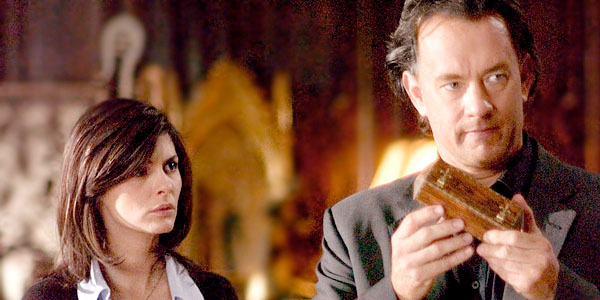
DA VINCI 1

Hanks plays a noted religious symbology professor named Robert Langdon who is doing a series of lectures in Paris, France. He finds himself the prime suspect in a grisly murder inside the Louvre museum. He’s asked to come to the crime scene by a suspicious police captain (Jean Reno). While there Langdon discovers that he has been left a message from the victim that points him towards a mysterious cryptex, a device containing a message that could hold world-changing secrets. He’s joined by Sophie Neveu (Audrey Tautou), a French cryptologist and granddaughter of the victim. The two find themselves in the crosshairs of the French police and a mysterious religious sect, both trying to get their hands on the cryptex.

The big revelation turns out to be a possible death blow to Christianity and the Catholic Church. It’s told through a swirl of long-winded religious conspiracy theories, absurd revisionist history, and anti-Christian nonsense that serves as nothing more than insulting shock value. Most of this is revealed to Robert and Sophie by Leigh Teabing (Ian McKellen), an old acquaintance of Robert’s and a Holy Grail enthusiast. He believes many of the secrets are hidden in Leonardo Da Vinci’s “The Last Supper”, secrets that the cryptex can corroborate. Blah, blah, blah. Honestly it’s all so bloated, preposterous, and boring.

Goldsmith’s script is simply terrible. There’s not an ounce of creativity or subtlety in his storytelling. Everything is so contrived and by the books. There are numerous scenes of tedious exposition meant for nothing more but to fill in the audience on certain bits of information. There’s nothing wrong with that except for the fact they’re so poorly written and we know what they’re there for. This is also a movie loaded with ridiculous conveniences. So many times the story is advanced by a simple convenience that allows our heroes to either escape or find the next clue. Some of them are so lame that I found myself laughing out loud.

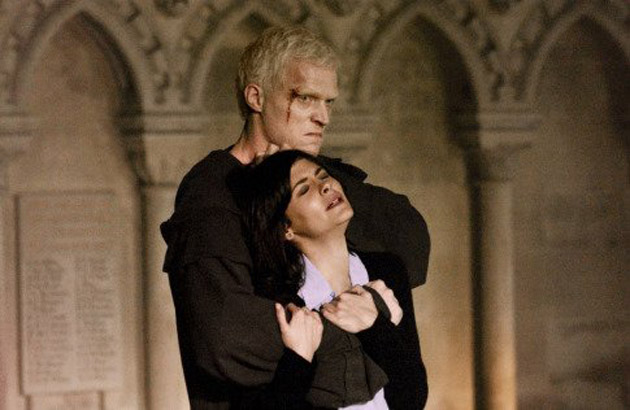
da vinci 2

I could go on about the writing but I can’t let Ron Howard off the hook either. This thing is an utter mess. It’s a thriller without thrills. The action sequences have no pop whatsoever. The dialogue is as stale and lifeless as you’ll find. His movement from scene to scene feels more like an assembly line production. And his dull and dank color palette gives the movie a dark and unattractive look. I mean neither Paris or London have ever looked worse on screen. Howard has shown in the past he knows how to direct a picture. I have no idea what happened here but a lot of the movie’s problems can be put on him.

I still can’t imagine how “The Da Vinci Code” made over $750 million at the box office. That’s something that boggles my mind. Maybe it was the controversial label that it received and deservedly so. Whatever the reason, it wasn’t because this is a good film. Even without its eye-rolling, anti-Christian shock value, “The Da Vinci Code” is a movie filled with cheap shortcuts, head-shakingly bad dialogue, and poor visual decisions throughout. It’s a shame it turned out this way because there was a good cast in place. But this just shows that you can have a good cast but if you throw them crap the result is going to be crap. Such is “The Da Vinci Code”.

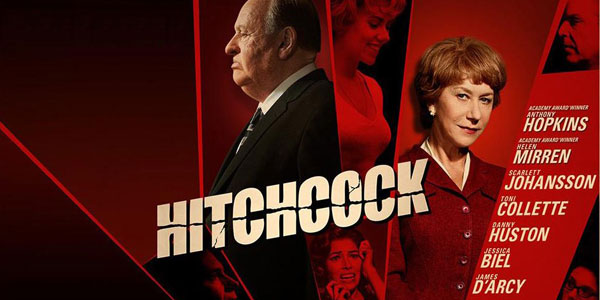
“Hitchcock” – 4 STARS

HITCHCOCK POSTER

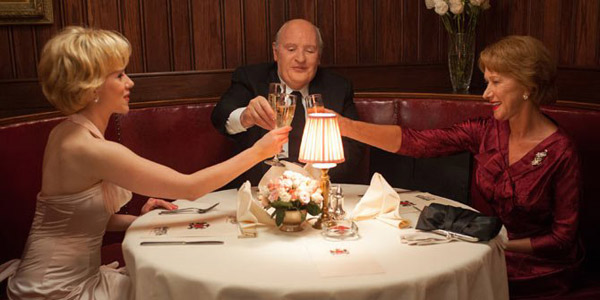
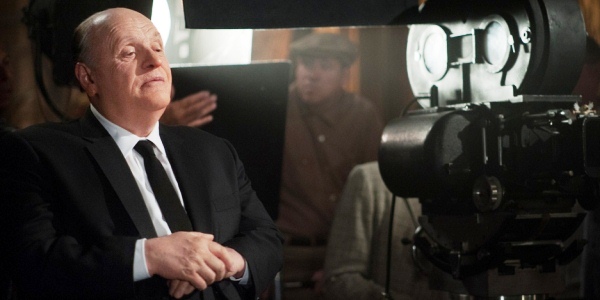
You know, I just love movies about making movies. That’s one reason I thought the movie “Hitchcock” would be right up my alley. Another reason is that it’s about one of cinema’s greatest directors – Alfred Hitchcock. Yet another reason I was interested was because of the fantastic cast specifically Anthony Hopkins as Hitchcock and Helen Mirren as his wife Alma Reville. These and several other yummy ingredients had me really hungry for this film and after seeing it I can say that it’s quite satisfying.

But enough with the gastronomical analogies. “Hitchcock” takes place during the filming of arguably the director’s most popular and groundbreaking film “Psycho”. The movie begins just after the release of Hitchcock’s wildly successful “North By Northwest”. He still owes Paramount Pictures another film but he’s struggling to find the right one. He also feels that the studios and press believe he is past his prime and he wants to pick a bold project that will prove otherwise. He finds himself attracted to a Robert Bloch novel titled “Psycho”. He convinces Alma and his agent Lew Wasserman (Michael Stuhlbarg) that it’s the right choice but he has a harder time with Paramount president Barney Balaban (Richard Portnow). They finally reach an agreement where Hitchcock agrees to fund the picture for 40% of the profits and a Paramount distribution.

HITCHCOCK1

It’s really fascinating to watch the behind-the-scenes process and how Hitchcock labored to make “Psycho”. But a bigger and even more enjoyable part of the movie focuses on Hitchcock’s relationship with his wife. Hopkins and Mirren are a joy to watch. The two veteran performers dissect this marriage with surgical precision, bringing out so many interesting aspects of it. There’s a clear love that they both share for one another, but there’s an equally clear strain on their marriage brought on by the financial stress of funding the movie and by Hitchcock’s own negligence, pride, and fear of failure.

Hitch is betrayed as a self-assured man on the outside but he clearly has uncertainties on the inside. He has a wandering eye for his leading ladies and has a tendency to overindulge in food and drink – something Alma stays on him about. Alma is a talented writer herself and her uncredited contributions to Hitchcock’s creative process prove vital. Her growing frustrations lead her to begin her own collaboration with fellow writer Whitfield Cook (Danny Huston), something Hitchcock disapproves of. All of these pressures begin to wear on Hitch and ends up threatening the completion of “Psycho”.

As I alluded to, one of the real strengths of this picture are the performances. Mirren rightfully earns her award nominations that she has received. Hopkins does a fine job fleshing out this complex director under a coat of heavy prosthetics. He nails all the mannerisms and postures and his speech is almost perfect. But there’s one thing I struggled with. I never could quite get past that I was watching him do Alfred Hitchcock. Take Daniel Day-Lewis’ performance in “Lincoln”. I was so drawn in by his work that I forgot I was watching an actor play Abraham Lincoln. I never quite got to that point here. Don’t misunderstand me, it’s not a bad performance by any means. But I never completely bought into the idea that I was watching Hitchcock on screen.

????????????

I also have to mention the other supporting performances that I really enjoyed. I’ve liked Michael Stuhlbarg since seeing him in the Coen brothers film “A Serious Man”. He’s good here too. I was also impressed with Jessica Biel as Vera Miles. She’s an actress I normally don’t care for but she gives a nice subtle performance that works really well. But an even bigger surprise for me was Scarlett Johansson as Janet Leigh. I’ve never been completely sold on Johansson as an actress but I love the Janet Leigh she portrays. She’s beautiful and sexy but she’s almost a stabilizing influence on Hitch. She’s a lot of fun to watch in the role.

“Hitchcock” has a hard time escaping that biopic feel but it’s still a really good film. I think my love for the director’s movies and my particular affection for “Psycho” added a sense of nostalgia to my viewing, but there’s a lot more to this picture than just that. There are many clever little inclusions that go hand-in-hand with Hitchcock. For instance look closely and you’ll find his shadowy silhouette that fans of his will instantly recognize. Then there’s the cool opening and closing of the film that hearkens back the “Alfred Hitchcock Presents” days. These nifty treats fit in well with the solid script and wonderful performances and anyone with the slightest interest should come away well pleased.

“Heartbreaker” – 4 STARS

HEARTBREAKER POSTER

I’m a sucker for a good romantic comedy. Call me a softy but I really respond to them. Unfortunately the genre is in shambles as studios continue to pump out one lame, brainless rom-com after another. Maybe that’s why I get so excited when I actually find one worthwhile. Maybe that’s why I almost instantly rewatch it, knowing it may be a while before I get another good one. Such was the case with the 2010 French film “Heartbreaker”.

Okay, let me get this out of the way first. “Heartbreaker” is at times incredibly silly and like many romantic comedies it’s completely predictable. But that did little to quench my enjoyment of the film. For the most part “Heartbreaker” is smart even in its silliness and director Pascal Chaumeil wisely keeps the pace up, never allowing us to mull over the absurdity of some of the things we’re seeing. And then, by the end of the movie, I realized what a great time I had with the film and even that absurdity played its own little role in my enjoyment.

HEARTBREAKER

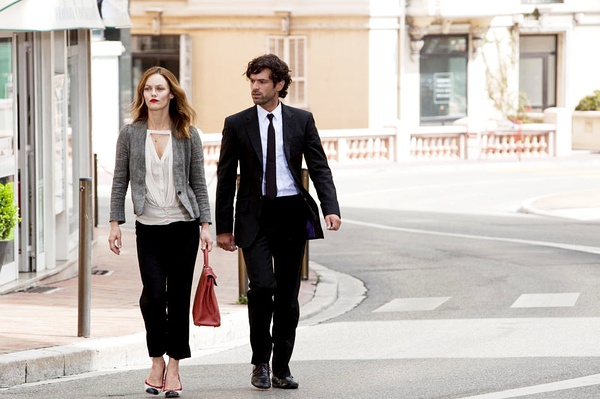
The story goes like this, Alex (Romain Duris) runs a unique business that breaks up relationships. He works with his sister Melanie (Julie Ferrier) and her dimwitted but tech-savvy husband Marc (François Damiens) to create elaborate ruses that persuade women to break off their relationships. But the team has their own honor code. Alex never takes a job involving a perfectly matched couple and he never breaks up a happy relationship. Alex plays the handsome swooner of the operation. Melanie play the well disguised ground operative. Marc handles everything technical. We learn all about their operation in the film’s amusing opening. Alex wraps up a successful job with a series of over-the-top lines that sets the smitten target woman free and left me laughing at his scripted sappiness.

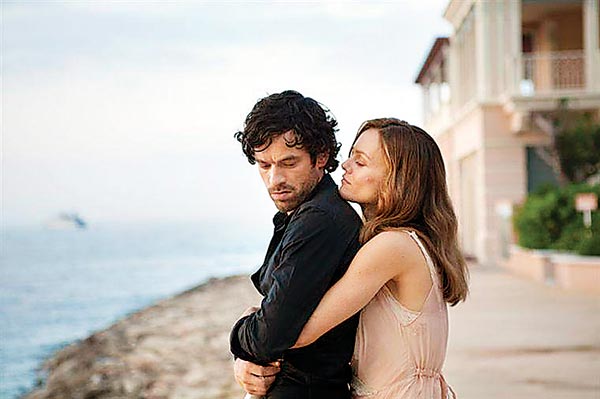
Alex is approached by a rich father with ties to organized crime who wants his daughter’s engagement to an Englishman ended. The wedding is in a few days and the couple seems happy, but Alex, knee-deep in debt with a loan shark, puts his rules aside and takes the job. The crew heads to Morocco where Alex meets the daughter Juliette (Vanessa Paradis) and poses as a bodyguard hired by her father. Juliette is a spunky and independent young woman and Alex finds out that the job is going to be more difficult than anticipated. As the wedding gets closer, Alex begins to run out of options. On top of that, things are made more difficult by the fact that he’s falling for her. Bet you didn’t see that one coming!

Heart breaker

The story is clever and the laughs are aplenty, but I thought the biggest treat was the cast. I had seen Romain Duris in a handful of other movies but never in a role quite like this. He is very funny and he wonderfully channels that good-looking arrogance and occasional knuckleheaded cluelessness. Vanessa Paradis continues to impress me with every performance of hers I see. She’s really good here playing it straight while the others around her have the fun. But she has her own funny moments that pulls some good laughs from the audience. Paradis and Duris have an odd but convincing chemistry and that’s a key ingredient to making this such an enjoyable experience. If you doubt me, just wait until you see the “Dirty Dancing” scene. I’ll just leave it at that.

As I mentioned there is a lot of predictability along the way and there’s nothing that will catch you by surprise. But the filmmakers and the cast know this and they never try to sell you anything else. It’s a rare romantic comedy that caused me to laugh a lot and to genuinely care about the characters. I’ve rewatched “Heartbreaker” a couple of times now to see how it holds up. It’s still funny. It’s still entertaining. It still leaves me extremely satisfied despite its few flaws. Now I hear that there is a US remake in the works. There’s no need in that. I would much rather this film get a bigger audience. It certainly deserves one.

REVIEW: “Breathless”

BREATHLESS poster

There are certain movies that will always be remembered for their undeniable influence. Such is the case with “Breathless”, the first feature film from acclaimed director Jean-Luc Godard and a major player in the French New Wave of the late 1950’s and early 1960’s. French New Wave was a bold and experimental movement that toyed with new techniques of filmmaking and storytelling. The stories were often rooted in and influenced by the social climate of the time and ambiguity, realism, and sometimes romanticism were key tools used to craft these stories.

French New Wave also had several distinguishable visual techniques that set it apart from the contemporary filmmaking of that time. New Wave directors experimented with long takes, creative tracking shots, handheld cameras, and fast scene changes. These techniques originated in low-budget necessity but they were also intended to buck the traditional brand of filmmaking. Godard and “Breathless” were instrumental in defining the movement. Nearly every technique unique to French New Wave can be found in “Breathless” and it has certainly made an important mark in cinema history.

BREATHLESS 1A

The movie follows around a young criminal named Michel (Jean-Paul Belmondo). His forte is stealing cars and petty crimes but things go bad when a simple car heist results in him killing a cop. He ends up on the run in Paris trying to secure some money to make his escape. Michel is not a good guy and it’s hard to get that impression from the film. But an argument could be made that, in a sense, the movie glamorizes Michel’s lifestyle. There is some legitimacy to that but I think it overlooks a major part if the story. Godard does try to emphasis a sense of cool about Michel through his freewheeling attitude, dangling cigarettes, and thumb rubs across his lips. But I feel his coolness is more his perception of himself – a misguided perception more rooted in arrogance than reality.

It’s a combination of his arrogance and his heart that proves to be his biggest obstacles. He fashions himself after movie stars such as Humphrey Bogart and he seems infatuated with his own press. Throughout the movie we constantly see him buying newspapers in an attempt to get information no doubt, but also to bask in his own headlines. He walks the streets of Paris, impervious to his wanted status, with nothing more than a pair of sunglasses to hide his identity. Even as scrolling marquees across the city report of the police manhunt drawing closer, Michel still takes to the streets of Paris with an almost cocky sense of invincibility.

Breathless 2

He also finds himself smitten with Patricia (Jean Seberg), a young American student at the Sorbonne and aspiring journalist. She’s a seemingly insecure young lady who ends up falling for Michel but with an ever-present sense of uncertainty. Michel often insults her and talks down to her yet she grows more and more fond of him. I believe it’s because she sees through his tough guy facade and finds something she can cling onto regardless of how unwise it is. She struggles with whether to stay with Michel or not but even after finding out what he’s done she can’t just walk away. In a very different way Michel finds himself in the same boat. It’s some compelling stuff.

“Breathless” is a little rough around the edges yet it’s exhilarating cinema. Much of the script was written as they were filming and it features a lot of improvisation. But I love the spontaneity that comes along with that both narratively and visually. Hand-held cameras, a signature of the movement, are tremendously effective both in giving it a unique style as well as capturing some of the beauty of Paris. In fact, “Breathless” features some of the best views of the city you’ll find in cinema. The movie is also recognized for its fresh and bold use of jump cuts – a film editing technique where a scene makes quick jumps forward. There are so many filmmaking devices in “Breathless” that have influenced directors for years and still do today. And even though the storytelling structure may feel a bit jarring, the film is hypnotic and its mark on cinema cannot be overstated.

VERDICT – 4.5 STARS