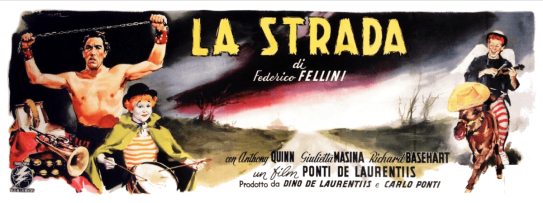
2016 Blindspot Series: “La Strada”

La strada poster

When venturing through Federico Fellini’s brilliant filmography you witness an unmistakable shift in his style of filmmaking and storytelling. From his roots as an Italian neo-realist to his more fantastical experimental pictures, Fellini made films that were identifiable and personal. He didn’t mind changing his style in order to make a more honest picture.

At the start of his transitional period sits “La Strada”, one of Fellini’s more strenuous and intimate projects. According to biographer Tullio Kezich, Fellini said the film was “a dangerous representation of my identity that was undertaken with no precedent whatsoever.” His internal and external struggles with making the film were significant.

Fellini had a difficult time getting the project financed and he was constantly maneuvering through various budget restraints. There were also casting conflicts. Fellini’s wife Giulietta Masina was a big part of his inspiration for the story and for him casting her was essential despite objections from the producers. Anthony Quinn passed on the role despite numerous requests from Fellini. It wasn’t until he saw “I Vitelloni” that he was convinced of Fellini’s abilities as a filmmaker. Injuries, several delays, and crew changes made things even more difficult.
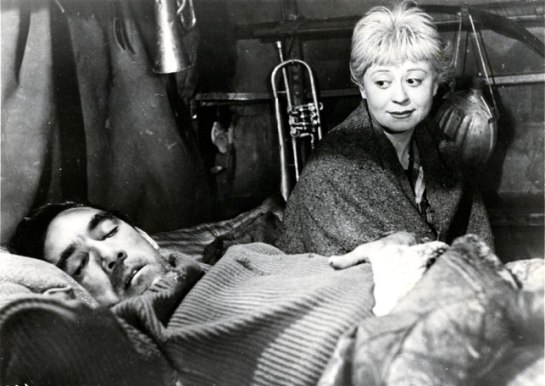
la strada1

But the emotional pressures were far more taxing than the production problems. The concept sprang from memories and images from his childhood, most of them troubling and unpleasant. The production issues were stressful for Fellini leading to severe bouts with depression and an eventual nervous breakdown. With the help of his wife and medical treatment Fellini was able to finish the film.

Like many true classics the movie wasn’t initially met with universal acclaim. Several critics blistered Fellini saying he had gotten away from the strengths of neo-realism. Despite the smattering of negativity “La Strada” had its fans and it received the first ever Academy Award for a foreign language film. Over the years critics and filmmakers have grown to appreciate its vision and influence even more.

The story begins with a young woman named Gelsomina (Masina) finding out her sister has died while working for a brutish traveling street performer named Zampanò (Quinn). In the face of poverty Gelsomina’s mother sells her to Zampanò to serve as his assistant. The two take Zampanò’s strongman act from town to town with Gelsomina playing his clown and passing around his hat for money.
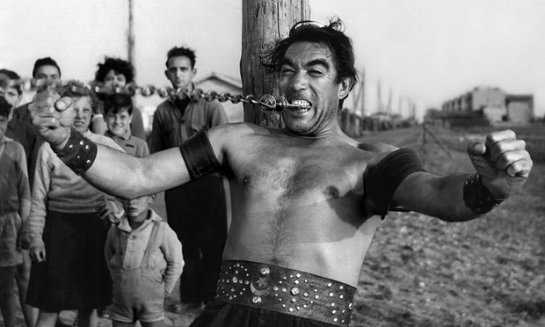
la strada2

For the simple and waifish Gelsomina it is a tough new world. She looks at everything through an innocent and naive lens. That’s what makes Zampanò such a despicable character. He treats her as worthless and disposable. His mental and physical abuse is abhorrent and it’s often met with confusion by Gelsomina. But she feels confined to her situation. The idea of leaving Zampanò surfaces several times in the film, but she never sees them as a viable option. Instead these two character archetypes travel on together, both bound to a situation that is certain to end poorly.

In many ways Fellini’s film is a tragedy. Others have viewed it as an inspirational piece. Regardless this is an instance where the film’s meaningful complexities serve as evidence of its greatness. It clearly shows a director branching off from his roots and exploring things foreign to the popular trends of the time. The story is beautifully poetic and painfully heartbreaking at the same time and the performances from Quinn and Masina are so good.

Fellini fans will notice techniques and visual touches from “La Strada” reused in many of his films that would come after. Its stylistic reach would stretch for decades as waves of filmmakers were inspired. And while some consider this Fellini’s greatest work, I agree with critic Roger Ebert. “La Strada” opened the creative doors to his true masterpieces that would follow. It’s a wonderful film and a turning point in one of cinema’s greatest filmmaking careers.

VERDICT – 4.5 STARS

4.5 STARS

Remember this trailer? – “Batman” (1989)

Classic Trailer Flashback – “Batman” (1989)

It’s summer time so naturally the theaters are flooded with big budget summer popcorn movie trailers. Back in 1989 the trailer for Tim Burton’s “Batman” was one of the biggest of all time. The trailer fueled the intense Batman hype and thankfully the film lived up to it. Looking at it now, the trailer is a rough, pasted together collage of scenes that certainly doesn’t resemble the highly polished and produced trailers of today. But at the time it excited us for what was to come and I’ll always love it.

So, do you remember the trailer for “Batman”?

REVIEW: “The Lazarus Effect”

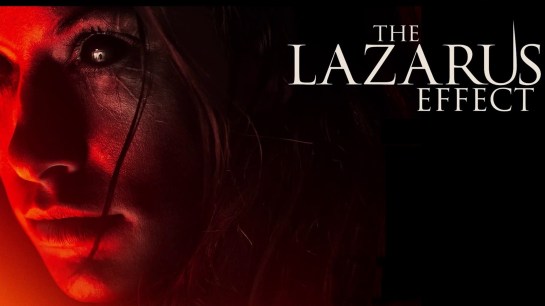
LAZ poster

There are some things we know we will get every movie year. Perhaps tops on that list are the mediocre and formulaic PG-13 horror flicks. Many of these aren’t terrible. They can be pretty entertaining despite their clichéd stories, rehashed scares and forgettable outcomes. Representing the Class of 2015 in this category is “The Lazarus Effect”. As with the majority of these films, “The Lazarus Effect” isn’t a bad movie. It simply does nothing original and leaves no real lasting effect.

The film was distributed by Relativity and it was a no-lose scenario. With a miniscule budget (overall estimates being from $3 million to $8 million tops) and an opening on over 2,600 screens, the film could have a mediocre box office run and still turn a pretty big profit. That’s what happened so financially the film was a success. But as a movie it falls right in line with so many other recent horror pictures. It follows popular trends and does nothing to differentiate itself.

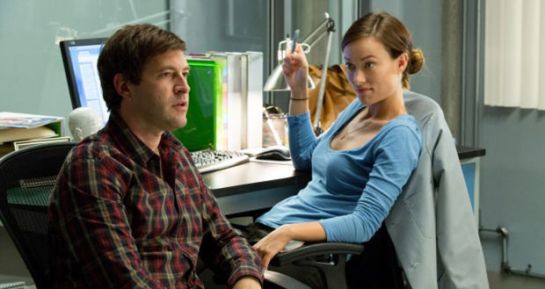
LAZ1

The movie is basically a twist on the familiar ‘bring them back from the dead’ story angle. Still, it starts with a fairly interesting premise. Zoe (Olivia Wilde) and her fiance Frank (Mark Duplass) lead a group of medical research students in the development of a serum meant to assist coma patients. But their experiments wander into morally questionable grounds when they bring a dog back from the dead. Frank sees this as a monumental breakthrough even after the dog begins to show erratic and troublesome behavior.

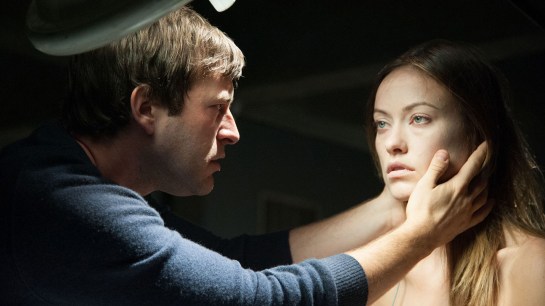
But soon things go bad for the team and they find themselves sneaking into the lab to recreate their experiment. In the process Zoe is electrocuted and killed. Against better judgement a grief-stricken Dr. Frankenstein…errr Frank uses his serum on Zoe and as you can probably guess the results aren’t as planned. This spins the movie into scenes filled with dream sequences, manufactured jump scares, and a number of other predictable horror devices.

LAZ2

What is really unfortunate is the film has some effective and genuinely creepy moments. A handful of surprises and a few visual flairs actually work. Wilde certainly sells her part well and Duplass is quite good in his dramatic role. But they really don’t have a lot to work with. For all of its good creepiness there are also attempted scares that you anticipate from a mile away. The film begins clinging to these clichés which drains the second half of the movie of any good horror.

Director David Gelb is handed a fairly interesting idea but he doesn’t do much with it. He doesn’t add a twist of originality or anything fresh. He has a good and somewhat nostalgic concept and he has a couple of interesting lead actors. Again, he doesn’t make a terrible movie, but when you’re getting this types of run-of-the-mill horror flicks on a routine basis, you begin to yearn for something fresh. Alas “The Lazarus Effect” doesn’t provide enough of the freshness the genre desperately needs.

VERDICT – 2.5 STARS

2.5 stars

Grading E3 – Microsoft

Keith Garlington's avatarParachuter

XBOXopening

by Keith Garlington –

Building on last year’s theme Phil Spencer and company again made games a focal point of their 2016 conference. Clearly Microsoft aimed to show gamers what they would playing this year and in the near future. Even though much of their conference had been leaked they were still able to promote some exciting titles several of which come out this year. But they also made news with their hardware announcements as well as revealing the new direction for the Xbox brand. A few rough patches aside, Microsoft really stepped up their game at this year’s showcase.

STRENGTHS

  • How can you not start with Microsoft’s hardware announcements? The show began with a video revealing the Xbox One S. Internal power brick, 40% smaller than the Xbox One, updated controller, 4k video playback, a very cool white console design, and a pricetag of $299. It’s a beautiful machine…

View original post 799 more words

Grading E3 – Sony

Some thoughts on Sony’s E3 conference…

Keith Garlington's avatarParachuter

SONY e3by Keith Garlington

The peculiarity of Sony’s 2015 conference left me with far more mixed feelings than the majority. It also left me extremely curious about how the PlayStation team would present their platform in this year’s conference. As it turns out the 2016 Sony show was a big improvement focusing more on games while also spending a little obligatory time on VR. But it wasn’t without its share of lulls and question marks.

STRENGTHS

  • Sony started their show with a bang revealing God of War. No number attached but still oddly connected to previous world. Several things stood out about the presentation: an older Kratos, his young son as a companion, an entirely new third-person camera, and an intriguing setting. The demo looked great and the potential is through the roof. Such a drastic change has its share of risks particularly for fans of the franchise, but the game…

View original post 640 more words

REVIEW: “The Mortal Storm”

MORTAL POSTER

The global political climate was dramatically changing in 1940 especially in Europe. The Nazi machine was already wrecking havoc and the United States was a little over one year away from entering World War 2. It was during this time that “The Mortal Storm” was released. When reading up on the film I learned that this was one of few openly anti-Nazi movies to be released prior to America’s entry into the war. The film and subsequently all other MGM movies were soon banned in Germany.

“The Mortal Storm” was directed by Frank Borzage, a filmmaker I was relatively unfamiliar with but who had a lot of success during the silent era and with early talkies. Here he tackles very potent and relevant topics of the time – Naziism, the rise of Adolph Hitler and the effects these things had on families and friendships. It’s a sincere and effective adaptation of Phyllis Bottome’s 1938 novel and it’s full of passion but also tragedy.

MORTAL1

The film is set in 1933 and takes place in a small Bavarian town. The opening ten minutes cleverly sets up the gut punch we get later on. We’re introduced to a prominent science professor named Viktor Roth (Frank Morgan). It’s his birthday and we get a series of playful scenes revolving around that. At his home later that evening we sit in on his birthday dinner with his family and old family friend Martin (James Stewart). We see his daughter Freya (Margaret Sullivan) become engaged to the cordial and mannered Fritz (Robert Young). Everything is painted as happy and intimate.

But one radio broadcast changes that forever. During their meal it is reported that Hitler’s power has grown and the Nazi party has become the one German political party. In an instant the happy moments at the table turn tense and contentious. Fritz and Prof. Roth’s step-sons show their previously unseen support of the Nazi ideals. Martin and Prof. Roth show concern and hesitation over embracing Hitler and his direction for Germany. From there things only get worse and the once joyous and united household is torn apart by intolerance and strife.

The story takes several interesting turns including a romance angle that at first seems wantonly obvious. But the romance doesn’t smother the film’s bigger points and instead is used to serve them. It’s also interesting to see how the film tries to soften the edge of its message while still pounding it home with clarity. For example the term “Jew” is never used in the film, but Dr. Roth and others are called a “non-Aryan”. The implication is clearly there. Also the film rarely uses “German” or “Germany” in its dialogue and the setting is rarely discussed. But these things do nothing to dull the blade the film uses to cut into Naziism and a different sides of its influence.

MORTAL2

One of the few difficulties I had was seeing the cast as German citizens. Think about it, Jimmy Stewart, not even attempting an accent, with that distinct voice of his being a German farmer. This really stood out to me. But that doesn’t mean the performances are bad. Quite the contrary, they are fantastic. Margaret Sullavan shines as the lovely and conflicted Freya and the seasoned Frank Morgan is the beating heart of the story. Also look for a young Robert Stack playing one of Prof. Roth’s sons. It was his second film performance.

This was the last of Stewart and Sullavan’s four movies together. Shortly after the film Stewart would enlist in the military and fight during World War 2. Sullavan made only five more movies before sadly being engulfed by personal issues. Still “The Mortal Storm” is a fine reminder of their beautiful chemistry. But it’s also a gutsy film with a much stronger message than people were accustomed to hearing. And even today the film stands strong as a testament to the persuasive power of the movies.

VERDICT – 4 STARS