REVIEW: “The Adjustment Bureau” (2011)

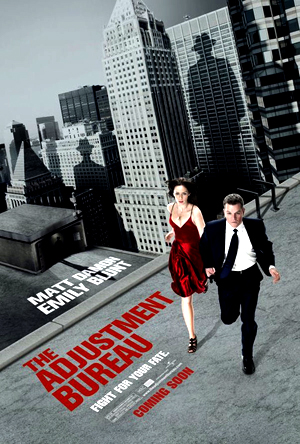
I think it would be fair to say that “The Adjustment Bureau” was a fairly big disappointment for me. The trailers and TV spots for the movie really sold it as something it’s not so I found myself expecting a little more than I actually got. I also felt the movie was going for an almost Hitchcockian feel. I mean look at the above movie poster that was released for it. Even it looks fresh out of Alfred Hitchcock’s creative mind. Unfortunately nothing in the film feels as creative as the poster and ultimately it’s a letdown.

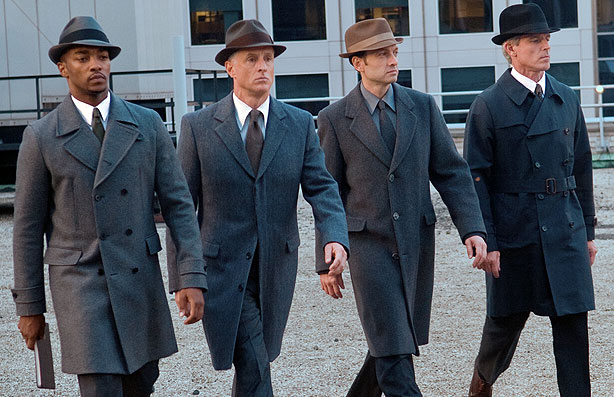
In “The Adjustment Bureau” Matt Damon plays David Norris, a young hotshot Democratic candidate for the U.S. Senate, who loses his bid for office due to his questionable maturity and impulsive behavior. While rehearsing his concession speech he bumps into and immediately is attracted to the mysterious but beautiful Elise (Emily Blunt). The problem is they aren’t meant to be together, at least according to “the plan”. Enter The Adjustment Bureau, a group of stiff, ominous men in hats who intervene to make sure this sprouting relationship never takes place and that “The Chairman’s” plan stays on course.
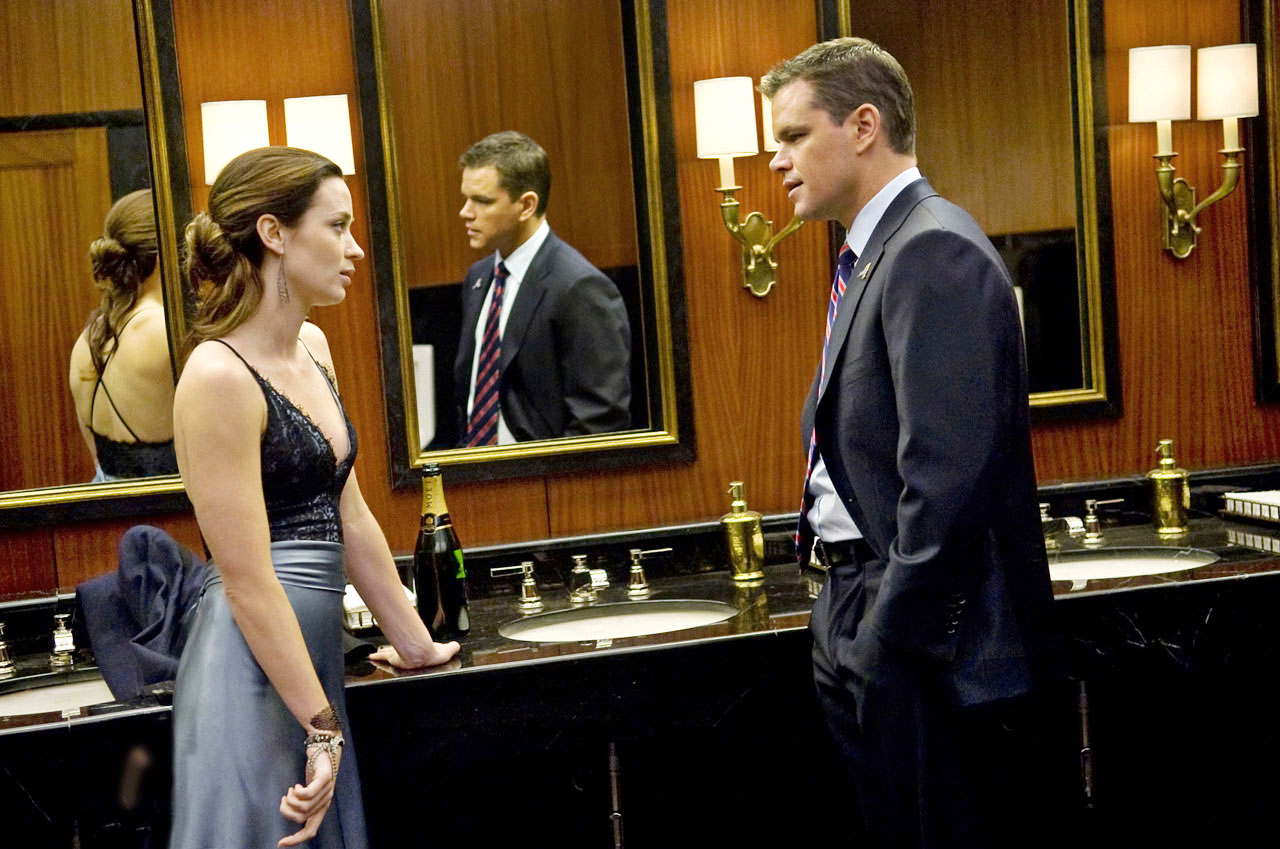
“The Adjustment Bureau” could be called a romantic sci-fi thriller. Sadly the film’s romance has no believable foundation. While Damon and Blunt have good on-screen chemistry, it was hard for me to believe in their romance. Director George Nolfi never allows the relationship to grow, instead choosing to springboard their undying love out of a few short hours together. I also felt the sci-fi element was pretty underwhelming.  There’s nothing that stands out about it. Instead we get doors that transport you from one part of the city to another (which is cool the first 10 times they are used) and magical hats that serve as keys (yes, I just actually said magical hats that serve as keys). The film also lacks any real sense of urgency that’s found in better thrillers. I never felt any intensity nor did I ever feel that there was a steady or consistent buildup.

Most of these problems are the results of a slow, lumbering script. The film spends too much time in the first act examining David’s political ambitions instead of developing the romance which is the supposed centerpiece of the entire picture. Then we get numerous scenes of tedious dialogue between David and Bureau members, meant to inform the audience but instead ends up deflating any momentum the film may gain. As more is revealed the sillier things get and by the time we get to the rather flat and uneventful ending, I wasn’t that interested.
As I mentioned, Damon and Blunt have good chemistry and both give earnest performances and could have pulled this film off with better material. I enjoyed seeing Anthony Mackie in a bigger role but he seems out-of-place in this picture. “Mad Men’s” John Slattery and  the great Terence Stamp also appear but neither are given the chance to do much that’s memorable, again a result of the sub-par material.

If you watched the trailer for “The Adjustment Bureau” you would be expecting an action-packed, intellectual thriller. Instead you get nothing close to that. This is supposed to be a film that promotes thoughts of free will versus fate but honestly, I was never engaged enough to be moved intellectually. The film is well made, uses some great Brooklyn locations, and has some nice performances especially from it’s two leads. But the inconsistent script, lackluster ending, and flat-out silliness brings down what could have been a fun movie.

VERDICT – 2 STARS

“TINKER, TAILOR, SOLDIER, SPY” (2011) – 4 STARS

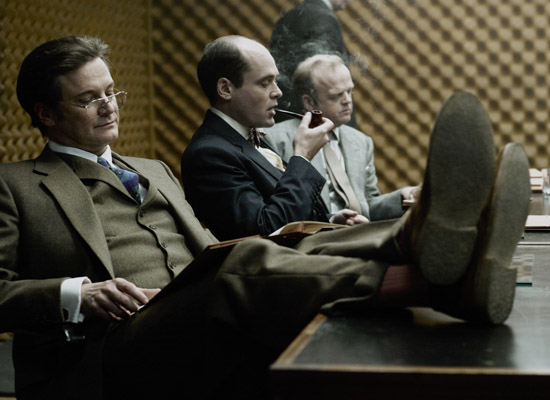
Bringing “Tinker, Tailor, Soldier, Spy” to the big screen was a pretty tough challenge. The movie is adapted from John le Carre’s complex 1974 spy novel of the same name. In 1979 it was adapted for television in the form of a seven part mini-series. So trying to condense the story down to two hours while maintaining its tense spy thriller feel was quite an undertaking. But hats off to director Tomas Alfredson and screenwriters Bridget O’Connor and Peter Straughan for not only pulling it off but for delivering a deep and enthralling picture.

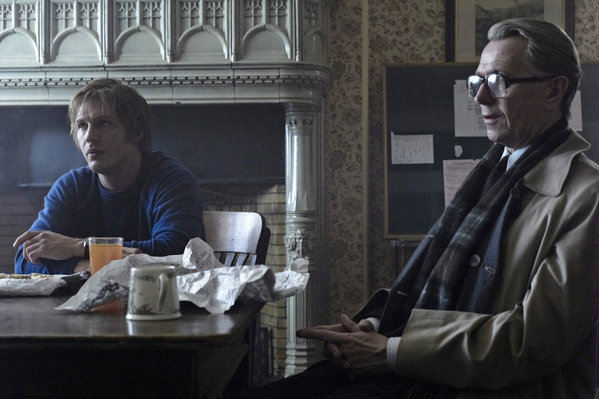
I was first attracted to “Tinker, Tailor, Soldier, Spy” thanks to its stellar cast. The film features a veritable who’s who of british actors. Any movie that features the incredible talents of Gary Oldman, Colin Firth, Tom Hardy, Mark Strong, John Hurt, Toby Jones, and Ciaran hinds (who is actually Irish) is automatically off to a good start. Some of my favorite actors are in this bunch and here they really shine. Each perfectly relay the antsy Cold War paranoia that this type of movie calls for. Not one performance is disingenuous or fake. In many ways you can call this an acting clinic.

The film takes place in the early 1970’s. George Smiley (Oldman) is called back to British Intelligence, also known as “The Circus”, to root out a high level “mole” who is believed to be leaking highly classified intelligence to the Russians. One year earlier Smiley along with his boss Control (Hurt) had been forced out after a botched assignment caused the capture of an agent (Strong) in Hungary. Since Control has been removed, the Circus is being run by Percy Alleline (Jones). Working alongside Alleline is Bill Haydon (Firth), Roy Bland (Hinds), and Toby Esterhase (David Dencik). Smiley puts together a team to help find the mole. An important piece of the puzzle is an agent named Ricki Tarr (Hardy). Tarr is the one who made the allegation of a mole and may have even more information that could bring everything to light. Smiley must sift through the misdirections and false leads to find the identity of the mole and the four Circus higher-ups are prime suspects.

“Tinker, Tailor, Soldier, Spy” rewards patience. It’s a story that unfolds through a slow leak of clues and cleverly timed flashbacks. It’s a complex and layered story that requires a lot of attention and that could be what attracts many people to it (myself included). On the flip side I can see where some may be dissuaded after seeing the story as a muddled, convoluted, and almost laborious exercise. I’m not going to lie and say I completely grasped everything I was seeing. It did take a few rewinds and a little research to really put everything together. In some ways that did take away from the experience but on the other hand everything was presented. While it’s deliberate and sometimes dry, O’Connor and Straughan’s script is tight, structured, and clearly intends to make the audience work right alongside of Smiley.

Another thing you will instantly notice is the careful attention to the look and presentation of the movie. Alfredson’s direction is quite good and the mood and tone is just right. The movie is saturated with blues and greys that creates a cold, sullen atmosphere. The steel-faced agents are in a constant state of seriousness to the point that any smile automatically evokes suspicion from the audience. Oldman’s understated performance is pitch-perfect. Smiley is tired and worn but committed and resolved. His weathered poker-face hides his thoughts and intentions from the other characters and from us. Even Tom Hardy’s strange-looking blonde wig seems perfectly in tune with the picture.

This isn’t a spy movie in the same vein as James Bond or Jason Bourne. I’m certainly no expect of being a secret agent but this feels as real and grounded as any spy movie I have seen. It’s slow-moving and sometimes difficult to navigate but it’s also smart and completely engaging. It’s top-tier cast makes things even better and the movie would be worth seeing just for the wealth of acting talent involved. “Tinker, Tailor, Soldier, Spy” isn’t a film for everyone. But I found myself completely invested even if it did take a little work to get the full thrust of the story.

“BULLY” AND THE MPAA

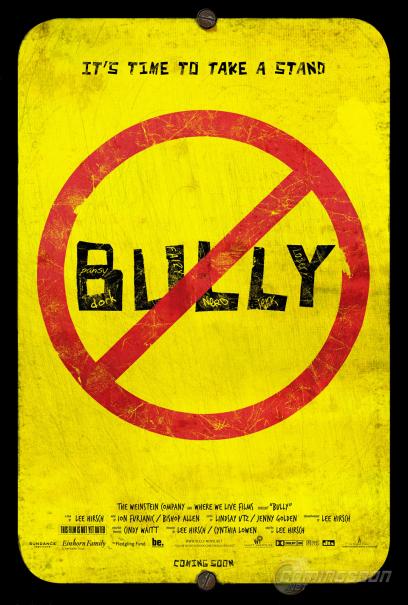
By now I’m sure you’ve heard of the war between Lee Hirsch’s documentary “Bully” and the Motion Picture Association of America. After viewing the film the MPAA decided to give it an R rating, a decision that raised the ire of the filmmakers, Harvey Weinstein of The Weinstein Company, advocacy groups, and even many celebrities. The MPAA gave “Bully” the R rating due to “some language”, more specifically the seven “f words” found in the film. Weinstein countered by threatening to release the film unrated. But this left him with several problems including the fact that most big movie theater chains have policies against showing unrated pictures. The MPAA stood its ground. Since then, “Bully” has been granted a PG-13 rating after editing out three of the seven “f words”.

But who was right? Was there grounds to be upset over the R rating? Was the MPAA simply doing its job? Those angered by the MPAA’s decision noted that the film’s potential social impact would be greatly hurt by the R rating. One protest group stated “Because of the R rating, most kids won’t get to see this film. No one under 17 will be allowed to see the movie, and the film won’t be allowed to be screened in American middle schools or high schools.” (This is only partially true. ANY child can see an R rated movie. The only difference is they must be accompanied by an adult). MPAA head honcho Joan Graves countered by pointing out the ratings association’s responsibility is to inform parents of content. She said “In the case of ‘Bully,’ the ratings system has worked exactly as it is supposed to: Parents have been kept informed of the content of each version of the film, and they have been given the information they need to make moviegoing decisions on behalf of their kids.”

While I have had my fair share of gripes about the MPAA, I tend to side with them on this one.  I don’t want the MPAA judging a film’s social impact or a filmmaker’s intentions. I want them rating movies based on the content found in the movies. They need to have a standard by which they judge content so that parents and moviegoers who don’t want to see or hear those things have a grounded point of reference. Some have objected saying “How does a movie like “Bully” with its instances of profanity get the same rating as a violent and grisly film like “Saw”? They point to that as one of the flaws of the current ratings system. But I don’t think you can compare movies like that. There needs to be a standard for violence, a standard for sexual content/nudity, and a standard for vulgarity/profanity. Have consistent standards and grant ratings based on how movies meet those standards.

But that also touches on some of the MPAA’s glaring failures. In many ways their lack of consistency has given people ammunition to use against them. The MPAA has given so many movies a PG-13 rating that’s had tons more profanity that what we find in “Bully”. I could give you so many examples. Just this year take a movie like “Chronicle”. It has over 60 uses of profanity. “Tower Heist” has almost 100 uses of profanity. Yet both of these pictures were granted a PG-13 rating simply because they kept their “f-bombs” to two or less. For some warped reason the MPAA sees three “f-bombs” in a movie considerably more serious than a film with 100 uses of every other bit of foul language. It’s this absurd reasoning that has breached the trust between the MPAA and many parents and moviegoers.

That kind of inconsistency could very well be what brought on this battle between “Bully” and the MPAA. On the flip side, Weinstein and company know the guidelines and shouldn’t be surprised when the MPAA doesn’t base their rating on the political and social message of the film. I also have a hard time believing those three “f-bombs” were crucial to the movie therefore editing them out without making it into a big issue shouldn’t have been a problem. I’m glad the MPAA didn’t cave in. I want them to have a standard and I want them to stick to it. But there lies another problem. They haven’t stuck to it and no one can argue that their standards could certainly use a little fine-tuning.

5 PHENOMENAL BASEBALL MOVIES

With the baseball season not even a week old, I decided to celebrate the sport I love by changing plans and doing a Phenomenal 5 on baseball movies. At first I thought this was an easy, easy assignment. But before long I had more movies on my short list than I expected. So needless to say this was tougher than I thought it would be. There are some really good baseball movies that aren’t just for fans of the game. Many of these are just good quality movies that any film lover can enjoy. So here’s my list. As always, I wouldn’t call this the definitive list, but there’s no doubt that these five baseball movies are absolutely phenomenal.

#5 – “MAJOR LEAGUE”

“Major League” came out back in 1989 and was a big success. It was followed by two sequels but neither could match the original. “Major League” was a genuinely funny movie that mixed straight comedy with baseball satire. After a self-absorbed heiress inherits the Cleveland Indians from her deceased husband, she decides she wants to move the team to Miami. To do this she would have to show a worthwhile reason to take the city’s team away. So she fields the worst possible team in hopes of losing games and losing interest from the local fans. The team of misfits features pre-nutcase Charlie Sheen, Tom Berenger, Wesley Snipes, Corbin Bernsen, and more.  Add the hilarious Bob Uecker as the voice of the Indians and you’ve got a baseball comedy that truly delivers the laughs.

#4 – “PRIDE OF THE YANKEES”

Gary Cooper’s performance as “The Iron Horse” Lou Gehrig in 1942’s “The Pride of the Yankees” is still one of my favorite roles of his. This is a film that was nominated for 11 Oscars including a Best Actor nomination for Cooper. In it you’ll see several real baseball players including Babe Ruth and Bill Dickey as well as a great story about an amazing player and individual. This movie really doesn’t pay close attention to the baseball part of Gehrig’s life. Instead it’s a biography of the highly accomplished yet tragically short life of a man many came to know through the game they loved. “Pride of the Yankees” has a few flaws but it also has a lot of heart and I  just have to include it on any list of phenomenal baseball movies.

#3 – “MONEYBALL”

I know that “Moneyball” just came out last year but it really impressed me. Bennett Miller’s baseball movie about Billy Bean and the 2002 Oakland A’s actually made sabermetrics and salary caps engaging cinema. Brad Pitt does a nice job fleshing out Bean and even the usually annoying Jonah Hill manages to keep his performance under control. It’s the story of a miracle team built around a system that should have never worked. Against the wishes of his scouts, coaches, and owners, Bean created a team that made a miraculous run that eventually put them in the playoffs. Again, this isn’t a traditional baseball picture. It looks at a different side of the game that I haven’t seen much of before. But it’s still very much a baseball movie and I thoroughly enjoyed it.

#2 – “THE NATURAL”

Obviously this movie was going to show up on a list about baseball movies, right? “The Natural” is one of those movies that I can stop and watch anytime I come across it on TV. How can you not like Robert Redord as Roy Hobbs and his bat simply called “Wonderboy”? Roy learns about baseball and life the hard way but finally gets his shot with the New York Knights. Sure, a lot of convenient things fall into place that allow him his opportunity but when he gets it, he makes the most of it. Redford is helped by a nice supporting cast and a story that’s sure to leave you with a smile on your face. And I can still hear that music as Roy clobbers a home run that shatters the lights and send sparks raining down on the field. A classic moment.

#1 – “FIELD OF DREAMS”

This is a baseball movie that lifts the game up as an almost mystical force. “Field of Dreams” celebrates the game of baseball as the true American pastime. I paints baseball as something beyond just a sporting event that we enjoy watching. But even while it has the most reverent perspective on the game of all the films on my list, it’s really about family and baseball is that link that brings a father and son together. There are so many memorable things about “Field of Dreams’. Who can forget the whispers in the cornfields? “If you build it, he will come”. Who can forget “Shoeless” Joe Jackson first stepping onto the baseball field that was built on a leap of faith? Who can forget James Earl Jones’ speech on baseball? I could go on and on. For me, “Field of Dreams” is the quintessential baseball movie. It’s unique but it still brings out my love for the game.

Like my list? Do you have a baseball movie that you think should be on here? Did I include a film that you disagree with? Take time to add your comments and don’t forget to share your top 5 baseball movies.

REVIEW: “The Maltese Falcon” (1941)

Classic Movie SpotlightMALTESEA good argument could be made that The Maltese Falcon is Humphrey Bogart’s best film. It’s a movie that seems to get better each time I watch it and has earned its recognition as a film noir classic. It’s also a film featuring two notable firsts. This was Sydney Greenstreet’s first feature film and it was John Huston’s directorial debut. Huston also wrote the story which is based on Dashiell Hammett’s novel of the same name. It’s said that Huston extensively planned everything in the script, even to the most minute detail. It certainly shows. The movie is smart, well written, and deftly made.
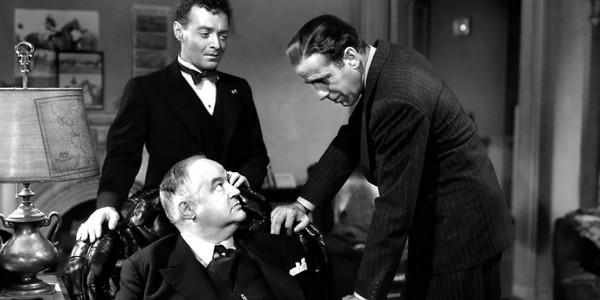

Bogart plays Sam Spade, a San Francisco private investigator. He and his partner Miles Archer (played by Jerome Cowan) meet with an attractive new client, Ruth Wonderly (Mary Astor), who hires them to help find her missing sister. Archer volunteers to follow her as she meets with Floyd Thursby, an acquaintance of her sister. Later that night Spade receives a call that Archer has been murdered. Spade weaves through a gnarly web of lies and an assortment of shady characters to find that it all revolves around a priceless statuette of a bird covered in jewels.

Bogart wasn’t Huston’s first choice to play Sam Spade, but after George Raft turned down the part Bogie was brought in. This was the beginning of a great friendship between Bogart and Huston that spawned many other wonderful films such as “The Treasure of the Sierra Madre”, “The African Queen”, and “Key Largo”. Bogart’s performance is simply brilliant and it’s hard to imagine anyone else in the role. Mary Astor gives a strong performance and sets the table for some of Bogart’s best lines in the film. Toss in the terrific Peter Lorre and Greenstreet, both of whom add their own flavors to the story. Also keep an eye out for a cool cameo from Walter Huston, John Huston’s father.

MALTESE1

The film’s is also helped by some fine cinematography. The movie features some crafty camera work, low-level lighting, and use of shadows which adds to the picture’s mood and tone. Cinematographer Arthur Edeson plays around with the angles and camera locations which give the movie a cool, sleek look.  It’s a technically sound and stylish movie and Huston’s accomplishment is really profound considering this was his first picture.

The Maltese Falcon epitomizes what high level filmmaking and storytelling is all about. Bogart’s performance became the model for other film noir detective roles and the supporting cast is nothing short of brilliant. The movie was nominated for three Academy Awards but it’s contribution to filmmaking  can’t be measured by that alone. This is a true cinema classic and it should be considered mandatory viewing for any fan of the art form. And despite being over 70-years-old, “The Maltese Falcon” still hits every beat.

VERDICT – 5 STARS

5 STARSs

5STAR K&M

REVIEW: “Easy Rider” (1969)

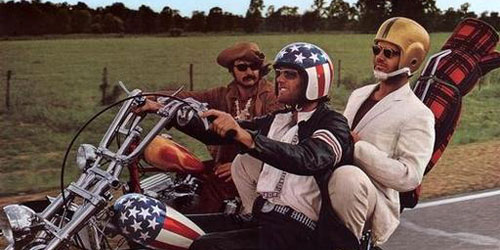
EASYI fully understand that the 1969 motorcycle road film “Easy Rider” is considered a motion picture classic. I also understand that the movie introduced a new style of filmmaking that had a great impact on the industry. But while so many film critics and movie fans hold “Easy Rider” in high regard, I found it to be a flat, muddled, and occasionally annoying picture that hasn’t aged well at all. At the time of its release it was a relevent film examining such things as the hippie movement, the drug culture, and the late 60’s political environment. On the surface it may sound like an intelligent and thought-provoking experience. But it’s banal presentation, clunky storytelling, and overly cynical portrait of America did nothing to draw me in or keep my interest.

“Easy Rider” is a buddy movie about two motorcycle riding potheads named Wyatt (Peter Fonda) and Billy (Dennis Hopper). It sounds like the ingredients for a stoner comedy but they are actually treated seriously. They’re free-spirited counterculturalists who are out to capture their idea of live-by-your-own-rules Americanism. After smuggling some cocaine across the border, the two sell it in Los Angeles for a large amount of money. They then use that money for a road trip across the southwest and eventually to Louisiana where they hope to make it in time for Mardi Gras. They travel from location to location with just their bikes,  a gas tank full of hidden money, and apparently a bushel of marijuana.

Just like any other road movie, “Easy Rider” is more about the journey than the destination. As they travel, Wyatt and Billy see some beautiful sites and encounter a wide assortment of people. They are helped by a rancher who is struggling to make ends meet. They pickup a hitchhiker (Luke Askew) who leads them to a hippie commune filled with people who resemble space aliens more than human beings. They befriend an alcoholic civil liberties lawyer named George played by Jack Nicholson. They are arrested by small town police officers and harassed by intolerant locals. Yet the one constant seems to be their love for pot. It seems like during every stop they take time for a smoke especially at night as they sit around their camp fire rambling while under the influence. The story ultimately becomes about Wyatt and Billy’s search for freedom, freedom that turns out to be much more elusive than they thought.

EASY

“Easy Rider” is basically the hippie movement’s self-portrait and it looks at everything through their eyes. But it comes across as a sanctimonious and often times self-indulgent lecture that doesn’t have near the substance it wants to have. One prominent movie critic who is older than me praised the film saying “Seeing the movie years later is like opening a time capsule.” I guess I can see where the movie would have a stronger impact on you if you were a part of those years or if you’re sympathetic to the hippie culture. But as someone seeing it for the first time it feels incredibly dated and it definitely comes across as a drug-induced hallucination at times. It does dabble in a few interesting themes and the cinematography is impressive especially considering the tiny budget. But I never connected with “Easy Rider” or its characters.

This is a movie that is considered by many to be great. In fact, it’s #84 on AFI’s Top 100 Movies of all time. I don’t see it. Maybe it’s the overwrought counterculture message or maybe it’s just my personal disconnect with this element of that time period (I was born is 1971), but “Easy Rider” became an uninteresting and sometimes tedious undertaking. There are several scenes including a terribly annoying drug high in a cemetery and numerous campfire ramblings that had me desperately wanting to hit the fast-forward button. What little screenplay there is does nothing to help the film and the final few scenes of the movie feel cheaply pasted together. We do get some pretty camera work and a breakout performance from Jack Nicholson. But that’s not enough make me want to watch “Easy Rider” again. No thanks, I’ll pass.

VERDICT – 1.5 STARS