REVIEW: “The Tree of Life”

It’s hard to deny that “The Tree of Life”, Terrence Malick’s first film since 2005′s “The New World”, is destined to be a polarizing movie. I’ve seen it called pretentious, self-indulgent, and a muddled exercise in tedium. But I had a much different reaction. I found it to be cinematic poetry. A profound and deeply moving picture that’s cryptic yet bold and thought-provoking. It’s a challenging meditation on life, family, and God. It’s a film that doesn’t revolve around a tight, concentrated narrative. Instead it feels more like an observation of everything from the creation of the world according to Malick to the life struggles of an ordinary family in 1950′s Texas. It moves at a stylish but deliberate pace and this is sure to drive some people crazy. But I feel it rewards the patient viewer and I found myself drawn in by the artistry and emotion of the film.

In the first few minutes of the movie we see Mrs. O’Brien, (Jessica Chastain) as she is receiving a letter stating her 19 year old son is dead. She calls Mr. O’Brien (Brad Pitt) at work to let him know the tragic news. The film then moves to present day as we are introduced to Jack (Sean Penn) the oldest of the O’Brien’s three sons. Jack comes across as an emotional wreck and we find out that he is still devastated by the loss of his younger brother. He notices a tree being planted in a small construction area which triggers an extended flashback to his childhood.

Jack’s childhood revolves around something said at the first of the film. “There are two ways through life, the way of nature and the way of grace. You have to choose which one you will follow”. Jack’s dad is a man of nature. He’s a short-tempered and strict father whose hypocrisies don’t go unnoticed by his children. He has a cynical and hardened view of the world and recognizes success as beating the world at it’s own game. Jack’s mom is a woman of grace. She sees the world as a beautiful place and her faith fuels her loving and trusting nature. She’s quiet and gentle and her love of life is unquestioned even through life’s struggles. The question is which path will young Jack follow?

As we watch Jack and his brothers grow up in 1950′s Waco, Texas, Malick gives us some of the most grounded and natural portrayals of early adolescence that you will find on film. Young Jack, played by the fantastic Hunter McCracken,  has a great relationship with his brothers but always finds himself falling short in his father’s eyes. There are several painfully potent scenes that convey this and over time it leads to some disturbing changes in Jack. It’s heart-wrenching enough to watch this young boy flirt with self-destruction but witnessing his inner struggles with his actions is even more despairing. We hear him in voiceover ask ”What have I done?” He painfully states ”What I want to do I can’t do. I do what I hate.” It’s pretty weighty material and Malick doesn’t treat it halfheartedly.

Malick takes the O’Briens through trials and tragedies but he uses them to explore forgiveness, reconciliation, and peace. He’s not afraid to ask tough questions or address things such as existence, spirituality, and the afterlife. But this gets at another thing that makes this film special. It can speak to different people in so many different ways. Whether it be the spiritual subtext or the strained family dynamic, Malick takes something that is obviously deeply personal and touches the audience in a wide variety of ways.

“The Tree of Life” is a technical masterpiece and it’s impossible to talk about this film without mentioning it. Emmanuel Lubezki’s gorgeous cinematography should garner instant Oscar consideration. In many ways ”The Tree of Life” is more lyrical than dramatic therefore many scenes find their strength in imagery and camera work other than any form of dialogue. Many of Lubezki’s gorgeous shots carry more dramatic and emotional weight than almost any acted sequence I’ve seen all year. Alexandre Desplat’s brilliant score hits at just the right times during the film, weaving itself between Malick’s signature scenes featuring nature’s ambiance.

This is a unique film which calls for a unique approach by the actors. With the absence of a more precise narrative, the performances are structured around Malick’s vision. Pitt is fantastic in a conservative and more restrained performance. Chastain is graceful and has a subtle elegance. But it’s McCracken who steals the show with his authentic and measured performance. He sells every seen he’s in and Malick uses him perfectly.

“The Tree of Life” requires the audience to accept it for what it is. It’s bold and unwavering and while it could be misconstrued as a vanity project, it’s a film that’s clearly close to Malick’s heart. It most certainly isn’t for everyone, but I found myself immediately drawn in and unable to take my eyes off the visual splendor and mesmerizing meditation. It’s easy to be put off by things such as length and the lack of a focused story. But I implore audiences to judge “The Tree of Life” for what’s it’s meant to be. It touched me in many ways and it’s a film that with stick with me for a long time.

VERDICT – 5 STARS

5 STARSs

REVIEW: “THE BEAVER” (2011)

Regardless of your thoughts on Mel Gibson’s real life personal struggles, there is no denying that he can still command the screen. In “The Beaver”, he gives one of the strongest performances of his career in a role that may touch close to home for him. Everything in this film revolves around Gibson and it’s his mesmerizing performance that sells not only his character but the main focus of what his condition is doing to his family. It’s a painfully authentic portrayal of mental illness and director Jodie Foster allows Gibson to make this complex character his own.

Gibson plays Walter Black, the CEO of a toy company who is facing serious struggles with depression. His wife Meredith (Foster) kicks Walter out of the house after seeing his lack of interest in getting treatment as well as the terrible effects his depression is having on their two sons. Walter comes across a beaver hand puppet in a dumpster and it becomes a channel of communication between him and everyone else. The beaver becomes therapeutic in the sense that Walter begins to gain a self-confidence. He begins mending fences with his family and even comes up with an idea that turns the struggling toy company around. But it’s all done through the mediator which is the beaver leading us to question whether or not Walter is progressing or simply developing a growing dependency.

While Walter is able to regain a relationship with Meredith and his younger son Henry (Riley Thomas Stewart), his oldest son Porter (Anton Yelchin) would rather he stay gone. There’s a huge disconnect between Porter and Walter and Porter’s greatest worry is that he will become his father. Their fractured relationship adds an interesting dynamic to the story but it feels underwritten. Sure, we understand the tension between the two but it seems that we have to do too much reading between the lines. Porter finds a little solace in an attractive but deceptive girl at school played by the wonderful Jennifer Lawrence. We get some fun scenes between the two as their relationship is actually fleshed out more than his and Walter’s.

“The Beaver” sold me on almost every point and the performances really click. I love every scene that Foster and Gibson share on screen and it reminded me of why these two have such strong track records. I only wish that Gibson and Yelchin had more screen time. Their relationship seems to be a crucial element of the story and therefore deserved more time than it received. While this is a moving and poignant drama there are also several scenes featuring some really funny dark humor. It all works together to create a really solid picture that, even with it’s few misfires, deserves more attention than it’s been given.

VERDICT – 4 STARS

REVIEW: “Fast Five”

I wasn’t expecting to say this but “Fast Five” was actually quite fun. I haven’t been the biggest fan of this series and it’s lack of appeal has caused me to skip some of the installments in what’s become a pretty popular franchise. But there was enough in the trailer to grab my attention and I came out pleasantly surprised. I think one reason this film worked for me is that it moves away from the street racing theme. At it’s core, “Fast Five” is a fuel-injected heist film and it makes no bones about it.

Thankfully it doesn’t take an in depth knowledge of the previous films to understand “Fast Five”. While being transported to prison, Dom (Vin Diesel) is sprung by Brian (Paul Walker) and his sister Mia (Jordana Brewster). They flee to Rio de Janeiro where they are offered a job swiping some cars from a train. They find out that the cars have been seized by the DEA and belonged to powerful crime boss Hernan Reyes (Joaquim de Almeida). Reyes has men in on the job who kill three DEA agents and turn on Dom, Brian, and Mia. But the three manage to escape with the one car Reyes has the most interest in. Dom is framed for the deaths of the agents and Special Agent Luke Hobbs (Dwayne “The Rock” Johnson) is called on to bring them in. So with both Hobbs and Reyes hunting them, Dom assembles a team for that “one last job” – stealing $100 million from Reyes and then disappearing for good.

Among the things I liked about “Fast Five” is that it never tries to be something it’s not. This is a high-octane action picture and it never veers too far off that path. Director Justin Lin goes for the outrageous and does things with cars that stretches the boundaries of belief. But it works because “Fast Five” aims for the spectacular and delivers it through several huge cinematic action sequences that I couldn’t take my eyes off of. There are plenty of RPMs, bullets, and flying fists injected throughout the rather simple but cohesive and entertaining narrative. There’s a particularly cool rooftop chase, a mano-a-mano throw-down between Dom and Hobbs, and a ending vehicle sequence that blew me away.

One thing that’s instantly noticable is how beautifully the film is shot. There are some gorgeous ariel shots of Rio that really helps set the atmosphere of the picture and the furious camera work during the action scenes give them such energy. The camera is imperative to Lin’s storytelling and it gives the film it’s biggest kick. The acting is steady and Diesel and Walker sell their characters pretty well. But it’s Johnson who seems to be having the most fun with his performance. Whether he’s hamming it up with the stereotypical tough guy oneliners or throwing haymakers, Johnson is a great fit.

I wasn’t expecting much from “Fast Five” but I really enjoyed what it offers.  There’s nothing challenging or contemplative here but there’s plenty of fun and excitement. If you watch the movie knowing what to expect there is a lot to like. Yes, there’s some corny dialogue and it’s sometimes overtly implausible, but it’s impossible not to be drawn in by sprawling action scenes and overall enjoyment. This is certainly one of the bigger surprises of 2011.

VERDICT – 4 STARS

REVIEW: “Contagion”

Whether it be “Twelve Monkeys”, “Virus”, “Outbreak” or the new Steven Soderbergh project “Contagion”, I’ve always had an affection for end of the world, deadly virus movies. In “Contagion”, Soderbergh takes a much different approach than most of these types of films, choosing to give it a more realistic and clinical feel. I’ve heard it described as a “medical thriller” and that’s pretty accurate. We spend a lot of time with scientists and doctors from The Centers for Disease Control and The World Health Organization as they try to identify and find a cure for a ravaging epidemic. Soderbergh fills his film with an incredible cast most of which are perfectly utilized. None of them play the one key protagonist. Instead each are cogs in Soderbergh’s greater machine.

The movie wastes no time getting things started. Beth Emhoff (Gwyneth Paltrow) contracts a mysterious virus while on a business trip in Hong Kong. Before the symptoms set in and on her way home to her husband (Matt Damon) and children in Minneapolis, she stops off in Chicago where she not only has a quick fling with an old flame but passes on the highly contagious virus. After arriving home, Beth develops a cough and a high fever which results in her being the first casualty of what becomes a  worldwide epidemic. Damon’s storyline gives the movie it’s biggest injection of humanity. It brings the seriousness of the threat to a household level and for the most part is very effective.

Dr. Ellis Cheever (Laurence Fishburne) from the CDC teams up with Dr. Erin Mears (Kate Winslet) to find the origin of the virus which they hope will lead to a cure. This is where the movie really takes off. Fishburne and especially Winslet are convincing as doctors who are well versed in science but caught completely off guard by both the nature of the disease and the rate of it’s spread. In fact, it’s a professor (Elliott Gould) defying direct orders from the CDC who gives them their first lead towards a viable vaccine. What makes this work is Scott Burns’ incredible dialogue. It’s crisp, intelligent, and filled with all sorts of medical lingo. But it never gets bogged down in the terminology. Instead it feels like we’re sitting in on these intense and urgent conversations.

Soderbergh also introduces us to Dr. Leonora Orantes (Marion Cotillard), sent to Hong Kong by the World Health Organization to investigate the origin of the virus. Me also meet Alan Krumwiede (Jude Law), a blogger who is actually more of a conspiracy theorist. He believes that the government is hiding information and threatens to reveal it regardless of the consequences. We even get John Hawkes in a minuscule role as a janitor at the disease center. Each of these character’s stories branch off from the main narrative and each offer some interesting angles. But there are huge gaps in Dr. Orantes’ story that I wished had been filled in a little. Also Hawkes’ character is terribly underwritten. I also didn’t find any of their individual endings all that satisfying.

“Contagion” moves at a sharp and steady pace, never letting the audience feel as though the threat has let up. Soderburgh throws us plenty of curve balls and no character is too big  to fall victim of the virus. Knowing this had me constantly questioning how the movie would end. The first part of the film is the strongest and it does a great job of setting up the threat. It also got in my head as it showed the numerous ways germs can spread. Soderbergh’s closeup shots of door handles, drinking glasses, and handshakes had me developing my own personal phobias. The second half of the film features some riveting sequences showing the chaos brought on by the quarantines and shards of misinformation that was spreading throughout the cities. The great thing is that Soderbergh doesn’t milk these scenes. He gives us just enough of them to set the proper tone.

“Contagion” is a movie that starts a lot stronger than it finishes but it never goes off the rails. It’s biggest problem is that it branches out in too many directions and ends up shortchanging a few of the characters. But it’s still a high quality film that doesn’t give in to any one single formula. It develops the threat, raises the stakes, and lets a remarkable cast tell the story. Soderbergh puts together a really good film here.

VERDICT – 4 STARS

REVIEW: “A Better Life” (2011)

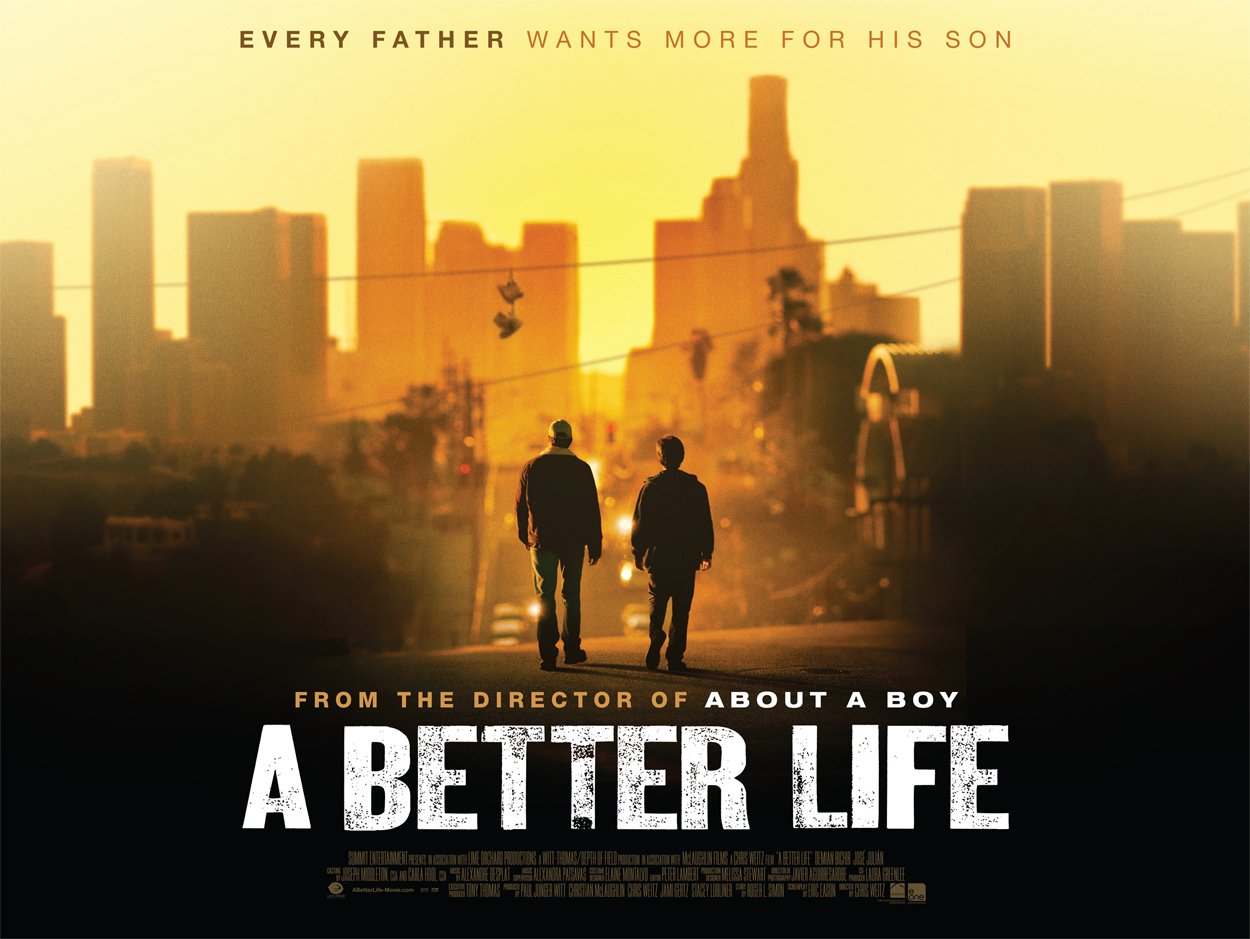
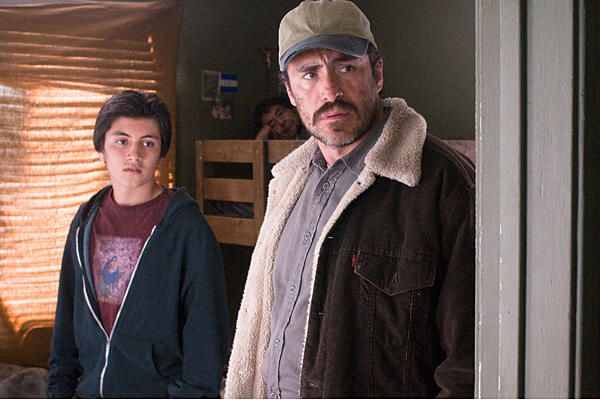
“A Better Life” is a touching and poignant drama and a surprisingly different movie for director Chris Weitz. It’s a story about Carlos, an illegal immigrant and single father played brilliantly by Mexican actor Demian Bichir. Carlos works as a landscaper to provide for his son Luis (Jose Julian) in East Los Angeles. Hoping to improve his and his son’s circumstances, Carlos agrees to buy his employer’s work truck and go in business for himself. But he finds this to be a difficult and daunting task and things quickly go wrong.

Carlos is certainly a likeable character and you can’t help but sympathize with his motivations. You see his dedication to his work which flows from his dedication to Luis. He’s up early and off to work and then comes home late and immediately goes to bed. This probably contributes to the disconnect between him and Luis. While Carlos is spending all his time earning a living, Luis has fallen in with a rough crowd at school and finds himself being drawn to the street gang lifestyle. At first Luis has no intention of ending up like his father. But later he begins to see the contrast between his father’s life of integrity and the trouble-filled dead end that gang life brings.

“A Better Life” is all about the relationship between a father and son. The movie is really at it’s strongest when it focuses on Carlos and Luis and their struggle to stay close in light of their circumstances. Bichir’s earnest performance is completely natural and organic. He sells his character and you truly want him to succeed. Julian’s performance isn’t quite as consistent although he and Bichir share some wonderful moments in front of the camera. 

While ”A Better Life” does sometimes seem to overlook that Carlos is actually breaking the law by being here, it still manages to show that illegal immigration can cause numerous problems. It’s that backdrop that gives the story a slight bit of tension. The stakes are high and Carlos knows he could lose everything in a heartbeat. There are a couple of slightly underwritten plot points but otherwise it’s a well paced and well structured story and I found myself completely invested.

There’s so much to like  about “A Better Life” even with it’s few flaws. While the father and son dynamic works on many levels, it doesn’t take many chances and goes down a more conventional path. Also, Julian’s performance was a bit wooden in some of the film’s more important scenes. But this is still a strong picture anchored by a fascinating performance from Bichir. It’s hard not to get wrapped up in the lives of these two people even if we pretty much know how everything is going to end.

VERDICT – 4 STARS

REVIEW: “J. EDGAR”


At first glance, “J. Edgar” has Oscar nomination written all over it. It’s a period biopic directed by Clint Eastwood and starring Leonardo DiCaprio. It looks just like the kind of film you would expect to hear mentioned a lot on Oscar night. While the movie does several things right, it ultimately falls victim to some flat direction and an unfocused script. The movie starts strong and the first half of the picture seems to have a good sense of direction despite it’s lack of any real emotion. But the film seems to lose it’s identity and in the second half we end up with a hodgepodge of disjointed historical and personal vignettes.

The story unfolds through numerous reflections from Hoover to his typist as he prepares his autobiography. We jump back in forth through time and get a look at everything from Hoover’s work with Mitchell Palmer to his rise to acting director of the Bureau of Investigation. We get small glimpses of the Palmer Raids, the Bureau’s war against the likes of John Dillinger and Machine Gun Kelly, the Lindbergh kidnapping, the JFK assassination, and more. And even though we never stay long, the film is strongest when moving from one historical moment to the next, particularly in the first half of the film.


“J. Edgar” paints Hoover as the complex individual he really was. We see Edgar as a well-intentioned man who truly loves his country and believes in what he’s doing. But we also see him become a man more concerned with his legacy and with maintaining power regardless of the laws he may break. We see his contributions to forensic investigation but also his willingness to blackmail various presidents to get what he wants. He can be pitiful and sympathetic but at other times despicable and the movie does a good job conveying this to the audience.

While the first half of the picture had the look and feel of a well-crafted historical biopic, it felt dry and emotionless. The second half of the film tries to make up for that by spending more time looking at Hoover’s personal life. But this is where the movie loses it’s focus and ventures from fact into speculation. It was rumored that Hoover was a closet homosexual with strong feelings for his second in command Clyde Tolson. But the rumors were never proven. Eastwood stated that the film would address the relationship but leave it open for the audience’s interpretation. I think that approach would have worked much better. Instead, Eastwood’s picture leaves little for interpretation and the result is a cut and paste relationship that never feels genuine or natural. It does more to bog down the film than add to it.

DiCaprio gives a strong and committed performance that’s only held back by the occasionally clumsy script. He fleshes out his character’s insecurities, quirks, and unpleasantries without becoming a simple caricature. DiCaprio never loses his character even while playing him as young and old. It’s hard to take your eyes off of him even when he’s working through some occasionally stilted dialogue. While this isn’t my favorite work of his, it’s a well-rounded and controlled performance that could get some serious Oscar consideration. Armie Hammer as Clyde Tolson starts off strong but ends up giving a rather uneven performance. Hammer is subtle and effective as the younger Tolson but doesn’t quite sell him in his later years. And unlike DiCaprio, Hammer just isn’t able to overcome the material when it stumbles.


Visually “J. Edgar” does a nice job capturing the different decades. Careful attention is given to wardrobes, furnishings, and automobiles. It’s hard not to be impressed with the look of the film and Tom Stern’s cinematography really draws out the detail. One big topic of discussion has been the makeup used to age Hoover and Tolson. DiCaprio’s makeup is a bit jarring at first but I quickly grew used to it. Hammer’s makeup never looked natural and at times was pretty distracting.  There’s one scene outside in the sunlight where Hammer’s makeup was extremely pasty and looked more like a mummy that a human being. I was really taken back by how fake it looked.

“J. Edgar” could he been a classic picture. Instead it’s a good movie that never reaches it’s potential. It’s Dustin Lance Black’s script that leads to many of the film’s bigger problems. While it starts strong it eventually loses it’s cohesion and Black’s liberties in the second half of the film fall flat. But there are times where it really feels like an important picture and I did enjoy jumping back in time to see some of the bigger events in American history through Hoover’s eyes. “J. Edgar” is also worth seeing for DiCaprio’s solid performance. This isn’t a terrible film and it does manage to be entertaining despite it’s flaws. But at the end of the day I can’t help but be disappointed at what could have been a great picture.

VERDICT – 3 STARS

3-stars