REVIEW: “Chernobyl Diaries”

CHERNOBYL Popster

I remember the first time I saw the trailer for 2012’s “Chernobyl Diaries”. I thought it looked pretty good and I wondered if it might be the shot in the arm that the struggling horror genre desperately needed. Modern horror films have become lazy, uninspired, and derivative. Unfortunately those three words also perfectly describe “Chernobyl Diaries”. It turned out to be a classic case of the trailer being better than the movie. Every good scene is found in the trailer and some could reasonably argue that even those scenes are lacking. Yet another example of how the genre is stuck in a rut and just spinning its wheels.

I’ll give “Chernobyl Diaries” credit, the premise for the film is a pretty good one and it seemed ripe with potential. Three twentysomethings, Chris (Jesse McCartney), his girlfriend Natalie (Olivia Dudley), and her best friend Amanda (Devin Kelley) are on a European trip. After stops in London, Paris, Rome, and Prague, the three visit Kiev where Chris’s brother Paul (Jonathan Sadowski) lives. The next stop on the itinerary is Moscow but before they go Paul convinces the group to take a day trip to Chernobyl and the ghost town of Pripyat which is built around it. Their tour guide is a man named Yuri (Dimitri Diatchenko) who specializes in “extreme tourism”.

Chernobyl 2

Just to freshen your memory, the Chernobyl catastrophe was a devastating Soviet nuclear incident that happened in 1986. A massive explosion in Chernobyl reactor four shot radioactive fallout into the atmosphere where it spread for miles across the Soviet Union and Europe. A Soviet coverup followed and the true death toll of those effected throughout the following years is unknown. The town of Pripyat, with its population of almost 50,000 people at the time, had been originally built to house the Chernobyl workers and their families. Due to its close proximity, the town was the hardest hit. It was instantly vacated and remains a ghost town today. This is where our four young tourists, Yuri, and another signed up couple pay a visit.

The brief history lesson I just gave is probably more entertaining than anything you’ll find in the film. Obviously when the group arrives there and begin to tour the abandoned city things go afoul. We know that’s going to happen. What I didn’t know was that the movie would take this interesting premise and ruin it almost immediately. It didn’t take long before I started noticing the same repetitive tricks, none of them effective. There’s honestly not one genuine scare in the entire picture and the movie never does anything to create a creepy atmosphere. Constantly walking in the dark with a flashlight or down tight hallways doesn’t constitute horror. But obviously that’s all the filmmakers had, creatively speaking.

Another big flaw in the film deals directly with the “threat” the group is facing. We are never really given a satisfying explanation of who or what they are and we never really see them. Now in much more capable and competent horror movies this might have added to the mystery and intensity of the film. Not here! I kept thinking that maybe the baddies could bail the movie out of the dull and lethargic hole it was in. Instead they’re just a faceless group that feel like retreads from other films. The movie tries to explain who or what they are in the final scenes but it’s so poorly done and I honestly didn’t even care at that point.

Chernoby 1

The movie also isn’t helped by its pretty shoddy acting and paper-thin characters. It’s funny watching the film try to give them some depth early on. We get some details about some past family drama between the brothers and the relationship between Chris and Natalie is about to take a turn. Yada, yada, yada. None of it adds an ounce to the characters. But apparently the filmmakers cared as little about the characters as I did. I don’t think any of them were actually killed on screen and one of them was completely forgotten.

One good thing about “Chernobyl Diaries” that it doesn’t prolong the agony. At a running time of under 90 minutes, I was quickly able to go about my business of forgetting the forgettable. Now the film was running on a small budget and that’s evident. But capable filmmakers have made really good films with even less money. This is an example of squandered potential but it’s also pretty crappy filmmaking featuring a pretty crappy cast built around a pretty crappy screenplay. In other words, I think it’s safe to say that “Chernobyl Diaries” won’t be credited for kickstarting the horror genre. In fact it shouldn’t be credited for much of anything.

VERDICT – 1.5 STARS

“Chocolat” – 3 STARS

Chocolat POSTERIn the 2000 romantic drama “Chocolat” a woman comes into a small French village and attempts to inject new life into the prudish community through her scrumptious chocolates. Sounds a little odd, right? Well in some ways it is but the film also delves into several heavier social and family issues sometimes convincingly but not always. It does have plenty of entertaining moments and it features some fine performances, but I’m still not convinced it’s a film worthy of the Oscar Best Picture nomination it received.

The story is based on Joanne Harris’ novel and written for the screen by Robert Nelson Jacobs. It takes place the a fictional French hilltop village of Lansquenet-sous-Tannes. One day a strong north wind blows Vianne (Juliette Binoche) and her young daughter Anouk (Victoire Thivisol) into town. The two newcomers quickly rent an abandoned patisserie and the apartment above it from the crabby Armande (Judi Dench). Vianne turns the place into a chocolate shop and begins to capture the attention of the locals.

One such local is Comte Paul de Reynaud (Alfred Molina), the town’s mayor who rules the community with an iron moral fist. He’s particularly turned off by Vianne for her more provocative attire and her insistence on opening a chocolate shop at the start of Lent. Reynaud goes to great lengths to sour the people’s view of Vianne but as more people taste her magical chocolate concoctions a profound change begins to take place in the village. Several townsfolk find that her chocolates cure personal troubles in their lives. They spark a new romance, they lead someone to independence, and in another case they even work as supercharged Viagra.

chocolat 1

It seems that organized religion may serve as the punching bag in this film. It’s portrayed as stuffy, intolerant, and overbearing. But it’s the concept that’s the target more than the people. The people are treated more as simple-minded followers with Reynaud being the moral dictator and true mouthpiece of the church. But I was never fully convinced that Vianne was such a great person either. She certainly exposes several of the churches hypocrisies and she makes the lives of several people better. But she also uses some pretty disrespectful tactics including usurping parental authority and planning a fertility celebration on Easter Sunday clearly to be confrontational. The film treats these moves as positive but that’s not the way to win me over to her perspective. And what exactly is she? Is she a witch, a chocolate magician? I never did figure it out.

The film’s strongest point is its acting. Binoche is brilliant and she has always amazed me with the believability she brings to ever performance. Judi Dench was also great as Vianne’s grumpy landlady. Dench does ‘surly’ well and she’s a real treat here. I also loved the always underrated Alfred Molina. He was fantastic as a character who’s a lot more complex than you may think. Johnny Depp even pops up in a smaller role as a river drifter who catches Vianne’s eye. There are several other fine performances worth mentioning from Lena Olin, Carrie-Anne Moss, Leslie Caron, and Peter Stormare.

“Chocolat” is a movie that’s entertaining despite its occasional heavy-handedness and familiar storylines. It does suffer from a few periods of dullness and the conventional ending seems a little disjointed considering how most of the film seems quite unconventional. But it’s the performances that carry this film and there are enough interesting developments in the story to keep things moving. Yet despite that, there were some things that kept pushing me away and I can’t help thinking that there was potential here for a little more satisfying experience.

REVIEW: “Conan the Barbarian” (2011)

For the past few years Hollywood has been consumed with remaking movies from the 1980’s. I have to admit, “Conan the Barbarian” was one I could see being remade with satisfying results. I’m a fan of the original 1982 fantasy film starring Arnold Schwarzenegger. It was a gritty and violent movie jammed with swordplay and sorcery. This time Jason Momoa takes on the role of Conan and while he does a good job channeling the Barbarian’s grunts, growls, and muscle flexes, ultimately the movie’s story runs out of gas and the special effects don’t live up to what you would expect from a 2011 movie.

We’re introduced to Conan at the time of his birth on the battlefield during an intense attack. His mother dies and he is raised by his father Corin (Ron Perlman), the leader of a tribe of barbarians. Conan grows into a young boy who’s agility and skills with the blade are beyond his years. It’s during this time that his village is attacked by an evil warlord Khalar Zym (Stephen Lang) who is seeking the pieces to an ancient mask he believes will resurrect his deceased wife and eventually lead to his rule over Hyboria. Doesn’t it always come down to that?

Zym and his army destroy young Conan’s village and leaving the boy to witness his father’s death. The story then catapults ahead to an adult Conan working as a mercenary. Still thirsty for revenge, he finds a trail that he hopes will lead to Zym. Zym still hasn’t figured the mask out and now is seeking a monastery that houses a pure-blood descendant (Rachel Nichols), blah, blah, blah. Conan ventures from location to location before tracking Zym down, falling for the descendant, and getting caught between saving her and carrying out his revenge.

The story has promise especially for those who love these types of fantasy films. It has moments that captures what made the original film a cult favorite particularly during the first half. But it hits a point where it begins to lose steam, turning into becomes a conventional and predictable fantasy tale. There are plenty of action scenes featuring snarls, sword twirling, and blood splatters. Some of them work well, but much of the action lacked context and seemed like nothing more than dressing. And I also found the finale to be as underwhelming as the buildup to it.

It’s also surprising to see how bland the special effects turned out to be. Many of the location shots look like hazy paintings instead of lived-in lands. There is also a creature battle close to the end that certainly doesn’t stand up to the visual accomplishments of today’s effects. But there is a really good effects-driven sequence where Conan is battling a group of sand warriors conjured up by Zym’s witch daughter Marique (Rose McGowan). It’s clearly the best the movie offers.

As I mentioned, Momoa is a soild Conan and Nichols is a good match for him on the screen. Perlman is a nice choice for Conan’s father even though it’s a relatively small role. Stephen Lang isn’t as bad as he was in “Avatar” but once again he seems to be following the “How to Play a Movie Villain” handbook. He overplays several scenes and he’s never the slightest bit menacing. McGowan, his co-antagonist, feels like a bigger threat even though her character is pretty shallow and forgettable.

Forgettable is also a good way to describe “Conan the Barbarian”. It’s not a terrible movie but it squanders a lot of potential. It does do a few things right especially in the first half. There are also moments that made me reflect back to the original film and how I responded to it as a kid. Unfortunately this one can’t sustain a compelling story and the visuals don’t feel like a worthy enough upgrade. This was one remake that I expected a lot more from.

VERDICT – 2 STARS

2-stars

REVIEW : “Cloud Atlas”

“Cloud Atlas” has already stirred up quite a discussion between moviegoers. It’s safe to say the film has earned its fair share of fans. But it’s also true that it has its share of detractors. To be honest I can see where people could either love it or hate it. It’s a highly ambitious picture that pulls off an incredibly clever storytelling technique. But it could also be viewed as a three-hour grind that features many of the Wachowski’s familiar self-indulgences. So how was it for me, a groundbreaking cinematic accomplishment or an epic sized disaster? Well neither, But I did find it a chore to sit through despite the things it does right.

It’s practically impossible to give any kind of brief synopsis of the plot of “Cloud Atlas”. It’s basically six individual stories that take place at different points in time. The first story is set in the 1800s and follows a young lawyer handling business for his father on a voyage across the Pacific. The second story takes place in England during the 1930s as a young unfulfilled composer is hired to help an older accomplished composer create his music. The third story is set in the 1970s as an investigative reporter finds herself in danger after uncovering a nuclear energy conspiracy. The fourth story, set in 2012, follows a writer and publisher who finds himself in debt and in deep with some local mobsters. The fifth story jumps to a futuristic high-tech Seoul, Korea where a clone is believed to hold the keys to the future. The final story leaps further into the future where mankind is left to live in a barbaric caveman-like world.

Now there’s a process to watching “Cloud Atlas”. First the audience must adjust to the fractured form of storytelling. The Wachowski’s and co-writer and co-director Tom Tykwer don’t tell the six stories separately. Instead, the movie jumps from one story to another requiring the audience to keep up. For this to work, we first have to get to know the characters. For the most part the introductions work pretty well although I did struggle to connect with some of them. Once the characters and their stories are laid out then the audience can sit back and watch things unfold. This is when the movie was most effective. In fact, I found myself completely absorbed in what I was seeing during the middle of the film. Then the audience has to piece each of the stories together, some through more obvious and straightforward connections and others through more cryptic and allegorical meanings. This is another place where I felt the film really stumbled.

I want to start with the positives. The storytelling technique employed in “Cloud Atlas” could have potentially been a disaster. Earlier I used the word ambitious and for good reason. Taking pieces of six individual stories, breaking them up, and interweaving them together while maintaining a good strong narrative is an incredible challenge. I was blown away with how well it was done in this movie. We seamlessly move back and forth from story to story and the filmmakers are able to keep total control of the narrative. Even later when the transitions seem to come quicker and quicker, the broader story never loses its sense of cohesion. It’s intelligently crafted and executed and it serves as a great reminder of the power of cinematic storytelling.

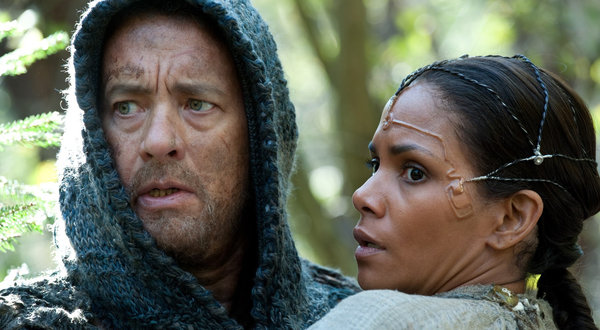
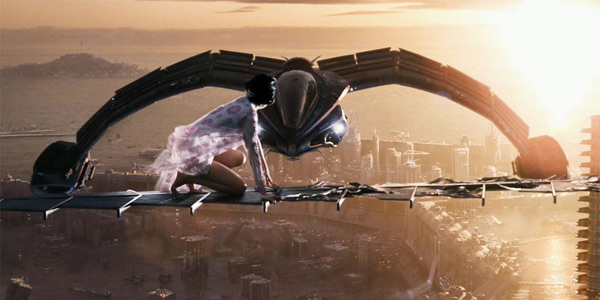
There are also some amazing special effects and spectacular cinematography. The overall visual presentation of “Cloud Atlas” gives it a true epic motion picture feel and it beautifully captures the various time periods that it dabbles in. I loved the period-perfect look of the 1800s as well as the futuristic landscapes and technologies from the later period. Every place we visit in time looks and feels perfect. It also helps to have such a superb cast involved. The movie is loaded with strong performances from actors and actresses playing multiple roles. Tom Hanks, Halle Berry, Jim Broadbent, Hugo Weaving, Susan Sarandon, Keith David, Hugh Grant, Bae Doona, and Jim Sturgess all do great work in bringing this complex story to life. Each play a variety of different characters in the different storylines often in heavy prosthetics and sometimes in full drag. This is a good lead-in to some of my questions and concerns about “Cloud Atlas”. I’m not certain why it was necessary to have these actors play multiple roles. I’m assuming the filmmakers felt it added a sense of connection between the stories. Or maybe there was another underlying intention that I just don’t care to figure out. Regardless, do we really need to see Hugo Weaving dressed up as a husky female nurse?

Then there is the issue with how some of the individual stories end. There are a couple that I found quite satisfying. But then there are those that feel a little too tidy and borderline conventional as well as one that’s just flat-out silly. Also I never felt as though I made the full connections between some of the storylines. The movie simply doesn’t tie them together sufficiently. Now to be fair, a movie like this almost begs to be viewed a second time. I’m certain there are little nuggets of information that I missed. But the problem is that I’m not sure I want to tackle it again and that’s in large part due to the sometimes laborious 3-hour running time. Now I don’t mind long movies, but there were stretches in “Cloud Atlas”, particularly in the first and third acts, where the film seemed to be spinning its wheels. This isn’t unusual for the Wachowskis and I had a similar problem with their Matrix series. Much like those movies, this film at times feel bloated and self-indulgent. I also found the social commentary to be obvious and heavy-handed. Even in the instances where the message is good, they sometimes come across as blatant and contrived. Now to be perfectly honest, I’m not at all familiar with the source material, but I can’t imagine it being as glaringly in-your-face as the film can sometimes be.

“Cloud Atlas” is a difficult movie to process. It can sometimes be exhilarating cinema and at other times a frustrating chore. From a technical standpoint the film is astonishing. Both the visuals and sound design are phenomenal and the ability to capture the uniqueness of each time period is quite amazing. Even more impressive is the artistry involved in the unconventional storytelling method. There’s a crisp lyrical harmony to how we’re moved back and forth from one story to the next. Unfortunately there are a host of other problems, including those mentioned above, that keeps “Cloud Atlas” from being a really good film. But I haven’t asked the bigger question surrounding this movie. What’s it really about? Is it above love conquering all? Is it about choices and the blessings or consequences that follow them. Is it about a deep interconnection that all mankind share? I’m not sure, but in the end “Cloud Atlas” is a relatively small movie hidden underneath its lavish ambition and grandeur. It’s an exercise in style over substance that has enough flaws and misguided conceits to overshadow the things it does really well. That’s a shame.

VERDICT – 2.5 STARS

“THE CABIN IN THE WOODS” – 3.5 STARS

I love a good horror movie. But there’s no denying that the horror genre has been struggling and just isn’t as strong as it used to be. Well leave it to Joss Whedon and Drew Goddard to take the genre, turn it on its head, and give it a good shake. Their film “The Cabin in the Woods” is far from conventional even though it certainly starts that way. But the fact is Whedon and Goddard are setting up the audience for what turns out to be a horror comedy that ranges from satirical to a full-blown critique of what the horror genre has become. Goddard directs, Whedon produces, and both write this bit of welcomed freshness that isn’t a perfect film but it certainly works on many levels.

It’s impossible to watch “The Cabin in the Woods” without seeing tips of the hat to several horror movie classics. You’ll also quickly recognize many of the same tropes and devices used in the genre for years. Whedon and Goddard dabble in the familiar territory of slasher movies, zombie flicks, ghost stories, torture porn, and even creature features. But its simply impossible to go into much detail without spoiling the film. Let’s just say that all of these ingredients fit very well into what “The Cabin in the Woods” is trying to do. And trust me, you’ll start out in very familiar territory but things quickly change as the story progresses.

Tell me if you’ve heard this before: five college friends set out to a remote cabin in the woods for a weekend of partying and frolicking. We have the big jock (Chris Hemsworth), the sultry blonde (Anna Hutchison), the studious good guy (Jesse Williams), the dope head (Fran Kranz), and the straight-laced, level-headed heroine (Kristen Connolly). These are all characters we’ve seen over and over in horror films. But here they are used intentionally and with good reason. Obviously their little getaway isn’t going to end well and we get little hints of that along the way. As things begin to go bad, we see these characters making some of the same bone-headed decisions that they always make in these pictures. But the bigger difference here is with the consequences and more specifically who’s behind them. That’s as far as I’m willing to go in describing the story. It’s best to go into the film simply knowing that there is more to it than what you’re introduced to. Just know that things go nuts in the final act and the audience, especially horror fans, will find it an entertaining challenge to process all that we are given.

But the movie does have a few issues that keep it from being a great film. The most glaring issue for me was with the gaping plot holes scattered throughout the story. There were instances where the film changed course while leaving unfinished business behind . There are also a couple of times where certain characters drop off the map. I know I’m being incredibly vague here for fear of spoiling things, but let’s just say the story requires you to sometimes brush aside what seems like useful information. The ending also requires a very abrupt acceptance of what you’re seeing. Don’t get me wrong, it’s lots of fun and it will have you wanting to watch the movie again. But it’s so out-of-the-blue that when the credits start to roll you have to accept what you’ve seen and just go with it.

I didn’t mention one of “The Cabin in the Woods” strongest features – it’s humor. There are some really funny moments in this picture and I found myself laughing out loud on more than one occasion. On the flip side, the movie isn’t scary at all which I found to be a bit disappointing. But then I asked myself if Whedon and Goddard cared if it was scary or not. In the end, this is one part homage and one part critique of a genre that has seen better days. Looking at the movie from that perspective makes it a very satisfying horror experience. And even though it stumbles with its storytelling in a few places, the undeniable freshness, good humor, and blood-soaked final act make it all worthwhile.

REVISITING A CLASSIC: “Citizen Kane” (1941)

You may have heard by now that Sight & Sound Magazine recently announced the results of their The Greatest Films of All Time poll. If you’re unfamiliar with the poll, it’s a worldwide survey of critics that has been conducted every 10 years dating back to 1952. Since 1962 “Citizen Kane” has been at the top of this pretty prestigious list, at least until this year. Alfred Hitchcock’s “Vertigo” has dethroned “Citizen Kane” which has launched a ton of great discussions on both of these films. Personally, “Vertigo” isn’t the greatest film of all time. In fact, for me it isn’t even the best Hitchcock film. And for my money, even though I like “Vertigo” a great deal, it can’t beat “Citizen Kane”, a movie that is a lesson in quality filmmaking starring, directed, and co-written by Orson Welles.

Last night I had the opportunity to revisit this cinema classic and it’s amazing how it truly seems to get better with each viewing. “Citizen Kane” is a film that has aged like the finest wines and there are so many reasons for it. The more I watch the movie the more I can appreciate the skilled filmmaking and risks taken to bring the movie to life. The film certainly had its share of struggles particularly when trying to find an initial audience. William Randolph Hearst, the American newspaper giant who is the clear inspiration for the movie’s main character, was infuriated by the movie and took huge measures to keep “Citizen Kane” from reaching an audience. Fear of his power kept the film out of many newspapers and out of many theaters. But after all these years, it’s the movie that has come out with the better reputation.

While there has been some controversy over who was the driving force behind the movie’s screenplay, Orson Welles and Herman Mankiewicz are credited with its authorship. It tells the story Charles Foster Kane, an immensely wealthy newspaper mogul, who lies on his deathbed, alone within the closed isolation of his mammoth Florida estate known as Xanadu. We watch as Kane utters his final word “Rosebud” and then dies. This opening event catapults the entire story forward. In fact, the entire narrative is driven by one incredibly clever device – “Rosebud”. Kane’s final word becomes a huge topic of interest especially for investigative reporter Jerry Thompson (William Alland). Thompson is convinced that there is a deeper secret meaning to Kane’s final word and he sets out to uncover it by looking into Kane’s past and interviewing those closest to him.

This points to one of the things that makes this movie so special. There’s no straight-line, uninterrupted narrative. Instead the story is told through well placed flashbacks from the points of view of several different people. Through their eyes we learn about Kane’s impoverished childhood. We learn about his leap of faith into the newspaper business at a young age. We see his political ambitions. But we also see the story of a man whose motivations fester into those of power and self-promotion. We watch as his ego and self-indulgence destroys every nonmaterial thing in his life. He’s the epitome of gaining the whole world but losing all that’s important. It’s a fascinating study of a man who, regardless of his wealth, power, and influence, is unable to overcome the greatest obstacle to true happiness – himself. This all unfolds through the words of Kane’s guardian, ex-wife, business partner, butler, and best friend. Now as someone who isn’t always attracted to the use of flashbacks, I’m really impressed at just how well they work here. Welles is truly laying out a man’s life before us and I was enthralled not only in his story but also with the small question behind it all – just who or what is “Rosebud”?

While many love the story and the storytelling behind “Citizen Kane”, it is equally or maybe even better known for its ambitious visual presentation and stylistic techniques. Welles was given tons of liberties from RKO Pictures when it came to making the film and that’s all the more surprising considering that this was his first feature film. He took his creative control and mixed it with a young man’s enthusiasm that resulted in a visual style significantly different from anything else in Hollywood. I can still name numerous carefully framed shots and brilliantly conceived camera tricks. There’s also Welles’ penchant for placing his camera at ground level and shooting up at his characters. This is ever so effective particularly in one extended take featuring a crucial conversation between Kane and his long-time friend Jedediah Leland (played wonderfully by Joseph Cotton). There are several other cool camera techniques and special effects along with some impressive makeup work that still influences a host of modern filmmakers.

I worry that newcomers or even those who haven’t seen “Citizen Kane” in years will approach the film from the “So this is the greatest film of all time?” perspective. That’s a bad way to approach any film especially considering how subjective these lists are anyway. Instead, this movie should be approached as its own creation – enjoyed and measured within those bounds. Welles’ accomplishment with the film cannot be overstated. The direction is brilliant, the screenplay is fantastic, and he gives a thundering performance and all within what was his first feature film. “Citizen Kane” was a critical success at its time but struggled to gain a huge following. But as years have passed, the movie has risen to be appreciated as a monumental film in cinema history. I tend to agree. And while “Citizen Kane” wouldn’t be my personal “greatest movie of all time”, there’s no denying it’s inventiveness, it’s influence, and its overall excellence.

VERDICT – 5 STARS

5 STARSs

5STAR K&M