“THE VOW” – 1 1/2 STARS

Some movies are released that really leaves me scratching my head. I ask myself “How on Earth did this movie get made?” Such was the case with “The Vow”, yet another poorly acted and poorly written entry in the hurting romantic comedy genre. I was honestly dumbfounded that “The Vow” saw the light of day. But after seeing the movie rake in almost $200 million worldwide, I was reminded that there is an audience for this type of shallow and unoriginal storytelling.

“The Vow” offers nothing original. It almost comes across as a slightly better looking mid-day soap opera. Tell me if you’ve heard this before. Leo (Channing Tatum) and Paige (Rachel McAdams) are a happy young married couple. While heading home after a movie the two are involved in a car accident. Paige is thrown from the car and experiences severe head trauma. As she recovers, Leo stays by her side waiting for her to regain consciousness. When she does, as you can probably guess, she has amnesia and doesn’t recognize Leo. Yes, they really went there.

Things are complicated when her parents enter the mix. In pre-amnesia times, Paige’s relationship with her parents was nonexistent. They use her memory loss as an opportunity to jump back into her life. This pits them against Leo in an attempt to win her affection while she struggles to remember her old life. Throw in Scott Speedman as Jeremy, her ex-fiancee who she split up with prior to meeting Leo. Of course he wants back in her life and sees Paige’s memory loss as his ticket in.

Most of problems with “The Vow” can be traced back the shoddy writing. There’s not one single character mentioned above that feels authentic. They are all paper-thin versions of characters we’ve seen so many times before. The movie hinges upon the love between Paige and Leo. Unfortunately I never bought into them as a couple. Their dialogue is so silly and tripe and neither of the performers are believable. A lot of people like Channing Tatum as an actor but I’m still not sold on him. He delivers so many flat, stone-faced lines and I often found myself laughing at scenes not intended to be funny. McAdams tries her best but the material she is given is so incredibly slight and superficial.

There are instances where “The Vow” teases you into thinking it’s going in a more unconventional directions. But that’s never the case. Sure the ending isn’t the straightforward run-of-the-mill mush that we usually see, but it’s also not enough to save the film which labors from start to finish. Weak material and Tatum’s poor lead performance end up killing the movie before it even gets going. So I find myself again lamenting the status of the romantic comedy, a genre that I actually like but that is bombarded with poor movie after poor movie. But I guess as long as people keep paying money to see them, this is what we can expect.

REVIEW: “Deliverance” (1972)

The 1972 nature thriller “Deliverance” is considered to be a landmark film that’s still held in high regard. It’s based on and follows closely James Dickey’s novel from 1970. Dickey played a key role in bringing the film to the big screen. He wrote most of the screenplay along with director and producer John Boorman. Dickey even has a small role in the film as the sheriff that we see close to the end. “Deliverance” went on to earn three Academy Award nominations including Best Picture and Best Director and it’s preserved in the National Film Registry by the Library of Congress..

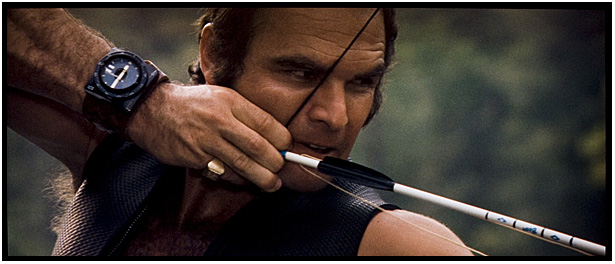
But for us moviegoers, those things aren’t what “Deliverance” is remembered for. The movie took the man versus nature dynamic, injected several disturbing regional elements, and created a unique thriller that still holds up today. It’s the story of four Atlanta “city boys” who drive into the forested north Georgia hills to canoe down the Cahulawassee River before it’s ruined by the construction of a dam. Lewis (Burt Reynolds) is the only one that could be called a true outdoorsman. Ed (Jon Voight) has a little experience with camping. But Bobby (Ned Beatty) and Drew (Ronny Cox) are new to the wilderness.

The four take off through the hills looking for the most remote place to drop their canoes. But before hitting the water they need to find someone to drive their vehicles ahead to where their canoe trip ends. They come across the home places of some mountain locals and we immediately see they are out of their element. Boorman and Dickey create a pretty thick tension between the two groups that is only eased when Drew (who is plucking his guitar while waiting on Lewis) is joined by a local boy and his banjo. This is one of the film’s most memorable scenes but for me it’s also the best. The two play “Dueling Banjos”, a composition by Arthur “Guitar Boogie” Smith. The song was incredibly popular and will always be associated with “Deliverance”. The problem is it was used without permission which led to a lawsuit. But it’s perfect for the scene which really sets the tone for the entire film. There is a sweetness about the scene but more than that there is a creepiness to it as well. The young banjo player (played by Billy Redden) has the look of being inbred and as a result perhaps mentally retarded. We see him one more time on an overhead bridge as the boys head down the river. It’s a creepy scene that sets the table for what’s ahead.

The guys are able to hire some locals to take their vehicles downstream and they soon find themselves on the river. They go on the trip with the intentions of enjoying nature’s beauty but they also encounter some of nature’s harsh challenges. Things are made even more difficult when they cross paths with two armed backwoods mountain men (Bill McKinney and Herbert Coward). A violent encounter follows which turns their trip deadly. If you haven’t seen the film, I won’t ruin it for you, but the four find themselves fighting for the lives. The sharp contrast between the sheer beauty of their surroundings and the threat it poses is ever-present and the twisted hillbillies seem like another arm of nature.

The movie was filmed on the Chattooga River between South Carolina and Georgia. The locations perfectly compliment the story and it’s easy to get lost in the beauty of the environment.  Boorman captures the high cliffs, raging rapids, and green lush forests with some sharp and clever camera work. And aside from the wonderful “Dueling Banjos”, the film’s carefully implemented score mixed with the natural ambience is perfect for the tone that Boorman is trying to maintain. The visuals and sound are a big reason that “Deliverance” works so well.

Also worth noting are the fantastic performances. Burt Reynolds is very good as the tough guy of the group. He flexes his brawn through his tight leather zipper vest and at times you truly believe the groups survival depends on him. Actually Voight carries most of the screen time and he’s very good. The movie is also significant in that it features the debut performances from Ned Beatty and Ronny Cox. All four are very well cast. The movie is also strengthened by some great smaller supporting roles which bring the locals to life. McKinney and Coward are believable and terrifying and I still find Redden’s character one of creepiest I’ve ever seen. Oh, and keep an eye out for a young Ed O’Neil in a small role as a policeman close to the end of the film.

While “Deliverance” is a good movie, I do think it stumbles a little at the end. It’s not that it’s a bad ending, it just doesn’t measure up to the level of intensity and suspense that had built up throughout the film. The ramifications of the events that take place do come to a head and certain decisions have to be made. But they never feel as important or as pressing as they should be. I don’t mean to second guess Dickey’s script, but it seems as though he could have put together a tighter and more satisfying ending.

Even though it may not end as strongly as it starts, “Deliverance” is a memorable movie and like I said, it still holds up today. Anchored by some solid performances, strong direction, and a sharp aesthetic, “Deliverance” creates an atmosphere as threatening as it is beautiful and throws it’s characters right in the middle of it. It’s a haunting and sometimes unnerving ride that will leave you never wanting to vacation in the south again.

VERDICT – 4 STARS

“MAN ON A LEDGE” – 2 1/2 STARS

Some movies can take a pretty preposterous concept and still make a fun and entertaining film out of it. There’s no denying that “Man on a Ledge” has a pretty preposterous concept. The question is, is “Man on a Ledge” a fun and entertaining movie? Well…kinda. Underneath the surface the movie has a fairly interesting premise. But it gets bogged down in it’s occasionally lame dialogue, it’s run-of-the-mill characters, and some truly head-scratching moments.

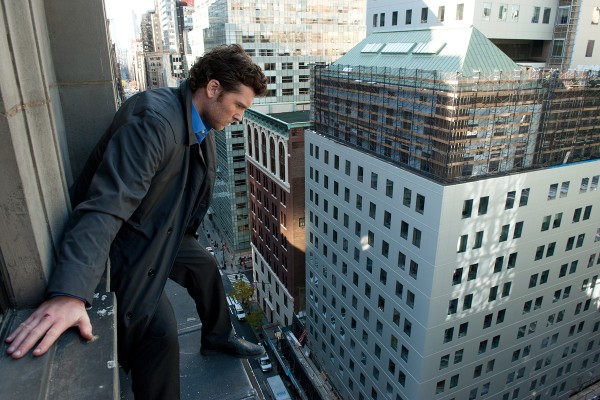
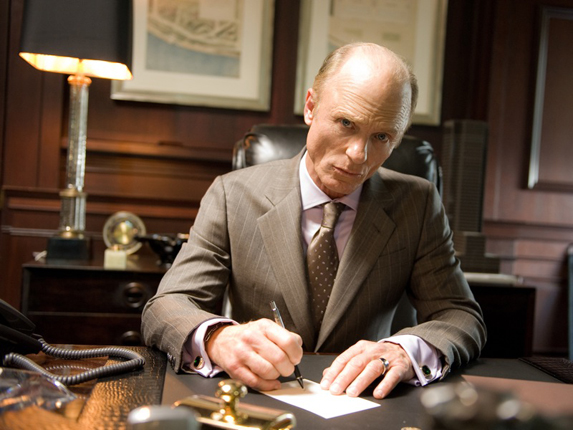
Sam Worthington plays Nick Cassady, an ex-New York City Policeman who is serving a 25-year prison sentence for stealing a $40 million diamond from a shrewd and unscrupulous businessman named Dave Englander (played by an alarmingly thin Ed Harris). After being notified of his father’s death, Nick is allowed to attend the funeral where he evades the guards and sets out to prove his innocence. His plan? To check into the Roosevelt Hotel, have a final meal, then climb out on the ledge of the building prepared to jump. It’s certainly not the normal approach one would take in trying to prove their innocence. Officer Marcus (Titus Welliver) arrives and takes charge of the scene and, at the request of Nick, calls in negotiator Lydia Mercer (Elizabeth Banks).

Now it’s clear that there is more going on than just a man about to jump to his death. Nick has a bigger plan in motion that hinges on Lydia’s cooperation, the craftiness of his brother Joey (Jaimie Bell) and Joey’s girlfriend Angie (Genesis Rodriguez), and the rabid crowd that has gathered below. The story takes several different turns and throws a few twists at the audience, but it’s hard to fully invest in them. Things get a little outlandish and it’s pretty hard to believe at times. Now in the defense of director Asger Leth, he’s well aware that he’s working with some wild material. He keep things moving at a crisp pace and he doesn’t drag the movie out longer that it needs to be. Also, Leth really uses the camera well and I had read where they filmed several scenes with Worthington actually out on the ledge. Unfortunately the good looks of the film isn’t enough to save it from it’s glaring flaws.

There are numerous instances where the writing left me scratching my head. Some scenes will leave the audience asking themselves “Can the NYPD really be this inept?” and “Is the movie making fun of New Yorkers or are we really to believe that 99% of them are bloodthirsty animals?”. There are also several cheesy exchanges between characters that either feel out-of-place or are just plain goofy. The film also features some of the same character types that we’ve seen in so many other movies. We have the wicked, wealthy corporate businessman. We get the typical corrupt cop. We even have the self-serving reporter who is more interested in getting the story that public safety. We’ve seen them all before.

You have to be impressed just looking at the movie’s strong cast. I like Sam Worthington even though he’s yet to really show much range in his performances. He’s actually quite good here even though the role doesn’t require as much from him as you might think. His New York accent does give way to his natural Australian accent in some scenes but he still gives a solid performance. Banks is also pretty good as is Edward Burns as a fellow negotiator. But the biggest problem is none of these performers can truly rise above the material which lets them down on numerous occasions. The always strong Ed Harris and Anthony Mackie as Nick’s former partner are terribly underused and should have been given more to do.

If you can put aside the flaws and suspend disbelief, there is some enjoyment to be found in “Man on a Ledge”. It’s impossible to take seriously and I have no doubt you’ll be shaking your head more than once. But “Man on a Ledge” is a harmless film with some cool action and fun moments. And while it’s a decent little afternoon diversion, it’s an action thriller that’s ultimately forgettable. Check it out if you have some free time. Otherwise, you can probably find something better to watch.

REVIEW: “BATTLE OF THE BULGE” (1965)

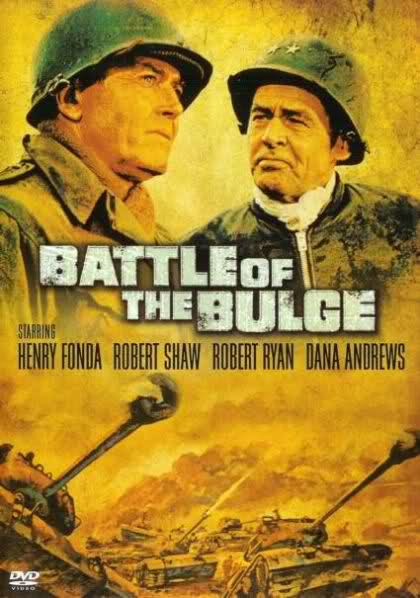
Ken Annakin’s “Battle of the Bulge” from 1965 is another solid entry into the field of War World 2 films. Over the Memorial Day weekend I had the opportunity to finally catch up with the entire film. “Battle of the Bulge” (the movie) has an interesting history. It was met with a wide range of opinions, mostly positive but plenty of negative. Some criticized the film for it’s obvious historical inaccuracies. Others griped about it’s overly talky and bloated script. There certainly is some merit to these and other criticisms, but I found the movie to be a solid war picture despite it’s overly long running time.

“Battle of the Bulge” is the telling of the German’s last-ditch offensive through the heavily forested mountain regions of Belgium in the later days of World War 2… at least the title of the film suggests that. It could be better described as loosely based on events surrounding the bloody, costly, and complicated battle. The film doesn’t depict any particular real-life figure during the war. It’s clearly intended to be a drama set during wartime. This is something some people took issue with but I don’t think the movie ever pretends to be something it’s not. Perhaps it could have chosen a different title for the film, but historical accuracy doesn’t seem to be a goal. That said, the movie does attempt to capture elements from the real 50 day battle. Some of the attempts work more than others.

The film’s centerpiece seems to be Colonel Hessler (Robert Shaw), a German officer put in charge of a large group of new King Tiger tanks. His mission is to slam into and push back the Allied lines which are slowly hemming the Germans in. The Americans believe the Germans are undermanned and out of resources and incapable of a worthwhile offensive, everyone except Lieutenant Colonel Kiley (Henry Fonda). During an overhead recon flight, Kiley noticed German tanks in hiding which leads him to believe the Germans are planning an attack. His suspicions are dismissed by General Grey (Robert Ryan) and the Americans are caught unprepared when Hessler and his tank division hit the Allied lines.
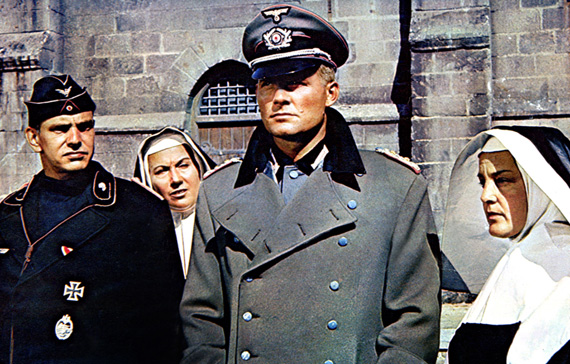
Hessler seems loosely based (there’s that description again) on the real-life Nazi Joachim Peiper. Peiper was a shrewd and brutal field officer with close personal connections with Himmler. During The Battle of the Bulge, Peiper was to lead a division of the new King Tigers. The tanks were heavily armored but they were gas guzzlers (it’s said the went about 1/2 mile per gallon of fuel). We see some of this with the movie’s Hessler character. He is a shrewd and dedicated German and we definitely see the fuel issue play a key role in how things turn out. But Peiper was a high-ranking SS Nazi and was convicted of war crimes for the brutal massacre of American prisoners and civilians who he came across during the battle. Hessler isn’t an SS officer and seems to be angered when he hears of a massacre that took place elsewhere during the offensive.

On the American side we send a lot of time with Lt. Col. Kiley as he tries to persuade the higher-ups of the upcoming attack and later as he plays a key role in trying to figure out Hessler’s ultimate strategy. We also spend time with Major Walenski (Charles Bronson) and his soldiers who find themselves face-to-face with Hessler’s forces on more than one occasion. Some of my favorite moments in the film revolved around Walenski and his men. I guess that’s why I was a little let down by the way he just drops off the map later in movie. Once he disappears, we never see him again. Telly Savalas plays Sgt. Gruffy, a tank commander who has a little business on the side. The movie tries to build a little story around him but it’s pretty flimsy. I did enjoy the short side-story about a green, by-the-books Lt. Weaver (James MacArthur) and the seasoned Sgt. Duquesne (George Montgomery). When things go bad for the two Weaver flaunts his rank while Duquesne relies on his field experience. It’s a familiar dynamic but one that I enjoyed.

But the complaints about the movie’s script are legitimate. There were instances where it felt like we were seeing the same thing over and over. The American leaders would discuss what the Allied game plan should be. Then we would switch to Hessler and his heads talking about a better course of action for them. Then we would do both all over again without making any progress in between. There were also some scenes that could have been edited better. For example, there is a cool scene where the Allies are sending guns via train to the front line to stop Hessler’s advance. The camera is put on the front of the train as it races to it’s location. But the coolness wears off as the scene just keeps on going and going. There were also several scenes features rolling tanks that seem to go on forever. A little better editing could have cut out some wasted time on scenes like these.

And while I don’t think the movie should be dismissed simply because it’s not historically accurate, I can see where some may not be as fond of it due to certain out-of-place details. For example, the location of a big tank battle close to the end almost resembled Arizona more than Belgium. It didn’t at all feel connected to the real environment in which they fought. In fact, much of the Battle of the Bulge was fought in snowy, hilly areas with thick forests. We see small bits of that here and there but it completely disappears later in the film. Now I perfectly realize that this is something that only someone interested in the history behind the battle would fuss about. And while it would add so much more to the film for someone like me, it really isn’t something that killed my enjoyment of the picture.

On the flip side, “Battle of the Bulge” is a visual delight. The film is filled with huge detailed set pieces and wide screened action sequences that feel completely authentic. The camera work is fantastic and there are times where the carefully crafted angles blew me away. Jack Hildyard, the Oscar-winning cinematographer for “Bridge on the River Kwai”, handles the same duties here and his work is fantastic. The movie is immediately set apart by it’s visuals and they only get better as the film progresses.

Yes “Battle of the Bulge” is long and sometimes talky. No it’s not a movie to watch in order to learn the real details of this historical and important battle. But in terms of cinematic entertainment, the movie works. The performances are good especially from Shaw and Bronson and it’s visual presentation can stand with any other war picture. “Battle of the Bulge” may not be the best World War 2 movie, but it’s certainly a satisfying film that captures a lot of the action and spirit you want. It’s definitely worth checking out.

VERDICT – 4 STARS

REVIEW: “Men in Black 3”

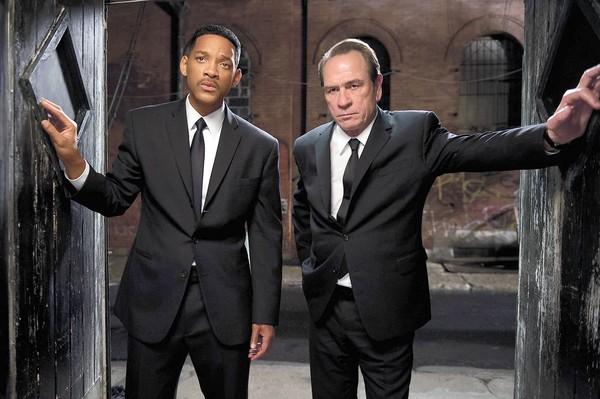
Let me preface this review by saying that I wasn’t the biggest fan of the previously two “Men in Black” movies. But I was certainly in the minority. The first “Men in Black” earned just under $600 million at the box office. The sequel brought in another $440 million. Obviously expectations are high for this third installment and it’s $300 million budget. Both Will Smith and Tommy Lee Jones are back as is director Barry Sonnenfeld and Steven Spielberg as Executive Producer.

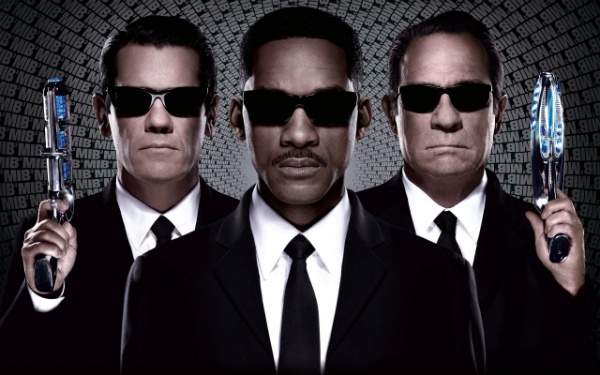
It’s been almost 10 years since we last saw Agent K (Jones) and Agent J (Smith). K is still the stiff-as-a-board, emotionless, straight-shooter, J is still a rapid-fire wisecracker with attitude to spare, and aliens are still on earth masquerading as humans. They both still serve as operatives working for a secret agency commissioned to protect the Earth from alien threats. This time their main threat is an alien named Boris (Jemaine Clement). Agent K apprehended Boris back in 1969 and put him in a lunar prison designed specifically for him. But Boris escapes and travels back in time to kill Agent K before he is able to thwart his original plan. After noticing K’s absence and a difference in the timeline, J travels back to 1969 a few days prior to K’s death to protect him from Boris.

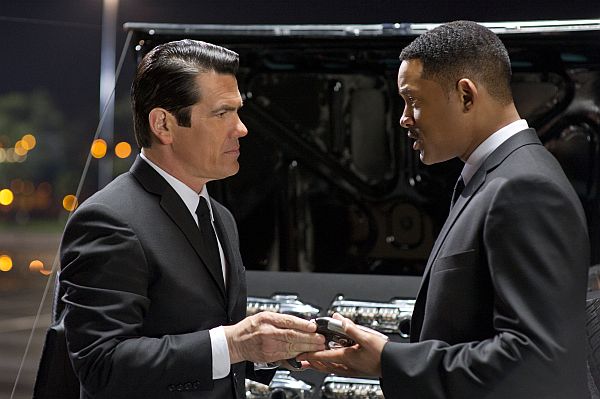
The movie starts off looking and feeling just like a “Men in Black” film. Funny exchanges between K and J and alien confrontations get the movie off on the right foot. There’s also a really cool time travel sequence as J heads back to 1969. It’s here that the movie both introduces it’s biggest asset as well as hit it’s biggest speed bumps. Josh Brolin plays the younger Agent K and he is fantastic. I swear there were times where I completely believed I was watching a younger Tommy Lee Jones instead of someone doing a Tommy Lee impersonation. Whether it’s his accent, his nicknames, or facial expressions, Brolin nails a 29-year old Agent K.

But while Brolin shines, the story really spins it’s wheels. There are a few back-in-time set pieces and late 60’s details that are fun but they get lost in the story that’s really pretty flat and lifeless. The humor loses it’s pop and seems to rely much too heavily on Will Smith’s quick wit. There’s great chemistry between Brolin and Smith but even it gets bogged down in the sometimes drab exposition. I have to admit, I found myself struggling to stay focused and interested in what was going on especially when an all-knowing alien named Griffin (Michael Stuhlbarg) enters the picture. I did enjoy Emma Thompson and Alice Eve as the older and younger Agent O and the movie is a visual delight. I just wish there was more energy and substance to go with the movie’s stronger points.

While I did have issues with the middle of the movie, it was almost made up for by a really good and surprisingly tender ending. There’s no way I can go any further without spoiling things, but I’ll just say that it makes you look at all three “Men in Black” movies from a different perspective. The ending is well conceived and even though there were a few questions that immediately came to mind, it really worked for me.

“Men in Black 3” most certainly isn’t a great movie but it’s definitely an upgrade over the almost unwatchable second film. Then again, that’s not really saying a much. MiB3 starts off strong and has a nice ending but it’s what’s in between that keeps it from being as good as it could be. Brolin is the highlight and he’s a lot of fun to watch. There are also some other pretty good performances. As I mentioned, the visuals are high quality, exactly what you would expect. But none of these pluses can outweigh the minuses. There’s just not enough substance or humor to make this anything more than an okay movie.

VERDICT – 2 STARS

REVIEW: “Shotgun Stories”

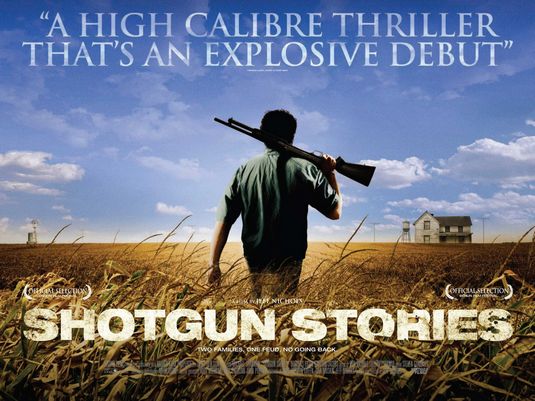
I was a huge fan of the 2011 movie “Take Shelter”. In fact, it was easily one of my top five favorite movies of the year and it featured two of the very best performances of the year. “Take Shelter” was written and directed by Arkansas filmmaker Jeff Nichols and it was only his second feature film. Since I loved the movie so much, I thought it would be worth it to check out Nichols’ first film “Shotgun Stories”. Boy am I glad that I did.  Like “Take Shelter”, “Shotgun Stories” stars Michael Shannon, an actor who is perfect for the type of rural, working class movies that Nichols is drawn to making. It also shows the amazing writing ability of a director who is clearly passionate about his material.

“Shotgun Stories” is set in the small rural town of England, Arkansas. It’s a part of the country that Nichols obviously knows well and that familiarity really shows itself on screen. Michael Shannon plays Son Hayes, a husband, father, and the oldest of three brothers. Son works at a local fish farm with his youngest brother Kid (Barlow Jacobs). Kid has no house or vehicle and lives in a tent in Son’s backyard. Having her fill of Kid’s presence and of Son’s gambling, his wife Annie (wonderfully played by Glenda Pannell) leaves with their young son and moves in with her mother. While she’s gone, Son has his other brother Boy (Douglas Ligon) temporarily move in to give him a break from living in his van. We quickly are introduced to the three brothers and Nichols does a fantastic job of showing us each of their personalities, shortcomings, and quirks.

One day while the brothers are hanging out at Son’s house, their estranged mother shows up to notify them that their estranged father has died. We learn that when they were young their father left them to be raised by a mother who Son described as “hateful”. Their father remarried and started a new family completely leaving Son, Boy, and Kid behind. The boys crash their father’s graveside funeral service which infuriates their half brothers, especially Mark (Travis Smith), the oldest. Mark swears payback and this sets off a series of encounters, some violent, between the two sets of brothers.

“Shotgun Stories” has a pretty drastic change of tone close to half way into the picture. But where many movies have handled it in a clunky and jarring fashion, Jeff Nichols makes a near flawless transition. During the first part of the film there are some genuinely funny, laugh out loud moments. Nichols’ region-specific dialogue is perfectly done with a clever mix of humor that would work for those completely foreign to the rural Arkansas area or to those who are very familiar with the local nuances that Nichols plays with. The movie generates several understated laughs through the brother’s southern banter and peculiar circumstances. I found it to be quite funny at times.

By the tone changes when we see the friction between the two sets of brothers. Nichols shows us a deep-seated resentment that’s been hidden in the hearts of the brothers, especially Son. “Shotgun Stories” really builds a sense of tension and suspense and as you watch you just expect the pot to boil over at any second. The change in tone feels natural and appropriate and I was completely caught up in Nichols’ cleverly structured story which revolves around Michael Shannon’s performance. While some of the supporting performers aren’t all that good, Shannon is nothing short of brilliant and much like in “Take Shelter”, I was blown away by what he was doing on the screen.

With “Shotgun Stories”, Jeff Nichols shows that with the right skills in writing and filmmaking and with a phenomenal lead actor, you can make a strong movie even with a minuscule budget. This may be a movie that many have missed and some may not have even heard of it. But it, combined with “Take Shelter”, solidifies my position as a bonafide fan of Nichols and Shannon. “Shotgun Stories” is wonderfully written, brilliantly conceived, and cleverly crafted. Is that enough overused adjectives to prove that I really liked this film? You should check it out.

VERDICT – 4.5 Stars