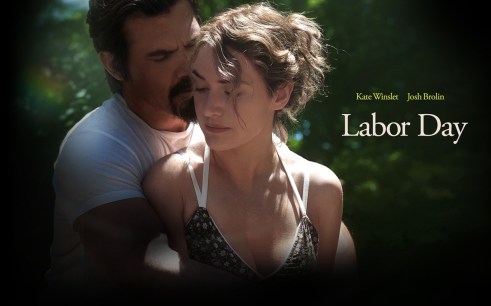
REVIEW: “Labor Day”

LABOR POSTEREven though the plot of “Labor Day” sounds like something plucked right out of Lifetime’s primetime television lineup, I was still optimistic considering the talent involved in the project. I greatly respect Jason Reitman as a screenwriter and a director. It also features Kate Winslet and Josh Brolin – two very capable performers who have done some great work during their careers. But I approached the film with a level of skepticism. Could Reitman deliver an intelligent romantic drama or would it be formulaic mush befitting a Harlequin novel?

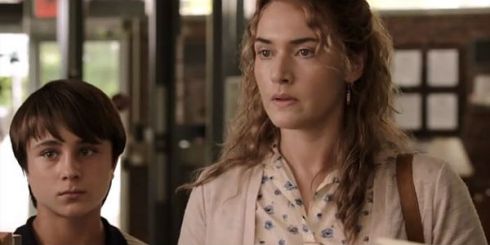
First the story. The film takes place in the fictional town of Holton Mills, New Hampshire during a hot Labor Day weekend in 1987. 13-year old Henry (Gattlin Griffith) is a sweet and responsible boy who takes care of his severely depressed single mother Adele (Winslet). A number of terrible misfortunes have left her an emotional wreck so much so that their once-a-month trips to the supermarket triggers her anxiety. During one of those trips they encounter an escaped and injured felon named Frank (Brolin) who “convinces” them to drive him to their home. Once there he hopes to lay low until his wounds heal and he can skip town.
LABOR1

As every trailer and television commercial has already shared, Frank isn’t a terrible guy. We get some threatening vibes from him, but as escaped convicts doing time for murder usually go, he is pretty docile. He quickly connects with Adele and Henry, filling all sorts of fatherly and husband-like voids in their lives. He begins fixing things around the house, he teaches Henry how to throw a baseball, and a romance is sparked with Adele. The three create a beautiful fantasy-like world within the homeplace, but right outside is the reality of Frank’s past and his status as a wanted man.

In lesser hands this could have ended up a mushy, clichéd mess. Fortunately Reitman handles the material in a way that keeps that from happening. But not completely. There are a few incredibly sappy bits that hit us head-on. For example there is one scene where Frank reveals his culinary aptitude. In it we get a sequence ripped straight from the signature scene in “Ghost” except here the clay is replaced by peaches. We also get some schmaltzy lines of dialogue such as Frank saying in just the right romantic tone “I’ve come to save you Adele”.

There are also a couple of narrative choices that didn’t really work for me. There is an odd little diversion that gets into Henry’s pubescent struggles. Through it we meet an eccentric young girl who serves as his introduction to puberty. Both she and the entire story angle is underdeveloped and tacked on. We also get the old tried-and-true method of telling Frank’s backstory through a series of random flashbacks. They get the job done but it is a pretty conventional approach.

LABOR2

But despite all of these jabs I’ve thrown its way, “Labor Day” still manages to work. Other than the few hiccups, Reitman creates a small-scale intimacy that I connected with. Most importantly he gives us three main characters that we genuinely care about. This is important because when the film stumbles I still wanted to stay with these characters. I also love how Reitman uses the camera. He frames some beautiful shots and I love his visual perspective. And of course there are the two lead performances. Winslet has always been great at playing women in some form of anguish. Here she does it again with striking authenticity. Brolin’s rugged looks and charming sincerity are perfect for the role and helps their chemistry.

So clearly “Labor Day” has some issues but it also has some undeniable strengths. It can be a little too sappy and the melodrama can be extremely heavy. But it also has a sweet story with a lot of heart at its core. It all comes down to your ability to just go with it and get lost in the story. If you’re able to do that there is enough here to like. If you can’t then more than likely the film’s flaws will be all too glaring.

VERDICT – 3 STARS

Top 5 Performances of 2013 – Lead Actor

A light painting of the year 2013 written against a black background

This is it – the final ‘Best of’ list for the 2013 movie year. For me, narrowing down this particular category to just five was the most difficult of any of these best performance lists. It pained me to leave off so many great performances from 2013, but someone decided that Top 5 lists can only feature five picks so I’m sticking to it. No need to drag this out any further. Here are my five favorite performances from a lead actor:

#5 – Robert Redford – “All is Lost

ALL IS LOST

All is Lost” may be a film that feels too familiar for some but I felt it had more to it than you may first perceive. But regardless of that, no one can doubt the incredible work from 77-year old Robert Redford. It’s such a physically demanding role and we immediately notice Redford’s 100% commitment. But being he is the only cast member, he is tasked with having the audience invest in him and he definitely succeeds. Considering there are only three lines of dialogue in the entire film, it is amazing how much he tells us through expressions and gestures. It’s just brilliant work.

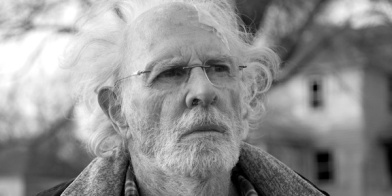
#4 – Bruce Dern – “Nebraska

NEBRASKA

What a joy is was to watch the great Bruce Dern in Alexander Payne’s “Nebraska“. Dern’s career started in 1960 and since then he has shown a wide range of mostly supporting roles. But here he gives one of the saddest yet most endearing performances of the year. His character isn’t the warmest or the nicest. Yet over time you begin to sense he’s more than we may think. Payne’s script brilliantly hides little details about the character and the audience gets to put the pieces together as we go. But it’s Dern that keeps us fixated and invested. With so many big and showy performances this year Dern probably won’t take home an award. But he’s certainly worthy of one.

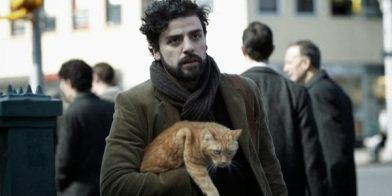
#3 – Oscar Isaac – “Inside Llewyn Davis

LLEWYN

I’ve always been a fan of Oscar Isaac and I was thrilled to see him get the lead role in the Coen brothers film “Inside Llewyn Davis“. He certainly didn’t disappoint. There are so many things I loved about Isaac’s work. First, he’s the perfect fit for the Coen’s signature unique and slightly offbeat lead character. But Llewyn Davis is much more than that and Isaac masterfully peels back all of these layers. Another beautiful element to this performance can be found in the music. Isaac performed all of his own songs and the musical scenes in the film were all recorded live, never dubbed. It’s just another reason this performance was so good.

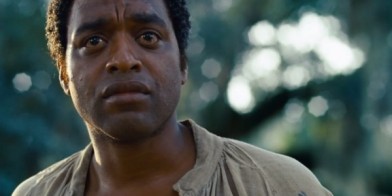
#2 – Chiwetel Ejiofor – “12 Years a Slave

12 years

Perhaps the most daring and courageous performance of the year came from British actor Chiwetel Ejiofor. What tremendous work he does in Steve McQueen’s gripping and bold “12 Years a Slave“. There is nothing disingenuous or halfhearted about Ejiofor’s depiction of Solomon Northup. With amazing commitment and a ton of emotion he brings this reflective and unsettling story to life. There are so many scenes that will cut deep and stay with you well after the credits role. You immediately connect with him. You root for him. You hurt with him. If done poorly this role could have sunk the whole film. Ejiofor never allows that to happen.

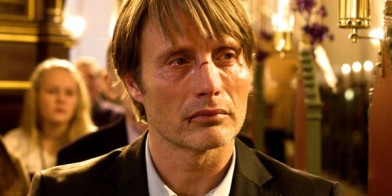
#1 – Mads Mikkelsen – “The Hunt

THE HUNT

Regardless of the criminal omissions by the Award types, Mads Mikkelsen’s performance in “The Hunt” was my favorite of the year. The story itself is tough and unsettling and it needed a good actor to give the film the gut-punch it was looking for. Mikkelsen is the perfect guy. It is painful to watch what his character endures both physically and emotionally. Mikkelsen’s performance invests us in this man’s story, his plight, and his emotional state as things unfold. We watch and shutter as this man’s life is changed forever. This is an immensely crowded field full of great actors and performances. It says a lot that Mads Mikkelsen is at the top of that field. Brilliant work. HONORABLE MENTIONS: Tom Hanks (“Captain Phillips“), Hugh Jackman (“Prisoners“), Christian Bale (“American Hustle“), Joaquin Phoenix (“Her“), Michael B. Jordan (“Fruitvale Station“), Ben Stiller (“The Secret Life of Walter Mitty“), Jude Law (“Side Effects“) So what do you think? Who did I miss or who did I rate too high? Please take time to share your thoughts in the comments section below.

REVIEW: “Mildred Pierce” (1945)

Classic Movie SpotlightMildred PierceJoan Crawford had an interesting career to say the least. In 1937 she was called “The Queen of the Movies” by Life magazine but she would be called “Box Office Poison” only one year later. A few moderate successes would follow before her 18 year run with MGM studios was ended. Hungry for a new start, Crawford signed with Warner Brothers. One of her first pictures with her new studio was “Mildred Pierce”. The film was a huge success and Crawford would go on to win the Best Actress Oscar. Her performance was rightly recognized and her career was revived.

“Mildred Pierce” was directed by Michael Curtiz. The acclaimed director didn’t want Crawford as his lead but after his first choices bowed out (Bette Davis, Barabara Stanwyck, Olivia de Havilland), she got the job. The film was adapted from James Cain’s edgy 1941 hardboiled novel. Several plot lines from the book couldn’t be included in the picture due to the movie content code restrictions of the time. This allowed for the film’s introduction of the murder angle and several other creative differences.

Speaking of that, the movie opens with a murder. In a wonderful opening scene dripping with noir flavor, a man is shot several times by an unseen assailant who then flees the scene. The police bring in a successful restauranteur named Mildred Pierce (Crawford) for questioning. The murder victim turns out to be Mildred’s second husband Monte Beragon (Zachary Scott) and the cops believe they know who did it. The main plot structure is built around her interrogation. Through flashbacks we are introduced to the main players and we follow Mildred’s rise from a hard working single mother to an owner of multiple restaurants in the Southern California area.

But we are also introduced to a darker side of Mildred’s life. It’s a side featuring two failed marriages, an unthinkable tragedy, and a bitter, contentious relationship with her oldest daughter Veda. It’s Veda who may be Mildred’s biggest failing. We watch her become a selfish and materialistic young girl who is actually a product of Mildred’s own making. Her desire to shower upon her daughter the most lavish things creates a scheming young girl who looks down with great haughtiness on the ‘have-nots’. Ann Blyth plays Veda and she is sublime. Blyth was actually on loan from Universal Studios at the time. Her performance garnered well-deserved praise which culminated in a Best Supporting Actress Oscar nomination. Blyth would make several more films but none as memorable as “Mildred Pierce”. She was only 17 at the time but this performance showed an astuteness and attention usually associated with the greats.

Mildred Pierce1

There is an assortment of other great side characters that help tell Mildred’s story. Bruce Bennett plays her first husband Bert who subverts any good intentions he may have with his carousing and disrespect. Yet you end up wondering if he knows more about Mildred than we first do. Then there is Bert’s real estate partner Wally (Jack Carson) who is never beyond an occasional flirt or a shady business deal. He’s a rather slimy fellow who also has self-centered intentions. Eve Arden gets some wonderful lines as Mildred’s friend and restaurant manager. And Butterfly McQueen has some good moments as Mildred’s maid.

While the film revolves around the murder of Beragon, the life of Mildred Pierce is the centerpiece. Much of the movie’s brilliance is shown in its storytelling style and in the clever ways it depicts Mildred’s changes. She’s an entirely different person by the film’s end. She becomes a woman enslaved by the poisonous relationship she has with her daughter. Things become darker and more twisted as the film moves along which gives “Mildred Pierce” a unique sense. It slices up and mixes portions of film noir, mystery, and romance to form a sordid yet thoroughly compelling whole.

I’m a big fan of “Mildred Pierce” and it’s easily one of my favorite Joan Crawford pictures. She is exceptional here as is her supporting cast, particularly young Ann Blyth. Ranald MacDougall’s adaptation is smart and crafty and it works seamlessly with Michael Curtiz’s style of direction. The film takes a few unavoidable diversions from the novel but they nicely translate cinematically. It all resulted in a spirited film that showcased a still relevant Crawford. It’s also a true classic that still packs a hefty punch today.

VERDICT – 4.5 STARS

REVIEW: “Lee Daniels’ The Butler”

BUTLER POSTER

Lee Daniels’ 2013 drama “The Butler” is very loosely based on the life of Eugene Allen, an African-American man who served as a White House butler for 34 years before retiring in 1986. During those years Allen served under 7 different presidents and became a beloved member of the White House staff. “Lee Daniels’ The Butler” is built on these handful of facts but goes on to invent its own story which is sometimes too overt and preachy but at other times intensely powerful.

In the film Cecil Gaines (Forest Whitaker) is the main character. His life is quite different from the real life of Eugene Allen. Cecil grows up on a cotton plantation and endures plenty of horrors. But a series of fortunate events sees him eventually being hired as a butler to the White House during the Eisenhower administration. During his years at the White House huge nation-changing events occur which not only effect the presidents he serves but his family at home.

Butler2

Speaking of his family, Lee Daniels and screenwriter Danny Strong go heavy on the dramatic family dynamics. His wife Gloria (Oprah Winfrey) is a boozing shrill whose attitude can change in a second. His oldest son Louis (David Oyelowo) is a disgruntled young man who would rather be proactive in the fight for equality. His youngest son Charlie (Elijah Kelley) is the fun-loving baby of the family who enlists to go to Vietnam. They are all built for high drama and we get plenty of it. Some of it really works on an emotional level. Other times it feels contrived and utterly predictable.

The film seeks to create a historical profile chronicling race relations in the United States. Much of this is done surrounding the Louis character. He ends up going to a college down south where he partakes in various action groups. This leads to protests, arrests, and even encounters with the Klu Klux Klan. There are moments where the tension is incredibly well developed and the discomfort of what you’re watching is powerful. But there are also a few things that I couldn’t quite shake. For example Louis happens to be present at so many of the events that made headlines from the Alabama bus firebombing to the assassination of Martin Luther King, Jr. His presence certainly helps out the story but feels more or less like plot devices.

THE BUTLER

But it’s Cecil who is the real attraction and Whitaker is amazing. He is the real heart of this picture and watching him age as the film moves forward makes you feel as if you’ve been on a journey with him. It is hard to gauge at times what Daniels thinks of the character but I thought he was compelling. I also loved the work of David Oyelowo. The 37-year old actor actually first appears as a teenager and is very convincing. But he’s even better as his character springboards into some of the film’s more powerful scenes. The supporting cast is strong and features Cuba Gooding, Jr., Terrence Howard, Lenny Kravitz, and Vanessa Redgrave just to name a few. Then there is the unusual assortment of actors who play the presidents. The strongest performances come James Marsden who plays Kennedy and Alan Rickman who plays Reagan. Perhaps the weakest is Robin Williams who is oddly cast as Eisenhower.

Even with the film’s ambition and deeply moving moments, “The Butler” still comes across as a big Hollywood piece. That’s not always bad. There are several big moments that work very, very well. But the further I got into the movie the more it felt scripted. Unlike the more raw and organic “12 Years a Slave”, this film seems to be more dependent on plot gimmicks and melodrama. It also can’t help but get a tad political specifically in the final third of the film. Still, I can’t downplay the great work by the cast led by Forest Whitaker. He’s simply brilliant. I also really enjoyed the smarter and more focused scenes which can be both inspirational and challenging. I just wish we had been given a few more of them.

VERDICT – 3 STARS

K&M Commentary: The Movie vs. The Book

typewriter-banner 1

I’ve always been fascinated by the different reactions people have to movies based on popular books. In many ways the passion of fans towards some literature rivals that of any movie. So naturally whenever a film is made based on a popular novel or book series you’re going to get a plethora of responses. But is it fair to hold a movie in contempt for steering away from the source material? Or is it fair to restrict a film within the bounds of the book(s) it is based on?

I tend to be pretty lenient when it comes to this subject. The reality is that movies are a drastically different storytelling medium than books. Movies are confined by time and have the added responsibility of visualizing what books allow us to create in our minds. There are a number of challenges that filmmakers face when bringing a popular bit of literature to the big screen and often times they are met by a very critical and biased audience.

But that’s not to say filmmakers get a free pass. I allow them a lot of creative liberties as long as they don’t abuse the story or key characters. As long as there exists respect for the source material I’m okay. But there are many examples of poor creative choices which has butchered the book(s) movies are based on. Just look at some examples from the comic book superhero genre. Joel Schumaker’s Batman films made a mockery of the character and his wonderful rogues gallery. The pathetic mistreatment of the Cyclops character in “X-Men: The Last Stand” was almost criminal. Even last year on a smaller scale “Iron Man 3” took a prominent character from Iron Man lore and obliterated him.

But there are other things worth considering as well. Is the movie intended to be a full on adaptation or is it loosely based on the book. I think people are often turned off from a movie because of its inaccuracies when it’s never intended to be a full adaptation of the book. “World War Z” is a good example. In many ways Max Brooks’ novel reads like a United Nations zombie report (as screenwriter Michael J. Straczynski noted). Realizing that, the film clearly took on a different form. So it was “loosely based” on the novel. Yet many took issue with the filmmakers’ divergences even though their intentions were obvious. So in that case is it fair to judge the film by anything other than its own merits. It’s an interesting question.

This is a tricky topic especially considering the passion of both movie and book fans. For me this is the perfect formula: Watch the movie first then read the book. This lets the movie be viewed objectively and allows the book to expand and broaden the story. But obviously that isn’t always possible nor is it fair to those who love reading. Just remember the hurdles and obstacles that filmmakers face and always consider their aim and intent. As long as they aren’t insulting or disrespecting the source material, we should be able to measure and appreciate their work if it’s done well.

So what are your thoughts on the subject? Agree or disagree? I’d love to hear your take in the comments section below. As always, thanks for reading.

THE END

REVIEW: “The Act of Killing”

KILLING POSTER

A film like “The Act of Killing” is almost indescribable. It is strikingly unique and it certainly can’t be labeled or put in a box. Director Joshua Oppenheimer calls his film a “documentary of the imagination”. It’s bizarre, unsettling, and at times impossible to comprehend. It’s horrifying, repulsive, and unflinching in its focus. It’s an overused statement but “The Act of Killing” is unlike anything you have seen before and digesting what we are fed isn’t all that easy.

To understand this documentary you must first look back to 1965 in North Sumatra, Indonesia. A splinter group’s failed coup d’état led to a military takeover of the government. The new leadership blamed the Indonesian Communist Party (PKI) and soon sanctioned the wholesale massacre of communists across the region. But the killings weren’t restricted to alleged communists. There were also brutal mass murders rooted in racism and religion. It is said the killings have been overlooked in most Indonesian history books and by the international community, yet a CIA report called them “one of the worst mass murders of the 20th century”.

killing1

With that historical backdrop in place, the film spotlights some of the authors of the murders and we are told of their atrocities from the men themselves. Anwar Congo and Adi Zulkadry went from movie theater ticket scalpers to heads of military death squads responsible for thousands of brutal killings in 1965 and 1966. Even more appalling, they have never been punished or even found guilty of any crime. In many ways they are celebrated among the ignorant or sympathetic. These are the men we spend two hours with in “The Act of Killing”. Their words, their candor, their lack of remorse, their impunity. These men openly discuss their parts in the anti-communist purge in uncomfortable detail and often with smiles on their faces.

These men also have an unusual infatuation with western cinema which finds its way into the movie on several occasions. They constantly refer to themselves as ‘gangsters’, a term stemming from their love of American gangster movies. But it also seems that some of their real-life killings were patterned after these films. Anwar especially seems to treat the title of gangster as a badge of honor.

Killing2

But their love for movies also plays into the stories they tell. Throughout the documentary we listen in on pointed and detailed recollections of some purely evil murders. But these men also tell their stories through dramatic reenactments for the cameras intended to glorify their atrocities. Their scenes borrow from their favorite mob movies, westerns, and musicals. It’s these uneasy sequences of boastful self-aggrandizement that reveal the true evil dwelling within these people. As we get deeper into the movie the reenactments become more bizarre and surreal possibly a result of Anwar’s desire to squash any feeling of guilt that may be surfacing.

It took Joshua Oppenheimer over five years to make “The Act of Killing” and during that time he accumulated 1200 hours of footage. The result is a potent exposé that unveils one of the darker secrets of our world. I knew nothing of this horror which made the film all the more enlightening and disturbing. At times I did feel disconnected from the more absurd and unintelligible mini-productions from Anwar and company. But there are far more times where I sat in silent shock due to what I was watching. This is audacious filmmaking and there are several scenes carved into my memories. I would be surprised if others didn’t have that same experience.

VERDICT – 4 STARS