

I just wanted to take a moment to wish each of you a very Merry Christmas. Thank you so much for every visit, every “like”, and every comment you’ve made over the last year. Your time, input, and encouragement has never gone unnoticed. So here’s wishing you a wonderful holiday season and a blessed 2015 filled with great movies that we get to talk about throughout the year!
Author Archives: Keith Garlington
YOUR VOICES: On your favorite Christmas movie

Your Voices is a simple concept created to encourage conversation and opinions between movie lovers. It works like this: I throw out a certain topic and I’ll take time to make my case or share my opinions. Then it’s time for Your Voices. Head to the comments section and let fellow readers and moviegoers know your thoughts on the topic for that day!

Tis the season for Christmas movies and at our house we have several seasonal favorites that we watch every December. For one reason or another each of these holiday films entertain us and make us all the more festive. But when thinking about my favorite Christmas movie one film has always instantly came to mind. It’s a movie that over time has grown into a traditional classic and you’ll always see it on television this time of the year. I’m talking about the Frank Capra treasure “It’s a Wonderful Life”.
To be honest I really don’t like restricting this film under the label of “Christmas movie”. Simply put it’s a truly great film for anytime of the year. Yet it does have those Christmas traits that have endeared it to audiences through the years. But this isn’t just a fluffy feel-good tale. Capra looks at deeper issues but never through a heavy-handed lens. These subtle motifs mix well with the film’s well used sentimentality and invigoration of the human spirit.
And then there is Jimmy Stewart. What a fantastic performance. He exudes small town Americana and paints a distinct portrait of a man shelving his dreams for the sake of others. Stewart has rarely been better. It’s a great performance in a great film that truly transcends time. For me it never grows old and I look forward to seeing it each year. In my view “It’s a Wonderful Life” is a near perfect film and it is easily my favorite ‘Christmas movie’. But now it’s time for your voices…
YOUR VOICES: What is your favorite Christmas movie?
Now it’s time for Your Voices. With so many Christmas movies to consider, which one would you call your favorite? Please share Your Voices on today’s question. I’d love to hear from you in the comments section below.
REVIEW: “The Babadook”

You could say there are two very different stories being told in “The Babadook”. But over time you’ll notice that the two are cleverly and shrewdly interwoven giving us something well beyond a run-of-the-mill horror film. It’s an intelligent film made with a tiny $2 million budget and actually completed thanks to a Kickstarter campaign. The end result turned heads at Sundance and it is finally getting deserved respect from a wider audience.
The film was written and directed by Jennifer Kent and found its roots in a short film Kent made in 2005. The story follows a widowed single mother named Amelia (Essie Davis) and her young son Samuel (Noah Wiseman). The two have been alone since the death of her husband and his father. Samuel hasn’t adapted well to his fatherless home. He’s a lonely boy with a number of behavioral issues which cause problems at school and home. On top of that Samuel is haunted by dreams of a terrifying monster and his belief in it causes his behavior to be even more erratic and troubling.
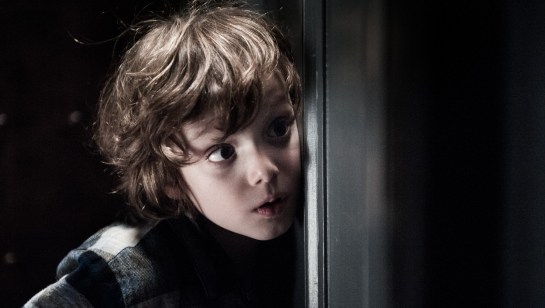
But it could be said the film is more about Amelia. She is an earnest and loving mother who struggles to conceal her own sorrows and burdens for the sake of her son. Kent’s vision and Davis’ performance create a disconsolate portrayal of a woman drowning in her circumstances. We get close looks at how her situation effects every social and potentially romantic relationship she has. We easily sympathize with Amelia which makes the sharp turns in the second half of the film all the more devastating.
One night things take an even worse turn. Samuel asks Amelia to read him a pop-up children’s book titled “Mr. Babadook”. It’s a grisly story about a creature who consumes those made aware of his existence. Samuel is convinced Babadook is real leading to even more troubling behavior. A series of creepy events begin happening around their house which Amelia first attributes to her son. But soon she too comes face-to-face with the question of Babadook’s existence. It’s here that the lines between reality and the supernatural are blurred.
“The Babadook” is a creepy movie but not in the conventional sense. Jennifer Kent pointed to movies like “The Shining”, “Texas Chainsaw Massacre”, and even “Nosferatu” as influences and you can see them in her technique and presentation. And “The Babadook” does indeed employ several familiar horror film devices. But she uses such a careful and strategic blend of classic haunted house scares, boogie man frights, and the film’s most potent element – psychological horror. It all works to near perfection. Adding to the movie’s uniqueness is the wonderfully eerie use of sound and the minimalist approach to special effects. These things are vital to giving the film its own satisfying aesthetic.

But the main reason that the horror works is because of the characters. The first half of the film sets them up and connects them to the audience. By the second half we are so invested in Amelia and Samuel and their deteriorating circumstances that we are desperately rooting for a happy resolution. It’s this connection with the characters that so many horror films fail to establish. Davis gives an inspired performance and conveys such motherly authenticity through her character. Young Noah Wiseman is heartbreaking and deserves a lot of credit. His character transforms over time and he manages it so well in his performance. These two are the lifeblood of the film.
In the end I found myself smitten with “The Babadook’s” smarts and craftiness. The story is rich with raw emotion and a genuine eeriness. There is always a tinge of uncertainty which constantly has you questioning what you’re seeing. I like that kind of interpretive challenge. This isn’t the type of film that will ever be considered a classic, but it’s well written and well made which I believe earns Jennifer Kent attention as a filmmaker to keep your eye on. She certainly has a winner with this film.
VERDICT – 4 STARS
REVIEW: “Boyhood”
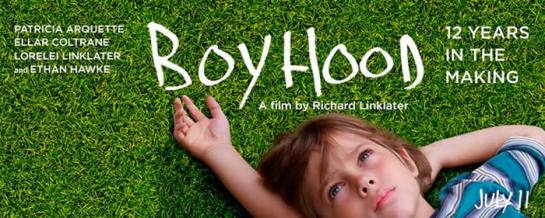
“Ambitious” is an adjective that is probably overused by many when reviewing movies. As a result many well-known and prominent movie critics steer clear of the word and often view it as a negative description of the film. Their idea is that many people excuse a film’s faults by hiding them under ambition. That may sometimes be true, but I’ve never prescribed to that reasoning nor do I avoid using the word when it accurately describes a film. There are plenty of examples of movies that have combined great ambition and great storytelling. “Boyhood” is one such example.
Let’s talk about the film’s ambition. Writer and director Richard Linklater has shown himself to be one of the great modern American filmmakers. In “Boyhood” he gives us a coming-of-age drama unlike any you’ve seen before. Filming spanned twelve years starting in 2002 and the same cast was used the entire time. They were brought back to shoot scenes periodically throughout those twelve years in hopes of capturing an accurate physical representation of aging. It also allowed the cast to grow with their characters making the film’s time transitions all the more realistic. This is an extremely ambitious project.

But it isn’t just the clever and innovative approach that makes this a good film. It’s Linklater’s simple but beautifully conceptualized vision for presenting a young boy’s life from preadolescence to early adulthood. There is no distinct streamlined plot. Instead we are introduced to a young boy named Mason and we experience his complicated, topsy-turvy boyhood with him. Linklater doesn’t ask us to dissect or wrestle with the material. Instead he seeks to show us the complexities and minutia of real life. He wants us to invest in Mason and let his circumstances strike an emotional chord. We laugh with him. We fear for him. We worry about him. Essentially we grow up with him.
Mason is played by Ellar Coltrane, a relatively unknown actor who was 7-years old when filming began. Coltrane has a quiet reservation about him that we consistently see in every stage of Mason’s life. It’s an acting quality that gels nicely with Linklater’s vision for the character. When we first meet young Mason he is living in Texas with his older sister Samantha (played by Richard Linklater’s own daughter Lorelei) and his single mother Olivia (Patricia Arquette). His father Mason, Sr. (Ethan Hawke) reappears after over a year doing his own thing in Alaska.
Mason’s life has its share of obstacles and it starts with his parents. His mother works hard to provide for Mason and Samantha. She moves them to Houston where she finishes her degree and gets a good job. But her loneliness leads to bad choices which effect her children. Mason, Sr. is a flaky and irresponsible father who won’t get a job and doesn’t always provide a mature fatherly influence during his time with his kids. In a sense Mason and Samantha’s time with their father is an escape. Mason, Sr. clearly hasn’t been a good father, but he loves his kids and they recognize his good intentions. As the film harmoniously moves along we learn more and more about these characters and we watch them and their circumstances evolve.

At times “Boyhood” feels like a series of random moments sewn together to form a beautiful whole. We often move from scene to scene without any narrative connection between them. But that’s okay because the film is about the journey. We literally watch Mason (and Coltrane) grow up before our eyes. One minute we see a young boy laying on the couch asking his father about the existence of magic and elves. An hour later we watch a 16-year old get into his Toyota pickup. It’s such a visually satisfying trip through time brought to life through Linklater’s brilliant approach, Sandra Adair’s impeccable editing, and the cast’s unquestioned commitment.
Speaking of the cast, I’ve talked about Coltrane being a great fit as Mason and he only gets better as he transforms from a first-grader to a college freshman. But Patricia Arquette is the one getting a ton of attention and rightly so. This is a such a strong and honest performance , significantly better than when I first saw her years ago in “A Nightmare on Elm Street 3”. She doesn’t offer an ounce of pretense and she never overplays her scenes. And as you would expect Ethan Hawke is really good and you never doubt the truth he brings to his character.

The only performance I struggled with came from Lorelei Linklater. In her defense she is considerably better by the end of the film but by that time we rarely see her. Prior to that I felt she was forcing her performance and she looked like a young actress who was having every line, every look, and every expression drawn out by the director. I also struggled with these odd and sometimes clunky political sequences that pop up several times. At first they feel like a natural extension of a particular character. Later the politics and characterizations seem forced and very heavy-handed. This stands out mainly because Linklater is such an instinctive and precise writer.
Those things aside, what is it that great movies do? They challenge us. They cause us to reflect. They cause us to appreciate. They cause us to feel. “Boyhood” did all of that for me but not in a casual sense. It is a coming-of-age story but it also looks at other things like parenting – the sacrifices of good parenting and the consequences of bad parenting. As a father, that hit home for me. The film had me looking back on my own childhood, but also thinking about my 13-year old son and the life he is living. Walking out of the theater I wanted to hurry home, give him a hug, and tell him that I loved him. Some may call that corny. I call it being moved by a very good movie.
VERDICT – 4.5 STARS
(Fun observation for “Dazed and Confused” fans: Pay close attention to the brief scene in the liquor store. The clerk is played by none other than David Blackwell. He played a very similar convenience store clerk in “Dazed”)
K&M Commentary: “The Interview” Controversy

Full disclaimer: For those who don’t know, I am not a fan of Seth Rogen or his brand of humor. As I’ve stated ad nauseam, I am so tired of the raunchy comedy, and Hollywood (as it so often does) drowns us with anything that tastes slightly successful. The vast majority of comedies these days fit into this category. The genre has become a dead zone for people who don’t find humor in the antics of Rogen and company. This is why I won’t miss “The Interview” from an entertainment perspective. But what about the precedent set by Sony’s recent actions.
For those who don’t know, Sony has decided not to screen Rogen and James Franco’s movie about assassinating North Korea’s leader. This comes after information which seems to indicate North Korea was behind the Sony hackings which released tons of personal information, emails, upcoming projects, full-length movies, and more. More serious threats surfaced, major theater chains withdrew the film, and soon Sony pulled the plug. Naturally this has drawn all kinds of reactions. But is there a clear-cut answer to who’s right and who’s wrong in this controversy?
The main player under the public microscope is Sony. Was their act spineless and cowardly? Is this some backhanded way to get more attention for the film? These are just some of the questions being asked and I tend to think it’s a little of both. In some ways Sony has modeled this climate of appeasement that we often see in our government today. It’s caving in to a threat without weighing the repercussions. But on the other hand we live in a different world. In this day and age retaliation can go well beyond hacking into a database and stealing some movies. Was this on Sony’s mind when they made this decision?
Or could it be that Sony was embracing the old adage “there is no bad press”. Is it beyond reason to think that this may have played a role in Sony’s decision? I mean look around on blogs, websites, and news shows. Everyone’s talking about “The Interview”. And how do Sony’s financial woes fit into the equation? Are they drawing attention to the film because they need it to bring in a lot of money? Are they pulling the film in hopes of not potentially losing more money?
But Rogen and Franco shouldn’t escape the microscope. They have a significant role to play in this as well. Look, I get the whole idea about creative expression and the freedoms of an ‘artist’. I’m thankful for that ideal, otherwise we would have missed out on a number of great films throughout the years. But I can’t help questioning the wisdom behind making “The Interview”. I mean we aren’t just talking about mocking a nation’s sitting leader. We’re talking about assassinating him. Regardless of how bad the leader may be or how threatening his policies are, you’re obviously pushing boundaries that are going to elicit responses, some a lot more severe than hacking a computer.
But then I think about their freedoms to creatively express themselves. Does this send the ball rolling down a hill that could squash any future project which might be deemed dangerous or controversial? And isn’t it good that this precedent hasn’t already existed? I automatically think back to “The Great Dictator”, a film by Charlie Chaplin poking fun at and critiquing the fascist and antisemitic regime of Adolf Hitler. It’s a great movie and it is rightly viewed as a classic. But there were concerns about the adverse effects of “The Great Dictator”, and it didn’t push things as far as “The Interview”. In fact, several years after its release Charlie Chaplin said he never would have made the film had he known more at the time.
So is there a cut-and-dry right answer to this? Is Sony cowardly for giving in to the pressures? Was it wise for Rogen and Franco to make a movie that could have serious repercussions for many people other than themselves? Is this one of the most shrewd and shameless marketing ploys ever used for a movie? Is the creative license subject to any boundaries? Personally I think this controversy has asked more compelling questions worthy of conversation than most people think.
REVIEW: “Gone Girl”
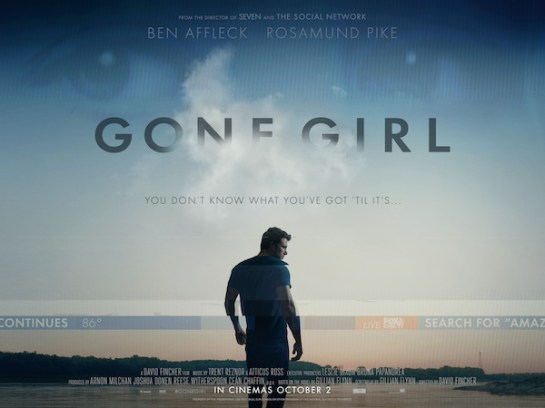
There are a number of popular modern filmmakers who are beloved by their devoted fans. Interestingly enough, I often find myself a little more mixed when it comes to these directors. David Fincher is a good example. I didn’t like two of his more popular films “Fight Club” and “The Curious Case of Benjamin Button”. But I’ve found that Fincher has made more good films that I have appreciated such as “Se7en”, “Zodiac”, and “The Social Network”. His latest film is “Gone Girl” and it can definitely be grouped in with Fincher’s better projects.
Fincher is no stranger to dark and uncomfortable subject matter. It’s a trait of many of his films that sometimes works but other times turns me off. “Gone Girl” has a bit of both, but for the most part the dark material is very effective. It feels like about three movies put into one and the film ends in a very different place than where it began. I can’t honestly say I found each ‘segment’ of the film to be equally compelling, but I can say the movie never flattens.

The story begins on the day of Nick and Amy Dunne’s 5th wedding anniversary. Nick (Ben Affleck) returns to his Missouri home to find Amy (Rosamund Pike) is missing. Signs indicate a struggle and soon Detective Rhonda Boney (Kim Dickens) is leading the investigation. Amy’s disappearance attracts a media frenzy and people become obsessed with the never ending cycle of news about the case. As Detective Boney digs deeper she uncovers inconsistencies and holes in Nick’s story. This combined with the media hype ends up making Nick a key person of interest.
To go into any further detail would be doing a huge disservice to the movie. It’s based on Gillian Flynn’s popular 2012 novel so many people will know how it plays out. But lets just say that the narrative takes a significant shift in the second act and an even bigger one in the final act. As I mentioned above these shifts never flatten the film. It maintains its intensity and intrigue throughout. But I do think the movie starts off incredibly strong only to slowly and slightly step away from what I enjoyed most about it. It’s not that the ending isn’t satisfying. In fact I like the way it ended quite a bit. It just seemed like the story strayed a bit in getting there.
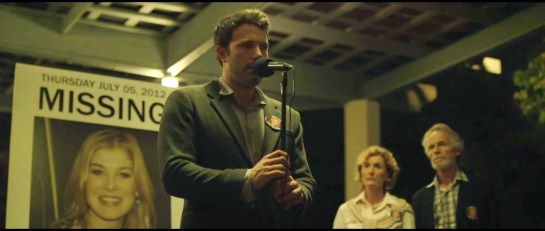
But I don’t want to cut this film short because it does so many things well. Fincher employs a fractured style of storytelling similar to several of his past films. Carefully crafted and well placed flashbacks are sprinkled in to give us nuggets of information about Amy’s disappearance. But to make things more complicated the audience is frequently fed small bits of unreliable information. Misdirections and red herrings conflict with the truth and muddy any insight into what actually happened. I loved that. I found myself hanging on every exchange and flashback trying to determine fact from fiction.
“Gone Girl” also dabbles in a number of different themes, some more intriguing than others. One such theme is economic hardship and particularly its effects on a marriage. In fact “Gone Girl” seems to project a very cynical view of marriage as a whole. It seems to be constantly nipping at the concept of a happy and stable marriage. Or is it indicting us for our self-centeredness which often destroys marriages? Perhaps its most effective examination is of the media and the sensationalism that seems to follow these events. Tabloid journalism and the predatory tactics of reporters play key roles in the film. And Nick is shown how to use and manipulate the media and their willingness to exaggerate or stretch facts.

And then you have the performances. I like Ben Affleck even though I understand some of the criticisms thrown his way. He is often dry and seemingly emotionless. But I find that his acting style often fits the characters he is portraying. That’s definitely the case in “Gone Girl”. Affleck offers the right tone and demeanor and he constantly has us trying to figure him out. But the real star is Rosamund Pike. She is an actress that I have always loved and have wanted to see get bigger roles. Hopefully this will be the performance that finally gets her the attention she deserves.
“Gone Girl” has many of the signature trademarks of a David Fincher film. And the visual presentation is moody and comfortless yet perfectly appropriate. The music from Fincher favorites Atticus Ross and Trent Reznor creates atmospheres of tension. Also the film sometimes turns me off by pushing its desired edginess a little too far. All of these things scream Fincher. But where some of his other films in the past squander their potential “Gone Girl” capitalizes on it, at least for the most part.

