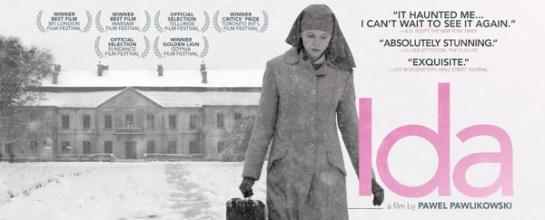
 Within its compact 80 minute running time the Polish film “Ida” tells its story and creates its visual landscape with a precision and an artistry unlike any other film I’ve seen this year. Shot in striking black and white and told with an unbridled humanity, “Ida” feels as if it would be at home in the filmography of Robert Bresson. It’s a stark and penetrating story working with an aesthetic that is both grim and intensely beautiful.
In the very first shot we are introduced to 18-year old Anna who is played by the wonderful Agata Trzebuchowska. She is a novice nun who is a few days away from taking her vows. But prior to the ceremony her superior instructs her to go visit her one living relative, an aunt who Anna never knew existed. We learn that Anna has grown up in the convent and she basically has no knowledge of her past. The life that Anna does know has been defined within the walls of the convent and for her everything else is a mystery.
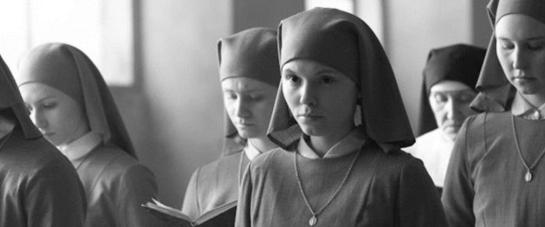 “Ida” is a movie about self-discovery. It’s about a young girl finding her identity and dealing with the revelations of who she is and where she comes from. Helping in her journey is the aforementioned aunt, Wanda Gruz (Agata Kulesza), a hard-drinking Communist judge who has watched her career and life suffer due to her self-destructive behavior. Kulesza is marvelous in her depiction of Aunt Wanda. There are several depressing complexities at Wanda’s core, but she also provides some surprising moments of dark humor. These are refreshing little breathers in a film otherwise full of bleak and troubling turns.
Director Pawel Pawlikowski has a meticulous eye for visual detail which is only overshadowed by the sheer beauty of so many of his shots. You could make a coffee table book full of stunning still images from this film. The story is set in early 1960s Poland and filming in black and white enhances the feelings that we are in the proper time and place. But it isn’t just the look of the film that makes it such a visual delight. It’s also about what Pawlikowski tells us with his camera. We obtain a wealth of information simply by observing and soaking in what the camera is showing.
Let me give you an example. There is a beautiful shot of Wanda and Anna in a car. The camera is in the backseat and we just see the back of their heads as they are driving down a long, straight road. Both are silent and staring straight ahead. Critic Josh Larson points out that in this film “the spiritual meets the secular” and this scene shows that even down to their appearance. Both have head coverings but for very different reasons. Both are heading down a road filled with conflicting emotion and uncertainty. This brief shot, while beautiful in its execution, also tells us a great deal about the two main characters.
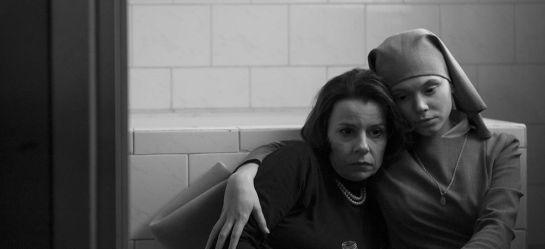
Pawlikowski also knows how to bring the most out of his two leads. Make no mistake, these are two of the best performances of the year, but the director uses their strengths to the film’s benefit. Trzebuchowska’s big, dark, expressive eyes explain to us the range of emotions her character experiences throughout the film. Likewise Kulesza’s stern, hollow stares often point to an emptiness within her that she can’t quite handle. Both actresses reveal these things to us, but Pawlikowski is a smart filmmaker and he allows them to express without holding our hands and baby feeding us everything.
There are so many other good things I could say about “Ida”. For example the clever use of sound. Background noises are so well implemented whether it be a crow cawing in the distance or the tinging of spoons hitting soup bowls. I also love the way music is employed. There is some great music in this film, but in every instance (as far as I noticed) it was being played in the movie itself either by a band or a record player. This was a cool little shift from the norm – musical scores playing over scenes.
“Ida” will never get mainstream love and that is a shame. We get annual Transformer-type movies by the dozens, each greeted at the box office with millions of dollars. Yet a film like “Ida” can go easily unnoticed. It certainly deserves attention. Pawel Pawlikowski takes a dramatic turn from his last film (“The Woman in the Fifth”) and shows exceptional craft and technique to go along with two top-notch performances and some really good material. In the end “Ida” offers more in its captivating 80 minutes than many big movies are capable of delivering with more time and a lot more money.