An examination of Fellini’s “8 1/2”

8 poster

Director Federico Fellini has long been one of Italy’s most important gifts to the world of cinema. A daring and proficient filmmaker, Fellini had a career that featured various stages of evolution. Most notably was his turn from popular Italian neorealism to an almost surreal fantasy mode of cinematic storytelling. There are some who have viewed Fellini’s shift in style and approach as a turn in the wrong direction and a small handful of his later films may support that view. But I can’t go along with that, especially when said style shift gave us treasures like “La Dolce Vita” and “8 1/2”.

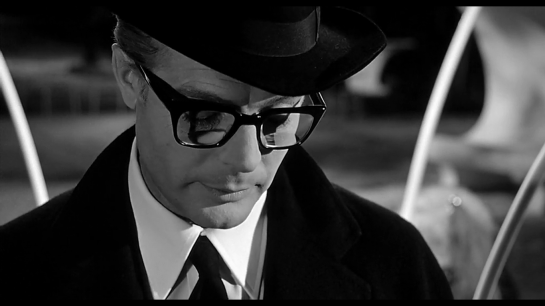
“8 1/2” is a semi-autobiographical film that gets its name from the eight and a half feature films and shorts Fellini had made up to that point. For the first time in his life Fellini was experiencing a creative stall. His struggles with director’s block inspired him to start over and make a film about a prominent Italian director laboring through the same creative pains. Trusted actor and friend Marcello Mastroianni would play the lead role of Guido Anselmi who is an undeniable reflection of Fellini with a few added dramatic twists.
8-3

At first glance it may be easy to dismiss “8 1/2” as a malaise of off-beat dream sequences and surreal imagery. But as with every great cinematic work, there are layers of creativity and ambition that one can’t appreciate with a single viewing. There is no doubting that at that point in his career Fellini was a visual storyteller and his images play a pivotal part in “8 1/2”. But they aren’t images just for the sake of images. Fellini has specific things in mind and it takes some digging to find their meaning.

Take his dream sequences as an example. Each of the film’s dream sequences serve as an escape for Guido – a refuge from the anxiety and stresses of his real life. But each dream also feeds us information about who Guido really is. Some are simply memories taken from his past. Some are past memories heightened with hyperbolic flare. Others are full blown dreams emphasizing Guido’s perspectives, his fantasies, or his different states of mind. In other words the dream sequences in “8 1/2” aren’t simply indulgences or vain attempts at masking Fellini’s uncertainties.
8-2

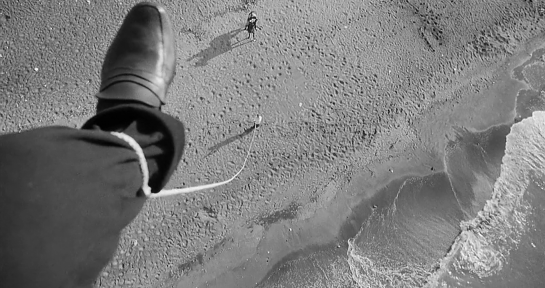
While the movie isn’t thick with plot, it paints a mesmerizing portrait. Its story resides within the Guido character and the absorbing performance from Mastroianni. We get an idea of who Guido is through the film’s unforgettable opening scene. While caught up in a massive traffic jam smoke filters from the vents of his car filling the cab. Desperate for help he pounds the windows, but everyone around him simply stares. He manages to escape and makes an angelic-like ascension. But while in the air and getting a small taste of freedom, he feels the tug from a rope that is tied around his leg. On the other end of the rope is a member of his production team who represents the maddening life he can’t seem to escape.

Guido is surrounded by chaos. He is a respected director working on a big budget science fiction picture, but his deadline to begin filming has come and gone. A huge hunk of “8 1/2” takes place at a fancy Italian resort where his cast and crew have gathered to begin working on the film. The problem is Guido has hit a creative wall and his apathy is frustrating everyone involved. He is bombarded with pressure from his short-tempered producer, his misanthropic lead writer, a high-maintenance French actress, and several others from his production crew. Guido has no defined plan for his movie and we slowly witness the emotional toll it is taking on him.
by r

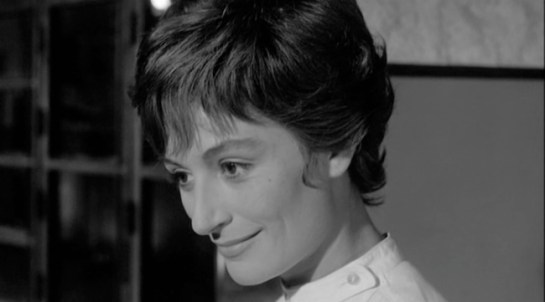
There is another contributor to Guido’s melancholy. It’s his messy, complicated web of relationships which includes his wife and mistress. The alluring Anouk Aimée plays Guido’s wife Luisa, a smart and elegant woman frustrated by her husband’s indifference. Carla (Sandra Milo), his mistress, is a chintzy, nagging starlet who irritates as much as excites. It appears as if Guido juggles these relationships without an ounce of thought. At one point in the film he has both women at the resort at the same time. But is this simply a mismanagement of his mangled love life or is it an intentional move by a man desperate for some form of resolution? As with most of “8 1/2” there is more to it than what we see on the surface.

Guido’s perception of women, love, and romance is skewed. We see this in the film’s famous harem dream sequence which features all of the women in Guido’s life embodying various fulfillments of his imagination. While it does reveal his warped perspectives, the dream also visualizes the internal conflict that’s fueling Guido’s deteriorating state of mind. In essence Guido can’t escape the turmoil in his dreams or his reality. To combat this mental and emotional back-and-forth Guido loses himself in reoccurring visions of the “perfect” woman. The stunning Claudia Cardinale represents his ultimate fantasy. She is his symbol of purity, spontaneity, and innocence. She is always dressed in white and she appears with a ghostly elegance and grace. She is his dream girl.
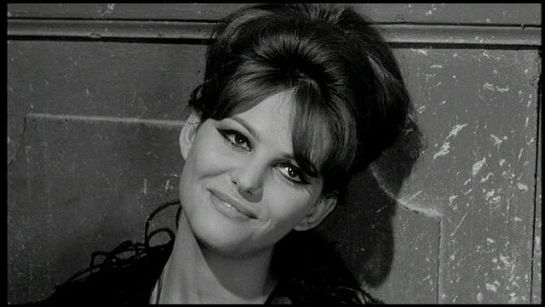
8-4

But as with everything else in Guido’s life, reality offers a much different perspective than his fantasies. That gets to the greater point of “8 1/2” – dealing with reality instead of fleeing from it and finding genuine inner happiness. At the same time and more directly Fellini examines the pains and pressures that accompany creativity – the inspirations and expectations filmmakers struggle with during the creative process. Roger Ebert called this the best film ever made about filmmaking. It’s hard to argue with him.

“8 1/2” is a movie that marches to its own beat and it doesn’t follow any established formula or convention. It is free of any and all caution and hesitation. It is a film that will undoubtedly still have detractors who won’t completely respond to its unbridled vision. But it could be said that the true beauty of “8 1/2” is found in its confusion. It’s found in the physical and psychological mayhem. It’s found in Fellini’s unique film language and audacious visual approach. And the most amazing thing about “8 1/2”? It found its genesis and inspiration in the mind of a struggling, burdened auteur. It just goes to show that true cinematic art, much like the life we choose to live, originates within us and not in some polished and meticulously detailed script.

VERDICT – 4.5 STARS

YOUR VOICES: On movie survival during a cataclysm…

your-voices

Your Voices is a simple concept created to encourage conversation and opinions between movie lovers. It works like this: I throw out a certain topic and I’ll take time to make my case or share my opinions. It could be serious, relevant, or downright silly. Then it will be time for Your Voices. Head to the comments section and let fellow readers and moviegoers know your thoughts on the topic for that day!

EARTH

Needless to say this YOUR VOICES definitely falls into the dumb, stupid fun category but in some weird way it struck me as interesting. Let me set the preposterous stage: Lets say that a huge cataclysmic world event has occurred. Lets say in order to survive you must leave the planet with a group of fellow bloggers…err survivors and you can only bring five DVDs or Blu-Rays from your collection. Sure it’s a ridiculous stipulation, but this is a pretty ridiculous post, right? So my question, which five do you bring?

For something so absurd, I have went back and forth on this. Only five DVDs or Blu-Rays which means they must be something near and dear to my heart. Movies that I want to see over and over. Movies that I want to preserve. How on the dearly departed earth do you narrow down such a thing? But such is the nature of the apocalypse so if the ship is about to depart, I would grab these five DVDs or Blu-Rays from my shelves:

“Casablanca” (Blu-Ray) – I call it my favorite film ever made, and I watch it a couple of times every year. Of course it would have to come along with me.

“La Dolce Vita” (Criterion Collection Blu-Ray) – The visual artistry and unique narrative layers in Federico Fellini’s masterpiece never ceases to amaze me. I’m still reeling from my first few viewings.

“Night of the Living Dead” (DVD) – My affection and admiration for this small but influential 1968 horror classic knows no bounds.

“No Country for Old Men” (Blu-Ray) – I have heralded this film as a modern classic ever since I first saw it. Nothing has changed over subsequent years.

“The Empire Strikes Back” (DVD) – As a huge Star Wars fan how could I leave the planet without something to remember the franchise by. Plus it just may be the best sequel ever made.

There, I did it. So….did anyone pack a Blu-Ray player??? Now it is time for YOUR VOICES:

YOUR VOICES: What 5 DVDs or Blu-Rays would you take from your collection if fleeing from an impending worldwide cataclysmic doom?

So let Your Voices be heard. Sure this is a corny and goofy Your Voices but under the surface it does shed a little light on your movie tastes and the ones you hold dear to your heart. Please share Your Voices on today’s nutty question. I’d love to hear from you in the comments section below.

ROAD

REVIEW: “John Wick”

WICK POSTER

Let me say I have always liked Keanu Reeves even when his movies didn’t quite hit their mark. He has always come across as a likable guy which has often translated onto the screen. That’s why I’m glad to see him put out a movie like “John Wick”. Let’s face it, Keanu’s career reached its high point during the 1990s and early 2000s. Now at 50 years old he stars in a stylized revenge thriller that tips it hat to several films that came out during his heyday.

Let’s get this out of the way first, “John Wick” is a hyper-violent action movie and it doesn’t pretend to be anything else. There isn’t much character development. There isn’t a lot of shoehorned drama. There aren’t hidden deeper meanings. But there are a ton of bullets, blood splatters, and broken limbs not to mention a body count that would rival anything from Stallone or Schwarzenegger. In many ways it’s a throwback flick and I really appreciated what it set out to do.

WICK1

Reaves plays the title character John Wick, a retired hitman mourning the recent loss of his wife to an unspecified illness. We don’t get any drawn-out backstory about their relationship or the onset of the illness. Just quick flashes that indicate they had a very healthy and loving marriage. After her funeral he receives a delivery – a puppy his wife had arranged to be delivered upon her death in hopes that it would help John cope with her passing. It doesn’t take long for John to take a liking to the puppy and it appears that it may be helping him deal with his loss.

That changes when he meets three thugs tied to a Russian gang led by Iosef (Alfie Allen). Iosef takes a liking to John’s ’69 Mustang and is angry when John refuses to sell it. Later that night the trio attack John in his home, kill his puppy, and steal his car. This triggers the other side of John Wick – the side directly tied to his past as a lethal hitman. He sets out to find Iosef who we learn is the incompetent son of the Russian mob boss Viggo (played by Michael Nyqvist). Viggo knows John Wick which means he knows what’s coming so he sends his mob army out to kill John before John kills his son. Obviously that is no easy task.

From there directors Chad Stahelski and the uncredited David Leitch stomp the accelerator and rarely take a breather. The action comes furiously and without remorse. And the influence of Hong Kong action cinema is undeniable. Both the early martial arts flicks and the later stylized John Woo shoot-em-ups are represented in some form in “John Wick”. It’s that style and sense of homage that keeps this from being your run-of-the-mill action tripe. The fight choreography is intense and the gunplay is absurdly entertaining. It’s so insanely over-the-top but it never becomes dopey or farcical.

WICK2

Recently Keanu Reeves has shown his affection for foreign action movie formulas so he is right at home here. In fact you can even see reflections of his popular “Matrix” series which makes sense. He first met Stahelski and Leitch on the set of “The Matrix”. In “John Wick” he becomes the familiar but convincing blank-faced killing machine, but he isn’t restricted to that thanks to some subtle, timely humor and the feeling of sympathy we have for his character.

“John Wick” may not do anything to reinvent the revenge thriller or action genre, but does it really need to in order to be successful? Not for me. It’s definitely a movie made for a particular audience and if wall-to-wall action and stylized violence isn’t your cup of tea neither is “John Wick”. But as someone who grew up during the time when big action movies were topping the box office, this was a satisfying and entertaining retreat. It is a cool nostalgic trip that also managed to feel surprisingly new. It definitely had more to offer than I ever expected.

VERDICT – 4 STARS

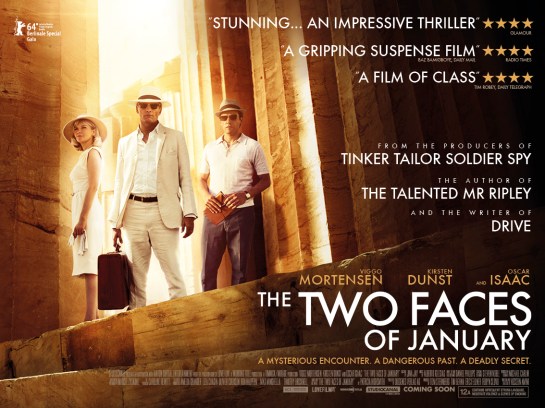
REVIEW: “The Two Faces of January”

JANUARY POSTER

Beautiful Greek locales and three strong performances anchor “The Two Faces of January”, a smart and measured adaptation of Patricia Highsmith’s 1964 novel. Viggo Mortensen, Oscar Isaac, and Kirsten Dunst star in this steady-moving thriller that doesn’t depend on big twists or reveals. Instead it is straightforward and focused – a slick and stylish retro noir full of fedoras and cigarette smoke.

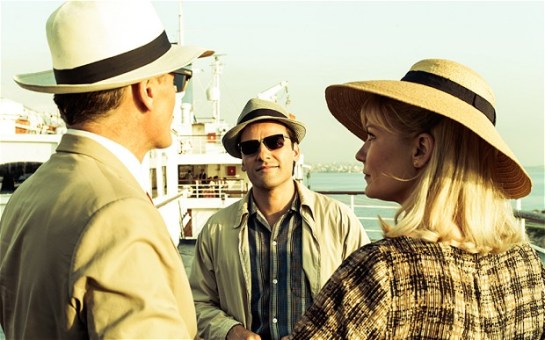
It’s 1962 in Athens, Greece. Rydal (Isaac) is a tour guide and small-time con man. While at the Acropolis of Athens he connects with an American couple Chester MacFarland (Mortensen) and his younger wife Colette (Dunst). Rydal is instantly attracted to Chester’s wealth and Colette’s beauty. Colette takes a liking to Rydal but Chester doesn’t trust him at all. The three have a pleasant dinner together and then part ways.


JANUARY1Chester and Colette return to their posh hotel where they are confronted by a mysterious armed man. Turns out Chester owes money to the wrong people. A struggle follows and the stranger ends up dead. In a panic Chester scrambles to do something with the body. While doing so he runs into Rydal who is returning a bracelet Colette left in a cab. A desperate Chester pleads with Rydal to help him and Colette get out of the city. Rydal agrees and the three head to the Greek Islands where they try to lay low until they can get back to the States.

The tensions between the three characters skyrockets. There is an obvious sexual tension between Rydal and Colette. This leads to a growing animosity between Chester and Rydal. There is also Colette’s anger and frustration with Chester for getting them into the mess they’re in. Then you can sprinkle in Chester’s heavy drinking and growing paranoia along with the question of Rydal’s trustworthiness. Each one of these tensions are allowed to play out, sometimes in unexpected but satisfying ways.

Screenwriter Hossein Amini, probably best known for his work on “Drive”, makes his directorial debut and he certainly has an intriguing eye. The film is exquisitely shot and Amini doesn’t shy away from using the beauty of his setting. He also gives a keen attention to detail particularly in creating a nostalgic noir atmosphere. I swear, at times this film looked as if it were plucked right out of the the late 1940s or early 50s. It’s something Amini is clearly going for and for the most part he nails it.

JANUARY2

The film is also helped by its exceptional cast. Oscar Isaac is finally getting the respect he deserves as one of cinema’s most reliable actors. Here he gives a character that is charismatic, charming, but also a mystery. Mortensen is tasked with the bigger and louder performance and he has no problems with it. He lays out the intricacy of his character sometimes with bravado but other times with quiet uncertainty. And Dunst was also very good. She is an actress who keeps getting better and better. Here she gives us a character who may be the only one worthy of our sympathy.

“The Two Faces of January” is an intelligent and efficient thriller that is very confident with its presentation and with the story it is telling. Hossein Amini gives an impressive directorial debut, but he also deserves credit for his well-conceived screenplay. And it doesn’t hurt to have talents like Isaac, Mortensen, and Dunst to help create your vision. I wouldn’t say “January” will be one of those essential time capsule movies, but it is a highly entertaining throwback thriller that more people need to see.

VERDICT – 4 STARS


REVIEW: “A Most Violent Year”

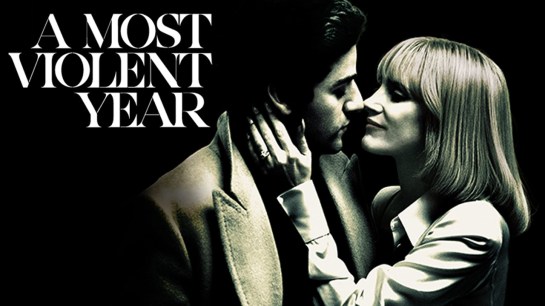
VIOLENT POSTER

Writer and director J.C. Chandor’s young filmmaking career has offered us two diametrically opposed films. His first movie was the wearisome, heavy-handed Wall Street critique “Margin Call”. His second film was the gripping, solitary survival drama “All is Lost”. “Margin Call” was a talky, dialogue-heavy film while “All is Lost” had only a few spoken words. “Margin Call” featured a huge impressive cast while “All is Lost” featured only Robert Redford. Two very different movies in terms of story and filmmaking approach, but two films that had me very interested in what Chandor would do next.

His third feature is “A Most Violent Year”, an unorthodox organized crime movie with a very deceptive title. This isn’t a prototypical gangster action flick. It’s a slow-burning drama set in 1981 New York City. As evident by Chandor’s other films, he is most interested in telling his stories through layered and well-defined characters. We may get that through copious dialogue or revealing observations, but his characters are his predominate storytelling tool.

VIOLENT1

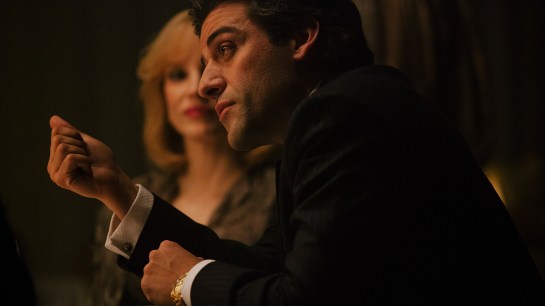
In “A Most Violent Year” our main character of focus is Abel Morales (Oscar Isaac), a dedicated and hard-working owner of a heating oil company. It’s a tough business environment but Abel has managed to grow his company mostly through legal means. We get hints that there are organized crime influences not only within the heating oil business but also in Abel’s family. Yet despite possible connections, Abel seeks to do things the right way, in hopes of avoiding any possible conflict with crime bosses or the law.

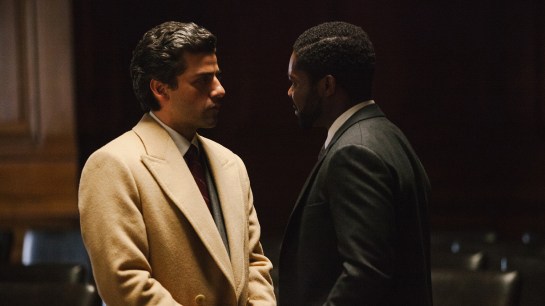
That goal becomes more difficult after his trucks begin to be hijacked during delivery runs. This creates a number of problems for Abel. The oil being stolen is taking a financial toll on his company. His firecracker wife Anna (Jessica Chastain) urges him to fight violence with violence. A local Teamsters head pressures Abel to break the law and arm his drivers. And to make matters worse, an ambitious Assistant District Attorney (David Oyelowo) is investigating Abel’s company which threatens to derail a vital business acquisition.

Chandor slow-cooks all of these ingredients, meticulously building his tension at a deliberate but effective pace. There is a very strategic flow to the story and I can see where some may long for more action or a quicker tempo. But I think that would undo much of what Chandor is going for. This film isn’t about gunfights and physical violence. It’s about a man desperate to avoid all of that even though it lingers in the background and around every corner.

VIOLENT2

There is something to be said about sitting back and watching good actors work. That is one of this film’s great pleasures. Oscar Isaac, with his well-groomed appearance and camel-hair coat, is wonderfully convincing selling us on Abel’s shaky confidence and good intentions. Chastain is also very good although there were moments when she came across as a little too big and showy. And I also have to mention Albert Brooks. Simply put he is just flawless playing Abel’s attorney who always seems to know more than he lets on. And while it is a relatively small part, David Oyelowo is always a delight.

“A Most Violent Year” is a very focused film that incorporates some of the tricks from J.C. Chandor’s other movies while also setting itself apart from them. The early 80s setting is impressively realized and the cold, wintry hues help relay the needed tone. The dialogue is sharp and intelligent. The performances are precise and confident. Most importantly the story itself pulled me in and what others may see as languid storytelling I see as uniquely fresh. Chandor’s third effort is a rich and gritty character-driven thriller that proves him to be one of the filmmakers that demands to be noticed.

VERDICT – 4.5 STARS

REVIEW: “The Railway Man”

RAILWAY POSTER If “The Railway Man” wasn’t based on a true story it would probably be dismissed as unbelievable hyper-drama. But it is based on a true story which for me made it all the more fascinating. It’s adapted from the bestselling autobiography of Eric Lomax and it strikes a number of heavy emotional chords. It looks at the stresses of war but not through the normal battlefield lens. Instead it examines the trauma some are left with well after the war has ended.

The first thing the film does right is its casting. Colin Firth is unquestionably one of the best actors in the business and this is material he can certainly handle. He plays Eric Lomax and we first meet him as a reserved if not slightly awkward train enthusiast. He sits down with a group of friends and tells them about his chance meeting with a woman named Patti who is stunningly played without an ounce of flash or glamour by Nicole Kidman. The two fall in love and eventually get married.


RAILWAY1

But in one of the movie’s few clunky bits of storytelling Patti and the audience learn that Eric is holding a lot of inner anguish. Patti’s love for her husband and nursing instincts wants to help him, but he continually shuts her out. She seeks information about Eric’s wartime past from his friend Finlay (Stellan Skarsgård). She finds out that during World War 2 he and some fellow British soldiers were captured by the Japanese and were placed in a hard labor camp where they worked on the railway between Thailand and Burma. During that time Eric endured unspeakable torture which has left him a broken man.

The audience gets to witness the events through a series of well done flashbacks. Jeremy Irvine plays the younger Eric and his resemblance to Firth is uncanny. Irvine was a big surprise and his performance stands right there with Firth’s and Kidman’s. In a great bit of method acting Irvine lost a significant amount of weight for the part. I also read where he did all of his own torture scenes. It’s truly impressive work. Actually I found all of the flashback sequences to be impressive in terms of production and in how it fits in the narrative.

The movie could have easily settled in as a traditional historical war film, but it doesn’t. Instead these flashback scenes work hand-in-hand with the film’s greater focus – an emotionally fragile man, the relationships surrounding him, and his ability to face and overcome the scars left from such traumatic savagery. I loved how these two narrative components worked together. For me each gave the other more meaning. Director Jonathan Teplitzky does a good job of maintaining a necessary cohesion between the two minus a couple of jarring instances where it seems key information was left out.

THE RAILWAY MAN

An argument has been made that “The Railway Man” is too polished and it takes the “safe route”. Others have pointed to its sentimentality feeling unearned. And then there are some who have taken issue with the liberties the film takes with the actual account. For example revenge fuels the film’s version of Eric, but in reality that doesn’t seem to have been the case at all. Each of these criticisms bring up valid points , but I can honestly say none of them hindered my enjoyment of the film or my connection to the characters in any way.

Ultimately “The Railway Man” works because of the amazing story and the fabulous performances that bring it to life. Firth is enthralling and unforgettable. Kidman is precise and beautifully reserved. Irvine shines in what should be breakthrough work. Sure, at times it is emotionally-driven and undeniably sentimental. It may be polished up and too much of a ‘prestige film’ for some. But to let those things hinder your experience would be a shame. I did find myself longing for information that the film chooses to skip over, but that’s my only gripe in what is otherwise a beautiful and moving movie.

VERDICT – 4 STARS