5 Phenomenal Movie Dream Sequences


movie_theatre - Phenom 5

There are so many things I love about cinema including its unique ability to visualize things. Through movies filmmakers can tell some amazing stories and they can sometimes visualize things that we can’t otherwise express. For example just look at dreams. We can try to describe some of our dreams, but it can be extremely hard to do. But not in the movies and that is what I’m looking at today. These are five of the best movie dream sequences. To set guidelines I decided to stay away from movies that spend most of their time in dreams. Movies like “Inception”, “The Wizard of Oz”, and “A Nightmare on Elm Street”. Now there are a ton of others to choose from so I wouldn’t call this a definitive list. But there’s no denying that these five movie dream sequences are nothing short of phenomenal.

#5 – “Shutter Island”

SHUTTER DREAM

I’m a huge fan of Scorsese’s psychological thriller “Shutter Island”. The lead character Teddy Daniels (Leonardo DiCaprio) is a U.S. Marshal tormented by painful dreams. Scorsese uses these dream sequences to reveal different bits of information about Teddy’s painful past. One of his most haunting dreams shows him and his wife Dolores in their apartment. Their conversation is full of anguish and hints at even more shocking revelations to come. The dream ends with Teddy embracing his wife and her turning to ash in his arms. It is such a dark and potent scene that gets me every time.

#4 – Raising Arizona

RAISING DREAM

There are so many things that I love about the wacky comedy “Raising Arizona” from the Coen Brothers. All Nicholas Cage and Holly Hunter want is to start a family of their own. It’s just that they are two of the dumbest people you would ever meet. But they are two of the most lovable and sympathetic dummies which makes the ending of the film so good. It features a dream sequence where the couple has grown old and all of the things they thought impossible has come true for them. I don’t want to ruin it for those who haven’t seen the film, but let’s just say it’s an incredibly touching moment in a film filled with craziness.

#3 – “Spellbound”

SPELBOUND DREAM

It shouldn’t surprise anyone that the fabulous Alfred Hitchcock would be on a list featuring great movie dream sequences. And how can a list like this not include his 1945 classic “Spellbound”. The film stands out thanks to its stellar cast led by Ingrid Bergman and Gregory Peck. But it also features an amazing dream sequence created by the surrealist Salvador Dali. Dali’s finished sequence was actually 20 minutes long and way too lengthy for the film. It was cut to around two minutes and while many would love to see Dali’s full vision, he does offer up a wonderful and truly trippy dream sequence nestled in this great movie.

#2 – “Aliens”

ALIENS DREAM

When it comes to science fiction and especially sequels it doesn’t get much better than James Cameron’s 1986 gem “Aliens”. This is a true favorite of mine and it has found its way onto several Phenomenal 5 lists. This time “Aliens” shows up due to its great dream scene early in the film. Ripley has just been rescued after 57 years in stasis. While recovering in the infirmary she has a terrifying dream of an alien inside her that is about to burst out. What makes it so great is we never see it coming. Cameron sets us up and lures us in before revealing the terror we see is actually a dream. I still remember the first time I saw it.

#1 – “8 1/2”

EIGHT

Honestly you could compile a Phenomenal 5 list of dream sequences just from this wonderful Italian classic from Federico Fellini. Without question Fellini’s visual style plays an important role in this film about a director struggling with an intense case of ‘director’s block’. He shows it most in his dream sequences none better than the movie’s great opening. It starts with the lead character Guido suffocating in the cab of his car as a host of people simply sit by and watch. He escapes by an almost angelic ascension only to find himself still tied to the craziness that is his life. That’s a vague description, but lets just say it is a brilliant scene worth experiencing for yourself.

So there are just five of the many great movie dream sequences. See something you agree or disagree with? See something I missed? Please go to the comments section and let me know what would have made your list.

REVIEW: “The Other Woman”

OTHERPOSTER

I suppose there was a chance, albeit a small chance, that “The Other Woman” could be a funny and spirited revenge movie for women. The concept, while admittedly dopey and trite, could be entertaining if placed in smart and creative hands. Well let me say not one single smart or creative hand touched any part this film. “The Other Woman” is unquestionably one of the most brainless and insipid attempts at comedy I have seen in a while. Not only is it offensive to intelligent women everywhere, it’s also offensive to any halfway discerning movie fan.

I’m not certain what screenwriter Melissa Stack is going for, but she definitely didn’t hit her mark. The film isn’t remotely funny. There isn’t an ounce of originality in the attempted humor. The characters are obnoxious, shallow, and brain-dead. I didn’t like anyone in this movie nor did I care about their situations. Basically the film trashes every bit of its women’s empowerment and independence potential.

Cameron Diaz gives yet another silly performance playing a New York lawyer named Carly. She has fallen for suave and debonair guy named Mark (Nikolaj Coster-Waldau). Things look good for them until she finds out he is married to the teeth-grindingly annoying Kate (Leslie Mann). The two develop an unusual friendship which only strengthens when they find out that Mark is also cheating with a third woman, an air-headed supermodel named Amber (Kate Upton). The three scorned ladies join forces to enact the ultimate revenge on the two-timing (or is it three-timing) Mark?

OTHER1

Stark and director Nick Cassavetes give us an annoying and inept mess of a movie. It doesn’t have an original thought or an shred of ambition. It seems to be copying things we’ve seen in other films. It’s so poorly made from its idiotic fecal jokes to its pretentious use of Cyndi Lauper’s “Girls Just Want to Have Fun”. And the performances don’t help. Bad performances from Cameron Diaz have become commonplace and it’s no different here. Mann is probably the most annoying of the cast and that’s saying something. Upton, well she is no actress and she makes that crystal clear.

I read that “The Other Woman” pulled in $200 million at the box office. I can’t tell you how perplexing that is. We all sometimes like a silly, dumb movie as long as it doesn’t insult us and it offers some semblance of filmmaking intelligence. “The Other Woman” has none of that yet it raked in a ton of money. I would love to watch a good comedy featuring the empowerment of women at the expense of a slimy disgraceful guy. “The Other Woman” is certainly not it.

VERDICT – 1 STAR

REVIEW: “A Most Wanted Man”

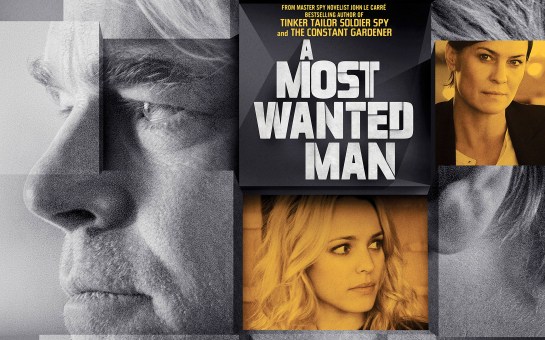
WANTED POSTER

Anton Corbijn’s brooding espionage-thriller “A Most Wanted Man” doesn’t follow any popular spy movie blueprint or formula and the movie is better for it. It won’t take audiences long to notice the intentionally deliberate pacing, dialogue-driven suspense, and strong character focus. All of these elements create a very grounded and methodical procedural that relies heavily on great performances and a strong screenplay from Andrew Bovell.

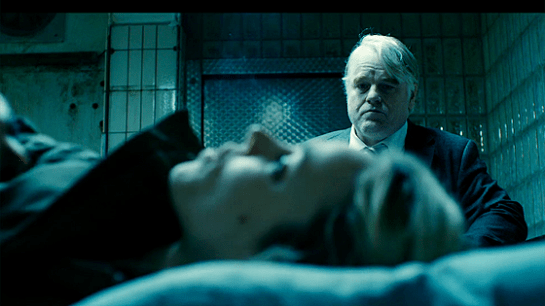
“A Most Wanted Man” isn’t just a unique thriller. It also has the sad distinction of being Phillip Seymour Hoffman’s final performance. He plays Günther Bachmann, the head of a German anti-terrorist group. He’s a heavy smoker, drinks a lot, and often times looks unkept. In fact, in an unfortunate case or art imitating reality, he looks terribly unhealthy. But Hoffman takes whatever personal struggles he may have been going through and injects them into this character creating someone full of raw authenticity.

WANTED2

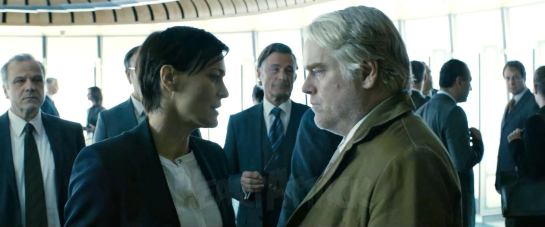
When a Chechen Muslim on Interpol’s radar illegally enters Hamburg Günther and his team begin tracking him down in hopes of catching bigger fish in a potential terrorist ring. Complicating things is a German security official (Rainer Bock) who wants to apprehend the Chechen instead of using him. Then there is an American intelligence agent named Sullivan (played with fascinating mystery by Robin Wright). No one knows her intent and Günther doesn’t trust her from the start.

The story spins in several different directions and we are kept on our toes by some interesting twists and character developments. It becomes a movie of ‘who is a terrorist and who isn’t’ and ‘who can I trust’. Watching Hoffman navigate through this maze of clues and information is half the fun. Willem Dafoe shows up as a banker with a very shady past and Rachel McAdams has a hefty role as a human rights attorney who latches on to the Chechen suspect’s case. Both characters play key roles in the unfolding story.

WANTED1

When you’re working with this type of material you have to trust your cast and they are all good here. I still find myself drawn to Wright’s performance and the unshakable confidence she brings to her character. Dafoe is also spot-on and many of the film’s great scenes have him in them. McAdams
is good although she often has trouble keeping her accent. But this is truly Hoffman’s film and he strips away every shred of showmanship in portraying this sad and weary soul whose life revolves around his work. He is obsessive to a fault, but that’s also what helps to make him such a compelling character.

“A Most Wanted Man” may not be for everyone and that’s a shame. It’s a slow burn meticulously built around nuggets of information we glean from conversations, interviews, and observations. It’s compelling stuff – crisp and razor sharp. There was a moment or two where I wasn’t sure what was being discussed and there are a couple of lulls. But even in those moments there is still Hoffman’s sublime performance. If there had to be a final performance this a fitting one – conscientious, complex, and forceful. It’s a clear reminder of the natural ability this man had as an actor.

VERDICT – 4 STARS

2015 Blind Spot Series – “Au Hasard Balthazar”

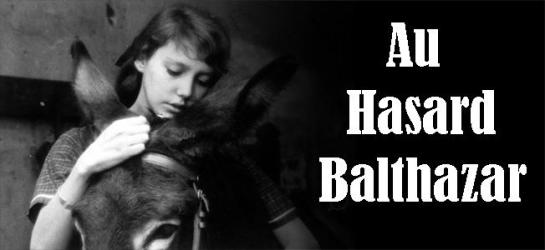
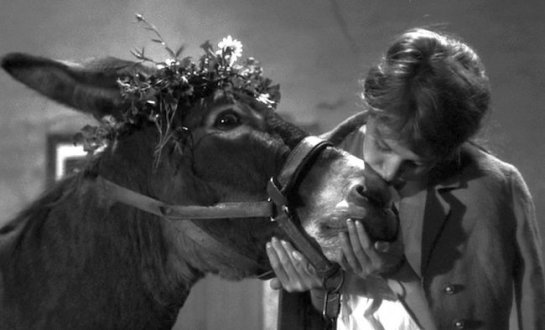
Anne Wiazemsky as Marie in Robert Bresson’s AU HASARD BALTHAZA

The brilliant auteur Robert Bresson has been called the father of French cinema. Many of the greats from France’s New Wave movement considered Bresson their chief influence. Other filmmakers from around the world often pointed to Bresson’s work as effecting the shape and form of cinema for generations. He was known for his unconventional style and techniques which found their roots in his own unique philosophies behind the art of cinema.

Bresson had an intriguing filmography and one of his best pictures is his 1966 drama “Au Hasard Balthazar”. His films often focused on lead characters weighed down by or struggling with their circumstances or their inner-self. The conflicts and turmoils they faced often left them physically or emotionally broken. Bresson’s films are not for those looking for a lighthearted affair. They are thought-provoking examinations of humanity that refuse to shy away from our crueler and harsher sides. “Au Hasard Balthazar” is a stirring example of this approach.

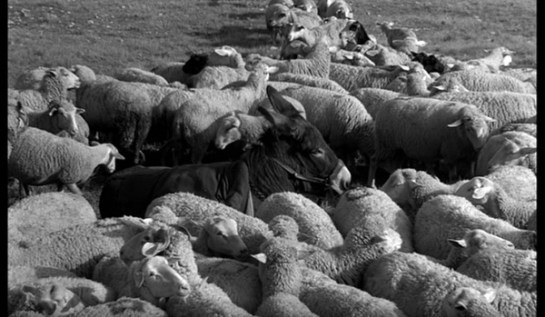
The film follows a donkey named Balthazar who encounters a wide assortment of deeply flawed people during his life. We first see him right after birth living on a small rural farm. Over the film’s quick 95 minutes Balthazar changes hands several times . Many of his owners and handlers abuse him often physically but sometimes out of sheer neglect. But Bresson doesn’t take a cheap way out. Balthazar isn’t a miracle animal. He doesn’t speak or come up with clever ways to repay his abusers. No, he’s just a donkey. Simple, innocent, and true to his nature. He knows what donkeys know, feels what donkeys feel, and acts as donkeys act.

AU1

Why is that so important? Because it puts the spotlight on humanity. Balthazar is doing what he should be doing. It’s the people he endures along the way who show their very flawed and sometimes wicked sides. It’s an indictment on the reality of how things are. When speaking on the movie the great filmmaker and one-time critic Jean-Luc Godard called it “the world in an hour and a half”. It’s a sad picture that is sometimes hard to look at. And despite his limitations Balthazar is still intensely sympathetic and able to touch our emotions.

But Bresson doesn’t just follow Balthazar around everywhere. He also tells us the stories of several characters who play roles in the donkey’s life. The main one is Marie (Anne Wiazemsky). She lives on the farm where Balthazar is born and shows love towards him. But in another instance of straying from the conventional, Marie also sits idly by while a group of young thugs led by the slimy Gerard (François Lafarge) beats Balthazar. Marie becomes an emotionless hollow soul, in some ways like Balthazar – a victim of her circumstances. But she loses herself in a much darker place.

AU2

Gerard ends up with Balthazar on a couple of occasions and his cruelty towards the animal is unsettling. Gerard is a thug, a thief, and is shown to possibly be a lot worse. There are parts of his story that didn’t make sense to me, but Gerard’s brand of sadistic evil is felt by man and beast. Balthazar also spends time with a baker, a traveling circus, and a local drunk. We see all of these people through the clearest and most honest eyes possible – Balthazar’s.

Several of Bresson’s signature style choices are clearly seen in the film. Most obvious is his penchant for using non-professional actors in his roles. You will rarely find room for big movie stars in a Bresson movie. The director would hire unknowns and then train them specifically for their part. He didn’t want an ounce of theatrics from his actors and he was known to film a scene over and over until every hint of performance was removed. Even more, Bresson didn’t refer to his performers as actors. He called them “models” and they offered a raw and reserved take unlike what you see in the mainstream. When watching “Au Hasard Balthazar” this can be a challenge especially for those not accustomed to Bresson’s work. The characters can appear cold and indifferent, but that also causes us to look at them in a very unique way.

“Au Hasard Balthazar” can be a difficult film to take in. Its narrative can be a bit challenging but once you connect with Bresson’s greater message everything falls into place. It’s visceral and heartbreaking. At the same time it holds a mirror up to the world we live in. And while this film was made in 1966, the reflection it casts is just as piercing today as it was then. Godard’s description of the film is spot on. Bresson shows us the world. The question becomes how are we going to change it? Even more, can we change it?

VERDICT – 4.5 STARS

AU finish

To see my full 2015 Blind Spot Lineup click HERE…

REVIEW: “Paddington”

PADDINGTON poster

“Paddington” is a film that was never on my radar, that is until I noticed the waves of positive reviews coming from overseas. Suddenly I found myself paying attention to its United States debut. The film is based on the classic children’s literature series by Michael Bond. “Paddington” was announced eight years ago with Colin Firth set to voice the cuddly brown bear with a penchant for marmalade. The film finally began shooting in 2013 with Firth out and Ben Wishaw taking his place.

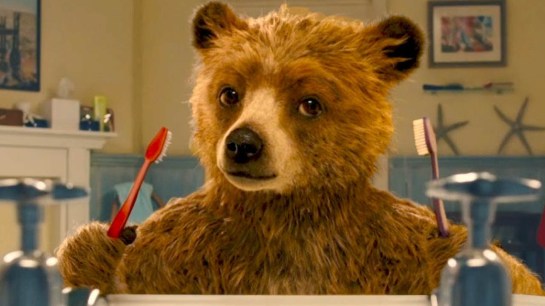
You remember the story of Paddington Bear, right? Forced to leave his home in the jungles of darkest Peru, Paddington, part of a special species of intelligent bears, sets out to find a new home. Many years earlier his family was discovered by an English explorer who told them they would always be welcome at his home in London. A desperate Paddington hitches a ride on a cargo ship and arrives in London where he expects overflowing kindness and of course a new place to call home.

PADDINGTON1

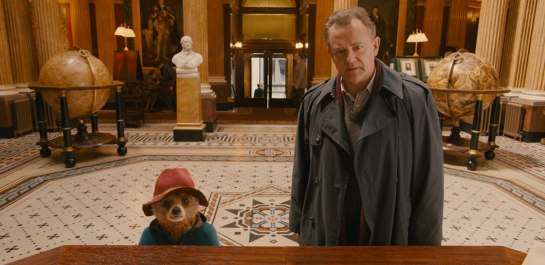
But things couldn’t be more different for this gentle and optimistic bear. He quickly finds that the people in London are as cold and unpleasant as the weather. Pushed aside and brushed off, Paddington begins to lose faith. But then he meets the Brown family. The wife and mother Mary (Sally Hawkins) and the youngest child Johnathan (Samuel Joslin) are both kind-hearted and compassionate. They convince the reluctant husband and father Henry (Hugh Bonneville) and their grumpy daughter Judy (Madeleine Harris) to let Paddington stay one night and then help him find the explorer who his family met in Peru several years earlier.

“Paddington” almost feels like two different movies. On the one side you have Paddington, his relationship with the Brown family, and his ‘fish out of water’ adjustments to life in the big city of London. This is the bulk of the film and it’s where “Paddington” absolutely sparkles. There is such a well conceived mixture of fun, playful slapstick and intelligent, heartfelt warmth. The film has a few big, wacky scenes, but they work because director Paul King doesn’t bury the material with the constant barrage of loud, frantic slapstick we get from most animated features. He always pulls back and then gives us scenes that humanize the story and the characters (even the bear).

Another reason these moments are so effective is because Paddington the character isn’t irritating, juvenile, or superficial. He’s charming, well mannered, and surprisingly genuine. It’s easy to love him and sympathize with his situation while also laughing at his well-meaning antics and the circumambient British wit. There is also enough substance and authenticity to his story and his relationships to give the movie a subtle emotional pop that I never saw coming. I was moved by an early train station scene inspired by a post-World War 2 reality and a one-word line of dialogue from Paddington himself near the end was absolutely perfect.

PADDINGTON2

But then there is that other movie I mentioned. Unfortunately King and co-writer Hamish McColl felt the need to shoehorn in an antagonist played by Nicole Kidman. A short side-story unfolds telling us of how Kidman’s mad taxidermist is intent on catching and stuffing Paddington. It’s silly, over-the-top, and it ultimately distracts from all of the things the movie does so well. The movie also follows a pretty predictable blueprint and it employs one of my least favorite narrative shortcuts – the big ‘this is the moral of the story’ speech at the end. These are all noticeable flaws, but thankfully they don’t kill the movie.

I could spend time talking about the fine performances from the tender-voiced Wishaw, from Hugh Bonneville, and especially Sally Hawkins. I could talk about the amazing job of mixing stunning CGI effects with live action. I could talk about the cool and artistic visual flair that Paul King brings to the film. There is so much I loved about the movie. Sure it has a few hiccups, but “Paddington” is such a welcomed treat. It’s head-and-shoulders above most of the PG-rated effects-driven family movies that we often get. Talk about a smart and entertaining surprise. Now pass me the marmalade.

VERDICT – 4 STARS

REVIEW: “The Guest”

GUEST POSTER

To be perfectly honest I had never heard of “The Guest”, at least not until it started popping up on various movie blogs. The film landed with a rather weak release and with practically no big studio backing. But in an almost underground-like show of support “The Guest” has started to catch on and more people are seeing it. Over time it has grown an enthusiastic fan-base, and many critics have given the film high marks. But me, I continue to wrestle with the movie and its overall aim.

“The Guest” employs several familiar plot points yanked from a host of different movies. It’s called an action thriller, but it incorporates elements of horror and comedy (sometimes intentional, other times…). The film’s central conceit involves a handsome and charming blue-eyed stranger named David (Dan Stevens). One day he shows up at the door of the Peterson’s, a bereaved family who recently lost a loved one to the war in Afghanistan. He tells Laura Peterson (Sheila Kelley) that he served with her son Caleb and was with him when he died in service. This immediately wins her over.

GUEST1

One by one David wins over the other members of the Peterson family. Caleb’s father (Leland Orser) is skeptical at first, but it only takes a few beers to win him over. David wins over Caleb’s sister Anna (Maika Monroe) by simply being cool at a party and digging her music. And finally he wins over Caleb’s little brother Luke (Brendan Meyer) by beating up the group of bullies who have been terrorizing him. So everybody loves David, well except for the audience because the film never makes an effort to hide the fact that something is clearly wrong with the guy.

The story tries to unfold at a deliberate pace and it doesn’t reveal all of its cards until the third act. But when it does show its hand things get a bit ridiculous. This is when it becomes harder to decipher what “The Guest” wants to be. It seems to struggle with a schizophrenic identity crisis. Does it want to be an action film? Does it want to be a horror thriller? Does it want to be a comedy? Personally I think it wants to be all of those things. The problem is you can’t always distinguish between parody and simply bad filmmaking. There are several scenes that are so ridiculous they have to be attempts at humor. Other times I’m not so sure.

GUEST2

At the same time the film’s genre waffling isn’t always a bad thing. Director Adam Wingard and writer Simon Barrett are clearly trying to have fun and they heighten every aspect of the movie. I really liked that approach when it was kept under control. There were also some pretty decent performances. Dan Stevens is the centerpiece and for the most part he does a pretty good job. He works hard to give us a mix of charming and psychotic. It’s a fun performance but I kept thinking the family must be idiots for not noticing his weirdness. I laughed particularly hard when Stevens would give us one of his glazed over evil stares. The goofiness of it isn’t totally his fault. A lot of that could be traced to the material and the direction.

But while I did struggle putting aside some of these issues, the film was still oddly entertaining. It never lulls and I was always engaged. The movie runs a quick 95 minutes and it does plenty of fun and creative things during that time to keep my attention. I can’t say I’m smitten with “The Guest” like many of my movie blogging pals, but I can see where their enthusiasm comes from. It was just too uneven and sporadic for me and I never could fully embrace it. But that doesn’t mean it doesn’t have its moments.

VERDICT – 3 STARS