
REVIEW: “Bone Lake” (2025)

In several ways, the first hour of “Bone Lake” plays like one of those steamy thrillers that frequented late-night cable television in the late 80s and early 90s. It works hard to be seductive, even veering towards trashy on occasions. And it attempts to give its story a sharp psychological edge. But neither the pseudo-eroticism or the overly familiar mind games can make this genre flick crackle the way it clearly wants and desperately needs to.

Directed by Mercedes Bryce Morgan, “Bone Lake” seems to have a clear vision of what it wants to be yet it never fully commits to it. Though never boring, much of it feels like reheated material from other features. It isn’t until the last fifteen minutes that the movie lets its proverbial hair down. Its big crazy finish wraps things up with a devilishly gory payoff that really doesn’t make much sense but is a lot of fun nonetheless.

Image Courtesy of Bleecker Street

Diego (Marco Pigossi) and Sage (Maddie Hasson) are a seemingly happy couple who book a weekend getaway at a lavish lakeside estate. A nervous but excited Diego plans on asking Sage to marry him. But Sage clearly has some buried reservations about their relationship which comes more into play as the story moves forward. But things really get complicated with the sudden and unexpected arrival of a second couple.

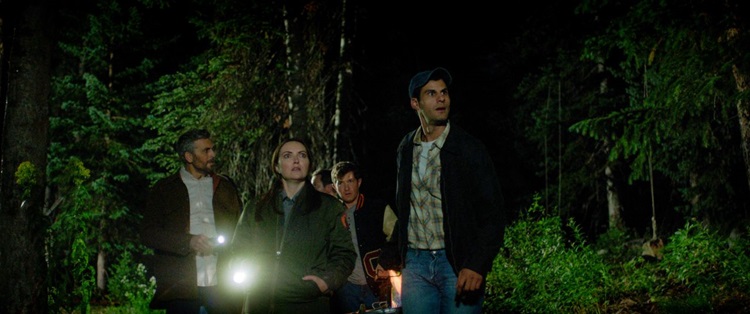
Diego and Sage are surprised by the arrival of Will (Alex Roe) and Cin (Andra Nechita). “It’s short for Cinnamon,” she’s quick to clarify. The latter couple reveal they too have booked the place for the weekend which leads to a table-setting conundrum. With both couples unable to reach the property owner and with the nearest hotel some 50-plus miles away, they make the ill-fated decision to share the place for the night. Bad idea.

From there it doesn’t take long for one of the movie’s more noticeable flaws to surface. “Bone Lake” makes the mistake of tipping its hand too early and openly. Simply put, Will and Cin are too transparent from the start. In no time they are openly flirting, planting lies, and manipulating Diego and Sage in ways that can be frustrating to watch. It’s one of those cases where most of the issues could easily be solved with the slightest bit of communication. Unfortunately…

Image Courtesy of Bleecker Street

Diego and Sage only make their situation worse through their maddening choices which move the plot to where it needs to go but leaves them looking like buffoons in the process. Such as Sage taking off and driving into town with the flirty Will while Diego stays behind in the house with the seductive Cin. What could possible go wrong? And when our protagonists finally have the conversations they should have had much earlier, it’s too late (of course).

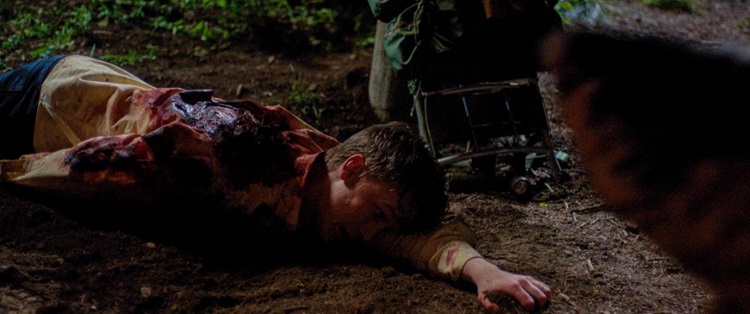
Again, the movie does finish with an entertaining blood-drenched final 20 minutes that almost makes it worth the journey to get to it. But outside of that, “Bone Lake” tells an familiar story patched together with ideas from more recent films like “Barbarian” to earlier movies like Michael Haneke’s “Funny Games”. The performances are serviceable and the gore is a blast (minus a pointlessly graphic opening sequence). But the film never goes as bonkers as it needs to, leaving us with little more than a tame and trite time-passer. “Bone Lake” opens in theaters October 3rd.

VERDICT – 2.5 STARS

REVIEW: “Stolen Girl” (2025)

In “Stolen Girl” Kate Beckinsale plays Mara, a down on her luck, divorced single mother living in Ohio with her four-year-old daughter Amina and her ailing father Joe (Matt Craven). Mara’s world is turned upside down after Amina wanders off while in a grocery store and is abducted. That kicks off this complicated story about a determined mother and the many obstacles she navigates in her efforts to find her daughter.

Directed by James Kent, “Stolen Girl” is inspired by a true story although the storytelling doesn’t always feel like it. Nagging frustrations such as narrative shortcuts, undercooked relationships, and instances of clumsy editing sometimes distract from the more serious issues at hand. But Kent, along with screenwriters Kas Graham and Rebecca Pollock, don’t take their subject lightly. And inside the film’s 1990s thriller veneer is a strong message that’s worth listening to.

Things escalate quickly after Amina’s disappearance as Kent hurries us through the first act. Basically Mara is convinced her ex-husband Karim (Arvin Kananian) took their daughter. The police check Karim’s home only to find it cleaned out with no signs of him. Everything points to Karim having left the country, but no one, from the local police to the CIA, offer much help. Two years leads to four years, and despite Mara’s determined efforts, there’s still no headway made.

A glimmer of hope comes when Mara is approached by a man who goes by Robeson (Scott Eastwood), an ex-Marine who now works as a child recovery specialist (aka a mercenary). He makes her a deal – help him find other people’s kids and he’ll help her find Amina. She agrees and a few scenes later she is accompanying Roberson and his partner Carl (Jordan Duvigneau) to Colima, Mexico. Her job is to “play mother” by keeping the recovered child calm while they transport him back to his rightful parent.

Too much of the film’s first half unfolds with very little meaningful buildup. Mara’s work to get answers both locally and in Washington DC is referenced more than it is realized. Her jump to mercenary fieldwork happens with practically no training whatsoever. Even her relationship with Roberson goes from strictly business to making out in a motel without a hint or spark of attraction.

But the story’s focus sharpens in the second half as the thriller elements take form. Eight years after Amina first disappeared, Mara gets a lead that Karim is in Lebanon. But unexpected obstacles arise from unexpected places paving the way to a surprising finish that packs the kind of emotional heft that almost makes you forget the rocky road to get there.

While the storytelling is a bit messy (specifically early on), the same could be said for the handful of action sequences that are hampered by clumsy edits, shaky cameras, and an over reliance of quick cuts. But to Kent’s credit he manages to hold it all together in large part thanks to Beckinsale. The sheer conviction in her performance brings home the weightiness of the subject matter. And there is never a moment where we question her character’s pain, frustration, and resolve. “Stolen Girl” is now available on VOD.

VERDICT – 2.5 STARS

REVIEW: “Eleanor the Great” (2025)

The indomitable and irresistible June Squibb once again shines in “Eleanor the Great”, the directorial debut for Scarlett Johansson. Written by Tory Kamen, this unusual little drama sees the 95-year-old Squibb once against putting her playfulness and charm on full display, Yet while she certainly gets in a few good zingers, the movie is more of a heartfelt drama that offers a thoughtful meditation on grief through very different life experiences.

The 95-year-old Squibb plays 94-year-old Eleanor Morgenstein, a feisty and straight-shooting New Yorker living in Florida with her best friend and roommate Bessie (a sublime Rita Zohar). Since their husbands died, the two longtime friends have done everything together from taking walks down by the beach to shopping. But their closeness is seen most in the times at home when Bessie, a Holocaust survivor still haunted by traumatic memories, pours her heart out to Eleanor.

Eleanor’s life is shaken to its core when Bessie dies. Unable to stay alone, Eleanor moves back to New York to stay with her daughter Lisa (Jessica Hecht) and her grandson Max (Will Price). The move proves to be a challenge for all three. Eleanor hasn’t been close to her daughter for years. Lisa is a career woman who’s worried about leaving her mother alone during the day. Lisa would rather she be in a senior care home which Eleanor resists.

Image Courtesy of Sony Pictures Classics

Johansson and Kamen take time to consider this complex mother/daughter dynamic – showing yet not overplaying the tension between them while empathizing with both sides and their set points of view. Some of the film’s best laughs come in Eleanor’s moments with her daughter (a well-timed Guantanamo reference had me laughing out loud). But it’s the more serious aspect of their relationship that is the most compelling, and I wish it was given more attention.

While visiting the Manhattan Jewish Community Center, Eleanor stumbles into a Holocaust survivors support group meeting where she ends up sharing Bessie’s survival story as her own. It’s a lie for sure, but one born out of her own grief. The story he shares grabs the attention of Nina (Erin Kellyman), a 19-year-old NYU journalism student siting in on the group’s session. Eventually an unlikely friendship forms as both Eleanor and Nina find someone they can connect with.

Nina is the daughter of a workaholic television news anchor named Roger Davis (the always reliable Chiwetel Ejiofor). At home, Roger has been distant and closed-off ever since his wife and Nina’s mother died six months earlier. As a result, Nina has been emotionally stranded and left to deal with her grief on her own. It’s a heart-wrenching storyline that adds new layers to the movie’s treatment of loss. Especially once Eleanor enters their lives.

Image Courtesy of Sony Pictures Classics

Johansson knows the treasure she has in Squibb and she allows the actress the space to both cut loose and dial it back. Squibb offers up a brilliant balance of feistiness and vulnerability. But the nicest surprise is Kellyman who matches her cast mate step for step. Kellyman gives an emotionally nuanced performance marked by some wonderfully subtle touches while at times being profoundly affecting. She’s a revelation.

Some may take issue with the movie’s conceit – more specifically, a story of someone falsifying their connection to the Holocaust. But neither Johansson nor Kamen make light of Eleanor’s offense or paint it as acceptable. Eleanor herself is uncomfortable with where her lie takes her, and there are significant consequences despite the film’s somewhat tidy ending. But Johansson is all about the humanity behind the actions, and her film examines it all maturely and with reverence.

“Eleanor the Great” tells an emotionally rich and morally complex story built around well-defined characters and their own personal bouts with grief. It’s an impressive directorial debut for Johansson who proves to be keenly in touch with her characters and the material. Her style is fittingly straightforward and shines most in her willingness to let her actors work. It may sound like a small detail, but Johansson conveys volumes by simply setting her camera on Squibb, Kellyman, Ejiofor, or Zohar and letting them go. It’s those instincts that leaves me excited for what she’ll do next. “Eleanor the Great” is in theaters now.

VERDICT – 4 STARS

REVIEW: “Tin Soldier” (2025)

Scott Eastwood stars, Jamie Foxx baffles, and Robert De Niro cashes a check in “Tin Soldier”, one of the most confounding features to reach a screen this year. While it’s technically an action thriller, finding a fitting category for it is a challenge. That’s because this confection is all over the map, attempting to be a little bit of everything but ultimately landing nowhere.

It’s hard to believe this ever looked good on paper, but something about “Tin Soldier” drew Eastwood and two Academy Award winners. The film is directed by Brad Furman who is helming his first feature since 2018’s “City of Lies”. He does everything he can to make something at least slightly cohesive. But even at under 80 minutes, his film has a difficult time generating or sustaining any momentum. That’s because the script (written by the trio of Furman, Jess Fuerst, and Pablo Fenjves) fails to develop into anything compelling or narratively functional.

Image Courtesy of Samuel Goldwyn Films

Seventeen years prior, a decorated naval officer named Leon K. Prudhomme (Foxx) founded a PTSD treatment center for veterans. He called it THE PROGRAM. But a secret FBI investigation discovered Prudhomme was actually forming a heavily armed anti-government cult. He reinvented himself as a charismatic (and unintentionally goofy) revolutionary called The Bokushi. And all indications point to his cult stockpiling chemical weapons.

Out of fear that a domestic terror attack is imminent, the FBI begin planning a raid on the Bokushi’s remote mountain compound (think Waco, 1993). But before they do, a covert tactical team organized by Emmanuel Ashburn (De Niro) is secretly organizing an unsanctioned mission to infiltrate the compound and take out the Bokushi before things escalate.

To guide his team, Ashburn approaches Nash Cavanaugh (Eastwood), a disheveled military vet and former member of Prudhomme’s cult. Nash struggles mightily with PTSD, a result of his time at war and in the Bokushi’s outfit. Nash wants no part of Ashburn’s mission. But when he hears his wife Evoli (Nora Arnezeder), who was presumed killed during his escape, may actually be alive, Nash agrees to join the operation with hopes of rescuing his wife.

From there the movie moves forward in the most mechanical way imaginable. It jumps from point to point with very little buildup and even less emotion. Furman makes an effort to break things up, but it mostly comes through instances of awkward narration and jarring flashbacks, none of which add much the story (there’s one unintentionally bonkers flashback of Foxx giving a musical performance that plays like an “In Living Color” sketch). Meanwhile other actors like John Leguizamo and Shamier Anderson do little more than add some familiar faces.

Image Courtesy of Samuel Goldwyn Films

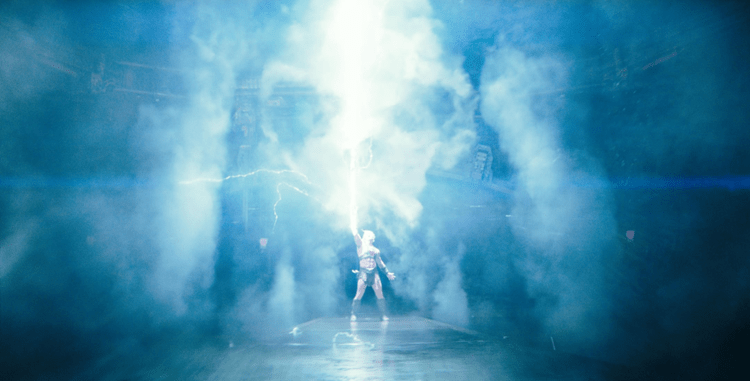
Not that it was ever fully together, but things completely fall apart in the final act where any attempt at an explosive finish gives way to utter absurdity. We get a laughably easy infiltration, a goofy cult ritual, and a hysterically bad monologue. And if that wasn’t enough, the story wraps up with a preposterous showdown in….a gladiator arena.

To its credit, there are a few striking locations, flashes of clever cinematography, and a couple of decent action sequences. But overall, “Tin Soldier” features more bad haircuts than good scenes. And no amount of effort can make this AI-quality creation remotely entertaining or inspired. “Tin Soldier” is in select theaters now and releases on VOD September 30th.

VERDICT – 1 STAR

REVIEW: “The Lost Bus” (2025)

It’s hard to believe, but 45 years ago this month my father and three other men suffered serious injuries while fighting a dangerous forest fire. I was really young at the time yet I still remember my upset mother dropping me off with my grandparents before heading to the hospital to meet the ambulances. For that reason, seeing news stories and even movies dealing with wildfires register a little differently for me.

“The Lost Bus” is a survival thriller based on Lizzie Johnson’s Paradise: One Town’s Struggle to Survive an American Wildfire”. Both are about the 2018 Camp Fire in Northern California’s Butte County. The Camp Fire has been called the deadliest and most destructive wildfire in California history. Beginning on the morning of November 8, 2018, the fire burned for seventeen days, fueled by extremely dry conditions and fierce katabatic winds. It resulted in 85 fatalities, over 18,000 structures destroyed, and an estimated 153,000 acres burned.

In the movie, Matthew McConaughey offers a wonderfully grounded portrayal of a down on his luck school bus driver named Kevin McKay. Kevin can’t seem to catch a break and it’s taking its toll. He came back to Paradise, California four months earlier when his father died. Now he takes care of his disabled mother Sherry (Kay McCabe McConaughey) while trying to connect with his estranged and rebellious 15-year-old son Shaun (Levi McConaughey).

Image Courtesy of Apple Original Films

Meanwhile at work, Kevin struggles to make enough money to pay for his mother’s treatments. He’s constantly asking his dispatcher and boss Ruby (Ashlie Atkinson) for extra shifts but he’s too far down on the seniority ladder. So Kevin makes do the best he can, running his usually route through the rolling forest-covered North California hills. But his and everyone else’s lives are about to change after sparks from a power line start a fire well outside of town.

It’s here that director Paul Greengrass ratchets up his signature visceral style, creating a palpable sense of realism that’s essential to his storytelling. As high winds and dry conditions turn the small blaze into a raging wildfire, Greengrass combines both practical effects and CGI to visually create an authentic you-are-there experience. It’s energized by the immersive cinematography from Pål Ulvik Rokseth, whose variety of shots add tension and a striking sense of scale.

While Kevin’s personal story unfolds, Greengrass routinely breaks away to show the efforts of the fire battalion led by Chief Ray Martinez (Yul Vazquez). Together with spotters and firefighters both in the air and on the ground, the battalion get to work tracking the fire, assessing the threat, and formulating a plan to contain it. Greengrass presents these scenes like a well-oiled procedural that emphasizes the determination of those putting their lives on the line to save others. It also adds a nail-biting authenticity that makes this story hum.

As far as the human drama goes, it ratchets up as well. With the wildfire bearing down on Paradise, a mandatory evacuation is issued. At Ponderosa Elementary a school teacher named Mary Ludwig (America Ferrera) is caring for 23 stranded children. With no other driver in the vicinity, Kevin agrees to pick them up and get them to safety just as the radio and phones go down. After loading Mary and her students into his bus, Kevin heads for the staging area. But with communications down, Ruby is unable to divert them to the backup safe zone.

Image Courtesy of Apple Original Films

Greengrass and his co-writer Brad Inglesby do a nice job balancing these two unknowingly connected stories of heroism. As Kevin is driving blind through an engulfed hellscape with Mary calming a busload of children, Chief Martinez and his team do everything in their power to get the fire under control. Both offer perspectives on the real-life disaster of distinctly different scales.

The story isn’t without its flaws. It teases us with subplots that mostly up and vanish. In one harrowing sequence a young fireman drives into the mouth of the inferno and attempts to lead a convoy of survivors to safety. Then they disappear and we never see them again. Later, a pack of gun-toting looters attack the bus and then are gone in a flash. You could also make a case that the final 30 minutes drag out a little longer than necessary.

But those things seem insignificant when placed next to the many things Greengrass gets right, starting with how effectively he makes us feel a part of this real-life horror. It’s seen in the way he captures the magnitude of the disaster; how he impresses upon us the grave danger of each situation; in his ability to relay the sheer ferocity of the fire. The visual wizardry is truly breathtaking. It’s so stunningly realistic that we need those moments of humanity which McConaughey and Ferrera organically provide.

VERDICT – 4 STARS

REVIEW: “The Strangers – Chapter 2” (2025)

When the new trilogy from The Strangers film series was announced I was hopeful yet cautious. The three movies were set to be a prequel to the 2008 original film. That movie (written and directed by Bryan Bertino) was a straightforward and genuinely unsettling blending of psychological and home invasion horror. Unfortunately it’s follow-up, 2018’s “The Strangers: Prey at Night” was a considerable downgrade which (as I’ve said in an earlier review) is better left forgotten.

That brings us to the new trilogy, all consecutively shot under the direction of Renny Harlin. Chapter 1 didn’t kick things off on the best note as it stretched about 30 minutes worth of story into a 90-minute feature. To be perfectly honest, the same could be said for “The Strangers – Chapter 2”. But there is one notable and unexpectedly effective difference. Chapter 2 moves away from the home invasion angle and is essentially one extended chase, with the previous film’s formidable final girl on the run from three masked psychopaths.

Image Courtesy of Lionsgate

Madelaine Petsch returns as Maya Lucas, the young woman who barely survived her petrifying encounter with three masked strangers while staying overnight at a secluded Airbnb. Her fiancé Ryan (Froy Gutierrez) was brutally murdered by the strangers and Maya was left for dead. But she was saved by first responders and rushed to the Venus County Hospital. That’s a serviceable summary of “Chapter 1” which immediately sets up its follow-up.

“Chapter 2” begins with Maya recovering in the hospital while mourning the loss Ryan. With the killers still on the loose, she’s understandably fearful for he safety. But the creepy and cryptic Sheriff Rotter (the always beguiling Richard Brake) isn’t much help. Meanwhile her family is still on their way, leaving Maya alone in her hospital room for the night. Enter the three strangers, known in the credits as Scarecrow, Dollface, and Pin-Up Girl, who return to finish what they started.

From there the chase begins with Harlin patiently moving us from one location to the next as Maya tries to avoid being butchered by the ax-wielding Scarecrow and his two followers. It starts throughout what has to be the emptiest hospital you’ll ever see. From there we follow Maya out into the rainy darkness where she soon stumbles upon a horse ranch. And it goes on from there. At each stop she encounters eccentric locals and just knowing who to trust is a terrifying challenge.

As Maya’s fight for survival progresses, co-writers Alan R. Cohen and Alan Freedland sprinkle in brief flashbacks that hint at the origins of the three strangers. It’s more eerie than insightful, and it’s hard to know if it will eventually amount to much in a series about the utterly random nature of some violence. But it looks like the plan is to show how a bond formed between this deranged trio. How effectively it will play out is anyone’s guess.

Image Courtesy of Lionsgate

While storytelling isn’t a strength, “Chapter 2” has some genuinely good scenes. There’s a nerve-racking sequence in the hospital’s morgue. And later on there is a terrifically edited scene inside an SUV as a frightened Maya tries to gauge the intent of the four twentysomethings inside with her. Other moments don’t fair as well, such as Maya’s encounter with a glaringly obvious computer generated wild boar. It’s well staged, but the CGI is distracting. Or a scene where she goes full John Rambo and sews up her own stomach wound.

Even with its blemishes, “The Strangers – Chapter 2” is a surprising step up from its predecessor. The movie is essentially three murderous maniacs endlessly pursuing a young woman through a rural backwoods community. Nothing about that sounds remotely original, and it’s hard to make the case that “Chapter 2” has anything new to offer. Yet I can’t deny its entertainment value which is mostly the result of Harlin’s craftsmanship. It’s still hard to figure out what the trilogy is going for. But “Chapter 2” earns enough goodwill to bring me back for “Chapter 3”.

VERDICT – 2.5 STARS