REVIEW: “The House of the Devil”

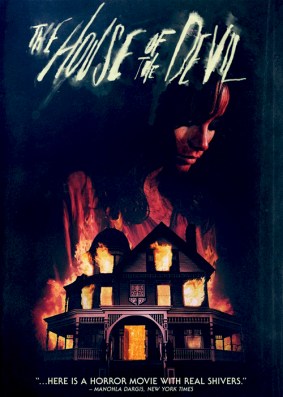
house-posterTi West has a clear grasp of the guiding principle for many classic horror films – the anticipation can be just as satisfying as the payoff. He takes that thought to heart in his 2009 film “The House of the Devil”. It’s a slow-boiling horror picture focused on building the audience’s dread and prodding their imaginations. West is deliberate with what he feeds us which is just fine since he creates a boatload of suspense in the process.

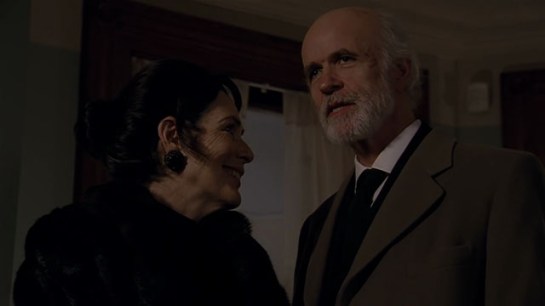
The main character is cash-strapped college sophomore named Samantha (Jocelin Donahue) who needs money for a new apartment. She responds to a flyer requesting a babysitter on the night of a rare lunar eclipse. Samantha’s best friend Megan (played by the always lively and true Greta Gerwig) drops her off at the large Victorian home of Mr. Ulman (Tom Noonan) and his wife (Mary Woronov). It so happens that the home is down an isolated wooded road AND next to a cemetery. Warning signs aglow.

The gentle voiced but creepy Mr. Ulman springs a surprise on Samantha – something he failed to mention in the flyer. I’ll let you find out what it is for yourself, but she only agrees to stay after he quadruples her pay. The Ulman’s head off to their eclipse-watching gathering leaving Samantha in charge, along with her intense curiosity and active imagination.
house1

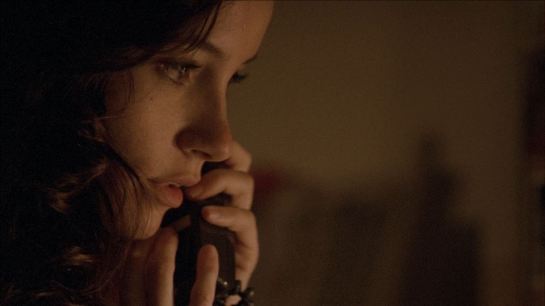
West plants here for a bit allowing the tension to build and then slowly simmer. As Samantha begins exploring the house we gain an ominous feeling of dread. We watch knowing all along something is going to happen. Even when Samantha pops on her headphones and playfully dances around to The Fixx’s “One Thing Leads to Another” (an amusingly appropriate title) we still are waiting for something terrible to occur. That’s something the good horror pictures of the 70s and 80s did well.

West has that same knack. Even though he is often playing with familiar ideas within the horror genre, he clearly knows what makes these films work. Some examples: He spends time developing the central character. Samantha isn’t a flimsy, disposable protagonist. He also understands the effectiveness of well-managed music. Jeff Grace’s Carpenter-esque score is a perfect complement and West knows how to employ it. And then there is his selective use of gore. The corn syrup does eventually flow, but this is far from some splatter-a-minute gorefest. Again, the focus is more on getting to the payoff. But that doesn’t mean the payoff isn’t a nostalgic bit of old-school fun.
house2

Another treat is the 80s setting. My wife and I had such fun seeing who could notice the most references to the decade. Feathered hair, high-waist blue jeans, friendship bracelets, and of course a Sony Walkman as big as a brick. West even shoots with 16mm film which makes it seem even more of a movie of that time.

“The House of the Devil” features an old-fashioned quality that I love, but it’s much more than just a nostalgic piece. It’s a genuinely tense throwback to the classic horror idea of doing the basic things really well. It also plays around with several subgenres and shakes them up just enough to add a unique flavor to the movie. All of these good ingredients mix well with West’s undeniable craft making this a real treat for horror fans.

VERDICT – 4.5 STARS

4.5 STARS

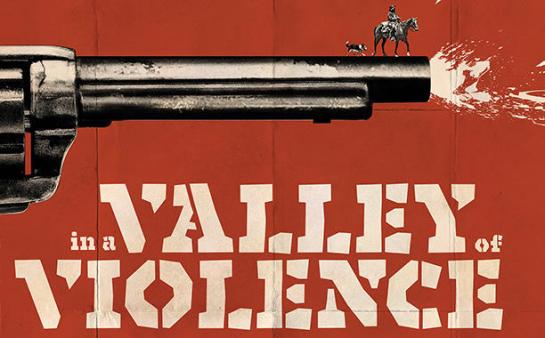
REVIEW: “In a Valley of Violence”

valley-poster

Apparently 2016 is a breakout year for Ethan Hawke westerns. Okay, so I’m being a tad facetious, but the 45 year-old Austin, Texas native has released two westerns over the last few months. The first was the crowd-pleasing shoot-em-up remake of “The Magnificent Seven”. And then there is this film, the much leaner and less serious “In a Valley of Violence”.

The film is written, edited and directed by Ti West, a filmmaker most known for his small, fresh takes on the horror genre. West has much the same goal in mind here, but at the same time this is a clear-coated homage plump full of familiar western tropes. West’s tongue-in-cheek handling of the material enables his celebration of the traditional western to also feel surprisingly fresh.

valley1

“In a Valley of Violence” proclaims the age-old prophecy (or at least it should be an age-old prophecy if it isn’t) – don’t come between a man and his dog. That’s exactly what happens when a drifter named Paul (Hawke) and his dog Abbie come across the small, rundown town of Denton on their way to the Mexican border. Denton is clearly a dangerous place as evident by its scarcity of citizens and its boarded-up church. But Paul needs supplies so he moseys into town.

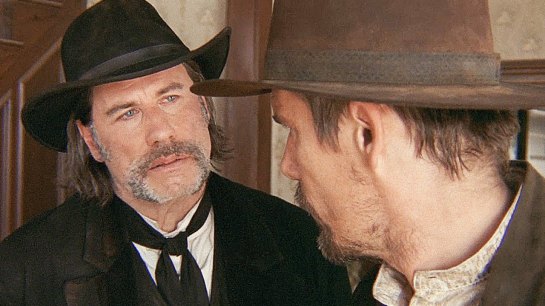
And can you ever stop in a small western town without hitting the local saloon? Paul does that very thing and has run-in with a drunken hothead named Gilly (James Ransone). Words are exchanged, a punch is thrown, Gilly’s nose is broken, and the town’s Marshal Clyde Martin (John Travolta) sends Paul on his way with a warning never to return. Sounds fair enough, but it wouldn’t be much of a story if ended on that note. Things sour and we see the violent side of Paul that has been simmering under the surface.

The story doesn’t stray too far from the traditional western revenge tale, but Hawke and Travolta both energize it with some really good performances. There is also some really good supporting work from Taissa Farmiga (younger sister of actress Vera Farmiga). She plays a young woman who helps run the town’s hotel and sees Denton for the unruly dead-end that it is.

valley2

It’s an enjoyable small cast who seem to have fun with West’s material particularly the humor. Despite its ominous threatening title, “In a Valley of Violence” is surprisingly funny. Some of its laughs come at the most unexpected times and range from subtle to absurdity. It never goes far enough to turn this into a spoof, but it does keep things light even when the tension amps up.

Despite its violence and dedication to formula, West and company (wisely) never take their movie too seriously. Even when it’s moving by the numbers, it remains quirky enough to feel slightly off-center. Appropriately shot in 35mm and featuring a sparkling Jeff Grace score, the film looks and sounds as it should which will endear it to genre fans. But most impressive is its ability to embrace the conventional and set our expectations only to then shake things up just enough for us to see things through a new lens. That makes this film too appealing to pass up.

VERDICT – 4 STARS

4 Stars

2016 BlindSpot Series: “Who’s Afraid of Virginia Woolf?”

woolfposter

When Edward Albee’s play “Who’s Afraid of Virginia Woolf?” landed in 1962 it set Broadway ablaze. Its scorching, abrasive story of a middle-aged couple’s volatile marriage won Tony Awards but was stripped of its Pulitzer Prize for Drama due to its controversial content. It was perceived as a story that could be told on Broadway but could never be filmed due to the infamous Production Code.

But things were changing in Hollywood. Screenwriter Ernest Lehman was determined to keep the play’s coarse language and twisted sensuality in hopes of capturing the same initial shock of Broadway. He succeeded and “Who’s Afraid of Virginia Woolf?” is now known as one of the key movies of the 1960s that led to the abolishment of the Production Code. The movie became one of only two films to receive an Oscar nomination in every eligible category (the other being “Cimarron” from 1931).

woolf1

Real life husband and wife Richard Burton and Elizabeth Taylor were cast to play George and Martha, a venomous, hard-drinking couple in marriage turmoil. George is an apathetic associate history professor at a small college. Martha is the bitter malcontent daughter of the college’s Dean.

After a late night campus party, Martha invites a young couple to their home for a nightcap. The guests are Nick (George Segal), a hunky newly-hired biology professor, and his mousy, reserved wife Honey (Sandy Dennis). George and Martha begin a caustic back-and-forth verbal assault. At first Nick and Honey are terribly uncomfortable by what they witness, but their hosts seem impervious to their rudeness or damaging words. At one point George flippantly explains “Martha and I are merely exercising, that’s all.”

woolf2

As more alcohol is consumed the conversations grow more toxic and soon the young couple find themselves caught up in George and Martha’s games of emotional destruction. Through various stages of drunkenness the four scratch and claw at every sensitive scar revealing deep-rooted anger and boiling secrets from their pasts. Lehman’s script is deeply loyal to Elbee’s story. Within it no feelings are protected and no verbal assault is too vicious.

The film marked the directorial debut of Mike Nichols who was nominated for an Oscar but lost out to Fred Zinnemann (but no worries, Nichols would win the following year for “The Graduate”). Nichols wisely takes a more conservative approach to this material, trusting his four key players and allowing them to do most of the heavy lifting. But that doesn’t mean Nichols vanishes into the background. His hand is seen in several strategic camera techniques ranging from shot framing to camera movement. His direction never overshadows the dialogue, but there are instances where he accentuates it.

woolf3

But when people talk of “Virginia Woolf” the performances most always top the conversation. The film earned Elizabeth Taylor her second Best Actress Oscar. Taylor dove headfirst into her character, gaining 30 pounds for the role, wearing a wig, and doing anything to shed her image as a beautiful movie star. Burton is equally good and brings a bruising passive-aggressive apathy to his character. Albee originally wanted James Mason but later admitted Burton was fantastic. Both Segal and Dennis also received Oscar nominations (Dennis winning her category) and each add their own unique and specific component to this dysfunctional tale.

There is simply no denying the strengths of “Virginia Woolf”, but your overall enjoyment may depend on your tolerance levels. This is 135 minutes of relentless verbal and mental cruelty. It’s a mean, acidic, piercing drama featuring one combustible scene after another. But the longer you stick with it the more layers are stripped away from the characters – the more we learn about them. And eventually the film asks if we are so different. Perhaps George said it best when watching Honey scratch the sticker off a bottle of brandy – “We all peel labels.” How true it is.

VERDICT – 4 STARS

4 Stars

REVIEW: “Jake Reacher: Never Go Back”

jack-poster

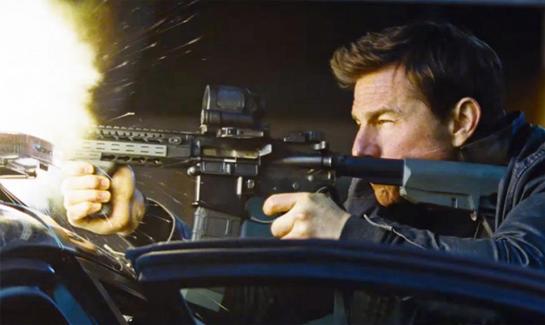
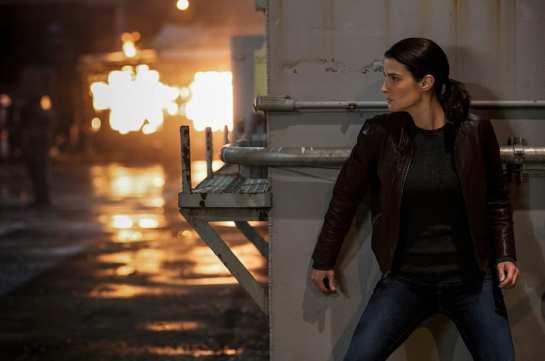
Don’t let its deceptive title fool you. You most certainly can go back. Just look at Tom Cruise, the 54 year-old ageless wonder. 2012 was the first time Cruise took on the role of ‘tough as nails’ ex-military cop Jack Reacher. Now four years later he ‘goes back’ for a second round of high energy, low monotone Reacher-style action.

Edward Zwick directs the film and has some history with Cruise. The two previously worked together on the 2003 epic “The Last Samurai”. Needless to say this is a much different picture. It follows the basic blueprint of the first movie – a no-nonsense, tough guy protagonist, some big action, and a military mystery through-line. Think of it as a big screen NCIS with a larger budget and Tom Cruise running the show.

jack2

Cruise’s Reacher is still a drifter who does his own thing but occasionally lends a hand to the military police he left behind. In doing so he develops an over-the-phone friendship with Major Susan Turner (Cobie Smulders) who now runs his old unit. Upon arriving in Washington DC to meet her for the first time, Reacher discovers she has been relieved of her duties and arrested for espionage.

Sensing an obvious set up, Reacher busts out Susan and the two fugitives set out to find out who wants her dead and why. Along the way Reacher learns he may be the father of a teenaged daughter (played by Danika Yarosh), a convenient little story thread that adds some manufactured vulnerability to our unstoppable hero.

That sarcasm you may sense in my tone can be attributed to the fact that I’m still struggling with how I feel about the film. Broadly speaking I do like it and feel many are being overly critical. It is competently made by Zwick and it delivers exactly what audiences will expect. Cruise is never the problem with his movies and he does good here as well. Smulders is even better as a tough, hard-nosed woman who is a far cry from the normal action movie damsel in distress. She is a genuine action heroine and the one true refreshing element.

jack3

But at the same time, it’s hard to see this as anything more than a ‘one-and-done’ viewing. Despite the efforts of Cruise and Smulders, things never rise above predictable and/or formulaic. There is nothing about the story that will catch you by surprise. And aside from more action and a new subtitle, “Jack Reacher: Never Go Back” doesn’t offer much new for the series as a whole.

Writer Lee Child has written 21 books as part of his Jack Reacher series. “Never Go Back” is based on his 18th novel so there is still plenty of material should they decide to make a third movie. I would go see another Reacher film since I have found entertainment in both of the these installments. But unless they are willing to shake up the formula, Jack Reacher 3 will be more of the same – entertaining enough at first but nothing that will stick with you past that initial viewing.

VERDICT – 2.5 STARS

Remember this trailer? #2 – “Robocop” (1987)

Classic Trailer Flashback – “Robocop” (1987)

When the trailer was released for Paul Verhoeven’s crime/action thriller “Robocop” I can see where people wouldn’t know what to expect. Keep in mind this was the time when Schwarzenegger, Stallone, Norris, Bronson, and company were defining the action genre with tons of bullets, blood, and bodies. Naturally some would watch the Robocop trailer and expect the same. Bullets, blood, and bodies were aplenty (prior to the final edit the film originally received an X rating strictly for its graphic violence). But as it turned out “Robocop” had much more to say than people expected. Themes of police corruption, media manipulation, and authoritarianism among other things were clearly explored making “Robocop” more than your run-of-the-mill action flick.

So, do you remember the trailer for “Robocop”?

REVIEW: “Café Society”

cafeposter

With each year comes a few certainties – taxes, a new model iPhone, a Woody Allen movie. For decades now the 80 year-old Allen has maintained his ‘movie-a-year’ formula with varying degrees of success. His films have shown signs of evolving from tightly wound, exploratory character studies to more free-flowing, nostalgia-soaked wanderings. How it plays with audiences is always up for grabs.

“Café Society” is Allen’s 47th picture and you could say it’s about a lot of nothing. We nose in on the lives of a handful of people, listen to their conversations, witness their quirks, watch their unfolding relationships. That’s basically it. But there are things to glean from these seemingly insignificant interactions. Saying it’s about ‘nothing’ is a little strong, but no one will ever call it deep or profound.

cafe1

The story is set in the 1930’s and its centerpiece is a young man named Bobby Dorfman (Jesse Eisenberg). He’s the youngest son of a Jewish family from the Bronx who wants no part of his dad’s jewelry business. So he packs his bags and heads to the star-studded wonderland of Hollywood.  Once there he seeks out his uncle Phil (Steve Carell), a pompous and powerful movie star agent. Phil gives him a menial job and introduces him to his secretary Vonnie (Kristen Stewart). Bobby instantly falls for her.

Eisenberg and Stewart have a sparkling chemistry and Allen wisely milks it for much of the film’s first half. Their sprightly, youthful banter as they tour local movie palaces and quaint coffee shops is infectious. But it wouldn’t be a Woody Allen movie without some sort of weird relationship contortion which in this case leads to a pivot back to New York for the second half of the film.

cafe2

Sprinkled in among the chronicles of Bobby and Vonnie are short scenes highlighting his family. Some are dinner table conversations between his parents (wonderfully played by Jeanne Berlin and Ken Stott). There is a reoccurring neighbor issue with his sister Evelyn (Sari Lennick) and her high-strung intellectual husband (Stephen Kunken). And there are the antics of his gangster older brother Ben (Corey Stoll). The injections of the scenes can be a bit jarring, but I liked the characters and enjoyed their screen time.

Allen’s film wallows in nostalgia which is actually a strength. The set designs and costumes scream 1930’s authenticity. In the Hollywood segment we get numerous fun Golden Age name drops – Paul muni, Rudolph Valentino, Barbara Stanwyck, Ginger Rogers, just to name a few. And the New York social scene of the time bubbles with pomp and energy in the second half.

cafe3

And you can’t talk about “Café Society” without mentioning the cinematography. The film was exquisitely shot by the great Vittorio Storaro. Film buffs may remember his first American film being “Apocalypse Now”. This is Allen’s first film shot digitally and Vittorio Utilizes every ounce of the technology. It’s filled with gorgeous framing and vibrant colors that burst from the screen. It falls right in line with Allen’s recent emphasis on visually capturing location and time.

Perhaps “Café Society” strolls at its own pace and perhaps Woody Allen is in cruise control with his latter films. Still I had a lot of fun with this one. He once again drew me into his time capsule, caught me up in the nostalgia of the era, and surrounded me with characters who I simply enjoyed following. I certainly can’t defend this as some deep, layered character study. But I can call it a well-made and well acted piece of entertainment that I would say easily falls into the ‘good’ category of Woody Allen pictures.

VERDICT – 4 STARS

4 Stars