REVIEW: “The Martian”

The Martian poster

Ridley Scott’s filmography has been pretty amazing. A quick scan shows it to be littered with cult classics, blockbuster favorites, and Oscar winners. But over the last several years many have hit Scott’s films pretty hard. Personally I have disagreed with the many. I loved the slower, character-driven approach to “Robin Hood”. I don’t think “Prometheus” was nearly as bad as many do. And despite its noticeable flaws, I thought “Exodus” was a pretty grand spectacle.

But now the 77 year-old Scott has once again caught the attention of his critics with “The Martian”, a brainy and somewhat observational  science fiction flick based on Andy Weir’s 2011 novel. Scott has long enjoyed delving into the science fiction realm, yet with “The Martian” he has managed to create something unique. This entertaining mixture of striking visuals and patient, methodical narrative has little in common with Scott’s past sci-fi experiences. “The Martian” is a much different movie but it still spotlights Scott’s talents as a filmmaker even though it may not sit among his best.

1E2FE3AD

“The Martian” plays out like some type of love letter to science and space exploration. There are A TON of science-heavy back-and-forths between the film’s large cast of characters and science is the centerpiece for nearly every scene. In many ways it was captivating to watch and listen to these people speak 10 light years over my head – bouncing around theories, equations, and analyzing data. At the same time it left two-thirds of the film feeling too emotionally dry. Drew Goddard’s script nails down the science but sometimes misses the human element.

The story hops into gear quickly when the Aries III Mars mission is hit by a brutal storm. They are forced to prematurely leave the surface and in the process astronaut and team botanist Mark Watney (Matt Damon) is presumed killed and left behind. Actually though, Mark miraculously survived and wakes up to find himself alone and stranded on the red planet. Armed with more scientific knowledge than a stack of college textbooks, Mark determines to use his science knowhow to survive. That starts by figuring out a way to communicate back to Earth.

For me Matt Damon is the epitome of the ‘reliable actor’. He is always solid and you know what you’re going to get. Here he handles his alone scenes well often talking to only himself of a computer screen. Many scenes require him to carry them ala Tom Hanks in “Cast Away”. He doesn’t exhibit the charisma or charm of Hanks but he more than gets the job done and you never doubt him or his predicaments.

MARTIAN1

The film’s second setting is on Earth. Upon discovering that Mark is alive, NASA sets out to find a feasible rescue plan. To accomplish this the movie introduces us to a host of characters many of which function solely to toss around their own scientific solutions. An interesting ensemble is put together for the NASA scenes. On the better side of the group is the rock-solid Chiwetel Ejiofor who plays Mars Mission Director Vincent Kapoor. In much more curious casting, Kristen Wiig feels terribly out of place as NASA’s chief spokesperson. And while Jeff Daniels certainly wasn’t “bad”, he was a bit hard to believe as the “Head of NASA”.

But there is a third setting and I would argue that it contains the more compelling and entertaining characters. It takes place aboard the Hermes where Mark’s crew is making the long trip back to Earth after losing one of their own. Or so they think. It’s here that the film gives us a better mix of science and human emotion. The casting is also stronger featuring Jessica Chastain, a reserved Michael Peña, Sebastian Stan, Kate Mara, and Aksel Hennie. I loved spending time with this group.

MARTIAN3

“The Martian” has wonderful visuals but not strictly in the way you might expect. There aren’t a lot of eye-popping visual spectacles. It’s more subtle and calculated, concentrating on gorgeous, slow-moving panoramic shots and unique, strategic camera angles that highlight the spectacular space settings. The storytelling is somewhat similar, at least until the last act. Most of the movie has the feel of a smaller more intimate picture despite its grand size and scale. I really appreciated that. It lasts right up until the finale. The ending felt much more studio polished and traditional.

Many people are heralding “The Martian” as a return to form for Ridley Scott. I would argue that he never lost his form but that is another discussion. Instead I’ll just say “The Martian” is another fine movie on a truly great filmmaker’s filmography. It’s not without its flaws. There is some questionable casting and some characters are woefully underdeveloped. Some of the humor doesn’t quite land (including a 70’s disco gag which never ends), and the ending was a bit too by-the-books. But none of these things keep “The Martian” from being a standout motion picture experience. It does several things we aren’t used to seeing from blockbustery type movies and it does them really well. And for me it is another reason why Ridley Scott remains a top-tier filmmaker.

VERDICT – 4 STARS

4 Stars

REVIEW: “The Salvation”

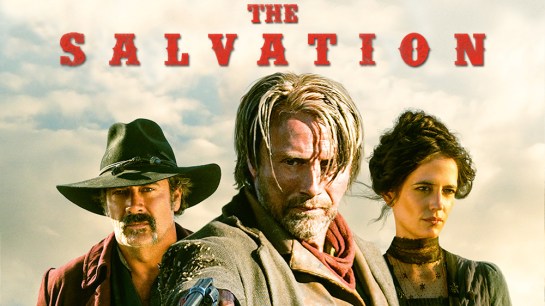
Salvation poster

Several years ago Westerns saw a bit of a resurgence. It didn’t come close to matching the genre’s popularity of the 1950s and 1960s, but it was great to see the visions for Westerns from modern perspectives. We still get the occasional Western from time to time which brings me to “The Salvation”, a Danish revenge tale from co-writer and director Kristian Levring. The film tips its hat to several classic Western movie tropes, but at the same time it maintains an evocative and unique edge to it.

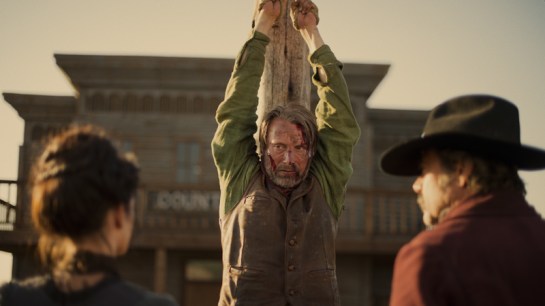
One of the film’s strengths is found in its charismatic lead Mads Mikkelsen. He plays Jon, a Danish settler and ex-soldier in 1870’s America. With the help of his brother Peter (Mikael Persbrandt), Jon establishes himself and then sends word for his wife and son to cross the Atlantic and join him at their new home in the American West. But shortly after reuniting with his family, an encounter with two thugs ends with his wife and son being murdered. Jon tracks down and kills the thugs responsible.

Salvation1

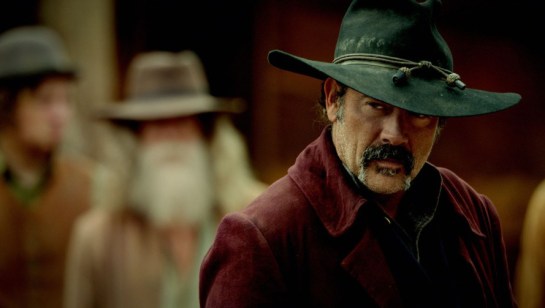
But Jon doesn’t realize that one the dead killers is the brother of a ruthless gang leader named Delarue (played with grizzled gusto by Jeffrey Dean Morgan) and the husband of the physically and emotionally scarred Madalaine (Eva Green). Delarue makes it his aim to find and pay back his brother’s killer. This sparks a conflict with the revenge-fueled Jon that (literally) bleeds into a small town held hostage by fear of Delarue. The town’s weak-kneed sheriff (Douglas Henshall) and opportunistic Mayor (Jonathan Pryce) are little help and they leave Jon to fend for himself.

Mikkelsen is the perfect man for his role. Jon is stern and rugged but also reserved and soft-spoken. Mikkelsen has always been able to convey through expression and Levring often relies on that. The story takes its lead character to some pretty grim places, and a quick gander at Mikkelsen’s filmography will show he’s familiar with taking characters to grim places. On the opposite end of the spectrum is the burly, gravelly voiced Morgan who seems to be channeling a nuanced Jack Elam vibe. Morgan’s character chomps up scenes with a playful abhorrence and he’s a nice counterbalance to Mikkelsen’s Jon.

Salvation2

Another strong point is the revolving aesthetic that defines the film’s dry and dusty world. In shooting the movie Levring and cinematographer Jens Schlosser move between classic Western imagery and a type of visual hyperbole. At times the film looks as if it were plucked out of a Sergio Leone picture. Other times things look stylized and experimental. We see it in backgrounds, camera techniques, and color pallets.

One could say “The Salvation” is too generic and cliché, but I don’t think Levring’s approach is that simplistic. The film certainly borrows from or pays homage (depending on how you choose to look at it) to certain Westerns that came before it. Yet the film has a unique feel and an intense visual flair that goes along with its violent self-awareness. Mikkelsen shines, Morgan is a hoot, Eva Green is a boiling mystery. When put together as a whole it is a stylishly focused and concise movie which happily embraces its influences.

VERDICT – 4 STARS

4 Stars


Great Images from Great Movies (2) – “No Country for Old Men”

Coen Images

Truly great movies leave indelible marks. It may be through an emotional connection to the story. It may be through a remarkable performance or a signature scene. But it could also be through the brilliant imagery that films carves into your mind. That’s what this feature is all about – highlighting great images from great movies.

COUNTRY POSTER

Country9

Country5

Country10

Country1

Country3

Country2

COUNTRY7


COUNTRY20

COUNTRY6

country15

Country14

Country222

country11

Country4

Country8

So what are thoughts on this Coen brothers classic. Is there a particular image that stands out to you?

REVIEW: “Everest”

EVEREST poster

I said this during a recent review – I have a real weak spot for good, thrilling disaster/survival movies. For decades it has been a genre that has constantly found a place for itself on big screens. No catastrophe is too big and no disaster is beyond cinematic creativity. Now of course some of these films have been nothing short of disasters themselves, but still I often find myself captivated by the melding of large-scale peril with human emotion and survival instinct.

Enter “Everest”, the new movie from Icelandic filmmaker Baltasar Kormákur based on the true story of the 1996 Mount Everest disaster. Mount Everest is the world’s highest mountain, ominously standing among Nepal’s Himalayas and armed with some of the most treacherous climbing conditions on planet earth. There is an almost mystic allure that surrounds Mount Everest and it has attracted climbers for years. Documented expeditions dating as far back as 1921 have helped to discover climbing routes as well as shed light on the mountain’s many dangers. Some have resulted in successful summits, but others have ended with disastrous loss of life.

EVEREST2

“Everest” assembles a stellar cast to tell the story of two expedition groups and their attempts to conquer and eventually survive Mount Everest in May, 1996. Rob Hall (Jason Clarke) is an expedition guide for Adventure Consultants. Among his clients are a lively Texan named Beck (Josh Brolin), a meek and timid mailman Doug (John Hawkes), and an experienced Japanese climber named Tasuko (Naoko Mori). They arrive at the base camp where they meet Rob’s team.

Also at base camp is the spirited Scott Fischer (Jake Gyllenhaal), a friendly rival of Rob’s who is there to guide a group for Mountain Madness. As conditions deteriorate and the window to ascend to the summit grows smaller, Rob and Scott agree to team up to try and get their groups to the top. But quickly complications mount as the mountain’s wealth of dangers hit the groups head-on. It turns into a man-versus-nature struggle where sheer survival becomes the ultimate goal.

“Everest” is a unique movie with a firm focus. It isn’t a film interested in serving up deep, fully developed characters. Nor is it interested in building layers of drama between its characters. It could be said that this is a weakness. Actually the film does give us tidbits that open up several of the characters albeit ever so slightly. We learn quite a lot about Rob through his reputation and interactions with his clients, co-workers, and especially his wife Jan (Kiera Knightley). There are also interesting glimpses into Beck and Doug’s backstories that help shape how we look at them.

But to my point, none of that is the prime focus of “Everest”. The film sets its sights on the climb. It grants insight into its characters but just enough to help frame its main focus – man versus mountain. The meat and potatoes of “Everest” is strength, endurance, and the human will to live violently clashing with the captivating, beautiful, yet deadly force of nature. Characters talk of accomplishment and fulfillment, but it all ultimately comes down to this conflict. That is what grabbed me and never let me go.

EVERST1

And perhaps most impressive is the sting of realism we get throughout the story. It doesn’t bomb us with big money moments or action-based contrivances. Everything that happens in preparing and especially during the climb feels organic. At times it is slow and methodical. Other times it is stressful and chaotic. And it is all captured with breathtaking awe. The visuals in “Everest” are stunning with several scenes literally causing me to exhale a deserved “wow”. Whether it’s the sheer beauty of the surroundings or capturing the climb itself, cinematographer Salvatore Totino’s mixture of CGI and on location filming is a sight to behold.

In the end “Everest” felt considerably different than I expected. It isn’t a brash, bombastic popcorn flick. It isn’t a by-the-books ‘real events’ movie. Sure, it has its big name ensemble cast and its share of visual ‘wow’ moments. But at the same time it felt small, concise, and restrained. The performances are exceptional throughout with actors filling in the character gaps and never allowing us to forget the human element. It’s harrowing, tragic, thrilling, and exhilarating. It could have easily been yet another disaster flick. For me “Everest” was much, much more.

VERDICT – 4.5 STARS

4.5 STARS

2015 Blind Spot Series: “The Pride of the Yankees”

YANKS poster

The are some actors who are forever connected to their movie characters and you can’t fathom anyone else in the role. Harrison Ford as Indiana Jones. Marlon Brando as Vito Corleone. Jon Heder as Napoleon Dynamite? For me Gary Cooper as Lou Gehrig in “The Pride of the Yankees” is another prime example. Cooper has that all-American quality that seemed to be present in Lou Gehrig. It also didn’t hurt that Cooper was a fantastic actor with the exact personality the role required.

“The Pride of the Yankees” is unique within its genre. It’s not your prototypical biopic. It’s more of a memorial to the beloved and respected star player from the New York Yankees. The film was released in 1942, only one year after Lou Gehrig died of amyotrophic lateral sclerosis (what is now commonly known as Lou Gehrig’s disease). He was only 37 years old. Naturally his death was fresh on the minds of audiences and there were reservations about the film. Producer Samuel Goldwyn had the now famous opinion that baseball movies were “box office poison”, but he was convinced to go along with it and the end results were respectful and satisfying.

YANKS1

The film doesn’t spend much time following the baseball aspect of his life. Instead the intent is to show his relationships with his wife, his parents, and his teammates. It puts the spotlight on his rectitude and character, on his rise from an unassuming and earnest New York City boy to an unassuming and earnest Major League Baseball player. Screenwriters Jo Swerling and Herman Mankiewicz and director Sam Wood clearly understand Gehrig’s popularity and beloved status. Instead of trying to exploit or manipulate that, their movie aims to build upon the public’s respect by opening up Gehrig’s life which in turn validates his veneration.

The film spends a little time with Lou Gehrig as a young boy before moving to his days at Columbia University. Gehrig (Cooper) has already shown the knack he has for playing baseball, but it conflicts with the plans of his muleheaded but well-intended mother (Elsa Janssen) who wants him to be an engineer. Lou pursues baseball behind her back with the help of his more objective father (Ludwig Stossel) and soon finds himself in the New York Yankees minor-league system. It doesn’t take long for the shy and nervous Lou Gehrig to make it to the big leagues.

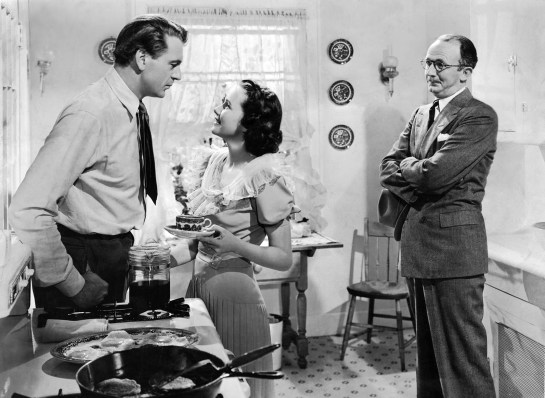
Lou is like a child among his heroes. Actual Yankee players Babe Ruth, Bill Dickey, Bob Meusel, and Mark Koenig play themselves which had to be a ton of fun. At first Lou is treated with the normal rookie disregard, but before long his talents on the diamond earns him the respect of his teammates. He quickly becomes one of their best players and a fan favorite. It’s at a game in Chicago where he meets a woman named Eleanor (Teresa Wright). Their playful relationship soon blossoms into a full blown romance and soon they are married. It’s easy to believe and invest in them which makes it tougher once the news of Lou’s illness comes and it makes the ending absolutely perfect.

YANKS2

The movie spends a lot of its time developing the relationship between Lou and Eleanor. From the awkward but charming dates to their lives as a loving and devoted married couple. At first the two couldn’t be more opposite, but over time the film reveals the confident and spirited Eleanor and the shy and reserved Lou to be “companions for life”. Cooper is such a perfect fit sporting a tall athletic build with that signature common man personality. Surprisingly he knew nothing about baseball and had to learn the game for the role. He even learned how to bat left-handed – not an easy task. And the more I watch Teresa Wright the more I think she is one of the true greats. She received an Oscar nomination for this performance. She was also nominated that very same year for “Mrs. Miniver” and won. Several other supporting performances really work including the previously mentioned Babe Ruth as himself and Walter Brennan as a sportswriter and close friend to Gehrig.

It would be easy for a cynical moviegoer of today to dismiss the emotional pull of “The Pride of the Yankees” especially after being nurtured by modern biopic formulas. It would be easy to dismiss it as overwrought melodrama or cheesy sentimentality. But this is a movie that should be looked at through a unique lens. Its sensibility and relevance to the audiences of 1942 cannot be understated and that is an impact the filmmakers were specifically targeting. While I certainly wasn’t around during the time it was released, I’m still easily able to make that connection. That’s just one reason “The Pride of the Yankees” works so incredibly well.

VERDICT – 4.5 GAMES

4.5 STARS

REVIEW: “The Hunger Games: Mockingjay – Part 1”

mocking poster

Why, why, why? Oh who am I kidding? The reason is obvious – money. That’s the reason they chose to split the final chapter of “The Hunger Games” series into two movies. It certainly isn’t the first time we’ve seen this done. Following the profitable but not narratively beneficial blueprint laid out by “Harry Potter” and “Twilight”, “Mockingjay – Part 1” is the first part of the much anticipated series finale.

The first Hunger Games movie was pretty good although it didn’t convince me that this was a franchise worth following. It was the second movie, “Catching Fire”, that won me over. The characters grow, the stakes are raised, you gain a firm understanding of where the franchise is going, and it ends with a bang. Now enter “Mockingjay – Part 1”, the first part of the final chapter, and a film with nowhere near the pop of its predecessor. It’s not that this is an inherently bad movie. Several interesting things happen. But it is stretched past its limits in order to make this a two-movie ending and the film suffers for it.

mocking1

All of the cast of characters return led by Katniss Everdeen (Jennifer Lawrence). Recuperating from the chaotic conclusion of “Catching Fire”, Katniss wakes up in District 13, the home of the burgeoning rebellion. After a brief reunion with her mother and sister, her is introduced to President Coin (Julianne Moore) who wants Katniss to be the face (AKA the Mockingjay) of the growing rebellion. Old friends Plutarch (Philip Seymour Hoffman) and Beetee (Jeffrey Wright) encourage Katniss to take on the role and inspire the people.

But Katniss remains unsure, that is until she see is taken to see the carnage and ruins of her home district left behind following an intense bombing by the Capitol. She eventually accepts but only if President Coin agrees to send a rescue team to free a captured Peeta (Josh Hutcherson) from the Capitol city. Peeta is being used by the noxious President Snow (Donald Sutherland) as a propaganda piece to quell the rebellion. Several other familiar faces return. Gale (Liam Hemsworth) is given a bit more to do this time around. Haymitch (Woody Harrelson) pops up in a couple of scenes to offer sage-like counsel. Effie (Elizabeth Banks) appears in what is basically a tag-along role. And Stanley Tucci’s wacky Caesar gets very little screen time.


“Mockingjay – Part 1” doesn’t offer a lot in terms of thrills and excitement. Instead it gives us speeches and debates. Then it gives us more speeches and debates. We have long moments of indecision, lots of pondering, a bunch of planning. We visit a few locations (one of them twice where we get the exact same camera shots) and we get a couple of random scenes featuring inspired rebels. But very little spans beyond Katniss’ reluctance in becoming the Mockingjay and the political wrangling by both the rebellion and the Capitol.

mocking2

To be fair, I did enjoy a lot of the political back-and-forths. I also still like spending time with most of these characters. And Jennifer Lawrence is once again superb. There is nothing glamorous about her role. She attacks it with such conviction and delivers genuine raw emotion. There are also great performances from Hoffman, Wright, and Sutherland who is so playfully vile as the the chief antagonist. Moore was the biggest new addition and she serves the part. But her character is pretty straightforward and generic and she is isn’t asked to show much range.

I know “Mockingjay – Part 1” is considered a part of a greater whole, but as a single movie it disappoints. It felt like a gradual meandering buildup towards a climax that we never get. Even the cliffhanger (if you can even call it that) was shockingly underwhelming. And you can tell that numerous scenes were stretched as far as they could go in order to make this a two-picture conclusion. Yet still there are enjoyable moments, good characters, strong performances, and the knowledge that this is just a set-up to what should be an action-packed final film. But as a single standalone movie, I was definitely hoping for more.

VERDICT – 3 STARS

3 Stars