2015 Blind Spot Series: “My Life to Live”

BLIND SPOT

“My Life to Live”

“Vivre sa vie” or “My Life to Live” is a French New Wave film that also feels distinctly different from some of the more prominent movies of the highly influential movement. Director Jean-Luc Godard released the film in 1962, two years after his groundbreaking debut “Breathless”. Viewers will undoubtedly see similarities between the two films, but “My Life to Live” differentiates itself both in structure, subject, aesthetic, and style. “My Life to Live” undoubtedly attempts to buck common, overused movie trends – something French New Wave films sought to do. At the same time Godard makes “My Life to Live” distinctly its own.

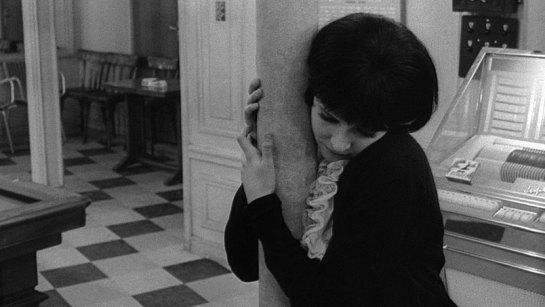
The captivating Anna Karina plays the lead character Nana and she was Godard’s wife at the time. Interstingly, Godard first noticed Karina in a series of Palmolive ads. Godard was preparing for “Breathless”, his feature film debut, and offered Karina a small role in the picture. She turned him down but his persistence led her to be in his next three films and his wife for four years. Their relationship is evident in the movie. Godard’s camera seems enamored by Karina’s face, by her expressions, by her countenance. His concentration on her eyes, the features of her face, the language of her body. Unquestionably much of Godard’s story is told through the lens of his star.

LIFE1

The film is broken down into twelve chapters each with basic synoptic captions. The first introduces us to Nana who is at a cafe with her husband Paul. We learn that she has just left him and their infant daughter to pursue acting. The revealing scene paints a complex picture of Nana. Adding to that complexity is the intriguing camera work by Godard and long-time cinematographer Raul Coutard. The focus is mostly on the back of the two character’s heads. The camera shifts back and forth while strategically giving us glimpses of their faces often through a mirror’s reflection. It leaves us curious about Nana and unsure how we are to feel about her.

Nana’s acting dream seems unrealistic. We see her working in record shop but apparently she can’t make ends meet. She asks different people to borrow money and one particular scene shows her being forcibly removed from her apartment. Out of a sense of desperation she turns to prostitution. But is it desperation or simple necessity? Nana is never easy to read. She approaches life with an open book mentality yet I always found a cloud of mystery around her. At times she seems impervious to possible consequences of her actions. Other times there is a playful life-loving personality that bubbles out. At other times she feels overwhelmed by her circumstances. Mainly she wants to be able to define her life and she wants to be the one to live it.
Life 2

The film’s look into prostitution of the day adds another level of intrigue. We see Nana grow more and more comfortable and content, but at the same time we the audience begin noticing cracks and concerns within her environment. Godard goes to great lengths to educate us on the mentalities, practices, and laws that made up the Paris prostitution scene of early 1960s. It gives us a better perspective even if it sometimes feels a bit dry and procedural. The coolest thing is how the approach to this element draws from the cinéma vérité documentarian style.

“My Life to Life” is a captivating film slowed down only by the occasional lulls – moments when Godard’s experimentation feels like experimentation instead of storytelling or progression. Still, it’s hard not to be drawn in by the portrait Godard paints. And his cinematic model Anna Karina is a mesmerizing expression of energy, wonder, and reality. Surround her with intoxicating style, layers of cultural references, and a grounded story and you have “My Life to Live” – a film that is uniquely its own nestled within the French New Wave.

VERDICT – 4 STARS

4 Stars

THE END

5 Phenomenal Movie Airport Scenes

movie_theatre - Phenom 5

Vacation time is in full swing. Families are packing up and heading to different locales around the world. Airports are buzzing. That got me to thinking about today’s Phenomenal 5 – movie airport scenes. Just take a moment to think and you will quickly realize that airports have been memorable settings for some truly great movie scenes. Today we are looking at five of my favorites. Now I did try to steer clear of obvious choices and movies that spend a ton of time in airports. Movies like “Airplane!” and “Die Hard 2” would otherwise easily make this list. In light of that I wouldn’t call this the definitive list. But there is no denying that these five movie airport scenes are nothing short of phenomenal.

#5 – “Up in the Air”

UP AIR

There are a couple of great scenes in Jason Reitman’s underappreciated “Up in the Air”. The one I’m including today is Ryan’s (George Clooney) first trip with Natalie (Anna Kendrick). The obnoxious seasoned traveler Ryan is like a machine – navigating the airport with precision. Natalie seems like a fish out of water and Ryan takes it upon himself to break her in. The scene is laced with humor but it also does a good job of helping to define Clooney’s faulty and often annoying character.

#4 -“Heat”

HEAT

“Heat” is a Michael Mann crime thriller masterpiece featuring two of cinema’s heavyweights – Robert De Niro and Al Pacino. There are so many great scenes and one of them takes place at an airport near the end of the movie. I certainly don’t plan to ruin it for those who haven’t seen it, but the film simmers and builds towards this inevitable confrontation. And while the terminal itself is a backdrop, the airport plays a pivotal role in how things play out. It is a fabulous scene.

#3 – “Argo”

ARGO AIRPORT

The suspense and intensity is what drives “Argo” and its fabulous airport scene. The stakes are through the roof in Ben Affleck’s Best Picture winner which tells the story of the CIA’s rescue of Americans during the Iran hostage crisis. This is another airport scene that serves as the film’s climax. It is clearly injected with dramatic effect but it works. The tension builds throughout the scene and Affleck films it masterfully. “Argo” received its share of negativity, but I’m a fan of it and its great airport scene.

#2 – “Bullitt”

BULLITT

Do you sense a trend here? “Bullitt” features a great airport scene near the end of the film. After several twists and turns Frank Bullitt finds himself on the trail of his chief suspect. It leads him to San Francisco Airport. Once there he must navigate more false leads before ultimately staking out a spot in the terminal. What follows is a great sequence that has you questioning along with Bullitt. Then there is the way it all unwinds. It is a fine conclusion to a true cinema classic.

 #1 – “Inception”

INCEPTION

Christopher Nolan’s “Inception” remains one of my favorite movies from recent years. For me it was an unmatched experience. Everything hit the right note to me including the incredible, emotional ending. A key part of that ending takes place in an airport where we see if Cobb’s (Leo DiCaprio) efforts have paid off. It is a beautifully shot sequence energized by a subtle yet effective suspense. And Hans Zimmer’s brilliant music is almost beyond description. I adore this scene and ending. I still find myself moved by it each time I watch.

So there are five truly phenomenal airport scenes. See something I missed? Please take time to share your thoughts or your picks in the comments section. I’m anxious to hear what would have made your list.

REVIEW: “Pompeii”

POMPEII PoSTER

I’ve always thought that the story of Pompeii was prime material for a big budget motion picture. Without getting too deep into the history, Pompeii was a Roman city nestled at the base of Mount Vesuvius. In 79 AD Pompeii and its inhabitants were decimated when Vesuvius suddenly erupted sending tons of ash and volcanic rock showering down. At the time somewhere between 12,000 and 20,000 people lived in Pompeii. Obviously it’s a sad and tragic story and I’m surprised that modern Hollywood hasn’t tackled it before.

Enter Paul W.S. Anderson and his succinctly titled “Pompeii”. Not exactly my first choice to direct such a potentially intriguing project, and once you start watching this film you quickly realize that this isn’t the smart and engaging historical epic it could have been. Instead it’s a silly and cliched exercise featuring numerous borrowed plot points and loads of cheese. It’s the kind of film you’re used to getting from Anderson – not totally unwatchable but far from being as good as it could have been.

POMEII1

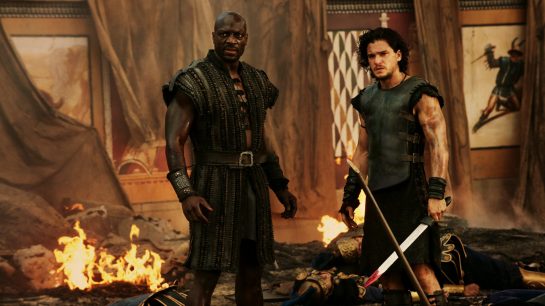
“Pompeii” plays like a poor man’s “Gladiator”. The problem is here we have no Ridley Scott, no Russell Crowe, no engaging and emotional story, no epic feel, none of the things that made “Gladiator” such a good film. But its clear aim is to be an action film first and foremost. The story starts with a flashback that shows us a young boy witnessing the brutal deaths of his parents on the battlefield at the hands of the Romans, particularly their evil field leader Corvus (Keifer Sutherland). Jump ahead 17 years later. The boy, whose name is Milo, is now a man and has been raised as a Roman slave and gladiator. Milo (played with the emotion of a brick by Kit Harington) and his unmatched fighting skills are noticed by his slave owner who then takes him to Pompeii to fight in their gladiator arena.

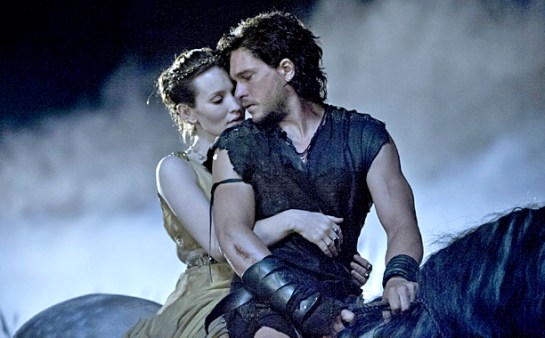
On the way there Milo catches the eye of the Pompeii governor’s daughter Cassia (Emily Browning). Can’t you see where this is going? Forbidden love springs up between a beautiful woman with status and a lowly slave with six pack abs and nice hair. We’ve seen this many times before. But what makes this worse is that the love story is so rushed and underdeveloped. The characters are already flimsy and then to have practically no attention given to building up their relationship. Everything about their love for each other feels phony and false.

In addition to being a “Gladiator” wannabe and a lightweight romance, it also becomes a revenge flick once Corvus shows up in Pompeii. Milo certainly hasn’t forgotten the man who slaughtered his family and added fuel comes in the form of Corvus’s affection for Cassia. And once Mount Vesuvius erupts it becomes a CGI heavy disaster movie. Oddly enough Vesuvius takes a back seat to all of the other stuff going on. Occasionally director Anderson throws in a brief scene to remind us of the ominous mountain, but for the most part its threat is terribly underplayed. And even when the eruption does happen the film wanders all over the place and the disaster element feels wasted.

POMPEII 2

Even more disappointing are the special effects. You would think that this film would at least provide some spectacular visuals. Well, there are moments that look really good, but there are just as many that are underwhelming. Quite frankly sometimes the effects look cheap and they resemble a television show instead of a motion picture with an $80 million budget. There are other glaring issues such as the clunky half-baked dialogue that spells out every thought and every emotion for the audience. We are rarely allowed to feel or think for ourselves. We are rarely allowed to glean emotional information from the character’s actions. It is all told to us.

Yet it’s funny, despite all of these gripes “Pompeii” still isn’t as bad as it could have been. There is an old fashioned quality to it that made it at least entertaining (in an odd sort of way). Also at just over 100 minutes it doesn’t drag itself out and overstay its welcome. Unfortunately its blunders are aplenty and it’s impossible to take anything the film does seriously. It copies off of so many overused storylines and none of the performances are good enough to energize the film. It’s a subpar concoction that is easy to digest, but you won’t care if you ever go back and taste it again.

VERDICT – 2 STARS

2 Stars

REVIEW: “Into the Storm” (2014)

STORM POSTER

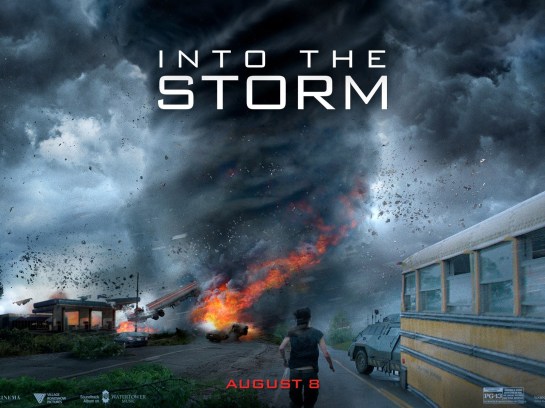
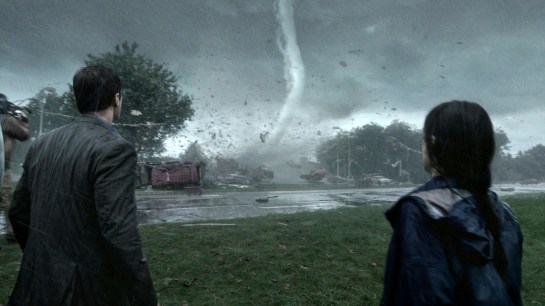
Tornadoes and heavy CGI devastation. “Into the Storm” put all of its eggs (and money) into that basket and hoped it was enough to win an audience. With a budget of $50 million and a box office take of $160 million I would say the movie more than accomplished its goal. Less discerning fans will leave satisfied with the numerous twisters and their swirls of dirt and debris. But if you happen to be looking for anything more than that “Into the Storm” will leave you wanting.

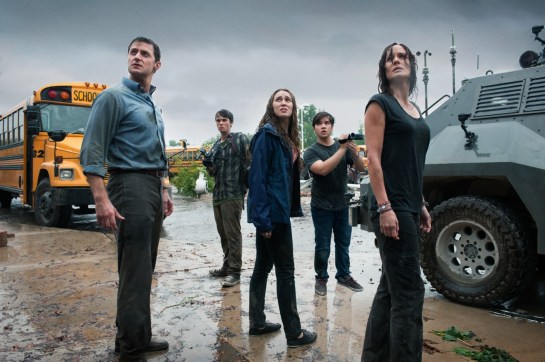
The story follows a couple of groups in and around the small town of Silverton, Oklahoma. One is a group of storm chasers led by Pete (Matt Walsh). He is a veteran chaser who is also working on a documentary, but the storms haven’t been good to him. He’s desperate to track down a tornado and he has brought in meteorologist Allison Stone (Sarah Wayne Callies) to help. She’s on a short leash especially after missing a recent storm and costing Pete some good footage. Pete reluctantly follows Allison’s storm tracker hunch and they head to Silverton.

STORM1

In Silverton school vice-principal Gary Fuller (Richard Armitage) is a widower and father of two high school boys. Donnie (Max Deacon) is his more quiet and reserved son. Trey (Nathan Cress) is his more obnoxious younger brother. Neither have had the best or most open relationship with their father since their mother died. It won’t help matters that Donnie shirks his duties of filming a graduation ceremony to help the girl of his dreams with her video school project.

As you can guess a massive storm front comes through spawning a number of tornadoes in Silverton. The movie takes us back and forth between our two groups as they encounter one destructive twister after another. Eventually both groups come together and must survive the queen mother of all tornadoes. I know this is true because one character actually says something like “It’s the biggest tornado ever”. This movie does that a lot. We aren’t allowed to glean information for ourselves. Everything is spelled out for us. Also don’t expect to find interesting and compelling characters. Everyone feels unoriginal and scripted. But to be fair plot, dialogue, and character development aren’t priorities here.

STORM2

“Into the Storm” partially redeems itself with its visual presentation. It’s hard not to be impressed with the CGI twisters blowing down trees, tearing through buildings, and slinging 18 wheelers like footballs. The special effects are thrilling, well conceived, and very satisfying. Clearly a huge hunk of the budget went towards the visuals and that’s okay. Most people will see the movie for Mother Nature’s spectacle and it doesn’t disappoint. The only thing that hampers the looks of the film was the decision to go the found-footage route. It’s implementation is clunky, annoying, and quite frankly I’m tired of the gimmick.

At a brisk 89 minutes “Into the Storm” doesn’t exhaust its welcome. It aims for one rather uninspired target and for the most part it hits it. In that regard I had fun with it. But the overly familiar characters, the bland and sometimes silly dialogue, and the plot’s lack of any originality whatsoever makes this just another run-of-the-mill disaster movie. And this leads me to a question: Can we not have a smart and engaging weather based disaster flick? I don’t know, maybe rain, wind, and intelligent creative writing don’t mix.

VERDICT – 2.5 STARS

REVIEW: “Annabelle”

ANNABELLE POSTER

One of my favorite horror movie from recent years was 2013’s “The Conjuring”. The film was a huge success banking close to $320 million at the box office. Well obviously Hollywood wasn’t going to let that kind of success rest with just one movie. A proper sequel is scheduled for a 2016 release but in the meantime we’ve been given “Annabelle”, a prequel to “The Conjuring” and potentially a new spin-off franchise. Much like “The Conjuring”, “Annabelle” was a huge box office success raking in over $255 million against its small $6.5 million budget.

“Annabelle” starts with the exact same opening scene that we see in “The Conjuring”. It’s 1970 and three young people are telling the Warrens about their terrifying experience with a doll they believed to be possessed. The film then moves back one year and follows a handsome young couple, John and Mia Form (Ward Horton and Annabelle Wallis). They live in a nice neighborhood in Santa Monica, California and are expecting their first child. John surprises Mia with a doll she has wanted for their nursery. Apparently Mia has a weird taste in dolls because this thing is the ugliest and creepiest looking doll you’ll see.

ANNABELLE1

One night Mia is awoken by screams from their neighbor’s home. While John is checking it out a man and a crazed woman holding the doll attacks Mia. The police show up and kill the man while the woman locks herself in the nursery and commits suicide while cradling the doll in her arms. As a result of the traumatic event and some subsequent unexplained phenomena, Mia asks John to get rid of the doll. The couple have a healthy little girl named Leah, leave their troubling Santa Monica home, and move to Pasadena to start over. But while unpacking guess what they find? Yep, it’s that creepy doll that John had thrown away and as you can guess a series of terrifying occurrences follow.

“Annabelle” becomes a fairly standard mix of haunted house and possession horror. It’s pretty slow moving and it takes some time to get rolling. But when the attempted scares do come they are your garden variety creaking doors, flickering lights, and frightening figures lurking in the shadows. There are a small handful of unsettling moments but for the most part “Annabelle” just doesn’t have the frights I was hoping for. It meanders a bit too much and none of its horror elements feel original. And perhaps the biggest problem – they just aren’t that scary.

ANNABELLE

Another shortcoming is tied to the performances. I’m not a bit familiar with Annabelle Wallis or Ward Horton but neither offer much in terms of charisma. It’s not that their performances are bad. They just feel terribly generic and by-the-books. Horton and Wallis are definitely likable and they are a very attractive couple, but their relationship never feels authentic. For me there was always a constant reminder that their relationship was scripted. Again not bad performances but pretty dry and buttoned up.

“Annabelle” often teases us with what it potentially could have been. It lays out a promising premise but it never goes beyond the routine run-of-the-mill horror flick that we have seen over and over. I loved “The Conjuring” and I like the idea of having tie-ins which expand the concept. But “Annabelle” doesn’t get the job done and if it does become a franchise, I can’t see myself investing much of my time in it. Simply put, regardless of its intentions and its potential, the film doesn’t do enough. That’s a real shame.

VERDICT – 2 STARS

2015 Blind Spot Series: “The Champ”

CHAMP POSTER

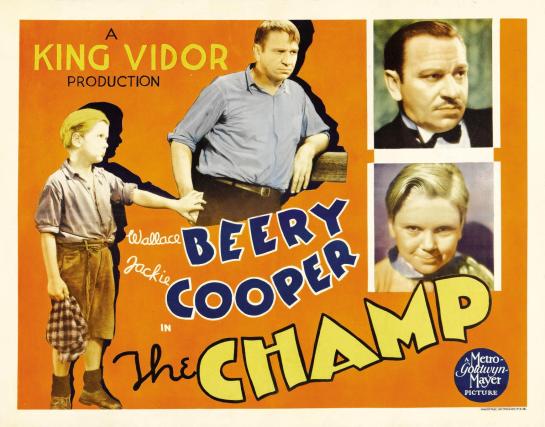
Hidden under the guise of a ‘down on his luck boxer’ movie lies one of the most vibrant and authentic father/son relationships ever put on film. It’s this relationship that is at the heart of the 1931 film “The Champ”. Throughout the decades to follow a number of movies would follow a similar blueprint in exploring the father/ son dynamic. “The Champ” is unashamedly melodramatic, but it’s very effective thanks to a strong script and two fantastic lead performances.

The Best Actor Oscar went to the film’s star Wallace Beery who plays a washed-up former boxing champion named Andy Purcell. He lives in a small run down apartment in Tijuana, Mexico with his adoring eight-year-old son Dink (played by Jackie Cooper). Andy’s self-destructive behavior keeps him from making things better for himself and his son. Every time an opportunity comes his way Andy finds a way to squander it and it could eventually cost him what he holds dearest.


Champ1Frances Marion’s story (which also won an Oscar) paints a vivid picture of the unwavering confidence and blind love that small children have in their parents. Dink sees his dad as a larger than life superhero of sorts. Yet he is constantly let down by his father’s drinking, gambling, and carousing. Jackie Cooper was such a treat. Watching him deliver young Dink’s roller coaster of emotions was a surprise. He avoided most of the traps that many golden era child actors often fell into and gave the film a ton of heart.
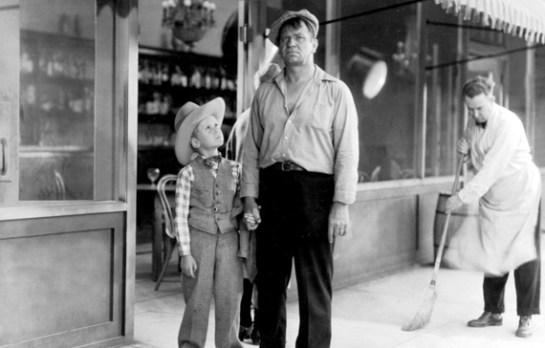
Cooper had caught attention with his work on “Our Gang”. Hal Roach, seeing Cooper as a potential film star, sold Cooper’s contract to MGM. “The Champ” soon came afterwards and it marked one of several collaborations Cooper would have with Beery. The two had a charming and believable chemistry which is a surprise considering that Beery made their off camera relationship difficult.


Champ2At the time this film was a part of Beery’s career resurgence. He had been a popular silent film star but had seen his star fade with the influx of ‘talkies’. “The Champ” solidified his return and spotlighted his knack for deeper and more dramatic performances. Beery gives us a character that is hard to like yet there is something about him (aside from our affection for Dink) that makes us want him to turn things around. Beery grounds Andy in reality which connects us to him and his circumstances.

“The Champ” is heavy on melodrama and some could argue that it milks emotions dry. I think all of that works because we never lose our investment in the two lead characters. Beery and Cooper drive the film which is full or heart, humor, and authenticity. It’s a very straightforward and unashamed look at one of the most important relationships we can have. More importantly, the movie doesn’t just look at it. It presents it in a way that touches the audience deeply. That in itself is an accomplishment.

VERDICT – 4.5 STARS