REVIEW: “Mad Max: Fury Road”

MAX POSTER

Has it really been 30 years since Mel Gibson last drove across George Miller’s dystopian desert wasteland in “Mad Max Beyond Thunderdome”? My how time flies. Between 1979 and 1985 visionary filmmaker Miller gave us three films: the intriguing but lethargic “Mad Max”, the fabulous cult classic “The Road Warrior”, and the fun but commercial “Beyond Thunderdome”. While the second film was the real standout, I have always had a natural soft spot for the entire franchise. So of course I would be enthusiastic when it was announced that a fourth installment was finally seeing the light of day.

For years Miller has toyed with the idea of bringing Max back to the big screen but there were always obstacles that hindered him. Mel Gibson was set to reprise his role and at several points the project seemed good to go. Several years have passed, Tom Hardy replaces the aged Gibson, and “Fury Road” is a reality. What’s truly amazing is that this is the wildest, craziest, and most visually arresting installment yet and all from the mind of its now 70-year old creator.
MAX1

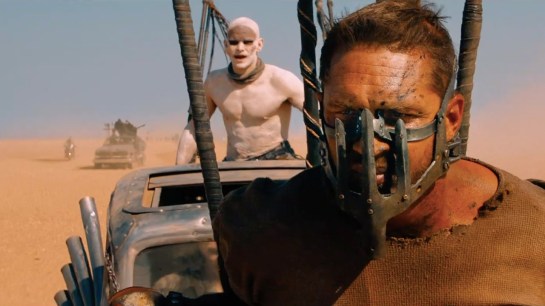
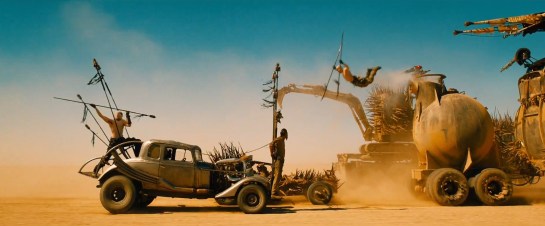
The first three films had a combined budget of less than $20 million. For “Fury Road” Miller was given $150 million and you will instantly see the benefits. The visuals are an essential component to this film. This is an unapologetic, full-throttle thrill ride, and a textbook lesson on how to make an action movie. Make no mistake, the action in “Fury Road”  is intense and relentless. The vehicular carnage is unlike anything most people have seen before. The story is a bit lightweight and clearly intended to serve the plot’s madness. This all may be enough to scare away some people. For me, it was the film’s unflinching, fuel-injected focus that made it the best movie experience I’ve had this year so far.

The film opens with a gruff Hardy saying “My name is Max. My world is fire and blood”. His world is an energy-starved, post-apocalyptic desert wasteland where he is haunted by his past and driven only by survival. Within the first few minutes, the nomadic Max is captured by the army of a savage and wickedly grotesque tyrant named Immortan Joe (Hugh Keays-Byrne). Max’s capture leads him to cross paths with Imperator Furiosa (Charlize Theron) who attempts to smuggle Joe’s five enslaved childbearing wives to safety. This invokes the wrath of the maniacal leader who brings his entire army after them. And guess what, Max is caught right in the middle.

I can’t think of a more fitting actor to take on the role of Mad Max than Tom Hardy. His dialogue is sparse and he mainly tells his story through grunts, expressions, and outright physicality. And he does it all to sheer perfection. It’s a very unorthodox role. He’s not asked to say much and he spends a good third of the movie with his face partially obscured by a metal contraption. But he masterfully sells us this tough, surly, and untrusting Max character. But the real surprise was watching Charlize Theron match his toughness punch for punch and bullet for bullet. She is so good here.
MAX2

But of course the true star and the main attraction is George Miller and his insanely energetic action and presentation. “Fury Road” is a visual delight – a movie filled with “wow” moments, unbelievable stunts, and mind-blowing vehicle action sequences. Miller shoots his action with a chaotic precision and cinematic fluidity. Many modern action directors should take notes. But equally impressive are the stunning amount of practical effects used. When mixed with the top-notch CGI, it makes this one amazing looking film. And going along with the stellar visuals is Junkie XL’s vibrant and invigorating score.

Some of us had given up on Mad Max ever returning to the big screen. After 30 years it was a reasonable conclusion. But after seeing “Fury Road” I can boldly say it was worth the wait. George Miller has given us an installment that stands right there with (and probably an inch or two above) his phenomenal “The Road Warrior”. This is pure action cinema – a beautiful mixture of old-school style and modern movie technology. And after this taste of Miller’s vision, I can only hope he has more Mad Max movies plan for the future.

VERDICT – 5 STARS

5 STARSs

5STAR K&M

REVIEW: “Maggie”

MAGGIE POSTER

One could make the argument that the cinema landscape has been saturated with zombie movies. There have been numerous interpretations of zombie horror. We have had zombie comedies. We’ve even had a weird zombie romance flick. Yet with so many variations of zombie movies, I’ve seen nothing quite like “Maggie”. Writer John Scott 3 pens a story that pulls the focus off of the normal zombie movie machinations and tropes. Instead he shoots for a more personal approach by spotlighting intimacies rarely considered in these types of films.

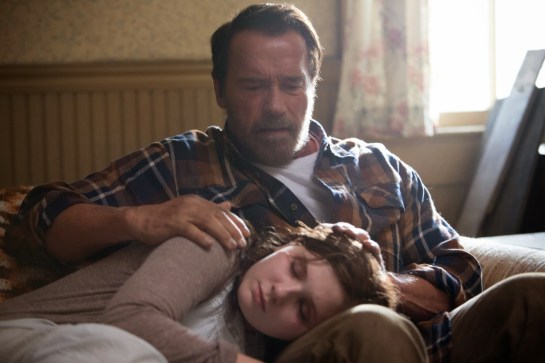
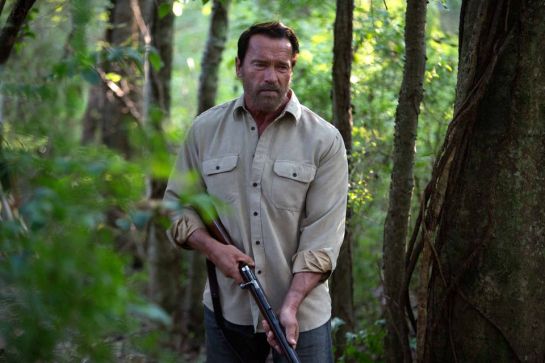
“Maggie” is a movie full of surprises. Perhaps the biggest comes in the lead performance from Arnold Schwarzenegger. In a dramatic departure from anything he has done before, Arnie plays a father whose daughter has been bitten and infected with a deadly, incurable virus. The majority of the story focuses on their time together between the onset of the virus and what looks like the inevitable outcome. Schwarzenegger dials it back and shows an understated side to his acting that is absolutely essential to his character, Wade Vogel. His bearded face is worn and weathered and he is clearly a man tormented by his new reality.

MAGGIE1

Abigail Breslin plays his daughter Maggie. We first meet her making a phone call to her father telling him not to come looking for her. Soon after she is caught in town past the city curfew and it is revealed she has been bitten and infected by the fatal disease that has ravaged most of the world’s population. Wade is allowed to take Maggie home for her final days until the virus reaches a point where she must be sent to what is called Quarantine to be “processed”. Joely Richardson is very good as Maggie’s caring but nervous stepmother. She struggles to balance her support for Wade with her fears of Maggie’s condition.

In a way “Maggie” could be called a family tragedy. It just happens to take place during a zombie apocalypse. But zombies are never the focal point. Their threat lingers in the background occasionally showing itself. Director Henry Hobson keeps his film from becoming a ‘zombie movie’. He effectively uses that backdrop to energize the movie’s sad and hopeless setting, but whenever the film is potentially moving into conventional directions his restraint becomes obvious and he pulls us back to the primary focal point.

Maggie2

As a whole, Hobson’s direction is yet another of the film’s surprises. It’s always nice to see a first time director throw aside a number of conventions and add a degree of style. This is clearly seen in the great job he does capturing mood and atmosphere. It’s well realized through Hobson’s camera, by his strategic use of David Wingo’s score, and through the telling expressions of his cast. Without the right tone the story would have fallen flat. I also like the deliberate pace of the story, something that Hobson and Scott clearly aim for. I can see where some may find it slow and even languid, but I never felt that at all. I fell right into the pacing and the story itself.

“Maggie” intrigued me from its first trailer, but the actual movie was even more enjoyable than I expected. It is such an interesting mix of subtle horror and emotional family drama. And even when it leans a little heavy on the melodrama, it feels surprisingly earned and acceptable. There is also an earnest sweetness at the heart of “Maggie”. The central father/daughter relationship is what drives the film and provides its satisfying emotional core. And that relationship is strengthened more by two very good performances particularly Schwarzenegger who shows us a side that I hope to see again.

VERDICT – 4 STARS

REVIEW : “The Expendables 3”

EXPEND POSTER

The entire Expendables franchise started as a nostalgic rekindling of the once prominent over-the-top action genre. It wasn’t afraid to parody itself or play with the familiar action cliches of the 1980s and early 90s. And half of the fun was just seeing these actors together hamming it up and shooting a ton of bullets. The first film was entertaining and it set the table for the second installment which I thought was funnier and more self-deprecating while clinging to the all-important nostalgia. Now we have an inevitable third film which tries to keep the ball rolling.

“The Expendables 3” is made for a PG-13 audience (at least so it says), but don’t be misled. The body count is still astronomical and bullets fly aplenty. But the blood is reined in just enough to somehow keep it from an R rating. Unfortunately its desire for a broader audience, while noble in purpose, is undermined by the fact that the movie simply isn’t as fun or nostalgic as either of the first two pictures.

EXPEND1

Sylvester Stallone and his action ensemble returns minus Bruce Willis who declined because he wanted more money (one of the film’s funnier jokes takes a shot at the publicized dispute). And in keeping with the franchise’s trend, several new stars are added into the mix. Wesley Snipes, Antonio Banderas, Harrison Ford, Mel Gibson, and action star extraordinaire (sarcasm absolutely intended) Kelsey Grammer. These are some interesting names and it would be fun to see what the movie would be like if they were all that was added to it.

But in an attempt to inject some youth and potentially pass the torch, a group of new Expendables are added to the group. This is one of the film’s major blunders because none of these youngsters are the slightest bit interesting. They are cardboard cutouts and sometimes their acting makes Stallone’s look good. In case you don’t know, that is no compliment. They are walking talking cliches and they zap the movie of its fun and playful energy.

But the film’s main dish is the action and as I mentioned there is plenty of it. The problem is it lacks the pop that we’ve seen in the other flicks. What I mean is the action scenes rarely energize the movie. In the earlier films regardless of whatever narrative problems they would be having you could count on the action to liven things up. Here it often feels generic and monotonous. There are moments when they do pull off one of those great over-the-top stunts that feels right at home in the 80s. There are other moments that just feel like a boring grind.

EXPEND2

Thankfully some of the old action veterans do save this from being a disaster. Mel Gibson is deliciously maniacal as the head baddie. While his grand scheme and ultimate motivations are murky, Gibson has a ball with the character and I loved every minute he was on screen. Harrison Ford was also a hoot as a grumpy hard-nosed CIA officer. Arnold Schwarzenegger is also fun and every line he has seems to be poking fun at himself. Same with Wesley Snipes. But many of the cast gets lost in the shuffle and rarely get their signature moment in the film. Too many characters and not enough screen time to go around.

In the end “The Expendables 3” lacks the fun, the excitement, and the charm that the franchise built itself on. The action isn’t good enough this time around to save the film from its clunky and paper-thin plot. And while some of the old guys are a lot of fun, namely Gibson and Ford, too many characters are shortchanged thanks to the introduction of an insipid younger crew. It’s unfortunate because I have always enjoyed these movies as entertaining nostalgic escapes. “The Expendables 3” has left me wondering if this ship has run its course.

VERDICT – 2 STARS

REVIEW: “Avengers: Age of Ultron”

AVENGERS POSTER

It could be said that the first Avengers movie was in a ‘can’t miss’ position. Sure, with that much ambition comes a degree of risk. But fans had already shown their devotion to the Marvel movies at that point. Iron Man, Captain America, and Thor each had their own films which had earned a ton of box office cash. Bringing them altogether was sure to bring in truckloads of more money. That proved to be true to the tune of over $1.5 billion worldwide. And of course that doesn’t include home-video, merchandising, etc. More importantly, as a movie fan, the first film was fun and very satisfying.

So as is customary in modern Hollywood, a sequel was on the way and we get it in the form of “Avengers: Age of Ultron”. Writer and director Joss Whedon is back this time with a new and unique set of obstacles in front of him. First, it’s always a challenge for a sequel to recapture the magic of a successful first movie while also being distinctly its own film. Also, if Whedon thought expectations were high for the first movie, they are nothing compared to what people will expect from the sequel. And then there is the question of superhero fatigue. Can Whedon and company continue to energize a genre that has a small but growing list of detractors?

AVENGERS1

I always give Marvel Studios credit. Their movies aren’t the assembly line sequels that we see each and every year. Certainly some films work better than others, but Marvel is always building upon their bigger cinematic universe and continuity which I enjoy. But for those not thoroughly invested it could be a legitimate stumbling block. “Age of Ultron” is unquestionably an installment – a transition chapter in this enormous franchise. Loose ends are tied up and potential plot holes related to other Marvel films are addressed throughout. Again, these are things that will satisfy fans but probably fuel the indifference of those not on board.

The film starts with our heroes attacking the snowy mountain compound of Baron von Strucker. He was the guy last seen in the mid-credits scene of “Captain America: The Winter Soldier”. Strucker has obtained Loki’s scepter and is using its powers for human experiments and other nefarious practices. The results of the conflict leads Tony Stark (Robert Downey, Jr.) to fulfill an ultimate peace keeping goal of his – the creation of an ultimate A.I. named Ultron (voiced by James Spader). Ultron becomes self-sustained and self-aware and immediately begins his own plan of global peace which happens to include the distruction of the world. Tony’s mishaps with Ultron and his failure to inform his fellow Avengers of his project creates a festering tension between the team. But they must work together if they have any hope of beating this new threat and once again saving the world.

AVENGERS2

That is just a brief set up to what is a movie jam-packed with moving parts. There are so many characters and subplots that are being serviced and it is a testament to Whedon’s writing skills that the film is coherent at all. Wrapped around the central story are countless tie-ins from previous movies and setups for future films. It truly is a miraculous feat, but it’s not a flawless one. There were a handful of things that felt terribly shortchanged occasionally to the point of making no sense at all. During these moments it was as if Whedon was saying “Look, I have so much to cover. I just need you to go with this.” Sometimes I found that a little difficult to do.

But considering the insane amount of moving parts and the hefty ground the film is asked to cover, “Age of Ultron” is an impressive accomplishment. All of the core characters are back and get their moments to shine. In fact the amount of screen time between each hero felt much more balanced than in the previous movie. It also helps to have actors who have become more and more comfortable with their characters. In addition to Downey, Jr., Chris Evans (Captain America), Chris Hemsworth (Thor), Scarlett Johansson (Black Widow), Jeremy Renner (Hawkeye), and Mark Ruffalo (Hulk) each are a load of fun. We also get a good assortment of past side characters and some very intriguing new characters. The super powers endowed Maximoff Twins, Wanda (Elizabeth Olsen) and Pietro (Aaron Taylor-Johnson) are an interesting addition and there is the appearance of another new character who really got my geek juices flowing.

AVENGERS3

“Age of Ultron” is clearly a movie aimed at serving a passionate fan base  which is really good for devotees like me, but maybe not so good for those unfamiliar with or lukewarm to its many intricacies. I ate up the funny banter between each unique superhero personality. I loved the large-scaled action which seemed ripped straight from the pages of a comic book. I was interested in the future movie tablesetting even when the scenes didn’t always play out smoothly. In a nutshell, “Age of Ultron” was a fun and entertaining ride that succeeded as the central cog in Marvel’s constantly moving cinematic universe.

“Age of Ultron” is not a movie devoid of problems and your experience will probably be influenced by the degree of affection you have for these characters and this universe. As a fanboy I loved being back in this world, I laughed at a lot of the humor, and I was thrilled by the big effects and larger than life action sequences. Yet while it scratched nearly all of my itches, it’s hard not to point out the messy patches. Still considering the film’s enormous importance to the Marvel movie universe and the even higher expectations, “Age of Ultron” succeeds where so many movies would have failed. Now I’m ready to start building towards the next installment.

VERDICT – 4 STARS

REVIEW: “The Birds”

BIRDS POSTER

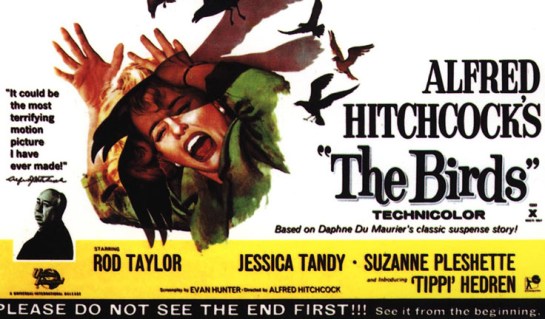
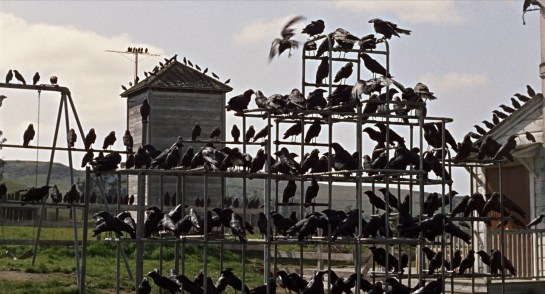
One of Alfred Hitchcock’s most recognized films is “The Birds” from 1963. In many ways “The Birds” could have been an absolute mess. The concept itself (loosely based on a story by the English author and playwright Daphne du Maurier) could be considered silly and absurd on the surface. In fact many ideas such as this in the hands of many modern day filmmakers end up as originals on channels like Sci-Fi Network.

But “The Birds” isn’t silly, absurd, and it certainly isn’t a mess. It’s a great film that shows what a master filmmaker can do even with what may seem like the craziest concept. Hitchcock liked the idea of random bird attacks from du Maurier’s story and he was enthusiastic about visually creating it on screen. He instructed screenwriter Evan Hunter to create a broader story with more defined characters. The end result was an effective thriller filled with Hitchcock’s signature style and suspense.

Birds1

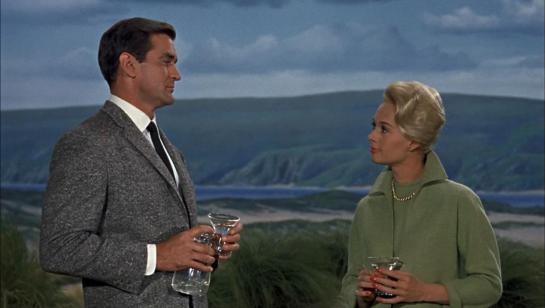
The film featured the screen debut of Tippi Hedren. She plays Melanie Daniels, a beautiful San Francisco socialite who meets a lawyer named Mitch (Rod Taylor) in a pet shop. He’s there to buy a pair of lovebirds, but he ends up more interested in Melanie. They don’t have the best encounter and Mitch ends up leaving empty-handed. Later Melanie second guesses her reaction and after finding a pair of lovebirds traces Mitch to Bodega Bay. Her stay there spans several days and during this time violent encounters with birds begin and later intensify. Soon Melanie, Mitch, and the entire community find themselves terrorized by a wide assortment of fowl.

Hedren was a great choice to play Melanie which clearly emphasized Hitchcock’s eye for talent. Hitchcock was ultra protective of his young female lead and over the following few years their tense relationship would lead to a great deal of controversy. But in “The Birds” Hedren fits nicely into Hitch’s cinematic world. Her performance never resembles that of a newcomer and her pairing with the more seasoned Rod Taylor was a good fit. There some good supporting performances as well particularly from Jessica Tandy and Suzanne Pleshette. I also loved the assortment of peculiar townfolk which gave the community such quirky life.

Birds2

Speaking of quirky, the film starts out with a subtle quirky vibe. But as Hitchcock moves us forward the story evolves into something much different. He moves into suspense where he sucks us in with his crafty and methodical buildup before plunging into what could be called shock horror. Through some amazing special effects and his unmatched eye for the camera, Hitchcock unleashes several scenes of unsettling terror that still hold up today. The film is often overlooked and underappreciated especially when lined up next to his other works. But rewatching the film and experiencing again the visual style used to create some of the film’s great scenes reminded me that the movie can’t be shoved aside.

There are a handful of narrative question marks that just don’t make a lot of sense. Also the ending, while stylish and pleasing to a degree, does feel a bit hollow and it left me wanting more out of it. These gripes may be enough to keep it from being considered the director’s best, but they certainly don’t soil the movie as a whole. Actually it’s quite the opposite. “The Birds” remains a wonderful experience. It takes a somewhat wacky concept and brilliantly creates a society turned on its head by the unlikeliest of terrors. Some today may not find it to be as unnerving or as horrifying as it was to those first audiences, but if you allow yourself to get swept up buy the buildup and the ultimate payoff “The Birds” is still extremely satisfying.

VERDICT – 4 STARS

2015 Blind Spot Series: “L’avventura”

AVENT POSTER

One of the many interesting things about “L’avventura” was how it was initially received. Michelangelo Antonioni’s Italian drama debuted at the 1960 Cannes Film Festival and was booed by the audience. After a second screening the film was received quite differently mainly from critics and Antonioni’s peers. It went on to win the Jury Prize and despite a wide range of reactions the film would become an international hit. Furthermore within two years Sight and Sound magazine had proclaimed it to be one of the greatest movies ever made. That quite a turnaround from how it was first received.

“L’avventura” is considered the first of a trilogy of films from Antonioni which also includes “La Notte” and “L’Eclisse”. Thematically the three movies seek to examine modernity and the disaffection and alienation it brings to his characters. They also share several stylistic similarities that Antonioni began experimenting with several years prior. Actress Monica Vitti is another common thread between the three films and it was her performance in “L’avventura” that made her a star.

AVENT1

Antonioni’s approach to making movies had evolved and he had grown uninterested in filmmaking conventions. He sought to break any conventional sense of visual storytelling and narrative structure. These aims are clearly evident in “L’avventura”. The film slyly presents itself as one thing when actually it’s something quite different. We are led along by the most clever of misdirections before having the rug pulled out from under us. Even the mischievous title tempts the audience into projecting their own expectations onto the story. There is a bold dramatic shift 30 minutes into the film and Antonioni not only changes his narrative focus but it alters the very perspective from which the story is being told.

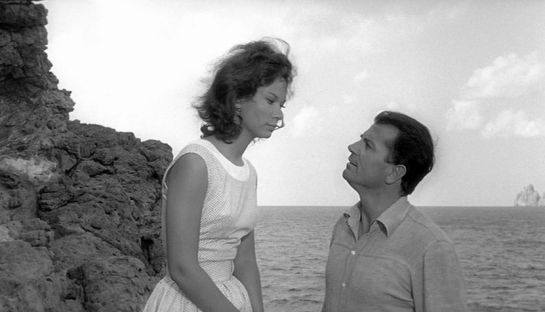
The film’s first shot introduces us to the moody and melancholy Anna (Lea Massari). From the very start we learn she has a very aloof and disinterested view of life and particularly her reunion with her boyfriend Sandro (Gabriele Ferzetti). Despite Anna’s reluctance the two meet and head off on a yacht cruise to the Aeolian Islands with a group of wealthy friends. Among them is Claudia (Vitti), Anna’s best friend and polar opposite. Claudia carries herself with a playful energy and optimism. We see it in her excitement for the cruise and in her attempts to pep up Anna. She is unquestionably unique and at first Claudia almost seems like an outsider among her bourgeois company.

AVENT3

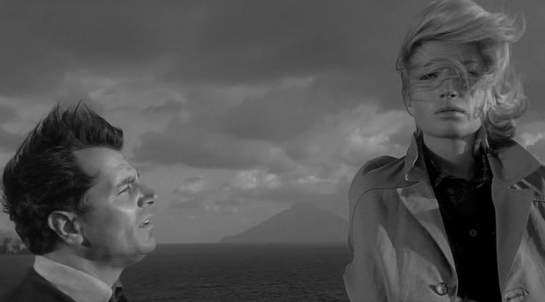
After a swim is cut short by Anna’s shark sighting, the group stops at the small rocky island of Lisca Bianca. Once ashore they all go there own way and explore. Anna and Sandro go off to themselves and talk about their relationship. Anna tells him she wants more more time apart, but a dismissive Sandro lays down and takes a nap. A short time later the group decides to leave the island as a storm approaches. Claudia wakes Sandro but Anna is nowhere to be found. The group scour the island looking for her but there is no trace. It’s here that Antonioni subtly begins to alter his focus and give his audience an unexpected perspective.

I’ll resist going into too much detail, but let’s just say the spotlight slowly moves from Anna to her companions. They continue their search, some staying on the island while others head out to a nearby town to contact police, but slowly a growing haze of indifference can be seen around them. A younger woman is more concerned with how unsatisfied she is with her older beau. Others don’t want to cut their cruise short. Later we see some of them more worried about potential business deals than the fate of Anna. Each move along with their upper-class lives with ease and Anna almost becomes an afterthought.

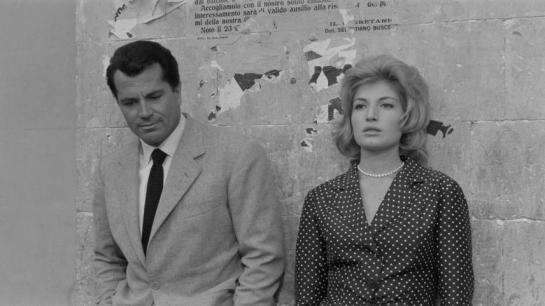
But then there is Sandro and Claudia. They put out the most effort to find Anna under the pretense of concern. But even they wander off into their own self-centered worlds. Antonioni follows them as they search a number of different locations but ultimately their focuses becomes something far more ignominious. It’s here that we see the uncomfortable undercurrent at the heart of “L’avventura”. Sandro and Claudia are poster children for the film’s perspective on the social and moral disconnection in the modern world. I’m dancing around the details, but giving too much away would cut the legs out from the story.

AVENT2

“L’avventura” is a visual masterpiece. The film is full of beautifully shot locales from the jagged, threatening island where Anna goes missing to the quaint small towns that Sandro and Claudia encounter during their search. But there is more to it than eye-grabbing scenery. Antonioni’s camera is always capturing a beautiful image or employing a clever angle. His ability to still his camera and allow the action to come to him and play out. There are no gimmicks. Just intelligently staged shots that are all about the location of the camera and the subtlest of movements. With his visual approaches he is able to change perspectives and even manipulate us into thinking certain ways.

Most criticisms of “L’avventura” have centered around it’s seemingly lethargic narrative. Some have said the film drags its feet and has nothing to say. I won’t deny it’s patient and deliberate pacing. Antonioni’s film stresses contemplation. But I simply can’t go with the idea that the film has nothing to say. And I also love that it bucks the conventional trends of the time – trends that are still very popular today. “Lavventura” doesn’t seek a conventional framework. It asks the audience the observe, think, and process. It is that type of engagement that makes Antonioni’s film a true classic.

VERDICT – 4.5 STARS