REVIEW: “Amour”

kinopoisk.ru

One of my most eagerly anticipated films to see has been Michael Haneke’s “Amour”. The 70-year-old Haneke is a director I’ve grown to admire even though I leave some of his films frustrated. He can seem infatuated with suffering and misery and his love for ambiguous endings can be testing. For example, after recently watching his 2005 film “Caché” I found myself growling at the open-ended finale. But soon after I found myself thinking more on the movie and what Haneke was going for. That’s when I really began to appreciate the film. Such is the case with several Michael Haneke pictures.

His latest movie is “Amour”, a French language drama that has blown critics away and garnered 6 Academy Award nominations. Haneke is no stranger to critical acclaim but make no mistake, he deserves every ounce of praise he has received for this stirring and often times devastating masterpiece. Like many of his pictures, it’s not a movie you can say you thoroughly enjoy watching. “Amour” deals with some depressing but very real subject matter and Haneke’s ability to express it all is astounding. He was able to get me so emotionally invested that I cared about every single thing I was seeing on the screen.

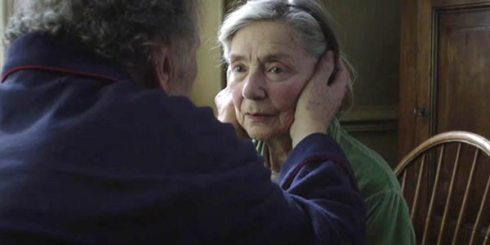
But the film would never work without its two phenomenal lead performances. Jean-Louis Trintignant and Emmanuelle Riva play Georges and Anne Laurent, a happily married couple, both in their eighties, living in Paris. We see some beautiful scenes of them together as they enjoy a night out at a concert and share conversations at the breakfast table. I instantly knew that these two people had been in love for a long time. But it’s at that breakfast table where Anne suddenly goes quiet and just stares straight ahead for several minutes. It turns out that she has what appears to be a stroke and after surgery she’s left paralyzed on her right side.
Amour1

Georges brings Anne back home to take care of her and promises that he’ll never take her back to the hospital or send her to a hospice facility. This doesn’t sit well with their daughter Eva (Isabelle Huppert) who has a few clashes with Georges over the decision. Sadly Anne’s condition worsens and Georges has to face the reality that his wife may not get better. This is difficult but reality-based stuff and the film never pulls any punches in dealing with it. We see the simplest of things become increasingly difficult for Anne and we see Georges right by her side through it all. We watch them go through something that so many others have experienced and that ability to relate is one thing that makes this such a powerful picture.

I hinted at the great performances by the two leads. Well with all due respect to every other female performance of 2012, and that includes Oscar front-runners Jennifer Lawrence and Jessica Chastain, no one gave a more stunning and committed performance than Emmanuelle Riva. She took my breath away. She gives this performance everything she has and that’s a key ingredient to making it work. There was never a moment in the film where I didn’t believe in what she was doing. And then there’s Trintignant who has a much different role but an equally essential and compelling one. He offers that same authenticity as Riva and for me watching him handle this material was a huge part of my experience.

I also have to take time to talk about Haneke’s technique. I loved how he opened the movie. We get one brief scene that sets the table for everything to come. In a sense Haneke shows his hand before playing his cards. But the true power of this film is in what follows and the opening scene allows us to put our focus where it should be. There’s also no musical score at all. This frees the movie from any potential emotional manipulation that music can sometimes bring. Haneke brings every ounce of his emotion from the characters. Now personally I would have liked a smart and subtle score but it’s absence does nothing to detract from the film.

Amour2

You’ll also notice that almost the entire movie takes place inside their Paris apartment. With the exception of the early sequence where they go to a concert, we spend the entire time in the apartment with them. During that time I felt I knew their home as well as they did. I know where their living room is. I know how their kitchen is laid out. I know their foyer, their halls, their bathroom, and their bedroom. This did a couple of things for me. It gave me a sense of place but it also relays the confinement they now experience. Anna’s illness has restricted them to the apartment where they even depend on good neighbors to get their groceries for them. Haneke also uses his familiar technique of setting his camera and then watching things unfold. Often times he’ll extend his shots which force us to take in some of the painful moments while at other times enjoying and appreciating the peaceful ones. I found this to be very effective.

And then you have the ending. As I mentioned in the first paragraph, anyone familiar with a Michael Haneke picture has to be prepared for the ending. Sometimes they’re nice and tidy but other times they can be abrupt and ambiguous. In “Amour” he ends it just right, well almost. There’s an incredibly moving moment that felt like the perfect ending to this film and essentially it is. But then he tacks on an extra minute-long scene. Now this brief final moment does carry some weight in itself and it does nothing to undo the previous scene. But it did have me wondering where it fit in chronologically. For me, he could have trimmed this scene and still have a near perfect ending. But it’s such a minor thing considering how incredible this film is as a whole.

Speaking of perfect, “Amour” is the perfect title for this film. This is a story of true love – a love between a husband and wife that only grew stronger through the many years they experienced together. It’s a love that’s taken for granted today and it’s often times treated so flippantly. But Haneke shows how precious it is and even in the face of this particular heartbreak it’s that love which shines brightest. There is an examination of cruelty and of suffering and there may be a bit of trickery going on. But for me it all came back to the deep love between this couple. I’ve thought a lot about this film since seeing it. I’ve thought about my marriage and growing old with my wife. I’ve thought about that cherished relationship that we share. Then I thought about Anne and Georges. They help us understand and appreciate the loyalty and self-sacrifice that comes with such a beautiful relationship. That my friends is amour.

VERDICT – 5 STARS

5 STARSs

5STAR K&M

REVIEW: “Silver Linings Playbook”

SILVER POSTER

I can’t say I was all that excited to see “Silver Linings Playbook”. But since its release I’ve heard nothing but positive things about it. The reviews have been unanimously great, and it has popped up on one Top 10 list after another. And then along came awards season. “Silver Linings Playbook” made a huge splash with the Academy, nabbing eight nominations including one in every major category. Now it looks like The Little Engine That Could as it gains more and more momentum heading into Oscar’s big night. So what’s with my reluctance to see this film?

Well let me get this out of the way, “Silver Linings Playbook” is a good film. It’s a sharp romantic comedy that avoids the usual pitfalls associated with the genre today – that is right up until the end. It’s written and directed by David O. Russell which quite honestly was one reason I was in no hurry to see it. I’m not a big fan of Russell’s abrasive and sometimes crass style of storytelling. But I have to hand it to him, even though we do get some of that here, Russell manages to tell a good story and his personal connection to the material is evident.

SILVER2

While Russell wasn’t a draw for me, the cast certainly was. Bradley Cooper plays Pat, a man who, due to his bipolar disorder, has spent eight months in a sanitarium. We learn that after catching his wife having an affair, Pat flies into a rage and beats the man to a pulp. His court agreement says he must receive treatment hence his stay in a mental hospital. He’s eventually released into the care of his parents with hopes of starting a new life and convincing his wife that he is cured. But there’s one problem, she has a restraining order which doesn’t seem to deter him one bit.

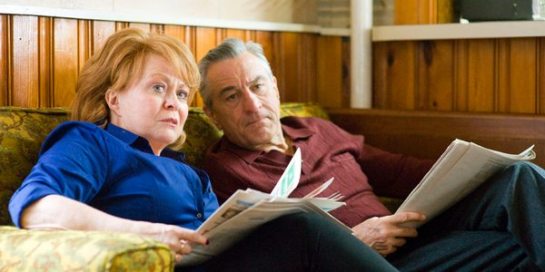
His parents are played by Robert De Niro and Jacki Weaver. Talk about perfect casting. Weaver is very good although most of her scenes put her in the background. It’s De Niro that really stands out, and this is the performance people have been waiting to see again. His character is honest and grounded. He has some hilarious moments, but he also gives us a look at where his son’s disorder may have originated. This was right up De Niro’s alley, and some of the film’s best moments are when he’s on screen, particularly when he’s hashing out his complicated relationship with Pat.

But it’s a troubled young woman named Tiffany (Jennifer Lawrence) who shakes Pat’s life up the most. Since the death of her husband, Tiffany has struggled to keep her life on track. At first the two have no idea how to react to one another. This leads to some really funny moments including conversations about medications and what constitutes a first date. Cooper and Lawrence have a nice chemistry and I was impressed with how well they played off each other. I can’t help but believe that improvisation played a role in their performances because much of their dialogue flows so naturally (especially their more heated discussions). They are two fractured souls and watching them struggle to manage their lives can be both funny and crushing.

Silver1

It would be hard to justify criticism of any of these performances. They are that good. But that doesn’t mean this is a flawless movie. There are a few issues and for me they can be traced back to Russell. There is so much that he does right in the movie, and I don’t want to downplay that. But I did feel it was a little longwinded early on and then there’s the ending. For most of the film things felt fresh, and I thought Russell was plowing new ground. Then things take a conventional and predictable turn. Obviously to keep from spoiling things I have to dance around the details, but you can see the ending coming from a mile away. I kept expecting Russell to steer away from the mainstream course he was on, but it never happened.

Now don’t misunderstand me, there’s nothing wrong with these types of endings. But here it did nothing to set the movie apart from the rest of these types of films. And since that seems to be what Russell was going for (and accomplished for most of the picture), it’s a real head-scratching choice. But enough with the negatives. “Silver Linings Playbook” is a fascinating look at mental illness and its effects on relationships, family, and social life. It’s also a master class in acting, showcasing some of the best performances of the year. Obviously I don’t find it as profound as many do, and I don’t see it as a Best Picture or Best Director Oscar winner. But it deserves praise for taking a difficult subject and nicely wrapping it in humor and emotion. That’s something many films have tried but failed to do.

VERDICT – 3.5 STARS

REVIEW: “A Good Day to Die Hard” (2013)

DIE HARD POSTER

Going into “A Good Day to Die Hard” (a.k.a. “Die Hard 5”), I knew that I would be the guy that would take a stand against the barrage of negative reviews from critics and fellow movie blogging buddies. I was prepared to respond to those who have berated the film or labeled it a major disappointment. I was ready to let everyone know why the current 16% Rotten Tomatoes score was misguided and wrong. But I ran into a problem. I was ready and prepared to defend this film. Unfortunately I can’t. If it weren’t for the title I would have never known this was a “Die Hard” picture. “A Good Day to Die Hard” is missing almost ever signature feature and clever nuance that has made this franchise great.

There are several things that have set this franchise apart from other action films. You have the fiery personality of its wisecracking lead character. You have strong, well-defined, charismatic villains. You have solid side characters that fit perfectly in John McClane’s chaotic world. You’ll have a hard time finding a trace of any of these things in “A Good Day to Die Hard” and for me the problems all start with the writing and direction. Skip Woods wrote the screenplay which explains a lot. His last two writing credits were for the terrible “X-Men Orgins: Wolverine” and the even bigger train wreck “The A-Team”. John Moore directs and while he’s received some box office success, his resume is filled with forgettable films. Put these two together and apparently this is what we get.

die hard

The story is simple and pretty generic. John McClane (Willis) heads to Moscow after receiving news that his estranged son Jack (Jai Courtney) has been put in prison. John finds out that his son is a CIA field operative and they both find themselves in the middle of a deadly terrorist plot. A lot of the movie is spent with Willis and Courtney bouncing lazy, ham-fisted lines off each other. I grew tired of Jack’s constant whining and John is now a self-reflecting softie. This gets into one of my biggest problems with this movie. This isn’t the John McClane of the other “Die Hard” pictures. We see very little of his signature spunk and in-your-face attitude. I kept waiting for him to go off on one of the bad guys McClane style but it never happened. In fact, the closest we get to seeing that is when he punches out a motorist for getting in his face. Not one of the terrorists – a civilian!

For me, if you take away McClane’s charisma and attitude you’ve already lost a lot. Apparently Moore thought that having Willis yell and scream here and there would be enough. Not even close! But to make matters worse, McClane’s great smart-alecky humor is decimated by Woods’ poor dialogue. So many times the one-liners land with a thud and they feel cheap and artificial. He does deliver a handful of lines that did make me laugh, but nothing close to the number of great quotes from the previous movies.

It also doesn’t help that he lacks a clear and present villain to go back and forth with. Instead of showing us the bad guy and then allowing McClane to fight his way to him, this film tries to play out like a thriller by throwing several twists in along the way. That’s fine except this is “Die Hard” and this is a significant departure from the structure of the other films. The story itself isn’t terrible and they do try and make some pretty cool historical connections. But it all plays out to be pretty basic stuff and doesn’t stick nearly as well as the other movies, even 2007’s “Live Free or Die Hard”.

die hard 2

But what about the action? I mean the action is the franchise’s bread and butter right? Does it manage to save the movie. Well, yes and no. There are a couple of unbelievable action set pieces even though they seem to grow more and more unimpressive as the film moves on. Perhaps the greatest scene in the film involves a huge car chase through the heavy traffic in Moscow. The sequence has some amazing stunts but it also has an unforgivable problem. It features some of the most frustrating camerawork and editing that I have ever seen in an action film. I am not a fan of the herky-jerky handheld camera craze. Here it’s amplified x10! It’s a long scene but the quick edits rarely leave the camera on a shot for more than a second. And the few times the camera does follow a shot it’s constantly shaking or moving from one place to another. Not only does it make things indecipherable but it basically ruined the scene for me.

I know this may be simplistic thinking especially from a pseudo-critic like me, but how can you mess up when you have such a tried and true formula to use? It may not sound like it but I did find some entertainment in “A Good Day to Die Hard”. I did think there were elements to the story that were pretty cool and there were some good action moments. I also can’t help but feel a little nostalgic when it comes to John McClane. But that’s also why this one stings. This film doesn’t do the movie or the character justice. The tag team of bad writing and bad direction sink this ship and it’s a bitter pill to swallow. Some are saying it’s time to bury this franchise. No way! I want McClane to go out right. So I hope they do another movie. Just don’t let Skip Woods and John Moore anywhere near it!

VERDICT – 2 STARS

5 PHENOMENAL MOTORCYCLE MOVIE SCENES

movie_theatre - Phenom 5

Have you ever stopped and thought about how many great motorcycle movie scenes there have been over the years? I’ve never owned one but I’ve always thought motorcycles were cool especially when our favorite movie stars are speeding, flipping, and jumping them in ways only possible in the movies. So why not look at 5 Phenomenal Motorcycle Movie Scenes? Now this was a tough list to put together because I always like to include a little variety. But there are some iconic motorcycle scenes that I hate to leave off. So here they are. Now I know people will find some popular choices missing therefore I’m not calling this the definitive list. But I have no trouble calling these five motorcycle movie scenes absolutely phenomenal.

#5 – “THE GREAT ESCAPE”

GREAT ESCAPE

Steve McQueen was one tough dude. He also had an affection for fast vehicles and maybe that’s one reason his motorcycle scene from “The Great Escape” is so good. McQueen, decked out in full Nazi soldier garb, makes his way by motorcycle into a small German occupied village as he tries to sneak out of Nazi territory. There he is discovered which leads to an amazing chase through the rolling Bavarian meadows. The gorgeous scenery is one thing, but watching McQueen handle the bike with Nazis in pursuit is exhilarating. Very little stunt work was needed. McQueen was a skilled motorcycle rider and he even played the Nazis pursuing him in several shots. The sequence climaxes with an amazing jump over a barbed wire fence (this time done by a stuntman). It’s a great scene from a great film.

#4 – “INDIANA JONES AND THE LAST CRUSADE”

INDY

There is a wonderful motorcycle sequence in “Indiana Jones and the Last Crusade”. Indy (Harrison Ford) and his father (Sean Connery) make a wild escape after being captured by the Nazis. The pair tear off on a motorcycle and sidecar with five Nazis on bikes right behind them. This is a typical Indiana Jones action scene and I love it. They bust through checkpoints, joust with an oncoming Nazi biker, and cause some of the wildest motorcycle crashes you’ll ever see. But as you would expect from an Indy film, humor is a key ingredient to making the scene work. It’s funny enough seeing Sean Connery whizzing around in a motorcycle sidecar. But watching Indy’s childlike exuberance when he takes out a Nazi versus his dad’s scowling show of disapproval is just hilarious.

#3 – “SKYFALL”
SKYFALL

I love it when I am able to put a newer movie on one of these lists and I have no reservations with including “Skyfall”. Much like “Casino Royale” this film starts with a bang as Bond (Daniel Craig) is pursuing a mercenary who has killed an agent and stolen a hard drive. The chase eventually ends up on motorcycles as the two speed through the crowded Istanbul market streets. From there they go to the rooftops of the Grand Bazaar before ending up on a moving train. This motorcycle chase sequence is utterly insane and a lot of that can be attributed to the profoundly good cinematography of Roger Deakins. This is a pure edge-of-your-seat adrenaline rush and its easily one of the best motorcycle chases of all time. Don’t believe me? Just check it out!

#2 – “SHERLOCK, JR.”

Sherlock
I feel for anyone who hasn’t experienced a Buster Keaton film. He was a true master of filmmaking and physical comedy. For those unfamiliar with his work, “Sherlock, Jr.” is a beautiful starting point. This 45 minute gem is absolutely hilarious and features some of Keaton’s greatest stunts. It also gives us one of cinema’s greatest motorcycle sequences hands down. In this scene Keaton finds himself sitting on the handlebars of a motorcycle. He doesn’t notice the driver is knocked off after hitting a big bump and he zips through a series of insane near-miss obstacles with no one steering the bike. This is truly jaw-dropping cinema. He flies through traffic, skims across a collapsing bridge (while it’s collapsing mind you), and almost gets hit by a train in one of the film’s most amazing shots. Give this silent film a watch. I promise you, the motorcycle sequence with blow you away!

#1 – “MISSION IMPOSSIBLE II”

MI 2
Many people didn’t care for “Mission Impossible II” but I enjoyed John Woo’s more stylized and action-packed picture. One of the reasons I liked it was the wild and explosive finale. In it Tom Cruise hops on a Triumph motorcycle and flees from a big group of baddies in SUVs followed by the terrorist leader on a bike of his own. Cruise jumps onto bridges, rides through explosions, and gets in a shoot out while going 90 mph. And of course the big showdown comes down to motorcycle versus motorcycle. Woo’s well known visual techniques of moving camera shots and slow-motion gives the sequence an over-the-top kinetic energy that I thought was great. “Mission Impossible II” certainly wasn’t a perfect movie, but its big motorcycle finish is just phenomenal.

Now let your voices be heard. See a pick of mine you agree or disagree with? Let me know. Also, be sure to share your favorite motorcycle movie scene.

The Keith & the Movies Valhalla Induction

K&M VALHALLA

The Keith & the Movies Valhalla is a place of tribute for those movies that I hold in the highest regard. These are films that embody everything that is great about motion pictures. These are the best of the best – movies that I truly love and that stand above the rest. There are many great movies that won’t find their way into these sacred halls. But here you will find those films that I believe personify brilliance in filmmaking, storytelling, and entertainment. These glorious 5 star accomplishments are worthy of special recognition as the very best. Ok, enough of the high drama! In other words, these are my favorite movies of all time, ok?

______________________________________________________________________________

NO COUNTRYNO COUNTRY FOR OLD MEN (2007) – I’m a huge fan of Joel and Ethan Coen and their crime thriller “No Country for Old Men” is one of their very best films. This Best Picture winner features the Coen’s signature mix of blood and grit with their unique brand of dark comedy. The brothers stick surprisingly close to Cormac McCarthy’s novel while at the same time making it unmistakably their own. It’s a riveting hunter versus hunted story led by perfect performances from Josh Brolin, Tommy Lee Jones, and Kelly Macdonald. And who can ever forget Javier Bardem’s work as the psychotic Anton Chigurh, one of cinema’s most memorable movie villains. Everything about this picture works – the sweaty southwestern locations, the subtle and dry humor, the sparse and often times absent score, the meaningful yet gruesome violence, the well-structured pacing. “No Country for Old Men” is the jarring revelation of a new age of violence and crime for a small town Texas sheriff. It’s a case against the pursuit of a quick and easy fortune. It shows the domino effect of one poor but crucial decision. I could go on and on. There’s a lot going on under the surface of this film if you just dig enough. But even without that, this is a spectacular action picture with some of the Coen’s funniest moments sprinkled in. It’s the total package and one of my all time favorites.

No Country for Old Men is the third inductee into the Keith & the Movies Valhalla. But there are more amazing movies to come in the near future so stay tuned. What are your thoughts on this Coen brothers classic? Is it worth the accolades it’s received or is it an overrated picture? You now know my opinion. It’s one of the very best. Take time to share your comments below.

REVIEW: “Warm Bodies” (2013)

Warm Bodies posterHave you ever walked out of a theater after seeing a movie asking yourself “What on earth did I just watch?” That certainly sums up my initial reaction to “Warm Bodies”. Now I’ve watched a ton of zombie movies over the years but I can honestly say I’ve never seen one quite like this. This is actually a romance film (Yes, you read it right. It’s a romance film). It also features some good humor and throws in some horror elements as well. After all this is a zombie flick so you have to have horror, right? But the bigger question is how does it all come together and does it equal a fun and entertaining movie?

There are several uniquenesses that “Warm Bodies” throws out there. Perhaps the biggest is that the story is told from the zombies’ perspective. I mean let’s be fair, in our movies we’ve seen a countless number of zombies shot in the head, ran over by vehicles, chopped up by helicopter blades, and blown to bits by an assortment of explosives. Isn’t it time that we see things through their eyes? Don’t we all just want the voices of the zombies to be heard? Okay probably not but that’s what we get here and I have to admit I kinda liked it.

Right off the bat we’re introduced to a young zombie simply named “R” (Nicholas Hoult). Through narration he sets the table for us, laying out the post-zombie apocalypse landscape and describing what it’s like to be a walking corpse. He does have a level of consciousness. He tells us about his desire for simple things such as casual conversation and we see his affection for 80s and 90s pop rock tunes. All of this is laid out in a pretty humorous fashion and it gives R his own odd but entertaining personality. Like a worker getting through his workday, R and the other zombies go about the mundane daily grind of shuffling through the ruined outskirts of the city.

The inner-city is protected by a giant wall and that’s where the living call home. But even they need supplies so periodically a group of young people will go into the outskirts of the city to bring back food and medical needs. Julie (Teresa Palmer) leads her friends on one of the supply missions but they are attacked by a group of hungry zombies which includes R. It looks as if Julie and company are doomed but then R sees her. And in what plays out as an ‘I saw her across the dance floor’ type scene, R is instantly smitten and leads Julie to safety. Julie triggers something inside of R which begins to change him. Is true unwavering love the remedy to bring the zombies back to life. As goofy and cheesy as it sounds, that appears to be the case.

Warm Bodies 1

As wacky as it sounds the romance component between Hoult and Palmer works mainly because it’s laced with some really good humor. The absurdity of what we’re watching is actually fun thanks to some clever writing by Jonathan Levine and two committed lead performances. The movie works best when it keeps its focus on this. But the film tries to develop a big threat in the form of a group known as ‘the bonies’. The bonies are basically zombies who have deteriorated into ravenous skeletons. They turn out to be the real antagonists of the film which sets up a big climactic showdown at the city walls. The problem is none of this really worked for me. The bonies feel like a tacked on addition to the story and they take away from the movie’s real strengths. And then there is the CGI used to animate them. It’s really terrible. I know this isn’t meant to be a big special effects picture, but they should look a lot better than this.

But I would rather dwell on the positive and on how the filmmakers took something so preposterous and made it entertaining. There are several stand-out gags that I think are really funny and I appreciated the film’s originality. Now don’t let the zombie thing scare you off. This isn’t a scary or gory picture. It’s a spoof of the zombie movie craze wrapped up as a quirky romantic comedy. Still its hard to imagine this being everyone’s cup if tea and I doubt it has much staying power after a first viewing. But it’s still clever enough, creative enough, and funny enough to make it worth a watch.

VERDICT – 3 STARS