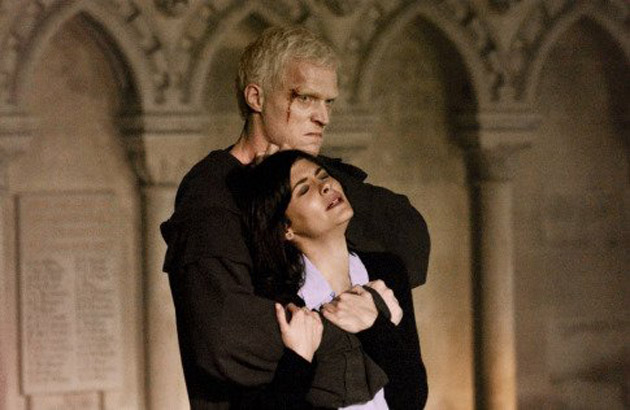
REVIEW: “Singin’ in the Rain”

SINGIN

They just don’t make movies like this anymore. That may sound like a very cliché and overused statement but when talking about the classic “Singin’ in the Rain” it most certainly fits. This is a film that overflows with the happiness and joy that once was prevalent in motion pictures. In fact, I would challenge any real movie fan to watch this picture and not notice an ever-present grin spread across your face. But this is more than just a happy little dance picture. It’s filled with romance, lots of good humor, and it’s set during one of the biggest transition periods in cinema.

SINGIN SMALL“Singin’ in the Rain” is first and foremost a musical and many call it the greatest motion picture musical of all time. While my personal preference is “An American in Paris”, it’s really hard to argue with them. Now I’m not a big fan of musicals so for a movie musical to get such a positive reaction from me says something. But this is simply a great film from start to finish and the musical numbers are some of the most memorable in movie history. Gene Kelly not only starred in the movie but he also co-directed it and handled the choreography. Kelly is amazing to watch and several of his numbers alongside the immensely talented Donald O’Connor cross classic dance with acrobatics. The results are playful and lighthearted yet display undeniable talents.

Kelly plays Don Lockwood, one half of a hugely popular silent movie couple. His partner is Lina Lamont (Jean Hagen), a beautiful blonde with the Hollywood good looks but with a screeching voice that seems made for the silent era. Their studio, Monumental Pictures, makes up a romance between the two. This was a real tactic that many studios would employ to increase the popularity of their performers with audiences. Don knows there is nothing between them but Lina didn’t get that memo. Her attraction to Don becomes a steady stumbling block for him throughout the picture.

While this is primarily a musical, it’s also a movie about making movies. As I mentioned elsewhere, I love it when a film takes us behind the scenes and shows us the creative process behind making motion pictures. “Singin’ in the Rain” is set during a pivotal time in cinema – the transition from silent films to “talkies”. It doesn’t dive deep into the history or process but it does use it honestly and effectively. Some silent stars made the transition fine. But others never made it because their voice work wasn’t good enough to be able to keep their audiences. Such was the problem Lina and Monumental Studios faced with her grinding voice.

Singin2Debbie Reynolds is one of the true delights of “Singin’ in the Rain”. Reynolds was only 19-years old when she made the film and this was her big break. She brings such a sprightly energy to every scene she’s in and she’s a perfect fit with Kelly and O’Connor. Reynolds would later say that “Singin’ in the Rain” was possibly her hardest shoot, but you would never know it by watching the picture. She’s a scene stealer and that’s high praise considering the heavyweights she shares the screen with. Her character Kathy Selden is a young aspiring performer who eventually becomes the romantic wedge between Don and Lina. This complicates the studio’s manufactured relationship between their two big stars but even they are won over by Kathy’s beautiful voice and amazing talent.

Another key ingredient is O’Connor whose dancing talents match Kelly’s step for step. He plays Cosmo Brown, Don’s longtime friend and proverbial sidekick. Cosmo’s quick wit and snappy one-liners provide the movie with some of its biggest laughs. But O’Connor may be most remembered for his spectacular dance number “Make ‘Em Laugh”. It’s a stunning display of physical comedy put to music where O’Connor throws his body around, runs up walls, and wrestles with a stage prop dummy. Words don’t do this dance sequence justice but you can’t watch it and not be wowed by O’Connor’s ability.

“Singin’ in the Rain” features a host of other memorable songs and dance numbers but interestingly enough only one, “Moses Supposes”, was an original song written for the movie. Every other song was pulled from MGM’s own music vault. But Gene Kelly, the true mastermind behind the production, was able to make these earlier tunes synonymous with this film. This was never more evident than with the title track. The lyrics and music of “Singin’ in the Rain” was written by Arthur Freed and Nacio Herb Brown all the way back 1929. But it’s Gene Kelly’s legendary dance number on a city street during a downpour that the song is instantly associated with. Kelly twirls his umbrella, stomps in puddles, and swings on light posts in what has come to be considered one of the greatest movie moments in history.

While I do love “Singin’ in the Rain’ immensely, there is still one gripe I have with it after all these years. Later in the film there is a huge production number that lasts a good 15 minutes. Now there’s nothing wrong with the number itself. It features the wonderful “Gotta Dance” song and it looks amazing. The problem is it yanks me out of the film’s story every time. Now it isn’t just a random dance number. Don is sharing his vision for his new movie with a studio executive and we basically watch what he’s envisioning. Again it’s a fine number but, just like in “An American in Paris”, it pulls me out of a story that I’m completely invested in.

SINGIN1

“Singin’ in the Rain” is a true motion picture classic and an absolute joy to watch even for tepid musical fans like me. Debbie Reynolds wins us over with her spunkiness and beauty. Donald O’Connor wows us with his feet and great humor. Jean Hagen pretty much becomes the antagonist of the film and gives us one hilarious classic line after another. But the glue that holds it all together is Gene Kelly. Both in front of and behind the camera, Kelly’s fingerprints are all over this film. His performance is pitch-perfect and his wonderful chemistry with O’Connor and especially Reynolds is key. But it’s his amazing dance numbers that still resonate through time. Kelly gave 110% to his dance and later in life his body would show the effects of that. But it’s that unwavering devotion and maximum effort that we see in every number he performs.

This is a movie of a bygone era – an era when an audience could be impressed by the sheer happiness of a story and moved by the footwork of a master. Perhaps I am being too cynical, but it’s hard to imagine a large modern movie audience sitting down and enjoying this picture if it were released today. But for many of us we still have “Singin’ in the Rain” and the reminders of the great history of filmmaking it brings with it during each viewing. Unlike today, it didn’t need a load of profanity and distasteful raunch to be funny. It didn’t need nudity or constant sexual references to be romantic. None of these modern movie crutches were needed to make this a truly timeless film. Like I said at the beginning, they just don’t make movies like this anymore!

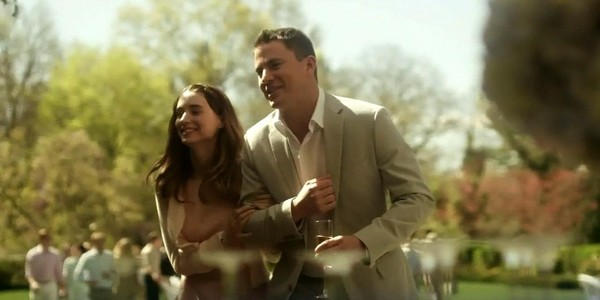
VERDICT – 4.5 STARS

“Side Effects” – 3 STARS

SIDE EFFECTS Poster

Steven Soderbergh has always been a hit or miss filmmaker in my book. He has an impressive resume but the two movies of his that I truly love are more recent efforts, “The Informant” from 2009 and “Contagion” from 2011. His new film “Side Effects” looked like the new “Contagion”, that is if you went by the trailers and TV spots. But other than the small medical connection, these two films couldn’t be more different. At its core “Side Effects” is a straight up modern day thriller. It’s the first of two Soderbergh movies in 2013 which will lead into what the director is calling his filmmaking “sabbatical”.

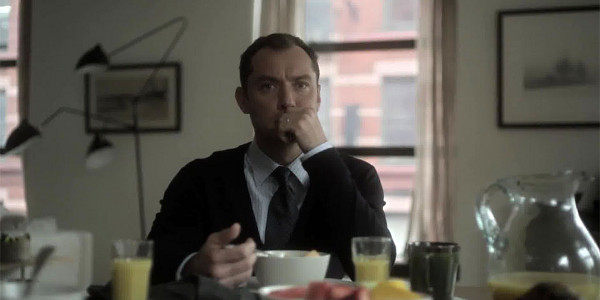
“Side Effects” is really broken into two halves. The first half of the movie focuses on a young woman named Emily (Rooney Mara). Her husband Martin (Channing Tatum) is released from prison after serving a 4-year sentence for insider trading. It seems like it would be a good time for the couple but Emily begins showing signs of depression. Martin tries to help her but things only seem to get worse leading to her attempting suicide by driving her speeding car into a wall. At the hospital she is examined by a psychiatrist named Jonathan Banks (Jude Law). She convinces him to let her go home as long as she agrees to regular counseling sessions with him.

Side Effects 2

The movie moves along like a clinical procedural throughout the first half. We watch Emily’s struggles with depression and we sit in on her meetings with Jonathan. We watch as he prescribes numerous medications, none of which work for her. We find out she has a history with depression and once saw another doctor named Victoria Siebert (Catherine Zeta-Jones). Jonathan meets with Victoria who recommends a drug called Ablixa. Jonathan finally agrees to give it a try and prescribes it for Emily. Things seem to get better for her except for the one side effect – sleepwalking. It’s during one of her sleepwalking episodes that she takes a knife and commits a shocking murder.

The second half of the film focuses more on Jonathan and the fallout from the murder and the court case that followed. It takes a heavy toll on Jonathan’s career and home life so he sets out to clear his name. It’s here where the movie finally starts to feel like a thriller. Soderbergh starts leading us in several different directions and causes us to question and reflect back on things we’ve already seen. At some point you’ll have suspicions of every character and their motivations. These are all things that you want and expect from a good thriller.

So considering all of these things, why didn’t I have a stronger response to “Side Effects”? It’s certainly not the acting. Everyone gives strong performances even the usually stone-faced Channing Tatum. Rooney Mara certainly answered my question of whether she could handle the lead role. But I thought it was Jude Law who was the real standout. He’s really, really good here. It’s also not the visual presentation that’s the problem. Soderbergh knows how to shoot a picture and his particular visual style of camera cuts and closeups works nicely here.

SIDEEFFECTS1

I think my problems lie in the way the story itself is structured. As I hinted at, this never feels like a thriller until well over halfway through the film. It’s only then that different threads of plot begin to branch out. But by that time the movie has but a little time to put all the pieces together. Soderbergh certainly manages to do this competently. I don’t remember there being any gaping plot holes or oversights. But I also don’t feel his ending is all that satisfying and the catalyst behind the big twist feels a little out-of-the-blue. For me the best thrillers are able to put the truth out there while causing the audience to look at it in a different and wrong way. At the end of “Side Effects” I didn’t feel it accomplished that at all.

I don’t want to be too hard on the movie because it’s a good watchable film that’s easy to digest. The performances are strong and Soderbergh has a visual style that perfectly fits this type of film. But underneath the veneer of clinical depression, pharmaceutical lingo, and legal proceedings lies a movie that never reaches its full potential. Its buildup is slow, its surprises feel arbitrary, and overall it’s underwhelming. It’s unfortunate and I still feel that somewhere offscreen lies an ending with more power and punch than the one we’re given – an ending that would give me the satisfaction I hoped for from “Side Effects”.

5 PHENOMENAL MOVIE ROMANCES

movie_theatre - Phenom 5

Well this is the week where millions and millions of dollars will be spent on fresh roses, boxes of rich chocolates, sparkling diamond jewelry, and expensive fancy dinners all in the name of undying love. Ok, let me reword that. This Thursday is Valentines Day – a day where we guys had better have our wives or girlfriends something nice or the following few weeks will not be very pleasant! In the spirit of this wallet-crushing holiday I thought it would be good to focus this week’s Phenomenal 5 on love. So today I’m listing 5 Phenomenal Movie Romances. These are classic onscreen romances that are equally memorable and romantic. Now with so many big screen romances gracing cinema for all these years I would be a real goof to call this the definitive list. But I have no problems calling these five movie romances absolutely phenomenal.

#5 – Jack and Rose (“Titanic”)

TITANIC

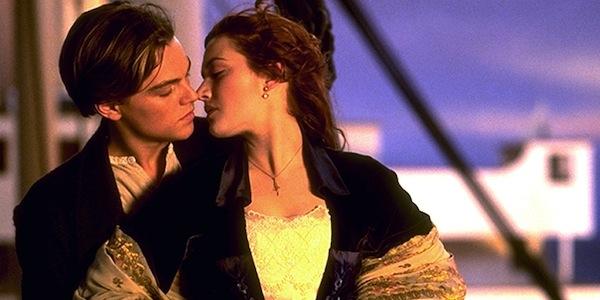
While the first half of James Cameron’s epic sized blockbuster “Titanic” wasn’t nearly as good as the second half, it did set in motion a romance that gave the tearjerker finale some huge emotional pop. Jack (Leonardo DiCaprio) is a poor drifter and Rose (Kate Winslet) is a member of the high society upper class. The two cross paths on the maiden voyage of the British luxury liner Titanic. Obviously they come from opposite ends of the social order but you know the old saying – “opposites attract” yadda yadda yadda. A deep and forbidden love develops between them and Rose’s family are none too happy about it. But all of that takes a back seat when the Titanic strikes an iceberg and begins to sink. At no time does their love shine brighter than in their struggle to survive and you can’t help but be moved by it.

#4 – Jesse and Celine (“Before Sunrise” & “Before Sunset”)

BeforeSunset

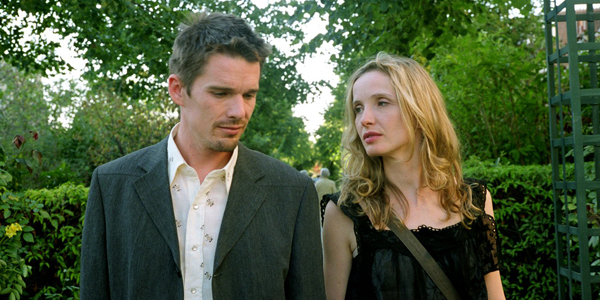
No list like this would be complete without including Jesse (Ethan Hawke) and Celine (Julie Delpy). These two young lovers first met on a train from Budapest to Vienna in “Before Sunrise”. Jesse convinces Celine to skip her connecting train to Paris and spend the night walking around Vienna with him. A romantic spark is lit and the two seem like true soul mates but at the end of the film they head their separate ways. They cross paths 10 years later in Paris in “Before Sunset” and their lives have taken on many new changes. But as they spend the day walking and talking we quickly learn that spark never went out. It’s such a wonderful but complicated romance and we’ll get to see them 10 years later in this year’s “Before Midnight”. I can’t wait.

#3 – Nathaniel and Cora (“The Last of the Mohicans”)

MOHICANS

Underneath the surface of frontier violence and costly war lies an incredible romance that plays a big part in “The Last of the Mohicans”. Cora (Madelenie Stowe) is an English woman who has arrived in the States during The French and Indian War. She’s rescued by Nathaniel (Daniel Day-Lewis) and his adopted father and brother after a Huron war party tries to kill her. Through Nathaniel she learns a different perspective of the war and how it effects the locals. Even more important to the story, the two develop a love for one another that carries them through blood, battlefields, and tragedy. The way this love story is told through this dangerous and violent environment is beautiful and “The Last of the Mohicans” remains one of my all time favorite films.

#2 – Scarlett and Rhett (“Gone with the Wind”)

GONE WITH THE WIND

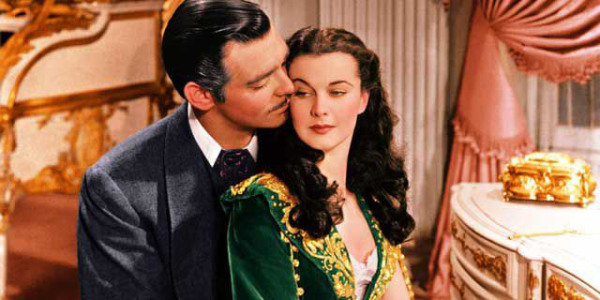
There may not be a more difficult and sometimes volatile relationship in film than the one shared between Scarlett O’Hara (Vivien Leigh) and Rhett Butler (Clark Gable). Their fascinating romance takes place during the outbreak of the Civil War. Scarlett is a fiery but spoiled daughter of a plantation owner and Rhett is just the one to tame her…or is he? Rhett is a confident and brash fellow who makes a play for Scarlett. But he’s not her puppet which often times infuriates her. But through their on again/off again relationship there is evidence of a truly passionate love between them. These two take us on a roller coaster ride that’s anything but a soft and tender love story. But it’s without a doubt one of the most mesmerizing romances to ever grace the movies.

#1 – Rick and Ilsa (“Casablanca”)

CASABLANCA

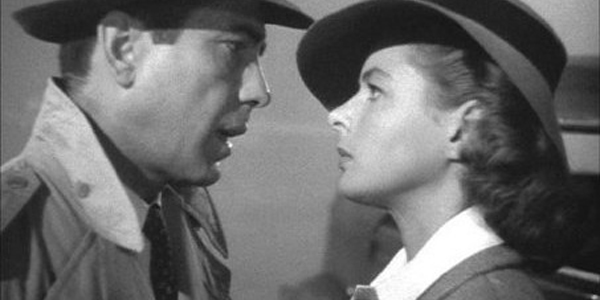
My favorite movie of all time also happens to feature what I think is the greatest romance in movie history. Humphrey Bogart plays Rick, a club owner in Casablanca during World War 2. His world is turned upside down when Ilsa (played by the stunningly beautiful Ingrid Bergman) reenters his life. We learn the two fell madly in love after first meeting in Paris but circumstances tore them apart. From the first moment their eyes meet again, we know that neither’s feelings have changed. But there are several obstacles keeping them from being together and watching what seems to be an ill-fated romance is simply great cinema. Bogart and Bergman have incredible chemistry and you never doubt their character’s love for each other. This is the quintessential romance in what’s a truly flawless movie.

So those are my five phenomenal movie romances. Now I want to hear your thoughts. What did I miss or where did I go wrong. Take time to comment and share you favorite movie romance.

REVIEW: “Apollo 18” (2011)

As I’ve said before, the found footage phenomenon has run its course with me. Like many things, Hollywood took an interesting new approach and milked it bone dry. Now it’s impossible to number how many movies use the technique especially in the horror genre. That’s the main reason I was a bit tentative when it came to “Apollo 18”. It also didn’t help that the movie was getting panned by critics and moviegoers alike. But to my surprise I found “Apollo 18” to be a fun little movie that uses and incorporates the found footage style in a slick and fresh fashion. It does have some issues but it also has some great moments wrapped into its tight 88 minute running time.

The general idea behind “Apollo 18” goes something like this – In 1974 NASA canceled a planned lunar expedition. At least that is what we were told. In actuality, Apollo 18 did make the trip to the moon but never returned. It wasn’t until recently that the United States government acknowledged the mission and declassified archived footage documenting the expedition. This movie is the edited video account released from the government of the 1974 trip which turned out to be our last visit to the moon. While this didn’t work for a lot of people, I found it to be a really cool concept. The movie lays all of this out for us through a brief but effective opening sequence. But this is also where the movie hits one of its biggest speed bumps.

We see some brief footage of the three men who will take part in the Apollo 18 mission. We briefly see footage of them at a backyard barbecue with their families. There are also a few scenes of them in training. But that is all we get in terms of building these characters. We never know who these men are and they never rise above your standard cookie-cutter character. I can’t help but think that the movie would have more pop if the characters had more weight. Now there are some scenes later in the movie where we do see a little more of the astronaut’s personalities. But they still feel underwritten to me.

The film really picks up once the mission is underway. Everything is documented through one handheld camera, mounted cameras inside the ship and landing vessel, and cameras planted in the spacesuits. Unlike many of the found footage films, I thought “Apollo 18” puts together the footage in a way that’s very convincing. The film quality resembles what you would expect from 1974 and it’s edited in a way that allows you to believe it could be archived government footage. More importantly, it’s edited in a way that doesn’t hinder the storytelling. Even when the story is taking its time, the editing moves along and flows nicely. This is especially evident when two of the astronauts take the landing craft to the moon. I loved the scenes where the men are exploring the moon’s surface and there’s a wonderfully uncomfortable and claustrophobic feeling when they are inside the small vessel. The intensity amps up once they discover a mysterious life form and the horror elements that the movie teases really kick in. This is where the movie really worked for me.

There is a reveal of sorts as the “Apollo 18” story unfolds. It’s intriguing and loaded with potential. I liked the direction the story goes even though I wish it would have been fleshed out a little more. And that gets back to the movie’s biggest problem – many things feel underplayed. A good argument could be made that the found footage approach does limit to some degree the abilities of the storytelling. Regardless, I did find “Apollo 18” to be much more satisfying than I was expecting. I still can’t help but believe that there was a formula in place for a great movie. “Apollo 18” falls short of greatness, but it succeeds in delivering a solid and unique sci-fi horror picture that I honestly enjoyed.

VERDICT – 3.5 STARS

“The Da Vinci Code” – 1 STAR

DA VINCI POSTER

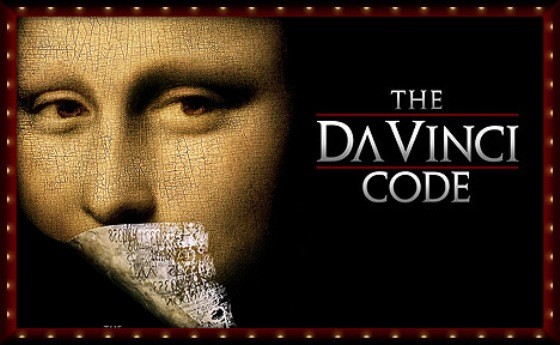
For the sake of full disclosure, it took two sittings for me to get through Ron Howard’s “The Da Vinci Code” and I felt that was an accomplishment. I was never interested in seeing this movie but finally caught up with it over a three day span. There were several things that pushed me away from it from Tom Hanks’ hideous hairdo too much more glaring flaws. As you can probably guess, the Hanks mop is the least of the film’s unforgivable vices. “The Da Vinci Code” is a sloppy, lazy, and amateurish production from a director that should know better.

“The Da Vinci Code” was based on Dan Brown’s wildly popular 2003 novel of the same name. It reportedly cost $6 million to obtain the rights for the film with Howard signed to direct and Academy Award winning writer Akiva Goldsmith handling the screenplay. Goldsmith is hard to figure out. He’s done some brilliant work including “A Beautiful Mind” and “Cinderella Man” but he’s also written some real stinkers. But even with some questionable work on his resume, I wasn’t expecting the lazy and amateurish results that we get here.

DA VINCI 1

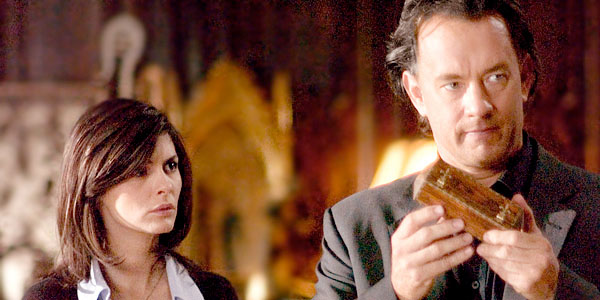
Hanks plays a noted religious symbology professor named Robert Langdon who is doing a series of lectures in Paris, France. He finds himself the prime suspect in a grisly murder inside the Louvre museum. He’s asked to come to the crime scene by a suspicious police captain (Jean Reno). While there Langdon discovers that he has been left a message from the victim that points him towards a mysterious cryptex, a device containing a message that could hold world-changing secrets. He’s joined by Sophie Neveu (Audrey Tautou), a French cryptologist and granddaughter of the victim. The two find themselves in the crosshairs of the French police and a mysterious religious sect, both trying to get their hands on the cryptex.

The big revelation turns out to be a possible death blow to Christianity and the Catholic Church. It’s told through a swirl of long-winded religious conspiracy theories, absurd revisionist history, and anti-Christian nonsense that serves as nothing more than insulting shock value. Most of this is revealed to Robert and Sophie by Leigh Teabing (Ian McKellen), an old acquaintance of Robert’s and a Holy Grail enthusiast. He believes many of the secrets are hidden in Leonardo Da Vinci’s “The Last Supper”, secrets that the cryptex can corroborate. Blah, blah, blah. Honestly it’s all so bloated, preposterous, and boring.

Goldsmith’s script is simply terrible. There’s not an ounce of creativity or subtlety in his storytelling. Everything is so contrived and by the books. There are numerous scenes of tedious exposition meant for nothing more but to fill in the audience on certain bits of information. There’s nothing wrong with that except for the fact they’re so poorly written and we know what they’re there for. This is also a movie loaded with ridiculous conveniences. So many times the story is advanced by a simple convenience that allows our heroes to either escape or find the next clue. Some of them are so lame that I found myself laughing out loud.

da vinci 2

I could go on about the writing but I can’t let Ron Howard off the hook either. This thing is an utter mess. It’s a thriller without thrills. The action sequences have no pop whatsoever. The dialogue is as stale and lifeless as you’ll find. His movement from scene to scene feels more like an assembly line production. And his dull and dank color palette gives the movie a dark and unattractive look. I mean neither Paris or London have ever looked worse on screen. Howard has shown in the past he knows how to direct a picture. I have no idea what happened here but a lot of the movie’s problems can be put on him.

I still can’t imagine how “The Da Vinci Code” made over $750 million at the box office. That’s something that boggles my mind. Maybe it was the controversial label that it received and deservedly so. Whatever the reason, it wasn’t because this is a good film. Even without its eye-rolling, anti-Christian shock value, “The Da Vinci Code” is a movie filled with cheap shortcuts, head-shakingly bad dialogue, and poor visual decisions throughout. It’s a shame it turned out this way because there was a good cast in place. But this just shows that you can have a good cast but if you throw them crap the result is going to be crap. Such is “The Da Vinci Code”.

REVIEW: “Hitchcock” (2012)

You know, I just love movies about making movies. That’s one reason I thought the movie “Hitchcock” would be right up my alley. Another reason is that it’s about one of cinema’s greatest directors – Alfred Hitchcock. Yet another reason I was interested was because of the fantastic cast specifically Anthony Hopkins as Hitchcock and Helen Mirren as his wife Alma Reville. These and several other yummy ingredients had me really hungry for this film and after seeing it I can say that it’s quite satisfying.

But enough with the gastronomical analogies. “Hitchcock” takes place during the filming of arguably the director’s most popular and groundbreaking film “Psycho”. The movie begins just after the release of Hitchcock’s wildly successful “North By Northwest”. He still owes Paramount Pictures another film but he’s struggling to find the right one. He also feels that the studios and press believe he is past his prime and he wants to pick a bold project that will prove otherwise. He finds himself attracted to a Robert Bloch novel titled “Psycho”. He convinces Alma and his agent Lew Wasserman (Michael Stuhlbarg) that it’s the right choice but he has a harder time with Paramount president Barney Balaban (Richard Portnow). They finally reach an agreement where Hitchcock agrees to fund the picture for 40% of the profits and a Paramount distribution.

HITCHCOCK1

It’s really fascinating to watch the behind-the-scenes process and how Hitchcock labored to make “Psycho”. But a bigger and even more enjoyable part of the movie focuses on Hitchcock’s relationship with his wife. Hopkins and Mirren are a joy to watch. The two veteran performers dissect this marriage with surgical precision, bringing out so many interesting aspects of it. There’s a clear love that they both share for one another, but there’s an equally clear strain on their marriage brought on by the financial stress of funding the movie and by Hitchcock’s own negligence, pride, and fear of failure.

Hitch is betrayed as a self-assured man on the outside but he clearly has uncertainties on the inside. He has a wandering eye for his leading ladies and has a tendency to overindulge in food and drink – something Alma stays on him about. Alma is a talented writer herself and her uncredited contributions to Hitchcock’s creative process prove vital. Her growing frustrations lead her to begin her own collaboration with fellow writer Whitfield Cook (Danny Huston), something Hitchcock disapproves of. All of these pressures begin to wear on Hitch and ends up threatening the completion of “Psycho”.

As I alluded to, one of the real strengths of this picture are the performances. Mirren rightfully earns her award nominations that she has received. Hopkins does a fine job fleshing out this complex director under a coat of heavy prosthetics. He nails all the mannerisms and postures and his speech is almost perfect. But there’s one thing I struggled with. I never could quite get past that I was watching him do Alfred Hitchcock. Take Daniel Day-Lewis’ performance in “Lincoln”. I was so drawn in by his work that I forgot I was watching an actor play Abraham Lincoln. I never quite got to that point here. Don’t misunderstand me, it’s not a bad performance by any means. But I never completely bought into the idea that I was watching Hitchcock on screen.

????????????

I also have to mention the other supporting performances that I really enjoyed. I’ve liked Michael Stuhlbarg since seeing him in the Coen brothers film “A Serious Man”. He’s good here too. I was also impressed with Jessica Biel as Vera Miles. She’s an actress I normally don’t care for but she gives a nice subtle performance that works really well. But an even bigger surprise for me was Scarlett Johansson as Janet Leigh. I’ve never been completely sold on Johansson as an actress but I love the Janet Leigh she portrays. She’s beautiful and sexy but she’s almost a stabilizing influence on Hitch. She’s a lot of fun to watch in the role.

“Hitchcock” has a hard time escaping that biopic feel but it’s still a really good film. I think my love for the director’s movies and my particular affection for “Psycho” added a sense of nostalgia to my viewing, but there’s a lot more to this picture than just that. There are many clever little inclusions that go hand-in-hand with Hitchcock. For instance look closely and you’ll find his shadowy silhouette that fans of his will instantly recognize. Then there’s the cool opening and closing of the film that hearkens back the “Alfred Hitchcock Presents” days. These nifty treats fit in well with the solid script and wonderful performances and anyone with the slightest interest should come away well pleased.

VERDICT – 4 STARS