“Life of Pi” – 3.5 STARS

LIFE OF PIE POSTER

“Life of Pi” is a movie I could never get excited about seeing. During several trips to the theater I tried to muster up enough interest to cause me to see it but it was tough. I wasn’t convinced of the story and I’m not the biggest fan of Ang Lee. It finally took strong reviews from several of my movie blogging buddies and the large number of Oscar nominations it received to get me to check it out before it left the big screen.

“Life of Pi” is based on Yann Martel 2001 novel which was considered by many to be an unfilmable book. The project passed through the hands of several different writers and directors before finally resting with Ang Lee directing and David Magee handling the script. This was a highly ambitious work requiring a clear vision and a large number of special effects artists to make it the jaw-dropping visual experience Ang Lee was shooting for. There’s no doubting that this is a major cinematic accomplishment and even though I may not have responded as strongly as others, I was still very impressed with what the filmmakers were able to do.

“Life of Pi” is a story of religion and faith. It’s not a story of a religion or a specific faith. No, it plays it safe by just speaking to the power of faith in God while never clearly defining the God it speaks of. I guess you could say that the movie isn’t in the business of proselytizing and it steers clear of that through the very tidy character of Piscine “Pi” Patel. The movie begins with a novelist, hungry for inspiration for a new book, visiting an adult Piscine (Irrfan Kahn) after being told he had a good story to tell. Piscine begins sharing his incredible story which we see through flashbacks.

LIFE OF PIE

We first see Piscine as a child living at the zoo ran by his parents. He changes his name to Pi after facing a year’s worth of ridicule over his real name from his classmates at school. Pi grows up to be a very smart and spiritual young man. At 13-years old, he is introduced to Christianity which he adds to his Hindu upbringing. Later he adds Islam into the mix to complete his unique theological perspective. Pi’s father wants him to be more of a rationally thinking person and ends up teaching Pi some lessons that change his view of the world. At age 16, Pi and his family are forced to close down the zoo, sell their animals, and move to Canada. They hop aboard a Japanese freighter with some of their animals in tow and head across the Pacific.

While at sea a monstrous storm hits which capsizes and sinks the huge vessel. For me this was one of the most visually stunning sequences in the entire picture. Pi manages to get to a life boat but his family and everyone else onboard are killed. But he’s not alone on the small boat. A crippled zebra, a baboon, a vicious hyena, and a huge bengal tiger known in their zoo as Richard Parker are also with him. The natural chain soon kicks in and Richard Parker and Pi are the only two remaining. The bulk of the film follows the two in their attempt to survive. Suraj Sharma plays the 16-year old Pi and he is really good. Sharma went through a lot of physical preparation for this role including ocean survival training. He also had the tricky task of acting with and reacting to a tiger that wasn’t there. It’s a great performance.

The movie becomes one part survival story and another part spiritual journey although I would argue that the spirituality takes a backseat until the end of the picture. It becomes more of a subtle and subconscious component of the film as things move forward. The relationship between Pi and Richard Parker becomes the driving force of the story. They begin as predator versus prey but soon becoming territorial enemies. It’s pretty fascinating to watch Lee and Magee take both of these characters down to the most basic animalistic survival instincts. You would expect it from Richard Parker but Pi finds himself fighting against these impulses. He learns it will take more than that if they are to survive their ordeal.

Life of Pie 2

A lot has been said about the visual experience that “Life of Pi” provides. I have to admit, at times it can leave you speechless. There are some beautiful shots in the film soaked in vivid colors and framed with such imagination. The animation involved in bringing Richard Parker to life is something you just have to see. I was blown away. But I have to say what I liked in the film could have been done without 3-D. Now don’t get me wrong, the 3-D is better than 90% of the stuff that comes out today. But after all I heard, I expected something that would knock my socks off. It does have a handful of dazzling 3-D moments but I think the movie would be just as visually stimulating in bright and clear digital.

I do have another gripe. I couldn’t help but feel the movie begin to lose me a little after Pi and Richard Parker had been lost at sea for a while. It seems like the movie took too much time in progressing their relationship and moving towards the finale. The survivalist element was quite good but eventually I did start hungering for some type of conclusion. But when it did come to an end, I felt it wrapped everything up in a smart, emotional, and thought-provoking way.

So while I may not be as crazy about “Life of Pie” as some of my moviegoing friends and the Academy, I still really appreciate what Ang Lee was able to accomplish. There’s a lot of creativity and skill on display. And while I felt the story did play it safe, it also asked some questions that many movies seem afraid of. That’s something else I can appreciate. “Life of Pi” wouldn’t have cracked my top 10 list of 2012 movies, but it’s a very good film and I am really anxious to revisit it.

5 PHENOMENAL MOVIES FROM 1982

movie_theatre - Phenom 5

It’s been a while since my last year-by-year look at the movies of the 1980s. Several months ago I looked at 5 phenomenal movies from 1980 and shortly after that it was five from 1981. Now its time to look at the movies from 1982. To be honest I never considered 1982 to be a very good movie year. But with that being said, there are definitely some movies from that year that I absolutely love. So without further delay here they are. Now obviously since we are dealing with a full year of movies I wouldn’t call this the definitive list. But for me there’s no doubting that these five movies are most certainly phenomenal.

#5 – 48 HOURS

48 Hours
There are a lot of notable firsts attached to “48 Hrs.”. It’s considered by many to be the very first ‘buddy cop’ movie which opened the door for many other similar films throughout the 80s and 90s. It was also Eddie Murphy’s big screen debut. Now keep in mind this was back when Murphy actually made good movies. He plays a wisecracking, smart-alecky convict who joins forces with Nick Nolte, a San Francisco police officer, to catch a couple of killers. Nolte and Murphy play off of each other perfectly giving the audience tons of good laughs as well as some good action. “48 Hrs.” is a lot of fun and it hearkens back to a day when Murphy did what he does best.

#4 – “E.T.”

ET
I saw “E.T.” three times in the theater when I was a kid and it never connected with me. Everyone loved it. Everyone talked about it. There were stuffed animals, toys, lunch boxes, and video games. Still I just couldn’t say that I liked the movie. Well over time my opinion of Steven Spielberg’s box office blockbuster has changed. There is a sweetness and warmth to the film that mixes perfectly with its many laughs. This is something I didn’t appreciate at first but certainly do now. There are also so many memorable images and unforgettable scenes that will live on throughout cinema history. I may not be ready to call it a timeless classic, but boy it’s a good movie!

#3 – “THE THING”

The Thing
While at the time of its release it may not have been recognized as a classic, “The Thing” has become one in my book. This science-fiction, horror picture was based on yet another classic, 1951’s “The Thing from Another Planet” from Howard Hawks. Kurt Russell stars in this tale of an Arctic research team that comes face-to-face with an alien creature that begins killing them off one by one. John Carpenter directs “The Thing” which falls just under “Halloween” as my favorite picture of his. Some could argue that the movie is dated and the creature effects look silly today. But I remember my reaction to them in the 80s which helps me still love them today.

#2 – “THE VERDICT”

THE VERDICT

I was really late catching up to Sydney Lumet’s brilliant film “The Verdict”. I’m glad I did or I would have missed one of Paul Newman’s greatest performances. He plays a boozing lawyer whose life has completely fallen apart. A buddy gives him what should be an easy case to help him get back on track. He ends up in a high-stakes medical malpractice suit with big ramifications. It’s mostly recognized for its great courtroom scenes and I agree, they are great. But for me the true joy of this film is watching Newman and his character struggling to get his life together. It’s riveting stuff made all the better thanks to Lumet’s direction and Newman’s performance. I love “The Verdict”

#1 – “BLADE RUNNER”

Blade Runner
Ridley Scott knows how to do science-fiction and here’s a great example of that. In “Blade Runner” Harrison Ford plays a burnt out cop who is convinced to take one last job – hunt down a vicious group of replicants hiding in Los Angeles. Ford wasn’t Scott and company’s first choice. They looked at many different actors with Dustin Hoffman being at the top of their list. Thankfully they went with Ford. “Blade Runner” was Scott’s third film and followed the great “Alien”. These two pictures cemented his science-fiction credentials for me. “Blade Runner” is a film that still holds up very well for me today and it stands as a classic example of what good sci-i should be.

So there they are, five phenomenal movies from 1982. There are a handful of good movies that didn’t make this list. So I want to hear from you. Where did I get it wrong? What did I miss? Please take time and add you two cents.

REVIEW: “Mr. Hulot’s Holiday”

Classic Movie SpotlightHULOTMy recent time spent looking at the movies of French filmmaker Jacques Tati has been a true delight. As I’ve made my way through his small but brilliant catalog of films I’ve grown more and more impressed with the ingenious craft at the heart of them. “Mr. Hulot’s Holiday” was the first film featuring Tati’s lovable Monsieur Hulot character and it’s arguably the greatest display of his physical comedic abilities. Tati both starred in and directed this picture and his meticulous approach to filmmaking is seen in every frame from his carefully conceived sight gags to his beautiful work with the camera.

There’s no strict and focused narrative in “Mr. Hulot’s Holiday”. It simply follows Hulot’s vacation at a small French beachside resort. Much like other Tati films, there is a great focus on community here. We’re introduced to a number of fellow vacationers each with their own unique personalities and quirks. There’s no real effort towards character development. Instead they simply become familiar faces who we grow to know through their reappearances. This is one of the characteristics of Tati’s films that I enjoy the most. I love how he develops a community of characters all built around their individual interactions with Mr. Hulot.

Hulot is the picture of gentleness and happiness. With his pipe in mouth and striped socks showing he certainly stands out in the crowd. But it’s his fidgety demeanor and overall clumsiness that makes him so physically awkward, something only rivaled by his social awkwardness which he seems totally unaware of. He simply goes on enjoying life completely impervious to the inconveniences he may be accidentally causing. He annoys several of his fellow vacationers which provides some great laughs for the audience.

HULOT2

For me the true treat was just watching him interact with this wonderful assortment of people. For example there’s the grumpy and mopey waiter who doesn’t crack a smile for the entire movie. There’s the pretty blonde who gets the attention of nearly every young man at the resort yet she lives in her own uninterested little world. There’s the older couple who just stroll around observing everyone and taking everything in. We get the mischievous children and a handful of animals, both of which Tati loves to incorporate into his films. There are several other great characters and we never really get to know any of them yet they become very familiar to us. They all share the resort, the dining area, and the beach with Mr. Hulot which results in some hysterical moments.

First and foremost Jacques Tati is a physical comedian, a skill that dates back to his early years as a mime. His films often reflect back on the days of Chaplin, Lloyd, and Keeton when the stories were told through the amazing vehicles of expressions, gestures, postures, and athleticism. That’s certainly the case here. The dialogue is scarce and the speaking we do hear from people is mostly unintelligible. Instead the story is made for our eyes and mainly told through the lens of Tati’s camera. His skill is incredible and you can’t take your eyes off what he’s doing on screen. It’s unlike anything we see today.

In many ways “Mr. Hulot’s Holiday” resembles a classic silent film yet there is a steady emphasis on sound. There’s the aforementioned chatter from the characters. Most of the time we have no idea what they’re saying yet they are a delightful ingredient. The spitting and sputtering of Mr. Hulot’s funky automobile almost makes it a character itself. Then there are the little things such as the swinging door to the dining room. Every time someone walks through, it makes this peculiar “fwoom” sound. Tati removes the music and places a heavy emphasis on that unusual sound. It may not sound like much but in the flow of the film it fits perfectly.

HULOT1

Tati is also a director of timing. So many of his hilarious gags are dependent on precise timing and I can imagine even some of the smallest scenes taking a lot of time and expertise to get right. Take one scene where Hulot is fixing his broken down jalopy on the side of the road. He is underneath his car but with his legs laying out in the road. Another car comes flying through and at just the right time Hulot pulls in his legs as the car barely misses them. He never moves his legs to miss the oncoming car but to just shift positions yet the timing is perfect. Now there could very well be some camera trickery involved but it’s just one example of the many great gags revolving around perfectly timed people or objects.

“Mr. Hulot’s Holiday” was a huge success upon its release and it remains a cherished movie for many today. It’s a perfect display of Jacques Tati’s artistry as both a filmmaker and a comedic actor. It’s a celebration of silent comedy as well as its own unique brand of filmmaking. It also gives us our first introduction to one of the most lovable characters in cinema chock full of his deadpan humor. Just a couple of days ago as I sat in a theater watching a series of comedy trailers that looked neither interesting or funny I thought of this film. I thought of how lazy and formulaic the one-trick-pony comedies of today are. Then I thought of Tati’s creativity, his style, his skill with the camera, his poetic grace. All of these things and more are beautifully wrapped up in “Mr. Hulot’s Holiday”. I sat in that dark theater thinking the same thing I’m thinking now – “Man I wish they still made comedies like this today”!

VERDICT – 5 STARS

5 STARSs

5STAR K&M

“Heartbreaker” – 4 STARS

HEARTBREAKER POSTER

I’m a sucker for a good romantic comedy. Call me a softy but I really respond to them. Unfortunately the genre is in shambles as studios continue to pump out one lame, brainless rom-com after another. Maybe that’s why I get so excited when I actually find one worthwhile. Maybe that’s why I almost instantly rewatch it, knowing it may be a while before I get another good one. Such was the case with the 2010 French film “Heartbreaker”.

Okay, let me get this out of the way first. “Heartbreaker” is at times incredibly silly and like many romantic comedies it’s completely predictable. But that did little to quench my enjoyment of the film. For the most part “Heartbreaker” is smart even in its silliness and director Pascal Chaumeil wisely keeps the pace up, never allowing us to mull over the absurdity of some of the things we’re seeing. And then, by the end of the movie, I realized what a great time I had with the film and even that absurdity played its own little role in my enjoyment.

HEARTBREAKER

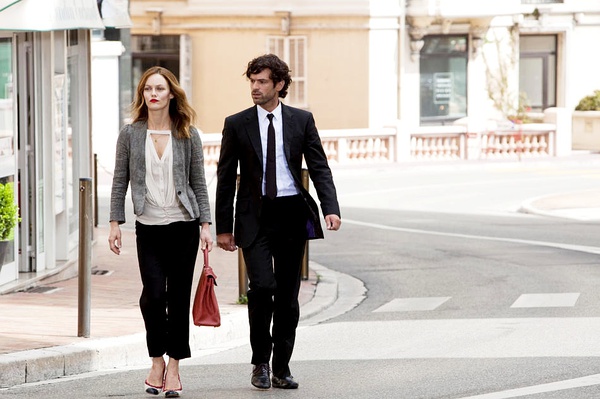
The story goes like this, Alex (Romain Duris) runs a unique business that breaks up relationships. He works with his sister Melanie (Julie Ferrier) and her dimwitted but tech-savvy husband Marc (François Damiens) to create elaborate ruses that persuade women to break off their relationships. But the team has their own honor code. Alex never takes a job involving a perfectly matched couple and he never breaks up a happy relationship. Alex plays the handsome swooner of the operation. Melanie play the well disguised ground operative. Marc handles everything technical. We learn all about their operation in the film’s amusing opening. Alex wraps up a successful job with a series of over-the-top lines that sets the smitten target woman free and left me laughing at his scripted sappiness.

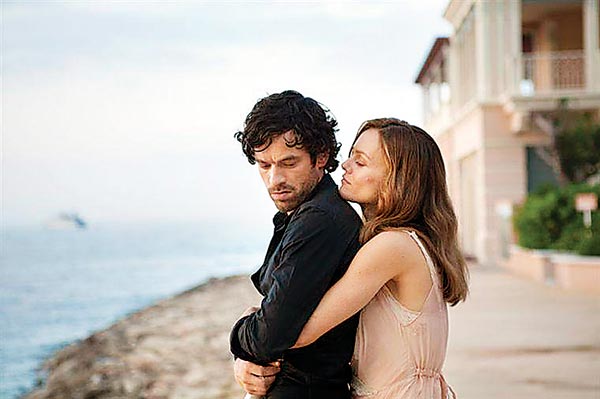
Alex is approached by a rich father with ties to organized crime who wants his daughter’s engagement to an Englishman ended. The wedding is in a few days and the couple seems happy, but Alex, knee-deep in debt with a loan shark, puts his rules aside and takes the job. The crew heads to Morocco where Alex meets the daughter Juliette (Vanessa Paradis) and poses as a bodyguard hired by her father. Juliette is a spunky and independent young woman and Alex finds out that the job is going to be more difficult than anticipated. As the wedding gets closer, Alex begins to run out of options. On top of that, things are made more difficult by the fact that he’s falling for her. Bet you didn’t see that one coming!

Heart breaker

The story is clever and the laughs are aplenty, but I thought the biggest treat was the cast. I had seen Romain Duris in a handful of other movies but never in a role quite like this. He is very funny and he wonderfully channels that good-looking arrogance and occasional knuckleheaded cluelessness. Vanessa Paradis continues to impress me with every performance of hers I see. She’s really good here playing it straight while the others around her have the fun. But she has her own funny moments that pulls some good laughs from the audience. Paradis and Duris have an odd but convincing chemistry and that’s a key ingredient to making this such an enjoyable experience. If you doubt me, just wait until you see the “Dirty Dancing” scene. I’ll just leave it at that.

As I mentioned there is a lot of predictability along the way and there’s nothing that will catch you by surprise. But the filmmakers and the cast know this and they never try to sell you anything else. It’s a rare romantic comedy that caused me to laugh a lot and to genuinely care about the characters. I’ve rewatched “Heartbreaker” a couple of times now to see how it holds up. It’s still funny. It’s still entertaining. It still leaves me extremely satisfied despite its few flaws. Now I hear that there is a US remake in the works. There’s no need in that. I would much rather this film get a bigger audience. It certainly deserves one.

REVIEW: “Mon Oncle”

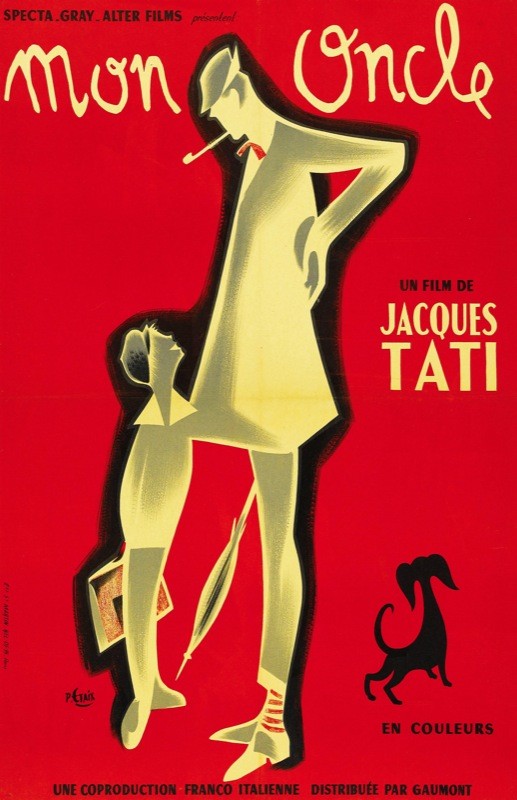
mon_oncle poster“Mon Oncle” Is French filmmaker Jacques Tati’s 1958 comedy and his second of four films featuring his Monsieur Hulot character. The acclaimed director only had six feature-length films to his credit and this was his first in color. It’s also a widely appreciated picture that earned Tati an Academy Award for Best Foreign Language Film. There are several themes that Tati plays with in what’s an otherwise playful comedy. He satirizes materialism and the lust for things. And he shows the sterile and artificial relationships of those absorbed with social status. These and other things are certainly interwoven within the story, but for me the movie is more effective as a fun and often times charming comedy.

Tati not only directed, produced, and co-wrote “Mon Oncle”, he starred in it as well. His Monsieur Hulot character is as lovable as he is inept. He’s an awkward and almost child-like character who views life with a smile, a bow, and a tip of his hat. Hulot lives in an energetic working class neighborhood in Paris filled with older buildings and busy streets. For me the very best part of this film is the time we spend in this close-knit community. Tati does a wonderful job of familiarizing us with the places and the people who make up Hulot’s lively neighborhood. There’s the lovely young girl from his building who always greets him with a smile and sometimes sweets. There’s the short cranky produce man whose tools fall out of his truck whenever he opens his door. There’s the friendly street sweeper who spends more time talking than sweeping. There’s the group of men who spend most of their time at the Chez Margot cafe. These are just a few of the people who give this community its beautiful life and character.

In stark contrast you have the wealthy upscale suburb which is where Hulet’s sister and brother-in-law Monsieur and Madame Arpel live. Their modern, high-tech home is as cold and sterile as an operating room, a description that also fits their relationship. Their true joy is in showing off their house to their more important visitors. There is a reoccurring joke that has Madame Arpel running to turn on a hideous metallic fish fountain in their front garden whenever a truly important guest shows up. It’s all about appearance and self-importance with the Arpel’s.

MON ONCLE

But their young son Gerard feels trapped inside the monotonous walls of the Arpel estate. That’s why he loves it when his Uncle Hulot comes to visit. Gerard loves going back to Hulot’s neighborhood to enjoy the vibrant atmosphere and especially to play with his mischievous friends. Some of the film’s funniest moments involve these little pranksters pulling all sorts of practical jokes on passersby. Hulot, in many ways a child himself, really doesn’t try to control them. He just reacts to them as he does everything else – no harm, no foul. Gerard’s affection for his uncle doesn’t make Monsieur Arpel very happy. He is jealous of the relationship even though he doesn’t invest any time in Gerard. He also looks down on Hulot as his inferior. Madame Arpel believes she can change all of that by introducing Hulot to their social circle, an idea that’s doomed (and hilarious) right from the start.

For the most part “Mon Oncle” is a visual comedy with very little understandable dialogue. Often times we hear the unintelligible voices of the people but it’s plenty to let us know what’s happening. The dialogue that is there is strategically placed and works perfectly within the confines of the story. The bulk of the story is told through nods, gestures, and mannerisms and the humor depends more on slick and subtle sight gags than normal straightforward jokes. All of this contributes to the sheer genius of this movie. Tati incorporates some methods taken from the great silent films both is his direction but especially in his acting.

I adore the Monsieur Hulot character. I love watching him tip his fedora and tap his pipe on the bottom of his shoe. I love his happiness and contentment that is ever-present even though he lacks the material possessions that others crave. I love his innocent naivety about the modern world and I love his playful relationship with his nephew. He’s such an endearing character and he’s the perfect model for Tati’s ‘man versus modern technological’ concern.

It’s not just the good humor and great characters that make this movie so good. There’s also Tati’s amazing visual technique. He uses the camera like a pair of eyes just watching and taking in what his characters are doing. This is what gives “Mon Oncle” it’s undeniable life and vibrancy. Tati never shortchanges any detail and as a result I felt I was right there walking through the neighborhood square and watching the same five little dogs pop up throughout the movie. This is made all the sweeter after getting a taste of the Arpel’s cold and impersonal home. The contrast is huge but it’s that kind of connection that makes the characters so dear and the humor so effective. And that’s what makes “Mon Oncle” such a classic.

VERDICT – 4.5 STARS

REVIEW: “Breathless”

BREATHLESS poster

There are certain movies that will always be remembered for their undeniable influence. Such is the case with “Breathless”, the first feature film from acclaimed director Jean-Luc Godard and a major player in the French New Wave of the late 1950’s and early 1960’s. French New Wave was a bold and experimental movement that toyed with new techniques of filmmaking and storytelling. The stories were often rooted in and influenced by the social climate of the time and ambiguity, realism, and sometimes romanticism were key tools used to craft these stories.

French New Wave also had several distinguishable visual techniques that set it apart from the contemporary filmmaking of that time. New Wave directors experimented with long takes, creative tracking shots, handheld cameras, and fast scene changes. These techniques originated in low-budget necessity but they were also intended to buck the traditional brand of filmmaking. Godard and “Breathless” were instrumental in defining the movement. Nearly every technique unique to French New Wave can be found in “Breathless” and it has certainly made an important mark in cinema history.

BREATHLESS 1A

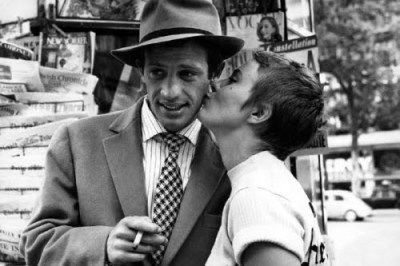
The movie follows around a young criminal named Michel (Jean-Paul Belmondo). His forte is stealing cars and petty crimes but things go bad when a simple car heist results in him killing a cop. He ends up on the run in Paris trying to secure some money to make his escape. Michel is not a good guy and it’s hard to get that impression from the film. But an argument could be made that, in a sense, the movie glamorizes Michel’s lifestyle. There is some legitimacy to that but I think it overlooks a major part if the story. Godard does try to emphasis a sense of cool about Michel through his freewheeling attitude, dangling cigarettes, and thumb rubs across his lips. But I feel his coolness is more his perception of himself – a misguided perception more rooted in arrogance than reality.

It’s a combination of his arrogance and his heart that proves to be his biggest obstacles. He fashions himself after movie stars such as Humphrey Bogart and he seems infatuated with his own press. Throughout the movie we constantly see him buying newspapers in an attempt to get information no doubt, but also to bask in his own headlines. He walks the streets of Paris, impervious to his wanted status, with nothing more than a pair of sunglasses to hide his identity. Even as scrolling marquees across the city report of the police manhunt drawing closer, Michel still takes to the streets of Paris with an almost cocky sense of invincibility.

Breathless 2

He also finds himself smitten with Patricia (Jean Seberg), a young American student at the Sorbonne and aspiring journalist. She’s a seemingly insecure young lady who ends up falling for Michel but with an ever-present sense of uncertainty. Michel often insults her and talks down to her yet she grows more and more fond of him. I believe it’s because she sees through his tough guy facade and finds something she can cling onto regardless of how unwise it is. She struggles with whether to stay with Michel or not but even after finding out what he’s done she can’t just walk away. In a very different way Michel finds himself in the same boat. It’s some compelling stuff.

“Breathless” is a little rough around the edges yet it’s exhilarating cinema. Much of the script was written as they were filming and it features a lot of improvisation. But I love the spontaneity that comes along with that both narratively and visually. Hand-held cameras, a signature of the movement, are tremendously effective both in giving it a unique style as well as capturing some of the beauty of Paris. In fact, “Breathless” features some of the best views of the city you’ll find in cinema. The movie is also recognized for its fresh and bold use of jump cuts – a film editing technique where a scene makes quick jumps forward. There are so many filmmaking devices in “Breathless” that have influenced directors for years and still do today. And even though the storytelling structure may feel a bit jarring, the film is hypnotic and its mark on cinema cannot be overstated.

VERDICT – 4.5 STARS